
- About Us

- Our Services
- Your Industry
- Resources
- News & Blog
Toy quality control in 2026 is a market-by-market evidence problem: importers must connect age grading, physical safety, chemical limits, labels, test reports, certificates, and shipment inspection evidence before release. A supplier claim that a toy is safe is not enough if the product, packaging, lab file, and destination regulation do not agree.
For the US, CPSC toy safety guidance explains that ASTM F963 became mandatory under CPSIA and is codified through 16 CFR part 1250. The importer decision is product-specific: not every ASTM section applies to every toy, so the file must identify the actual hazards instead of treating "toy testing" as one generic certificate.
For the EU, stronger toy safety rules were adopted in 2025. The European Commission says the rules add a digital product passport requirement and apply from 1 August 2030, while the Council describes tighter controls on harmful chemicals and better enforcement through digital passports. Importers do not need to pretend the 2030 obligation already applies, but they should start organizing traceability evidence now.
The practical 2026 question is whether a specific SKU, for a specific age group, going to a specific market, has enough evidence to pass customs, platform review, retail receiving, and buyer safety expectations.
- Do not use one global checklist: the US, EU, UK, Australia, Canada, and other markets can require different evidence.
- Start with age grading: under-3 toys, 3-to-6 toys, and older-child products can trigger different small-parts, labeling, and testing decisions.
- Separate inspection from lab testing: factory inspection can check the shipment, but it does not replace accredited safety testing or legal review.
- Use 2026 as a file upgrade year: future EU digital product passport work begins with cleaner SKU, batch, factory, and test-report traceability.
What Should Toy Importers Check First in 2026?
Toy importers should first confirm destination market, age grade, applicable safety standard, required lab test reports, label and warning requirements, product and carton markings, batch traceability, and pre-shipment inspection evidence before approving production release or shipment.
The US release file should begin with a product-specific ASTM F963 applicability review. The CPSC ASTM F963 requirements chart shows that some sections apply broadly while others depend on product type, age grade, materials, batteries, magnets, small objects, sound, or other hazards.
Age grading is the first operational gate because it changes the meaning of the same physical part. CPSC small-parts guidance is a useful reminder that inspection must consider both the as-sold product and parts that can detach during foreseeable use.
The importer should also decide what evidence belongs in the factory inspection report. Photos of the retail box, warning label, tracking label, SKU, carton mark, test report reference, age grade, and actual packed product reduce the chance that the lab file belongs to one version while the factory ships another.
A 2026 Toy Compliance Map for Importers
Use this map to turn regulation language into release evidence for each SKU.
| Control Area | Importer Question | Shipment Evidence | Release Risk |
|---|---|---|---|
| Destination market | Where will this SKU be sold? | PO, label language, market file | Wrong standard or missing warning |
| Age grade | Who is the intended user? | Age label, packaging claim, design review | Small-parts or warning mismatch |
| ASTM / CPSC | Which US toy rules apply? | ASTM F963 sections, CPC, test report | Invalid US release file |
| EU safety | Is the EU technical file complete? | Declaration, warnings, traceability data | Market surveillance or customs hold |
| Physical hazards | Can parts detach or expose sharp edges? | Use-and-abuse notes, inspection photos | Choking, cut, puncture, magnet risk |
| Chemical limits | Are coatings and substrates covered? | Lab report, material list, supplier declaration | Lead, heavy metal, phthalate risk |
| Traceability | Can the lot be matched to tests? | Batch code, factory, date code, carton mark | Report cannot support shipment |
The table is not a legal substitute for a technical file, but it gives buyers a practical release screen. If the product is going to multiple markets, build the strictest shared control file first, then add market-specific warnings, certificates, and language requirements.
A useful importer rule is to reject any toy release file where the test report, artwork, physical sample, and packed goods cannot be tied to the same SKU version. Most expensive toy compliance failures are version-control failures: the report is real, but it is not the report for the shipment being released.
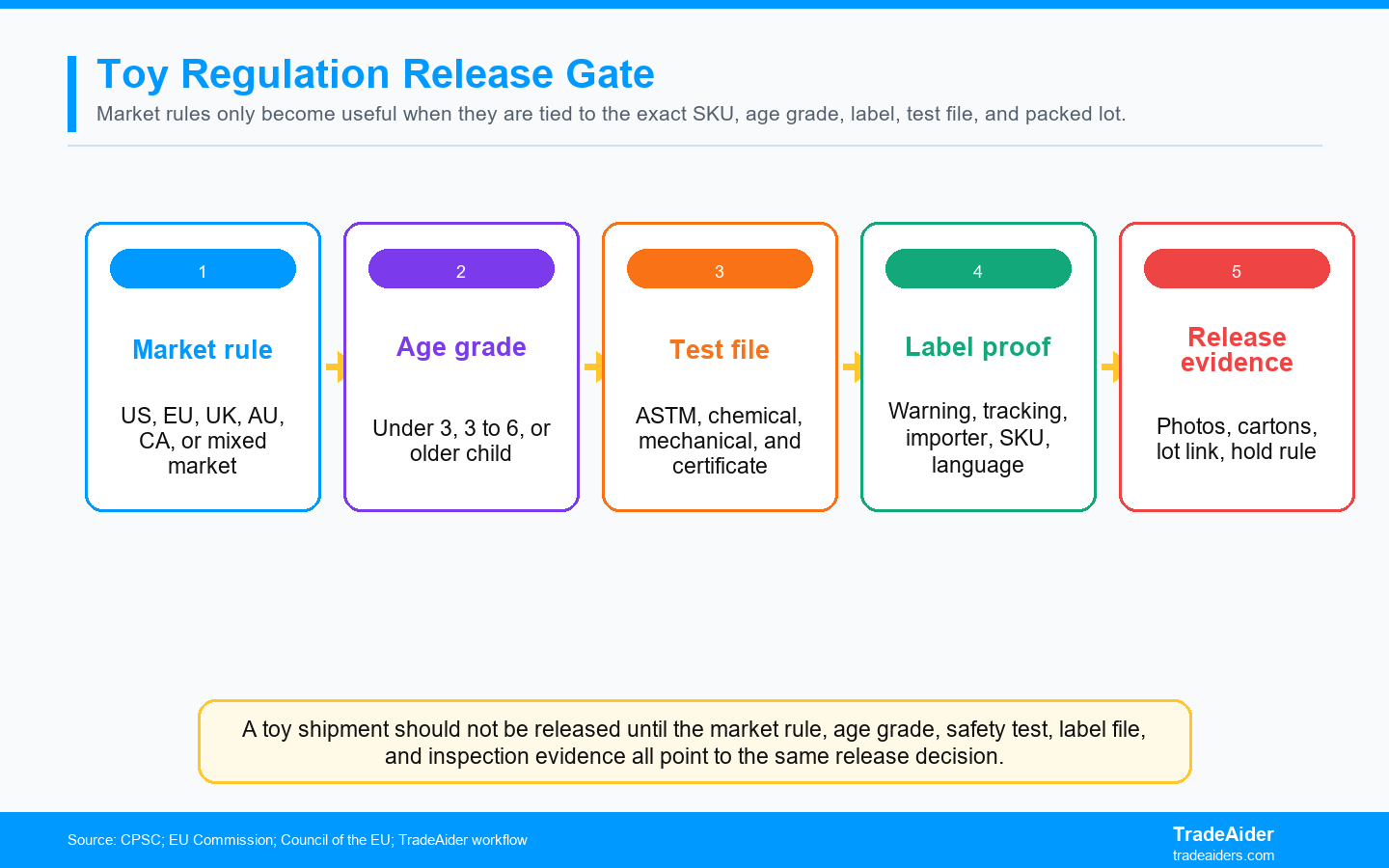
A toy shipment should not be released until the market rule, age grade, safety test, label file, and inspection evidence all point to the same release decision.
US Toy Rules Are Product-Specific, Not One Certificate
ASTM F963 is mandatory for US children's toys, but the relevant sections depend on the toy's age grade, materials, design, and hazards.
ASTM F963 and 16 CFR part 1250 define the safety baseline
For US-bound toys, importers should not ask only whether a supplier has an ASTM report. They should ask which ASTM F963 sections were tested, which sections do not apply, which additional CPSC rules apply, and whether the Children’s Product Certificate cites the right requirements. A battery toy, plush toy, projectile toy, art material, and magnetic construction toy do not carry the same risk file.
CPSC guidance also matters because some hazards are already covered by separate mandatory rules. Lead in paint, lead in accessible substrate, small parts, small balls, labeling, electrical toys, magnets, and sharp points can require different citations or supporting evidence. A good inspection instruction should name the evidence the inspector can see at the factory and the evidence that must come from the lab file.
Inspection should verify the shipment version
The inspection team cannot prove chemical compliance by looking at a toy, but it can confirm whether the packed product matches the tested sample, artwork version, material color, warning label, age grade, batch code, and carton mark. That is where many importers lose control: the lab file is technically valid, but the supplier changes a component or package after testing.
For private-label toys, ask the factory to prepare the approved sample, current artwork, lab report reference, CPC or declaration file, and production lot records before inspection day. The inspector should photograph the documents and the product details together so the buyer can see whether the file supports the goods.
EU Toy Safety Changes Are a 2030 Obligation With 2026 Preparation Work
The EU digital product passport is not a reason to panic in 2026, but it is a reason to fix traceability now.
Digital product passports change the evidence discipline
The European Commission announcement says all toys placed on the EU market will need a digital product passport containing safety and compliance information, accessible online through a QR code or another data carrier, when the new rules apply. The same announcement says the rules apply from 1 August 2030, which means the importer should not market a 2026 shipment as DPP-ready unless the required data structure is actually in place.
The practical 2026 step is traceability. Importers should ask whether the supplier can connect product model, material list, test report, technical documentation, factory site, batch code, carton mark, responsible economic operator, and online listing information. If those records are scattered across emails and old PDFs, the buyer will struggle when passport obligations become operational.
Chemical and online marketplace controls are moving upward
The Council of the EU toy safety overview describes the updated regulation as strengthening protection from harmful chemicals and improving enforcement through digital passports. For importers sourcing from China, this raises the value of early material control, supplier declarations, and product testing coordination instead of waiting until finished goods are packed.
Online retail also increases evidence pressure. Marketplaces, customs authorities, and retailers can ask for compliance evidence faster than a traditional distributor. A buyer who waits until goods arrive in the warehouse may discover that the missing evidence is not a small paperwork gap but a sales-blocking problem.
The Highest-Risk Toy Control Points Are Still Physical
Most toy compliance failures become visible through age mismatch, detachable parts, warnings, labels, and version changes before shipment.
Small parts and detachable components need shipment-level checks
The small-parts problem is not limited to the obvious tiny accessory. It can appear when a decorative cap detaches, a button breaks, a magnet loosens, a zipper pull separates, a sticker covers a warning, or a packaging insert adds a small loose item that was not in the tested sample. The supplier may still call the toy compliant because the original sample passed.
For under-3 and 3-to-6 products, the inspection checklist should include accessory count, pull or tension risk notes where relevant, small-parts screening instructions, warning label photos, and packaging photos. The buyer should treat any new detachable part as a version change until the compliance file is reviewed.
Labels and warnings must match the selling channel
Toy labels often fail for boring reasons: wrong age grade, missing importer identity, outdated warning artwork, wrong language, missing tracking code, mismatched carton mark, or a retail package printed for a different market. Those are not cosmetic details when a retailer, marketplace, or customs team relies on the label to understand the product.
A strong release file contains label artwork approval, actual package photos, carton photos, and a documented match between SKU, PO, and test report. If the warning label is applied by sticker, the inspection should check placement, adhesion, readability, and whether it covers another required mark.
Original Cost Screen: One Artwork Change Can Beat One Recall Discussion
Toy compliance control is cheaper when the buyer catches a mismatch before the lot leaves the factory.
Consider a 5,000-unit toy order where the finished goods are packed with an outdated warning label. If relabeling at origin costs about $0.18 per unit plus one extra inspection day, the direct correction cost might be around $900 plus a modest schedule delay. If the same mismatch is found after import, the buyer may face warehouse relabeling, retailer chargebacks, delayed listing approval, and a frozen sales window.
This is only a scenario estimate, not a universal cost rule. Its value is the decision logic: when a label or age-grade mismatch affects market access, the buyer should pay for correction before shipment rather than arguing later about whether the defect is cosmetic.
The same logic applies to missing tracking labels, mismatched batch codes, loose small accessories, and inconsistent age claims. The moment a defect connects to child safety, market access, or recall exposure, it stops being a minor workmanship issue.
Where TradeAider Fits in Toy Quality Control
TradeAider fits by turning the toy compliance file into factory-level release evidence before the order ships.
TradeAider can support toy importers through Pre-Shipment Inspection, checking packed goods, carton marks, warnings, labels, accessories, age claims, SKU identity, workmanship, packaging, and photo evidence before final balance payment.
When the risk appears earlier, Pre-Production Inspection and During Production Inspection can help verify materials, components, artwork version, sample approval, and production drift before a full finished lot is packed incorrectly.
TradeAider does not replace legal counsel or an accredited lab. Its role is practical and useful: collect the evidence that connects the test file to the actual shipment, coordinate visible checks, and help the buyer decide whether to release, hold, relabel, sort, or request testing support through product testing coordination.
SPAR Scenario: The Warning Label Was Correct, but the Age Grade Was Not
The buyer caught a market-access problem because inspection checked the product claim, not only the printed warning.
Situation: A US importer orders 7,200 plastic play sets from a Chinese factory for a mixed online and retail channel.
Problem: The package has a small-parts warning, but the product page and front panel still describe the toy as suitable for ages 2+, creating an age-grade conflict.
Action: The buyer asks TradeAider to photograph the front panel, warning panel, accessories, carton mark, SKU, and approved artwork file before release.
Result: The buyer accepts a two-day artwork correction delay and prevents 7,200 units from shipping with a conflict between age claim and small-parts warning.
Buyer Release Checklist for Toy Orders
Use this checklist before final payment when safety, age grade, or regulatory evidence matters.
- Confirm destination markets and sales channels before testing.
- Freeze age grade, warning label, and approved artwork version.
- Match test report, certificate, SKU, and production lot.
- Inspect retail packaging, carton marks, tracking labels, and warnings.
- Check detachable accessories and small-parts risk before shipment.
- Hold shipment when product, artwork, and lab file do not match.
The checklist should be assigned before production, not after goods are packed. If the supplier cannot show the current artwork, test report reference, and packed product together, the buyer does not yet have a reliable release file.
If your toy order has age-grade, warning-label, small-parts, or test-report questions, send TradeAider the product photos, artwork, PO, destination market, approved sample, test file, and packing status. The next step is to ask TradeAider to verify the toy shipment evidence before release.
Frequently Asked Questions
What toy regulation changed most for importers in 2026?
The most important 2026 change is not one universal rule; it is the need to keep US ASTM/CPSC evidence current while preparing stronger EU traceability and digital product passport files for future application.
Does a toy inspection replace lab testing?
No. Inspection checks the actual shipment, labels, packaging, accessories, and lot evidence. Lab testing is still needed for chemical, mechanical, electrical, and other regulated safety requirements.
When should toy quality control start?
Toy quality control should start before production with age grading, approved sample, artwork, materials, and test plan. Waiting until PSI makes correction slower and more expensive.
What should be photographed during toy inspection?
Photograph the product, accessories, warning labels, age grade, tracking labels, SKU, carton marks, packaging, batch code, and any document that links the inspected lot to the compliance file.
Can TradeAider decide legal toy compliance?
TradeAider can verify visible shipment evidence and coordinate inspection or testing support, but legal compliance decisions should be handled by qualified compliance professionals when the risk is material.

Related Articles
Grow your business with TradeAider Service
Click the button below to directly enter the TradeAider Service System. The simple steps from booking and payment to receiving reports are easy to operate.

