
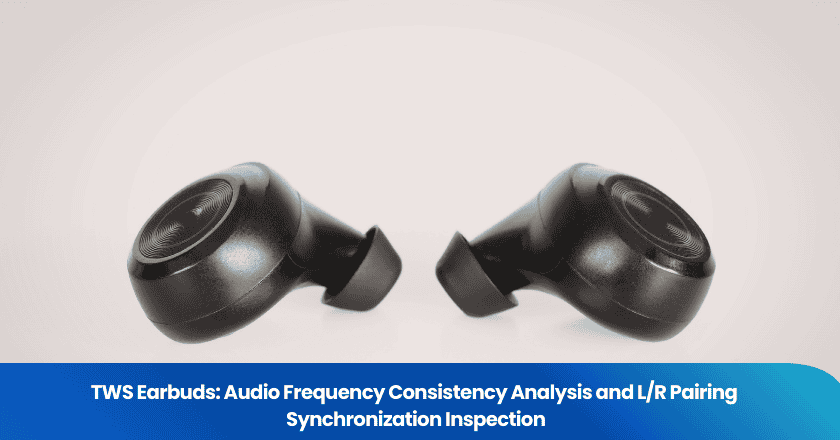
You order 5,000 units of TWS earbuds from a Chinese factory. They pass visual inspection. The packaging looks clean. But when your first batch of Amazon customer reviews rolls in, the complaints cluster around a specific problem: "left earbud sounds different from the right," "audio cuts out on one side," or "bass is totally missing." These are not cosmetic failures. They are frequency consistency and L/R pairing synchronization failures — and they are among the most common — and most overlooked — defect categories in TWS earbud production. This guide explains exactly what to inspect, what tolerances to enforce, and how to apply AQL-based sampling correctly before your shipment leaves the factory.
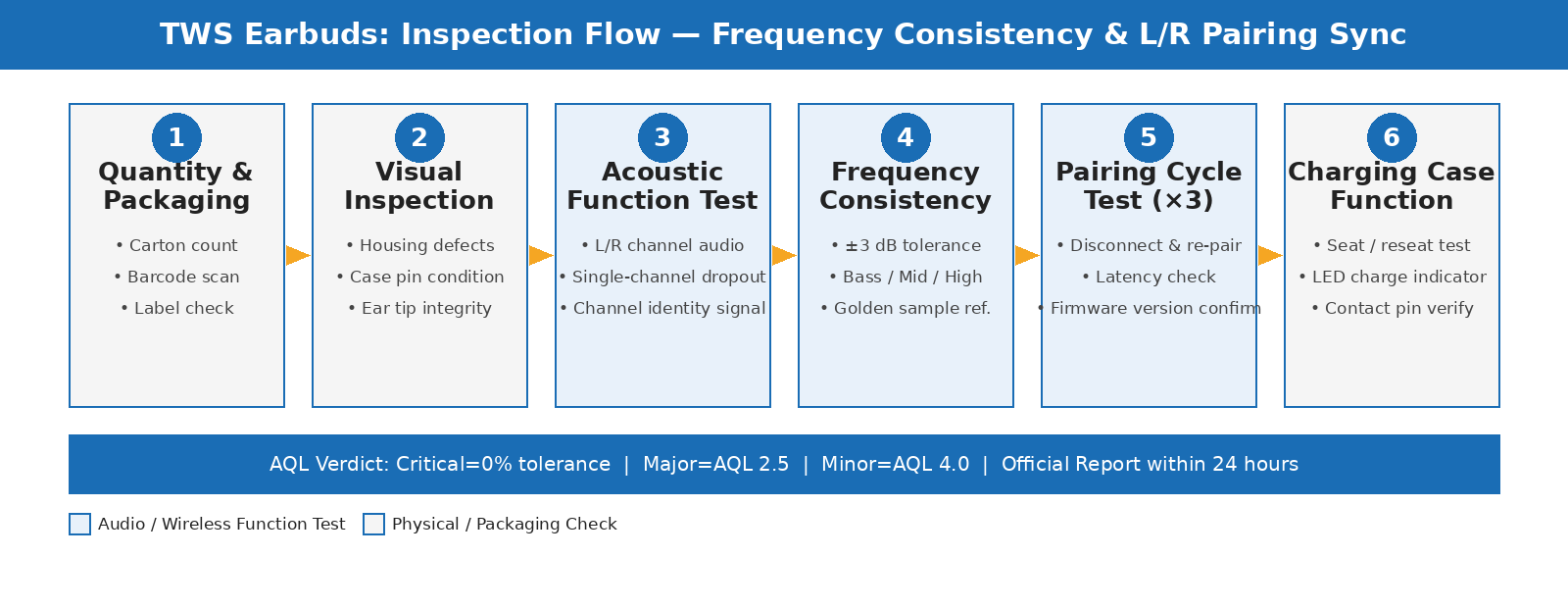
TWS earbuds inspection flow: from frequency response matching to L/R pairing synchronization verification.
Key Takeaways
- Frequency response deviation between the left and right earbud driver is one of the leading causes of negative reviews for TWS products — a ±3 dB tolerance across the 20 Hz–20 kHz range is the accepted industry benchmark for consumer-grade products.
- L/R pairing synchronization failures — including audio dropout on one channel and latency mismatch — must be classified as major defects under AQL inspection, with a 0% tolerance for complete single-channel failures.
- A well-structured pre-shipment inspection checklist covering acoustic performance, Bluetooth pairing stability, and packaging compliance is the only practical way to catch these defects before goods reach your fulfillment center.
Why Frequency Consistency Failures Are So Damaging for TWS Products
The Architecture That Creates Variation
TWS earbuds operate through a fundamentally different architecture than wired or neckband headphones. As Unikeyic explains, in modern TWS designs the source device — typically a smartphone — establishes independent Bluetooth connections with both the left and right earbuds simultaneously through binaural synchronous transmission. Each earbud contains its own independent driver, amplifier, Bluetooth SoC, and battery. Two physically separate units must reproduce audio with near-identical frequency characteristics.
This independence is what creates the consistency problem. Because each earbud is manufactured separately, driver tolerances, cavity resonance from the housing mold, solder joint quality on the amplifier circuit, and even the silicone ear tip compound can all introduce variation between the two units. Allion Labs' validation research on TWS audio quality identifies four primary failure categories that undermine electroacoustic performance: frequency response deviation, microphone directivity issues, total harmonic distortion (THD), and product design flaws that cause loose component resonance. Of these, frequency response deviation between the L and R drivers is the hardest to catch without acoustic measurement.
What the Human Ear Can — and Cannot — Detect
A deviation of ±1 dB across mid-frequencies is generally imperceptible to most listeners. But a deviation of ±4 dB or more at frequencies between 1 kHz and 8 kHz — the range where human hearing is most sensitive — produces an audible "tilt" in the stereo image. Users describe this as "one earbud sounds louder," "the audio feels unbalanced," or "the bass only plays on the left side." On Amazon, these descriptions map directly to one- and two-star reviews. The consumer rarely understands the technical cause; they simply know the product is defective.
Standard frequency response specifications for consumer TWS earbuds cover the full human hearing range of 20 Hz to 20,000 Hz, measured as sound pressure level (SPL) in decibels. A flat response between the two channels across this range is the target. In practice, factories apply a ±3 dB inter-channel matching tolerance as the accepted production standard for mid-range consumer products. High-end brands may tighten this to ±2 dB. Budget products may ship with tolerances as loose as ±5 dB — which is perceptible to most listeners.
TradeAider's inspection teams have documented frequency-related defects in consumer electronics across hundreds of factory audits in China. The pattern is consistent: factories that do not run 100% acoustic production-line testing ship batches with inter-channel frequency deviation rates that would fail any competent pre-shipment inspection. Catching this requires acoustic measurement at inspection — visual inspection alone cannot identify the problem.
For importers sourcing TWS earbuds for Amazon FBA or direct-to-consumer e-commerce, the consequence of missing frequency consistency defects is compounded. A structured quality inspection process that includes acoustic function testing is the only way to differentiate between a cosmetically acceptable unit and a functionally defective one before it reaches your customer.
Understanding L/R Pairing Synchronization: The Wireless Failure Mode
How TWS Pairing Architecture Creates Synchronization Risk
TWS synchronization problems are distinct from frequency consistency issues. Where frequency problems are hardware and acoustic defects, synchronization failures are primarily Bluetooth firmware, antenna, and RF hardware defects. The core challenge is that modern TWS designs using binaural synchronous transmission require both earbuds to receive and decode audio streams independently and simultaneously. Any deviation in timing between the two decoded streams produces audible latency mismatch — a phase shift between left and right channels that destroys the stereo image.
Three synchronization failure types appear most frequently in factory inspection:
1. Pairing instability: One earbud fails to complete the Bluetooth pairing sequence reliably, either taking more than 8–10 seconds to connect or dropping connection after an initial pair. This is classified as a major defect.
2. Single-channel dropout: One earbud disconnects during continuous playback while the other maintains signal. Audio-technica TWS testing documented by Allion Labs demonstrated that all tested TWS earbuds showed latency degradation under Wi-Fi coexistence conditions, with some models exhibiting pairing latency of up to 2.4 seconds under interference. A factory-floor inspector cannot replicate this coexistence environment, but they can run repeated pairing cycles to identify units with marginal pairing stability.
3. L/R channel swap: The left earbud plays the right channel and vice versa. This is typically a firmware or pairing ID misconfiguration defect — a critical defect under AQL classification because it renders the product non-compliant with its technical specification.
The Bluetooth Firmware Variable
One underappreciated source of synchronization failure is firmware version mismatch between the two earbuds. This occurs when a factory reloads firmware mid-production — for example, to apply an OEM firmware update — without ensuring both units in each pair receive the identical version. The result is a binaural mismatch that produces intermittent synchronization failures that may not appear during a short factory test but surface under extended use. Automated TWS testing research from Nextgen Technology identifies firmware-related pairing bugs as one of the edge-case failure categories that only surface through extended continuous playback testing — often beyond what manual inspection can replicate. This is why inspection protocols should require the inspector to run pairing tests on sampled units across multiple Bluetooth connection cycles, not just a single initial pair.
Building Your AQL Inspection Checklist for TWS Earbuds
Defect Classification Framework
Applying AQL sampling methodology to TWS earbuds requires mapping each potential defect type to the correct severity tier. The three-tier AQL classification — critical, major, and minor — determines both the acceptable defect rate and the consequences for the shipment. For TWS earbuds, the defect map looks like this:
| Defect Type | AQL Classification | Tolerance (Standard) | Inspection Method |
|---|---|---|---|
| L/R channel swap (firmware) | Critical | 0% (AQL 0.0) | Playback test + channel identification signal |
| Single-channel audio failure | Critical | 0% (AQL 0.0) | Full playback test, both channels confirmed |
| Frequency deviation >±3 dB (inter-channel) | Major | AQL 2.5 | Acoustic measurement or calibrated listening test |
| Pairing instability / fails within 3 cycles | Major | AQL 2.5 | Repeat pairing cycle test (min. 3 cycles) |
| Firmware version mismatch between L/R | Major | AQL 2.5 | Firmware version confirmation via companion app |
| Charging case contact issue (intermittent charge) | Major | AQL 2.5 | Seat / reseat test, LED charge indicator check |
| Touch control misregistration | Major | AQL 2.5 | Touch gesture function test on sampled units |
| Minor cosmetic housing defects (fine scratches) | Minor | AQL 4.0 | Visual inspection under standard lighting |
| Packaging label misalignment | Minor | AQL 4.0 | Visual check, barcode scan verification |
Sampling Strategy: How Many Units to Test
For a shipment of 5,000 TWS earbud sets, applying AQL General Inspection Level II under ISO 2859-1 / ANSI ASQ Z1.4 gives you a sample size of 200 units with an accept number of 10 for major defects at AQL 2.5, and 0 acceptable critical defects. For a shipment of 2,000 units, the sample size drops to 125 units. These numbers are drawn from the standard's sampling tables — use TradeAider's AQL Calculator to confirm the right sample size for your specific order quantity.
One important practical note: the AQL sample for acoustic and pairing testing should be drawn from multiple cartons distributed across the full production lot — not from a single carton or pallet. TWS factories sometimes produce batches in sub-runs, and firmware version mismatches or tooling changes that introduce frequency deviation may affect only a portion of the batch. Carton-distributed sampling is the only way to catch batch-within-batch quality variation.
The Inspection Workflow: What Happens on the Factory Floor
A complete pre-shipment inspection for TWS earbuds should follow this sequence during the factory visit:
Step 1 — Quantity and packaging verification: Confirm total packed quantity against purchase order, check barcode accuracy, inspect carton labeling. Step 2 — Visual inspection of sampled units: Check housing for scratches, gaps, or misalignment; inspect charging case for contact pin condition. Step 3 — Acoustic function test: Each sampled unit powered on, paired with a standard reference device, and tested for audio output on both channels. A calibrated stereo track with distinctive L and R channel content (a common method is a 1 kHz L-channel only tone followed by R-channel only tone) confirms channel identity and detects single-channel failures. Step 4 — Frequency consistency assessment: Inspector uses a reference listening track across bass (80 Hz), mid (1 kHz), and high (8 kHz) frequencies to identify units with perceptible inter-channel imbalance. This is not a lab-grade acoustic measurement — it is a structured listening test using the same calibrated reference signal across all sampled units. Step 5 — Pairing cycle test: Each sampled unit disconnected and re-paired at least three consecutive times; units that fail to pair or show pairing latency above specification are logged as major defects. Step 6 — Firmware version check: Confirmed through the companion app connection or manufacturer's diagnostic utility. Step 7 — Charging case function test: Each unit seated in and removed from the case; LED charge indicators verified.
TradeAider's pre-shipment inspection service covers exactly this sequence for consumer electronics. Through TradeAider's inspection service, you will not only receive a comprehensive Official Report within 24 hours detailing the overall quality status, but also gain real-time visibility into the inspection process through our online Service System.
By accessing the instant Online Real-Time Report, you can monitor on-site findings as they happen and make timely, informed decisions regarding any defective products identified during the inspection.
Based on the real-time results, you can determine whether the products:
- Are commercially acceptable as they are
- Require on-site rectification to meet acceptable standards, with the support of TradeAider’s inspectors while they are still at the factory
- Must be rejected and prevented from shipment
This transparent and responsive system empowers you to control quality risks efficiently and avoid costly post-shipment issues.
What Factories Get Wrong: The Three Most Common Failure Patterns
Driver Matching Without Acoustic Verification
Many factories use visual or resistance-based matching to pair left and right drivers — measuring coil resistance to select matched pairs. This is necessary but not sufficient. Driver resistance matching does not guarantee frequency response matching, because frequency response is also a function of the driver housing cavity, the nozzle geometry, and the ear tip material. A pair of drivers with matched resistance can still produce a ±4 dB inter-channel deviation at 4 kHz if the cavity dimensions are inconsistent between left and right housing molds. Electroacoustic testing following IEC 60268-5 standards for loudspeakers is the only definitive method for verifying frequency response consistency — and most small-to-mid factories do not run this test on 100% of production units.
Firmware Loaded in Batches, Not Pairs
A factory running a firmware update mid-production will typically load the new firmware onto a batch of units in sequence — all left earbuds first, then all right earbuds, or vice versa. If the production line is interrupted and resumes with the old firmware still loaded on some units, mismatched firmware pairs reach final packaging. This failure mode is almost impossible to detect through visual inspection and requires either a companion app check or a known channel identification test to surface.
Pairing Tested Once, Not Under Stress
Extended duration testing research has demonstrated that TWS pairing quality issues often surface only after multiple connection cycles or under interference conditions that do not exist on the factory floor. A factory QC process that pairs each unit once and marks it "pass" misses intermittent pairing instability that appears on the second or third connection attempt. Inspection protocols should require a minimum of three pairing cycles per sampled unit, with particular attention to units that show slow initial pairing — typically a leading indicator of marginal Bluetooth signal margin.
For importers placing repeated orders with the same factory, a pre-shipment inspection on every batch is the most cost-effective protection against factory shortcuts. The cost of a single inspection is a fraction of the landed cost of a failed batch — and well below the cost of Amazon account health damage from a cluster of defective product reviews.
Applying This to Your Sourcing Strategy
Define Your Defect List Before Production Starts
The most effective inspection begins before production, not after it. Providing your factory with a written defect list that specifies frequency matching tolerance (e.g., ≤ ±3 dB inter-channel across 20 Hz–20 kHz), acceptable pairing cycle count (e.g., ≤ 5 seconds to complete initial pairing), and firmware version requirements creates an objective standard that both your QC team and the factory's own QC team can work against. Without a written specification, inspection results are subjective and disputes about what constitutes a "defect" are inevitable.
Use a Golden Sample
A golden sample — a pre-approved, verified unit that meets all frequency and pairing specifications — gives your inspector an acoustic reference point during the pre-shipment check. When an inspector can compare a sampled unit's frequency output against a known-good reference using the same source material, the subjective element of the listening test is significantly reduced. Request that the factory retains the approved golden sample throughout production and that it accompanies the goods to the inspection.
Consider a During-Production Inspection for Large Orders
For orders above 10,000 units, a during production inspection (DPI) at the 20–30% production completion stage allows you to verify frequency consistency and pairing performance before the full batch is assembled. Catching a firmware loading error or tooling drift at mid-production means the factory can correct it before committing the remaining 70% of the order to the same defect pattern. At pre-shipment, the problem is already baked into every unit in the cartons.
Frequently Asked Questions
What is the standard inter-channel frequency tolerance for consumer TWS earbuds?
The standard inter-channel frequency tolerance for consumer-grade TWS earbuds is ±3 dB across the 20 Hz to 20 kHz range. This means the left and right drivers should produce sound pressure levels that match within 3 decibels at every measured frequency. For mid-range and premium products targeting audiophile-adjacent consumers, ±2 dB is a tighter, more appropriate specification. Deviations above ±3 dB at frequencies between 1 kHz and 8 kHz — where human hearing sensitivity peaks — are perceptible to most listeners and generate audible imbalance complaints.
How do I classify a pairing failure as critical versus major under AQL?
An L/R channel swap — where the left earbud plays the right audio channel — is a critical defect with zero tolerance, because it makes the product non-compliant with its fundamental technical specification. A unit that completely fails to produce audio on one channel is also a critical defect. Pairing instability — where a unit pairs inconsistently but does not completely fail — is a major defect classified at AQL 2.5. The distinction matters because a single critical defect found in your AQL sample is sufficient to fail the entire shipment, while major defects are evaluated against the accept/reject numbers from the AQL tables.
Can a factory's own QC team perform these checks, or do I need a third-party inspector?
A factory's own QC team performs end-of-line tests, but these are not a substitute for independent pre-shipment inspection. Factory QC is conducted under the factory's own standards and commercial interest, and the team may not apply your specific defect definitions consistently. An independent third-party inspector applies your written defect list, AQL tolerances, and golden sample reference without commercial interest in the result. For audio-specific function testing, a third-party inspector with a defined test protocol is the only way to get an objective, documented result that gives you grounds to request rework or reject the shipment.
What should a TWS earbud inspection report include?
A complete TWS inspection report should include: quantity and carton verification results, visual defect findings with photographs, acoustic function test results for each sampled unit (pass/fail per channel), pairing cycle test results, firmware version confirmation, charging case test results, and a summary AQL verdict. Photographs of any defective units found are essential — they are your evidence when negotiating rework with the factory. Sample inspection reports show the level of detail an inspection report should provide before you accept or reject a shipment.
How many pairing cycles should the inspector test on each sampled unit?
A minimum of three complete pairing cycles per sampled unit is the practical standard for factory-floor inspection. This means disconnecting the earbuds from the source device and re-pairing them completely from a reset state three times, with pass/fail recorded for each cycle. Units that fail on cycle 2 or 3 after passing cycle 1 have marginal Bluetooth connection stability and should be classified as major defects. Three cycles is a practical floor — for larger orders or premium products, five cycles provides greater confidence in pairing reliability across the batch.
Frequency consistency and pairing synchronization failures are invisible until a customer puts both earbuds in their ears. By then, the damage to your return rate and seller metrics has already begun. TradeAider's pre-shipment inspection for consumer electronics covers acoustic function testing, pairing cycle verification, and firmware checks — with a real-time report during the inspection and an official PDF within 24 hours. See how pre-shipment inspection works for electronics → or use the Inspection Charge Calculator to estimate costs for your next order.

Related Articles
Grow your business with TradeAider Service
Click the button below to directly enter the TradeAider Service System. The simple steps from booking and payment to receiving reports are easy to operate.

