

A supplier declaration is not shipment proof. The break usually appears when the declaration, the food-contact component in production, and the carton population awaiting release no longer describe the same order. A workable UK food-contact inspection plan therefore begins by defining the component and intended use, then follows that evidence through material changes and into the named finished cartons.
Define the Food-Contact Use and Destination Before You Request a Declaration
Food-contact materials and articles must be made under good manufacturing practice so that, under normal or foreseeable conditions of use, they do not transfer constituents to food in quantities that could endanger health, cause an unacceptable change in composition, or deteriorate organoleptic characteristics. Article 3 of the food-contact framework regulation is the reason a declaration must be assessed against the intended product use, not filed as a generic food-safe statement.
Start with four fields in the purchase-order file: the food-contact component, the material or coating reference, the foreseeable contact conditions, and the selling destination. A stainless-steel pan body, a polymer handle that will not touch food, and a non-stick coating require different evidence questions. The same is true for a reusable lunch box intended for cold food and a baking tray expected to see high oven temperatures.
- Define which component touches food and which supplier controls it.
- Record the product model, finish, material code, and revision.
- State the intended food, contact time, temperature, and destination market.
- Do not release cartons whose material identity is still only a sales description.
For BPA, the Food Standards Agency's June 2026 guide states that EU rules apply in Northern Ireland under the Windsor Framework while the EU BPA restrictions do not currently apply directly in Great Britain. The FSA's current BPA guidance is a material-specific example, not a shortcut for every food-contact rule. Its practical lesson is simple: place GB, NI, and EU destination in the review record, then confirm the route for the exact material question.
Treat the Supplier Declaration as a Scoped Evidence Record
UK government packaging guidance says that plastics, ceramics, and cellophane require written evidence of compliance, described as a declaration of compliance from the packaging supplier. GOV.UK's packaging guidance makes the operational point clear: request the document early enough to assess it before packing removes the buyer's room to contain a problem.
For an importer, the useful question is not “Do we have a certificate?” It is “Which component, model, material version, and intended use does this document cover?” File the declaration beside the approved specification, not in a shared compliance folder with no order reference. Before bulk production, buyers can use pre-production inspection to lock the sample, material references, and specification evidence so that a later inspection has a meaningful point of comparison.
First, Test Whether the Use Envelope Fits the Product
Food-contact declaration guidance identifies the intended food type, contact time and temperature, and surface-area-to-volume ratio as specifications that help downstream businesses assess compliance. Business Companion's food-contact guidance shows why a declaration needs more than a material name.
Call this the use envelope: the stated food types, contact time, temperature, and other conditions a document covers. Compare it with the sellable product, not merely the supplier's material swatch. If the declaration describes room-temperature dry-food contact, it does not automatically support an oven tray, a microwaveable bowl, or a coated utensil used with acidic foods. Record the comparison in a simple review row: declared condition, product claim, difference, owner, and disposition.
Then, Stop the File From Outliving the Material It Describes
For plastic food-contact materials and articles before retail, the written declaration must be renewed when substantial composition or production changes affect migration, and supporting documentation must be available to competent authorities on request. Articles 15 and 16 of the plastics regulation provide a specific change-control example; do not assume identical declaration rules for every material category.
Make a document-review trigger part of the change notice. It should apply to a resin, coating, pigment, adhesive, recycled-content route, subcontractor, curing step, or intended-use change whenever that change could affect the evidence scope. The trigger is not a finding of noncompliance. It is a pause on relying on the old file until the responsible technical review confirms whether fresh evidence is needed. If the change creates a question about a test scope or a material condition, review product-testing needs when a material or use condition changes before the goods are treated as release-ready.
Build an Inspection Plan That Joins Documents to Factory Reality
Food-contact good-manufacturing-practice rules cover manufacture, processing, and distribution and define quality assurance and quality control systems in relation to conformity and intended use. Articles 1 to 4 of the GMP regulation support a connected record trail, but they do not turn an importer's visual inspection into a chemical-safety assessment.
The inspection request should list what the inspector can compare: the approved model and component references, current declaration version, the relevant supporting-report reference, visible finish or material cues, labels, packing status, and carton markings. That turns “check food-contact documents” into observable questions. During production, buyers can use during-production inspection to surface a component or finish change before pack-out, when the affected production window is normally easier to identify.
| Evidence object | What the inspection can compare | Release consequence if it does not match |
|---|---|---|
| Supplier declaration | Issuer, date, material, intended use, and product reference | Hold the scope until the document fits the product |
| Material or coating record | Current supplier code, revision, process record, and approved sample reference | Escalate a changed build; do not inherit old evidence |
| Supporting evidence | Report identity, applicable material, intended conditions, and version link | Request technical review where the scope is unclear |
| Finished-carton record | Model, carton range, packing status, labels, and traceable production window | Limit an inspection result to the named population |
The table is a comparison of evidence roles, not a migration-test protocol. Based on this comparison, documents decide what should be true, while inspection verifies whether the named goods and records still agree. A mismatch is therefore a release-control issue before it becomes a broad shipment assumption.
Map Each Supplier Record to a Product Identifier
A declaration, supporting report, material record, and product specification should share enough identifiers to show which food-contact component and use conditions they describe. Start with the PO model, the component or coating code, supplier identity, document date, and an internal revision reference. The goal is not a universal document format; it is a reliable way to spot when a record describes a predecessor version rather than the goods now on the line.
Keep the identifier map short enough to use during a factory visit. A one-page record can show the product model, food-contact component, material code, document version, evidence owner, and the point at which a change must be reported. If the supplier can only provide “food grade” without mapping it to these fields, the buyer has a document claim but not an evidence trail.
Map Each Physical Check to the Same Finished-Lot Scope
A sampling result should support only the identified carton population that can be linked to the current product and evidence record. Here, a carton population means the identified group of packed cartons that an inspection result is intended to support; it is not every unit the supplier happens to have finished.
Ask for carton numbers or ranges, packing status, production window, and the model or component references visible on the cartons or packing list. Use those fields to define the inspected population before sample selection. This is especially important after a material change, because a correct-looking finished product may sit next to cartons made with an earlier material version. The first question is not whether the sample looks acceptable; it is whether the sample can be traced back to the evidence file it is supposed to represent.
Release Only When the Evidence Funnel Produces One Clear Order Scope
The FSA and FSS registers are the official source for food-contact material authorisations in Great Britain and include substance restrictions, specifications, migration limits, and compliance notes where relevant. The FSA register guidance gives the escalation path when a declaration raises a regulated-substance question that should not be settled by assumption.
For specifically controlled polyamide and melamine kitchenware from China or Hong Kong, the cited port-health guidance requires the declared documents and analytical evidence to relate to the defined consignment. The port-health guidance is deliberately narrow: it shows why declared evidence must match a defined consignment when that route applies, not that every kitchenware import follows the same process.
A supplier declaration becomes usable release evidence only when its stated material and use envelope, supporting documents, controlled production records, and named finished-carton population all point to the same order scope. That is the evidence funnel: scope first, then declared use, current material version, supporting evidence, and finally the carton population. If one gate is unresolved, a release hold keeps the identified goods from dispatch until the evidence mismatch is resolved. It does not declare the goods unlawful; it prevents the buyer from treating unknown scope as approved scope.
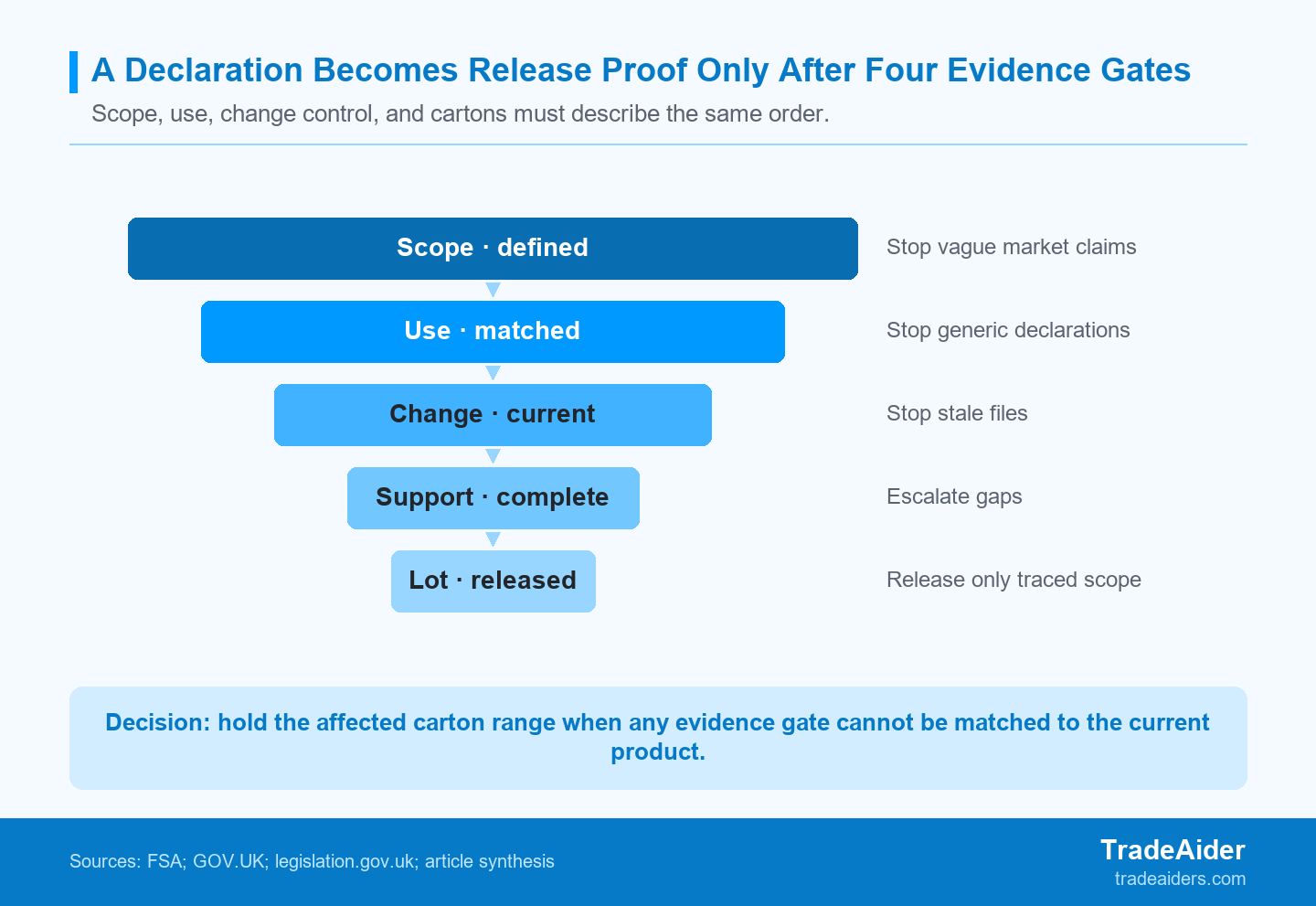
A supplier declaration supports release only when the declared material, use conditions, current evidence, and named carton population align.
Once the releasable carton population is known, buyers can use the AQL calculator to define a finished-goods sample size. Sampling then supports a defined release population, rather than a random visit being used to imply that all cartons share the same material history. The decision rule is simple: release only the cartons that have a complete evidence path; isolate the rest until their path is rebuilt.
Keep Inspection in Its Proper Role: Verify Alignment, Not Chemical Safety
Inspection can verify a match between documents, visible materials and a named carton population; it cannot prove migration compliance for a material, coating, resin, or use condition that the evidence file does not cover. This boundary protects both the buyer and the inspection team: a physical observation may identify a conflict, but it cannot make missing technical evidence appear.
An inspection plan should therefore include document presence and version, product and component identity, finish or marking consistency, carton traceability, visible damage, packing status, and the rule for reporting mismatches. It should not promise that a visual check certifies chemical safety. When the buyer needs a provider method that keeps inspection tied to documented scope, they can review TradeAider's quality-control approach before setting the handoff and escalation expectations.
Illustrative Scenario: A New Coating Creates a Document-Product Conflict
When the factory's physical food-contact coating and the declaration packet point to different material identities, hold the traceable affected cartons instead of approving the whole order from a generic certificate. In this illustrative case, a UK kitchenware importer has ordered 3,600 coated steel baking trays in 180 export cartons. When 150 cartons are packed, the original sample file still names a black silicone-based coating, but the factory has changed the production coating after a color adjustment.
Carton labels and model numbers still match the PO, which can make the order look stable. The production records, however, name a revised coating supplier and a different internal coating code, while the declaration packet names only the original reference. The physical trays, current production records, and declaration therefore do not identify the same food-contact material. Sampling the finished appearance would not close that documentation gap.
The buyer holds the 150 traceable cartons associated with the revised coating and does not extrapolate the original declaration to them. The corrective action is to obtain the revised material identity, applicable declaration, and supporting evidence, then update the model-to-carton mapping before final inspection. The cost is a controlled delay for a known scope, rather than a release decision based on a document that may describe a different build.
Before those cartons can re-enter the release population, the updated file must identify the revised coating, intended use, product model, and the 150-carton range. This is an illustrative release-control scenario, not a TradeAider client case and not a legal or migration-testing conclusion. Its point is narrower: a document-product conflict should widen only as far as traceability requires, but it must not be ignored because the cartons look correct.
Prepare the Release Handoff Before the Pre-Shipment Visit
A release handoff is usable when the inspection request, current evidence file, material-change log, and carton status all name the same product scope. Send those items before the visit, along with the PO, approved sample reference, product specification, carton range, packing percentage, and the planned release rule.
- Confirm the food-contact component, intended use, and destination.
- Attach the current declaration and supporting evidence to that component.
- List every material or process change since the approved reference.
- Define the carton population that the final sample can support.
- If goods are packed, arrange a pre-shipment inspection against the current food-contact release file with the matching records ready for review.
FAQs
Does a food-safe symbol replace a supplier declaration?
No. A symbol can help identify intended food contact, but it does not show the material identity, intended-use conditions, restrictions, or supporting evidence needed to assess a particular order. Use it as a visible cue, then compare the declaration and supporting records with the actual component, model, and destination. If those records do not name the product scope, the symbol does not close the evidence gap.
When should a supplier declaration be renewed?
For plastics, renew the declaration when a substantial composition or production change affects migration, and treat any unreviewed material change as a release hold until the evidence scope is confirmed. The practical trigger can be a new resin, coating, pigment, adhesive, processing step, or supplier code. The exact obligation depends on the material and route, so confirm the product-specific requirement before release.
Can a pre-shipment inspection prove food-contact compliance?
No. A pre-shipment inspection can compare records, visible components, labels, packaging, and named cartons, but it cannot prove migration compliance beyond the evidence and technical scope it can verify. Use inspection to establish whether the release file and finished goods agree. Escalate missing, changed, or mismatched material evidence to the responsible technical review instead of treating a visual pass as a chemical-safety conclusion.
What should be checked when goods go to Northern Ireland?
Confirm the Northern Ireland route separately. When the product, document, destination, or carton scope does not reconcile, the practical answer is to pause release of the affected scope and obtain the missing technical evidence. The applicable requirements can differ from Great Britain for particular material rules, so the destination must be a field in the declaration review rather than an assumption. Keep the market, material, and intended use together in the evidence file, then check current official guidance for the specific regulatory question before approving the shipment.
Related Articles



Grow your business with TradeAider Service
Click the button below to directly enter the TradeAider Service System. The simple steps from booking and payment to receiving reports are easy to operate.

