
A factory audit in China usually costs less than a failed supplier relationship, but the quote only makes sense after you define the audit type, product risk, factory location, report depth, and follow-up expectation. A simple supplier screening can be inexpensive; a technical factory audit, quality-system audit, social compliance audit, or corrective-action follow-up can cost more because it requires deeper evidence, more time on site, and more experienced auditors.
Importers often ask for one price before they know what decision the audit must support. That is understandable, because sourcing teams need a budget before they can book. But the better question is what evidence the buyer needs before placing a purchase order, increasing volume, approving a new product, or recovering from a supplier failure. The audit cost should follow that decision.
A supplier audit is not only a visit. It is a structured check of capability, quality systems, production controls, records, staff competence, equipment, subcontracting risk, traceability, compliance posture, and corrective-action discipline. A shallow visit can look affordable, but if it misses the risk that later causes rework, delay, or shipment rejection, the cheap audit becomes expensive.
- Smallest scope: desktop verification or light supplier screening before deeper due diligence.
- Common scope: factory capability audit, quality-system audit, or product-specific technical audit.
- Higher-risk scope: social compliance, environmental checks, corrective-action verification, or multi-site audits.
- Decision rule: buy the audit evidence required for the sourcing decision, not the lowest line item.
The Direct Answer
A practical China factory audit budget should be built from scope, auditor time, travel, report depth, and follow-up; the cheapest quote is only useful if it answers the buyer decision.
TradeAider publishes 2026 inspection and audit cost guidance that explains how China quality-control pricing varies by service type, location, volume, and provider model. Source: TradeAider China inspection service cost guide.
ISO 19011:2026 gives guidance for auditing management systems and is a useful reference for thinking about audit competence, audit programs, and evidence-based auditing. Source: ISO 19011:2026.
For budget planning, many importers should think in ranges rather than single numbers. A short screening or verification check may be quoted differently from a full quality-system audit. A remote industrial cluster may add travel cost. A high-risk product may require an auditor with technical category experience. A corrective-action follow-up may require fewer checklist items but deeper verification of specific fixes.
Factory Audit Cost Drivers
Audit cost changes when the evidence requirement changes.
| Cost Driver | Lower-Cost Version | Higher-Cost Version | Buyer Question |
|---|---|---|---|
| Audit type | Supplier screening or basic capability check | Technical, quality-system, social, or environmental audit | What decision must the audit support? |
| Factory location | Near a major inspection hub | Remote area, multi-site, or long travel route | Will travel consume auditor time? |
| Product risk | Simple low-risk product | Regulated, technical, safety-sensitive, or high-complaint product | Does the auditor need category expertise? |
| Report depth | Checklist plus photos | Evidence trail, records review, CAPA grading, and management interview | Will the report support a sourcing decision? |
| Follow-up | One-time pass/fail snapshot | Corrective-action verification or re-audit | Will the supplier need to prove fixes? |
This is why two audit quotes can look different while both are legitimate. One provider may quote a basic supplier screening. Another may quote a two-day quality-system and technical audit with management interviews, record sampling, production-line observation, and corrective-action recommendations. The buyer should compare scope before comparing price.
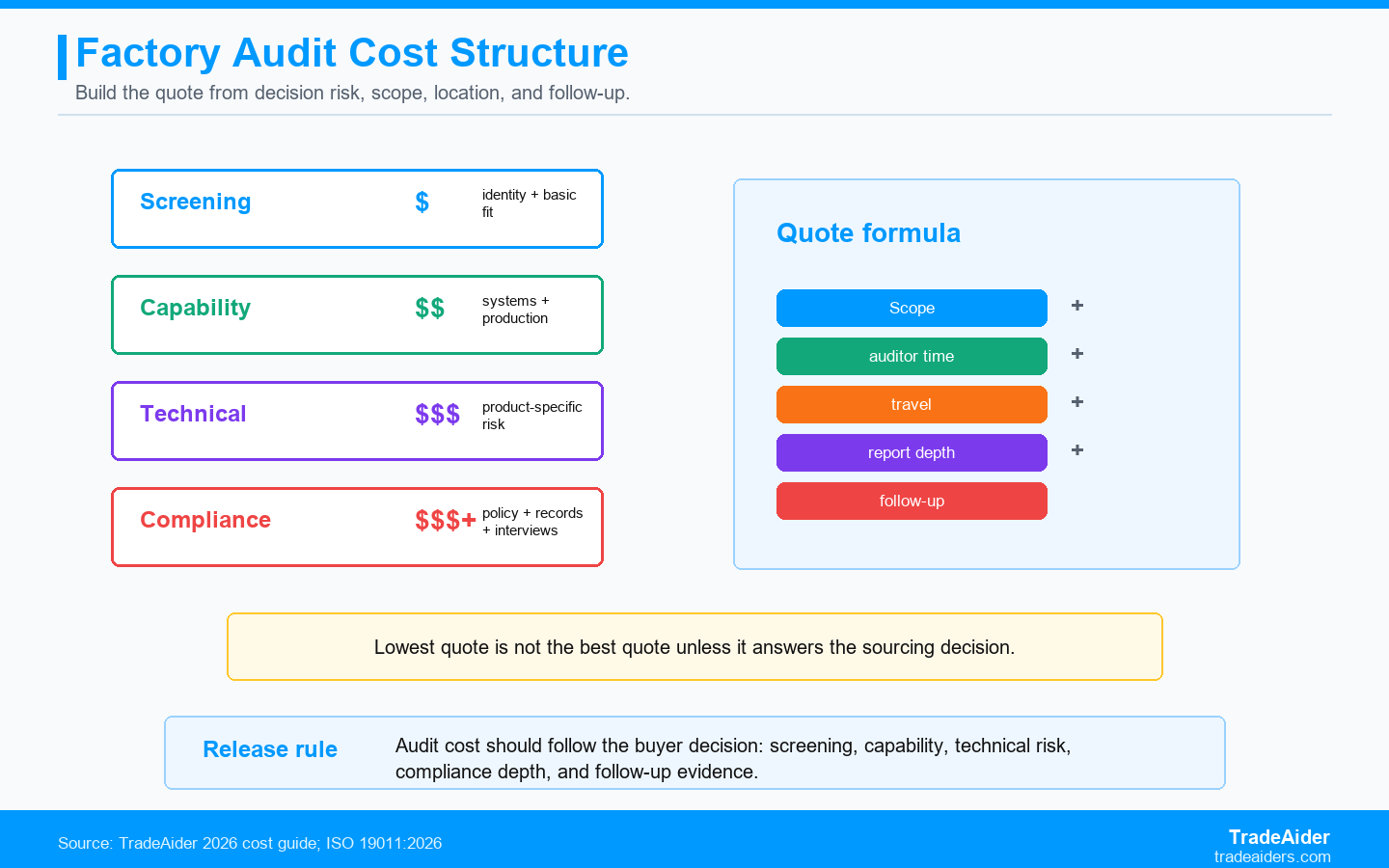
Audit cost should follow the buyer decision: screening, capability, technical risk, compliance depth, and follow-up evidence.
Pricing By Audit Type
The audit type is usually the biggest pricing lever.
A supplier screening check is the lightest option. It may verify business identity, address, factory existence, product category, basic capacity, and a limited set of photos. It can help remove obviously unsuitable suppliers before the buyer spends time on samples or negotiations. But it should not be treated as a full capability audit.
A factory capability audit goes deeper. It checks whether the supplier has the people, equipment, workflow, quality controls, production capacity, and records to make the product consistently. It may include production-line observation, incoming material controls, in-process checks, final inspection practice, nonconforming-product control, and management interviews.
A technical audit adds product-specific risk. For example, a buyer sourcing electronics, toys, medical-adjacent products, outdoor equipment, or customized mechanical goods should not rely only on a generic factory profile. The auditor should understand the production process, critical defects, testing points, traceability records, and release criteria that matter for the product category.
A social or environmental audit may require different expertise, worker interviews, payroll or time-record review, facility safety review, chemical storage checks, or local compliance evidence. The price often reflects the sensitivity of the evidence and the reporting burden.
| Audit Type | Best Use | Cost Behavior | Do Not Use It For |
|---|---|---|---|
| Supplier screening | Early supplier shortlist | Usually lighter and faster | Final approval for high-risk production |
| Capability audit | New factory qualification | Moderate, scope-driven | Deep social compliance conclusions |
| Technical audit | Product-specific production risk | Higher when expertise is needed | Generic supplier ranking only |
| Social or environmental audit | Buyer policy or retailer requirement | Higher evidence and interview burden | Replacing product quality inspection |
| CAPA follow-up | Verifying corrective action | Focused but evidence-heavy | Pretending the first audit never failed |
Pricing By Provider Model
Provider model changes what you pay for: access, expertise, speed, independence, or continuity.
Large multinational firms may offer standardized audit programs, global procedures, and brand recognition. Their pricing may be higher, especially when the audit requires a formal compliance program, specific accreditation, or global reporting. They can be useful when a retailer or corporate policy requires a recognized provider.
Specialized China-focused quality providers may be more flexible for sourcing teams that need practical evidence before purchase order release. They can often tailor the checklist to the product, factory history, order plan, and buyer decision. The buyer should still check auditor competence, report sample quality, and follow-up ability.
Low-cost marketplace options can look attractive for early screening, but the buyer should check whether the auditor is qualified for the category, whether the report has enough evidence, and whether the provider can support corrective action. A low quote without evidence depth can create false confidence.
The buyer should also consider continuity. If the same provider performs the audit, DPI, PSI, and CAPA follow-up, the evidence chain can become stronger. A provider that knows the audit findings can target future inspections more intelligently.
Hidden Costs Buyers Forget
The audit quote is not the full cost if the scope is wrong.
Hidden cost appears when the audit is too generic. The buyer may later pay for sample failure, delayed tooling, rework, reinspection, split shipment, air freight, replacement production, or customer complaints. The purpose of the audit is to reduce those downstream costs before they become urgent.
Another hidden cost is unclear corrective action. If the audit report only says poor quality control, the supplier may not know what to fix and the buyer may not know what to verify. A useful report identifies evidence, severity, owner, deadline, and follow-up method. That level of clarity may cost more upfront, but it saves negotiation time.
Travel can also distort the budget. A factory near Shenzhen, Ningbo, Shanghai, Qingdao, Xiamen, or Guangzhou may be easier to schedule than a remote inland site. The buyer should ask whether travel is included, whether there is an extra charge for distant factories, and whether multiple suppliers can be grouped efficiently.
Where TradeAider Fits In Audit Budget Planning
TradeAider fits by tying audit scope to the buyer's sourcing decision.
TradeAider can provide factory audit service when the buyer needs supplier capability evidence before ordering, scaling, or continuing with a factory after quality problems. The audit can be scoped around product risk, production process, quality systems, records, and corrective-action needs.
If the buyer also needs shipment evidence, TradeAider can connect audit findings to During Production Inspection and Pre-Shipment Inspection. That matters because an audit grades the factory system, while inspection verifies the actual order.
The business fit is budget discipline. TradeAider helps avoid both extremes: paying for a broad audit when a targeted screening is enough, or buying a cheap check when the buyer actually needs technical evidence before releasing a large order.
SPAR Scenario: The Cheapest Audit Was Not The Best Quote
A buyer compared audit quotes without comparing the decision each report would support.
Situation: A buyer sourcing customized metal home goods receives three China factory audit quotes. One is a quick verification, one is a factory capability audit, and one is a product-specific technical audit with process and record sampling.
Problem: The buyer is preparing a large first order with new tooling, so a basic verification would confirm the factory exists but would not answer whether the production controls can hold dimensions, coating finish, and packing protection.
Action: The buyer asks TradeAider to scope a capability and technical audit, then carry key findings into DPI and PSI checkpoints. The final audit budget is higher than the lowest quote but smaller than the cost of a failed first shipment.
Result: The buyer identifies weak incoming material records and coating-process control before production. The supplier fixes the control plan, and the buyer uses targeted inspection instead of broad uncertainty.
Action Card: How To Compare Audit Quotes
Compare evidence before price.
- Ask what audit type is included and what decision the report can support.
- Ask whether travel, photos, record sampling, management interviews, and CAPA notes are included.
- Ask who audits the factory and whether the auditor understands the product category.
- Ask for a sample report structure before booking.
- Ask how failed findings will be verified before the next order or shipment.
A practical audit quote should make the buyer feel clearer about the next decision. If the quote does not explain scope, time, location, evidence, report depth, and follow-up, the buyer is comparing numbers without comparing value.
For low-risk trial orders, a narrower audit may be enough. For high-risk products, regulated categories, new factories, large deposits, tight launch windows, or previous quality failures, deeper audit evidence is usually worth the additional budget. The buyer should match the audit to exposure.
Audit cost should also be compared with order value and failure cost. A modest audit can look expensive on a small sample order, but it can be very small compared with tooling, deposits, delayed launch, chargebacks, rejected inventory, or marketplace account risk.
A buyer should also decide whether audit findings will become purchase-order conditions. If the supplier must fix calibration records, incoming material checks, or packing controls before production, the audit has commercial leverage. If the report is filed away without action, even a good audit loses value.
The best pricing conversation therefore starts with the buyer's decision, not the provider's rate card. Define the decision, define the evidence, then compare quotes.
If you are budgeting supplier verification, send TradeAider the product type, supplier location, order value, risk level, and decision deadline. The next step is to ask TradeAider to scope the right factory audit before you book.
Frequently Asked Questions
Why do China factory audit quotes vary so much?
Because provider model, location, scope, audit type, report depth, technical expertise, and follow-up expectation vary. A basic screening and a technical audit are not the same product.
Is the cheapest factory audit enough?
Sometimes for early screening, but not for high-risk sourcing decisions. The audit must answer the decision the buyer is about to make.
Does a factory audit replace inspection?
No. An audit checks supplier systems and capability; inspection checks the actual order, lot, packaging, labels, and release evidence.
Should I audit before sampling or before mass production?
For higher-risk suppliers, audit before large deposits or mass production. For low-risk sourcing, a lighter screen may happen before deeper audit and inspection.
Related Articles

Grow your business with TradeAider Service
Click the button below to directly enter the TradeAider Service System. The simple steps from booking and payment to receiving reports are easy to operate.

