
Supplier QC integrity means the inspection evidence is independent, traceable, and protected from pressure by the factory, buyer impatience, or report manipulation. TradeAider uses notarized QC integrity confirmations and traceable service records so buyers can rely on inspection evidence when deciding payment, shipment release, supplier correction, or post-shipment dispute action.
Most importers understand supplier quality risk. Fewer understand inspection integrity risk. A factory may make bad goods, but a weak QC process can also produce a clean-looking report that does not protect the buyer. If the inspector is pressured, the report lacks evidence, photos are selective, or the supplier can influence the findings, the buyer may ship with false confidence.
Supplier QC integrity is not about assuming every supplier or inspector is dishonest. It is about designing controls so the inspection record can be trusted even when commercial pressure is high. Final payment, vessel schedules, production delays, and supplier relationships all create pressure. Integrity controls keep the report anchored to evidence.
- Independence: the inspector reports against buyer instructions, not supplier convenience.
- Traceability: service records, photos, and findings connect to the actual factory visit and shipment.
- Accountability: QC personnel and the inspected party acknowledge professional conduct requirements.
- Decision rule: inspection integrity matters most when the report will decide payment, shipment, or dispute leverage.
The Direct Answer
Supplier QC integrity is the control system that makes inspection evidence trustworthy enough to support buyer decisions; notarized QC agreements add accountability to the inspection process.
TradeAider's factory audit service page describes the use of a TradeAider QC Integrity Confirmation signed by the QC personnel and the inspected party, with notarization through blockchain certificate and notary office records. Source: TradeAider factory audit service.
TradeAider's mobile app page also describes online inspection media and official inspection record safekeeping with blockchain and public notarization for record validity. Source: TradeAider mobile app.
The practical benefit is not decorative technology. It is evidence discipline. When the buyer later asks whether the inspector was on site, whether the factory participated, whether photos belong to the service, or whether the report can support a dispute, traceable and notarized records make the answer stronger.
What QC Integrity Protects
Integrity controls protect the buyer from evidence failure, not only product failure.
| Integrity Risk | How It Appears | Buyer Impact | Control Needed |
|---|---|---|---|
| Supplier pressure | Factory asks inspector to soften findings | False pass or weak defect wording | Professional conduct confirmation |
| Selective evidence | Report shows only easy photos | Buyer cannot verify defect scope | Structured photo and media record |
| Vague report | Findings lack sample, location, or severity | Dispute value drops | AQL, defect class, and traceable findings |
| Identity confusion | Report does not prove inspected goods match PO | Wrong lot may be released | SKU, carton, label, and lot evidence |
| Post-event denial | Supplier disputes what happened during inspection | Negotiation becomes verbal | Signed and notarized service records |
The strongest inspection report is not merely detailed. It is connected. It connects the buyer's files to the factory visit, the sampled goods, the defect count, the photos, the supplier response, the release rule, and the final decision. Integrity controls help keep that chain intact.
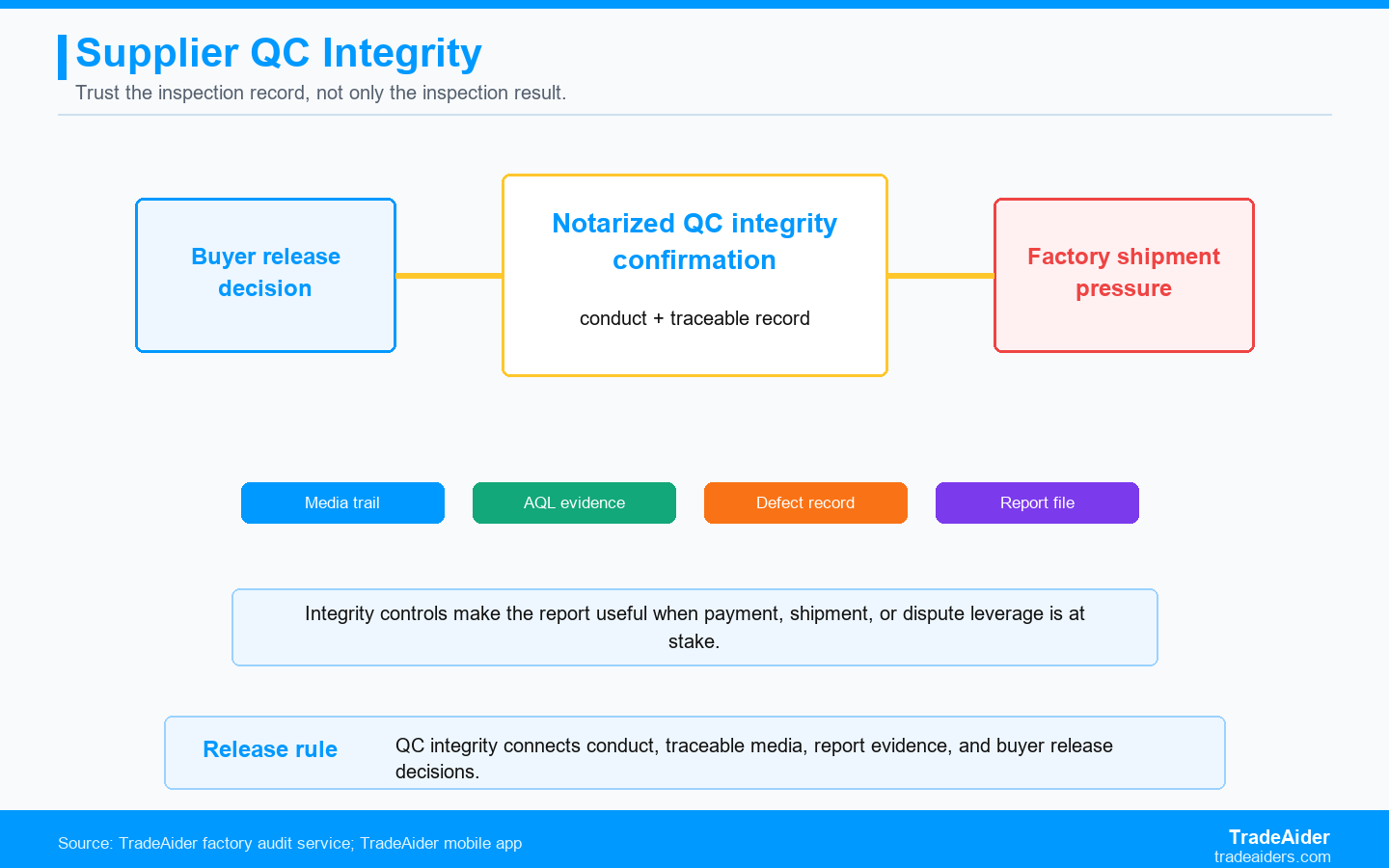
QC integrity connects conduct, traceable media, report evidence, and buyer release decisions.
Why Supplier QC Alone Is Not Enough
Supplier QC is useful process information, but it is not independent release evidence.
A supplier's internal QC team may be competent and useful. It can catch problems earlier, reduce rework, and improve process stability. But it sits inside the organization that wants the shipment to pass, collect payment, and keep production moving. That does not make the supplier untrustworthy; it means the incentive structure is different from the buyer's.
Internal QC reports may also use different standards. The factory may consider a defect acceptable because it is normal for their production line, while the buyer's customers may reject it. The factory may focus on production efficiency while the buyer cares about retail presentation, compliance labels, marketplace returns, and brand risk.
A third-party inspection report has value because it is buyer-directed and evidence-based. But that value depends on the integrity of the inspection process. If the third party lacks controls, the buyer has only another piece of paper. That is why integrity agreements, traceable records, and transparent reporting matter.
What A Notarized QC Agreement Does
The agreement creates a conduct record before the inspection result is written.
A notarized QC integrity confirmation is not a substitute for product inspection. It is a process safeguard. It records that QC personnel and the inspected party are expected to follow professional conduct requirements during the service. It also gives the buyer a stronger record if the supplier later disputes the inspection process.
The buyer should view this as one part of a broader evidence system. The agreement supports integrity, but the report still needs clear sampling, photos, defect descriptions, severity classification, product identity, label evidence, and release recommendations. A notarized agreement without a strong report is not enough.
The best use is prevention. When all parties know that the service record is traceable and conduct is formally acknowledged, there is less room for casual pressure, undocumented side conversations, or post-event denial. This can make the inspection smoother, especially when the result is unfavorable.
How Integrity Controls Help Disputes
When a shipment fails, the quality of evidence becomes the quality of leverage.
If the buyer must negotiate rework, discount, replacement, or refund, the supplier will ask what evidence proves the defect. A strong report can show sampled units, defect photos, carton identity, SKU, severity, AQL result, and supplier acknowledgment. A weak report may only say failed inspection without enough detail to support action.
Integrity records also help after goods arrive. If the supplier says the problem occurred during transport or warehouse handling, the buyer can compare arrival evidence with pre-shipment evidence. If the supplier says the inspector never checked the issue, the buyer can review the service record and report structure.
This does not guarantee dispute success. Contracts, governing law, Incoterms, payment terms, and supplier leverage still matter. But better inspection integrity gives the buyer a stronger factual base and a clearer negotiation path.
Where TradeAider Fits In QC Integrity
TradeAider fits by combining inspection service with traceable conduct and evidence controls.
TradeAider can use Pre-Shipment Inspection to verify the shipment against buyer files while creating a report record that includes sample evidence, product identity, defect classification, photos, packaging, labels, and release findings.
For supplier selection, factory audit service can check supplier capability while using integrity confirmations and traceable records to strengthen buyer confidence in the audit process.
The business fit is trust under pressure. TradeAider's notarized QC integrity approach helps buyers treat inspection evidence as a decision file rather than a disposable report.
SPAR Scenario: The Supplier Disputed The Failed Report
The buyer needed more than a pass/fail document.
Situation: A buyer schedules PSI for a mixed-SKU home product shipment. The supplier is late and wants the goods released quickly.
Problem: The inspection finds wrong labels and missing accessories. The supplier says the inspector exaggerated the issue and asks the buyer to approve shipment anyway.
Action: TradeAider's report shows sampled cartons, SKU photos, defect counts, label evidence, accessory photos, and a traceable service record connected to the QC integrity confirmation.
Result: The buyer holds final payment until the supplier sorts the affected cartons and passes reinspection. The dispute is resolved around evidence rather than personal trust.
Action Card: How To Check QC Integrity Before Booking
Ask how the report will prove the inspection happened and how the findings were produced.
- Ask whether QC conduct rules are acknowledged before the service.
- Ask how the provider records service time, factory participation, photos, videos, and sampled goods.
- Ask whether the report links defects to SKU, carton, sample size, severity, and buyer files.
- Ask how the buyer can report professional conduct concerns.
- Ask how the evidence record supports rework, reinspection, payment hold, or dispute negotiation.
The buyer should also build integrity into supplier agreements. The purchase order should state that the buyer may appoint an independent QC provider, the supplier must provide access to goods and records needed for inspection, and final payment or release may depend on the inspection result. Without that contractual foundation, even a strong inspection provider may face access problems.
Integrity is strongest when buyer, supplier, and QC company know the rules before the service starts. The supplier should know what will be inspected. The QC company should know the buyer's standard. The buyer should know how the report will be evidenced. This clarity reduces friction when findings are negative.
Integrity Controls Buyers Should Put In The PO
Inspection integrity works best when the purchase order gives the QC company room to inspect properly.
The PO should give the buyer or appointed QC company the right to inspect goods before final payment or shipment release. It should require supplier cooperation, access to packed and unpacked goods, access to relevant cartons, reasonable space for sampling, and permission to photograph product, labels, packaging, carton marks, and defects. These basic access rights prevent a supplier from narrowing the inspection after the appointment is booked.
The PO should also state that the supplier may not substitute prepared samples for random sampled units, prevent the inspector from opening selected cartons, or pressure the inspector to change defect classification. If the supplier believes a finding is incorrect, the response should be recorded through formal comments or corrective evidence, not through off-record persuasion.
Payment language matters too. If final balance is released only after acceptable inspection evidence, the supplier understands the commercial consequence before production starts. If reinspection is needed because the first inspection failed, the PO should say who pays for the reinspection and what correction evidence is required before the second visit.
What Integrity Does Not Do
Integrity controls strengthen evidence; they do not replace commercial judgment.
A traceable report does not automatically make a supplier pay every claim. The buyer still needs a clear contract, practical leverage, reasonable remedy request, and accurate defect classification. Integrity controls make the factual record stronger, but negotiation, legal terms, and supplier relationship still matter.
Integrity controls also do not remove the need for a good inspection scope. If the buyer never sends a specification, approved sample, label file, or defect list, the inspector may still lack the standard needed to judge the product. Integrity protects the process; the buyer must still define the product requirement.
That is why integrity and scope should be planned together, not treated as separate checklist items.
The buyer should not wait until a dispute to ask about report integrity. By then, the goods may have shipped, the factory may have been paid, and the evidence trail may be weak. Integrity controls are most valuable when built into the first inspection booking.
If you want stronger inspection evidence for supplier negotiations, send TradeAider the PO, inspection scope, supplier access terms, and risk history. The next step is to ask TradeAider to build a traceable QC integrity process for your shipment.
Frequently Asked Questions
What is supplier QC integrity?
It is the independence, traceability, conduct control, and evidence quality that make inspection findings reliable for buyer decisions.
Does notarization replace inspection?
No. Notarization supports the integrity of the process and records. The inspection still needs sampling, defect classification, photos, and clear findings.
Why is supplier internal QC not enough?
Supplier QC can be useful, but it is not independent from the party that wants the shipment to pass and get paid.
How does QC integrity help after a failed inspection?
It gives the buyer a stronger evidence trail for rework, reinspection, payment hold, supplier CAPA, or dispute negotiation.
Related Articles

Grow your business with TradeAider Service
Click the button below to directly enter the TradeAider Service System. The simple steps from booking and payment to receiving reports are easy to operate.

