
- About Us

- Our Services
- Your Industry
- Resources
- News & Blog
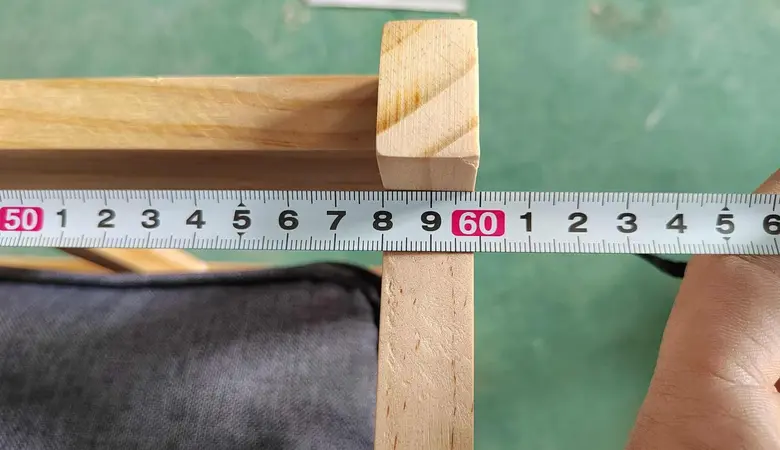
During furniture quality inspection in 2026, importers should check structure, dimensions, materials, finish, hardware, stability-sensitive features, labels, assembly instructions, packing strength, carton identity, recall-sensitive risks, and release evidence. A piece of furniture can look attractive in a photo and still fail because a joint is weak, a drawer binds, a panel is misaligned, hardware is missing, a stability file is incomplete, or the carton cannot survive the shipping route.
Furniture QC needs both quality and safety discipline. ISO 9001 is useful as a requirements mindset: the buyer must define what the furniture should meet before inspection can judge whether it conforms.
For sampled final inspection, ISO 2859-1:2026 supports lot-by-lot sampling by attributes. For furniture, that means the sample plan should spread across SKUs, colors, finishes, carton groups, production dates, and ready-to-assemble versions when those groups exist.
Safety-sensitive furniture deserves extra attention in 2026. CPSC guidance on clothing storage units explains that requirements are codified at 16 CFR part 1261 and apply to clothing storage units manufactured after September 1, 2023. A buyer inspecting dressers, wardrobes, cabinets, or similar units should treat stability, warnings, anchors, and instructions as release-critical evidence, not optional paperwork.
The risk is still live, not historical. In May 2026, CPSC announced a recall of about 165,000 Mainstays 9-Drawer Fabric Dressers because the dressers violated the mandatory standard for clothing storage units and posed tip-over and entrapment hazards. That makes stability files, anchor kits, warning labels, model identity, and carton checks part of practical 2026 furniture release control.
- Do not stop at finish: scratches and dents matter, but structure, stability, hardware, and assembly fit often create the bigger claim.
- Check function under realistic use: drawers, doors, hinges, slides, leveling feet, locks, shelves, and moving parts need repeated operation.
- Treat labels and instructions as 2026 release evidence: warnings, SKU, carton marks, assembly steps, anti-tip hardware, and hardware lists affect acceptance and safe use.
- Make packing part of furniture QC: heavy, fragile, flat-pack, glass, metal, and coated items fail quickly when protection is weak.
What Should Importers Check During Furniture Quality Inspection?
In 2026, importers should check furniture structure, joint strength, stability, dimensions, material identity, surface finish, color match, hardware completeness, moving-part function, assembly fit, labels, warnings, instructions, carton marks, packing protection, moisture risk, recall-sensitive evidence, and sample spread before shipment release.
The most common 2026 mistake is treating furniture inspection as a cosmetic review. Finish defects are visible and important, but a beautiful cabinet with loose joints, missing anti-tip hardware, weak drawer slides, wrong screw pack, poor alignment, unsupported stability evidence, or inadequate carton protection can still create returns, complaints, recall exposure, or safety escalation.
Inspection-body consistency matters because furniture checks combine visual judgment, measurement, function operation, assembly verification, and packing review. ISO/IEC 17020 frames inspection around competence and consistency, which is a useful buyer principle even when the buyer is not requiring formal accreditation.
The final rule published in the Federal Register explains the clothing storage unit safety standard context and test scenarios such as multiple open drawers. The practical 2026 inspection lesson is not to turn a factory visit into a lab test; it is to verify whether the product category needs stability evidence, warnings, anchors, model identity, and instructions before release.
Furniture Quality Inspection Checklist
Use the checklist to separate visible cosmetic defects from shipment-stopping furniture risks.
| Check Area | What to Inspect | Common Failure | Release Decision |
|---|---|---|---|
| Structure | Frame, joints, welds, glue, legs, shelves, load points | Wobble, crack, weak joint | Hold if repeated or safety-sensitive |
| Dimensions | Overall size, hole location, panel fit, alignment | Wrong size, poor assembly fit | Sort or rework affected SKU |
| Finish | Scratch, dent, stain, color, coating, edge, odor | Cosmetic claim or retailer rejection | Classify by visibility |
| Hardware | Screws, hinges, slides, handles, anchors, tools | Missing or wrong hardware pack | Correct before shipment |
| Function | Doors, drawers, locks, folding, reclining, wheels | Binding, noise, misalignment | Rework or reinspect |
| Labels and instructions | Warning, SKU, carton mark, assembly guide | Wrong warning or missing guide | Escalate by market risk |
| Recall-sensitive identity | Model, date code, factory, anchor kit, stability file | Wrong model or missing evidence | Hold for compliance review |
| Packing | Foam, corners, moisture bag, carton strength, count | Damage during transit | Improve packing or hold |
The checklist should change by furniture type. A sofa, chair, dining table, dresser, bed frame, office chair, metal rack, cabinet, and flat-pack shelf have different failure modes. The inspection file should identify the furniture's critical-to-quality points before the inspector arrives.
For ready-to-assemble furniture, hardware and instructions can be as important as the panels. One missing screw pack or unclear assembly step can turn a clean product into a customer support and return problem.
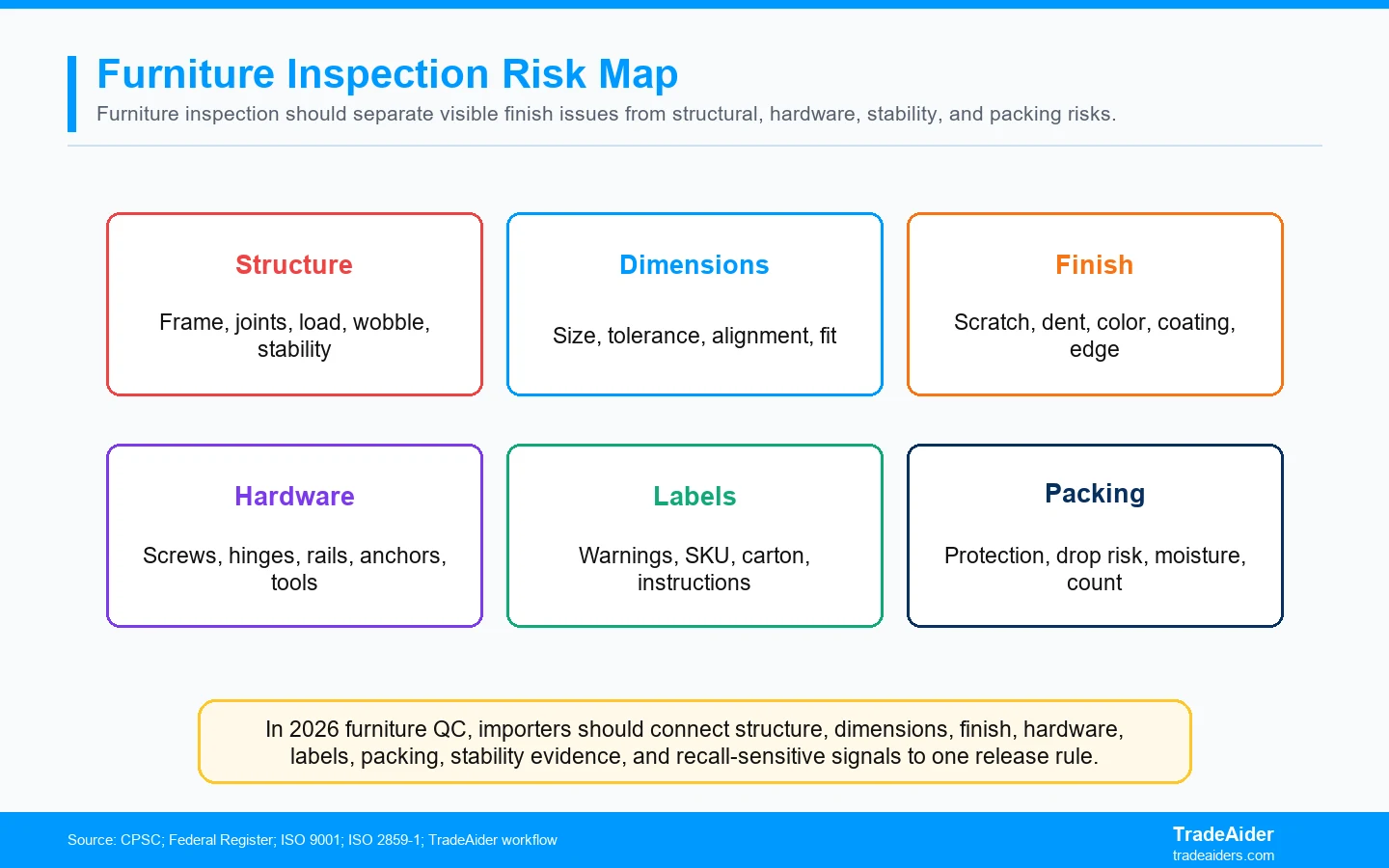
In 2026 furniture QC, importers should connect structure, dimensions, finish, hardware, labels, packing, stability evidence, and recall-sensitive signals to one release rule.
Furniture Inspection Should Separate Cosmetic and Structural Risk
A furniture item can pass appearance checks and still fail the buyer if the structure, function, or packing is weak.
Structural checks should come before finish judgment
Start with the frame, joints, legs, welds, glue points, shelf supports, load-bearing parts, panel thickness, screw holes, and wobble. If the structure is weak, a perfect finish does not make the product acceptable.
The inspector should apply reasonable function and stability checks defined by the product file. For a chair, that may include leg balance, backrest movement, weld finish, and fastener tightness. For a cabinet, it may include drawer operation, door alignment, shelf fit, wall anchor pack, and whether the unit stands level on a flat surface.
Cosmetic defects still need severity rules
Furniture finish defects are not all equal. A small scratch on a hidden underside may be minor. A dent on a visible tabletop, color mismatch across panels, coating peel, rough edge, stain, odor, or glue mark on a customer-facing surface may be major.
The buyer should define visible areas, acceptable shade tolerance, repair permission, and packaging-touch points before inspection. Otherwise the supplier may argue that finish defects are normal, while the buyer sees a retailer rejection risk.
Hardware, Assembly, and Instructions Are Release-Critical
Furniture customers judge the product during assembly and first use, not only when it leaves the carton.
Missing hardware creates immediate failure
For flat-pack and ready-to-assemble furniture, inspect screw packs, cam locks, dowels, bolts, washers, Allen keys, brackets, anti-tip hardware, spare parts, and hardware labels. Count the hardware against the instruction sheet, not only against the factory's packing habit.
If one carton group has missing hardware, do not assume the rest is clean. Check whether the packer, production date, SKU, or carton range is common to the failure. A concentrated packing issue can be corrected before shipment if it is isolated clearly.
Assembly fit should be checked with real parts
A visual review of panels is not enough when the customer must assemble the item. Hole location, panel alignment, dowel fit, screw depth, drawer rail position, hinge movement, leveling feet, and instruction clarity should be verified with actual components.
A partial assembly check is especially useful for first orders, new factories, new hardware, or high-return furniture categories. It converts the report from appearance evidence into customer-use evidence.
Labels, Warnings, and Stability Evidence Need 2026 Attention
For safety-sensitive furniture in 2026, the release decision should include more than dimensions and finish.
Storage furniture, children's furniture, bunk beds, cribs, high chairs, and other safety-sensitive categories can carry warning, instruction, anchor, stability, and test-report requirements. The inspector should verify that required warnings, assembly instructions, anchor kits, labels, and carton marks match the buyer's file.
The 2026 dresser recall pattern makes identity evidence more important. If a SKU, model label, date code, importer file, factory name, anchor kit, or instruction version does not match the approved record, the issue should be escalated before release rather than treated as a minor labeling defect.
A factory inspection cannot replace a required stability test or compliance review, but it can confirm whether the shipment includes the expected warning labels, instructions, anchor hardware, and product identity evidence. It can also show whether affected cartons share a model, date range, production line, or packing version.
When the category is safety-sensitive, the buyer should separate three questions: whether the product visibly matches the approved sample, whether required documents and test evidence exist, and whether the packed shipment includes the labels, anchors, warnings, and hardware needed for release. Mixing those questions creates false confidence.
Packing Is Part of Furniture Quality Control
Furniture often fails after inspection because the carton was never treated as part of the product.
Heavy and fragile furniture needs protection evidence
Check carton strength, corner protection, foam density, edge guards, moisture protection, glass or mirror isolation, hardware separation, spare parts, polybag, pallet condition, drop-risk points, and whether the package prevents movement inside the carton.
Furniture damage often appears as crushed corners, scratched panels, cracked glass, bent metal, chipped edges, moisture swelling, or missing hardware after transit. If the product is heavy, fragile, coated, or flat-packed, packing should be inspected with the same seriousness as surface finish.
Carton identity prevents warehouse and customer-service failures
Carton marks, SKU, color, size, barcode, quantity, gross weight, net weight, destination, and assembly instruction identity should match the purchase order and packing list. A correct product in the wrong carton can still create receiving errors and customer complaints.
For multi-carton furniture sets, carton numbering is critical. If carton 1 of 2 and carton 2 of 2 are mixed across colors or finishes, the buyer may not discover the issue until warehouse receiving or customer assembly. Inspection should verify set matching before loading.
Scenario Estimate: One Missing Hardware Pack Can Create Hundreds of Support Cases
Furniture inspection should treat small packing failures as large customer-experience risks when the error repeats.
Assume a 4,000-unit flat-pack cabinet order has a 3% missing-hardware issue in one carton group. That is about 120 units. If each support case, replacement hardware shipment, refund, or return handling event costs $14, the direct exposure is about $1,680 before counting customer reviews or retailer chargebacks.
This estimate is illustrative, not a guaranteed cost. It shows why a missing screw pack is not always a minor defect. If the issue repeats by packer, SKU, or carton range, the buyer should hold the affected group and correct it before release.
The best report does not only count missing hardware. It shows which carton range, production date, or SKU is affected, so the buyer can correct the smallest reliable subgroup rather than blocking the whole shipment or releasing a known complaint pattern.
Where TradeAider Fits in Furniture QC
TradeAider can help furniture importers turn 2026 structure, finish, hardware, labels, packing, stability, recall-sensitive identity, and release evidence into a shipment-ready inspection plan.
For first orders or new suppliers, Pre-Production Inspection can verify materials, panels, hardware, labels, packing design, and approved sample readiness before mass production.
For process drift, During Production Inspection can check early assembly, finish, hardware packing, and repeated defects. For final release, Pre-Shipment Inspection can verify finished furniture, carton spread, packing, labels, instructions, model identity, anchor kits, and release evidence.
If the product has stability, chemical, flammability, or performance claims that visual inspection cannot prove, TradeAider can coordinate product testing services alongside the inspection scope.
SPAR Scenario: The Finish Passed, but 2026 Release Evidence Failed
The buyer used subgroup evidence instead of rejecting or releasing the whole furniture order.
Situation: A buyer ordered 5,500 flat-pack bedside cabinets from a new factory.
Problem: Surface finish passed, but final inspection found missing wall-anchor packs and an older warning insert in cartons from one packing line.
Action: The buyer asked TradeAider to expand hardware checks by carton range, verify instruction versions, photograph model/date labels, and isolate affected pallet IDs.
Result: The buyer held 860 units for anchor-kit repacking and instruction replacement, released the clean cartons, and kept a traceable evidence file for the retailer's 2026 release review.
Furniture QC File Before Inspection
Send these details before booking a furniture inspection.
- Approved sample photos, drawings, dimensions, tolerances, finish standards, and visible-area rules.
- Material, panel, frame, joint, hardware, and moving-part requirements.
- Assembly instructions, hardware pack list, labels, warnings, and anchor kit requirements.
- Model identity, date code, factory, importer file, stability evidence, and recall-sensitive records.
- Packing method, carton marks, set numbering, pallet rules, and moisture protection.
- SKU, color, finish, carton, production-date, and factory sample-spread map.
- Safety, stability, performance, or compliance documents required for the destination market.
Furniture inspection works best when the buyer defines which defects stop release and which can be sorted or repaired. Without severity rules, the factory may treat structural or hardware issues as normal variation.
For 2026 furniture orders, the buyer should also identify whether the product category needs separate testing, regulatory review, or recall-sensitive model control. Inspection should verify visible evidence and documents, not replace required compliance proof.
If your 2026 furniture order has structure, finish, hardware, instruction, stability, recall-sensitive identity, or packing risk, send TradeAider the drawings, approved sample, hardware list, packing method, label/warning artwork, stability file, and production status. The next step is to set up a furniture inspection before shipment while the supplier can still correct the affected subgroup.
Frequently Asked Questions
What is checked in furniture quality inspection in 2026?
Furniture inspection checks structure, dimensions, materials, finish, hardware, function, labels, warnings, instructions, anchor kits, model identity, packing, carton identity, quantity, and sample spread before shipment release.
Is furniture inspection only about scratches and dents?
No. Cosmetic defects matter, but structure, stability, missing hardware, poor assembly fit, weak packing, and wrong warnings can create larger return or safety problems.
When should furniture be inspected?
Use early checks for materials and hardware setup, during-production checks for repeated defects, and final inspection when finished goods and cartons can be sampled before shipment.
Can inspection prove furniture stability compliance?
No. Inspection can verify visible condition, model identity, labels, anchors, instructions, and documents, but stability compliance may require the appropriate test evidence and regulatory review.
What should I send before furniture inspection?
Send drawings, approved sample, dimensions, tolerance rules, hardware list, instructions, warning labels, packing plan, carton map, model/date-code requirements, and any safety or test documents required by the market.

Related Articles

Grow your business with TradeAider Service
Click the button below to directly enter the TradeAider Service System. The simple steps from booking and payment to receiving reports are easy to operate.

