
- About Us

- Our Services
- Your Industry
- Resources
- News & Blog
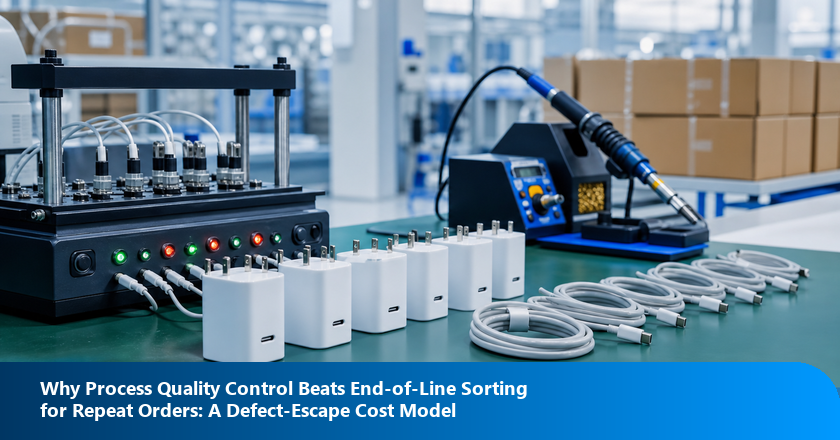
For a repeat order, the question is not whether final sorting has value. It does: it can keep a known-risk unit out of the shipment. The more useful question is where the buyer first receives a signal, who can act on it, and how much work has already accumulated by then. An earlier check moves the response closer to the point of change. A finished-lot sort remains a release layer, but it cannot recover the time, handling, and uncertainty already added to a completed shipment.
The Repeat-Order Cost Decision: Stop the Escape, Not Just the Shipment
End-of-line sorting can contain a shipment, but repeat-order quality control should move detection and reaction to the point where a defect can still be prevented. That distinction matters most when an accepted reference sample and a current production build no longer agree.
- Decision: Keep final sorting as a lot-release safeguard, then identify the earliest process point where the same failure can be detected and changed.
- Containment: Separate the known or suspect scope before release; do not let the urgency of shipment turn a temporary hold into proof that the cause is resolved.
- Cost: Compare the scope checked, work already added, correction work, and release consequence at each possible detection point instead of relying on a generic “cost of quality” ratio.
- Control point: For the next run, specify the product check, linked process input, record, owner, reaction, and verification gate before production continues.
This is a buyer-side decision framework. It does not replace the buyer’s specification, applicable regulation, contractual remedy, or authority to release a lot. Its purpose is to make a repeat-order quality discussion concrete enough to act on before another completed shipment needs sorting. TradeAider can use the resulting brief to align an inspection activity with the buyer’s stated release decision.
Process Quality Control Is an Escape-Prevention System
Process quality control is checking a production process while work is still underway so the cause of a quality risk can be corrected before more units are affected. NIST describes process control as comparing current performance with a historical snapshot or expected model so unusual variation can be investigated. Its discussion of statistical process control and inspection makes a useful boundary clear: information is valuable when it helps the team distinguish current behavior from an expected process pattern.
That is different from simply checking finished pieces. A final inspection asks whether the presented lot meets a release requirement. An upstream control asks whether a critical process condition is still producing the intended output, and what should happen if it is not. For a repeat order, the buyer already has an approved sample, a prior build, and known product characteristics. Those references can be turned into a narrower, earlier decision rather than waiting for cartons to be complete.
A workable control point therefore has two sides. The product side states what is checked: for example, charging function, connector fit, label readability, seam strength, or a dimensional feature. The process side names the input that can change that output: a set-up value, material batch, tool condition, assembly sequence, operator method, or test-station record. If the product check has no actionable process link, it may still find defects, but it is less able to prevent the next group of units from inheriting the same risk.
End-of-Line Sorting Contains a Lot but Cannot Recover Upstream Work
End-of-line sorting contains a presented lot after processing is complete, while process control investigates evidence during the work that creates the output. Sorting can be the right immediate response when a buyer needs a shipment-level decision, a defined defect category, and a clear disposition for accepted, reworked, and rejected units. It is especially sensible where the alternative would be releasing a known risk without a defined check.
The limitation is timing. By final sort, the affected unit may already have received components, labor, testing, cosmetic finishing, packing materials, carton handling, and production records that require review. A sort can identify the current scope, but it cannot make that earlier work disappear. It also cannot show, by itself, whether the next production day will repeat the same condition. Treat sorting as a containment tool and a source of evidence, not as a substitute for controlling the process that generated the evidence.
For the current lot, the buyer can still define a pre-shipment inspection scope around the actual failure mode, the affected population, the sampling or sorting method, and the release rule. The resulting report should separate what was verified from what remains unknown. That separation avoids a common mistake: calling a shipment “safe” when the real conclusion is only that a specified scope was checked at the end of production.
Containment Is Still Valuable at the Release Gate
Containment is temporarily separating a known or suspect product scope so it does not move forward while evidence is reviewed. Final containment is useful when a buyer needs to separate known suspect units from the release decision while the cause is investigated. A hold, a segregated pallet, a defined recheck group, or a documented rework queue can all be legitimate ways to protect the shipment decision.
Containment becomes weak when the scope is guessed. Ask four practical questions: Which units share the suspect condition? What evidence places them in or out of that group? Who may change their status? What result is required before a unit is released? If those answers are absent, a 100% sort may produce activity without producing a defensible release boundary. The buyer can contain the present lot while requiring a separate upstream correction for the next run; the two decisions should not be collapsed into one.
The Cost Starts Before Sorting Begins
NIST explains that observed process variation can accumulate from multiple sources, so a final sort should not be treated as proof that earlier process inputs were controlled. Its overview of process variability is a helpful reminder that a visible product failure can be the late result of several small changes rather than one obvious event.
By the release gate, the cost is broader than the defective unit. It can include finding the population, pausing movement, opening cartons, retesting good units, repairing affected units, repacking, reconciling counts, and explaining a delayed decision. If the failure reaches a customer, the buyer may face additional exposure such as returns, replacement logistics, or an account conversation. Those outcomes are product- and contract-specific; they should be listed as possible consequences, not assumed as universal amounts.
Use the Defect-Escape Cost Model to Compare Control Points
The Defect-Escape Cost Model is an illustrative buyer tool that compares scope checked, accumulated work, correction effort, and release consequence at different detection points. It is not a universal savings calculation. It gives the buyer a disciplined way to ask whether a critical check belongs at a process step, at final inspection, or at both.
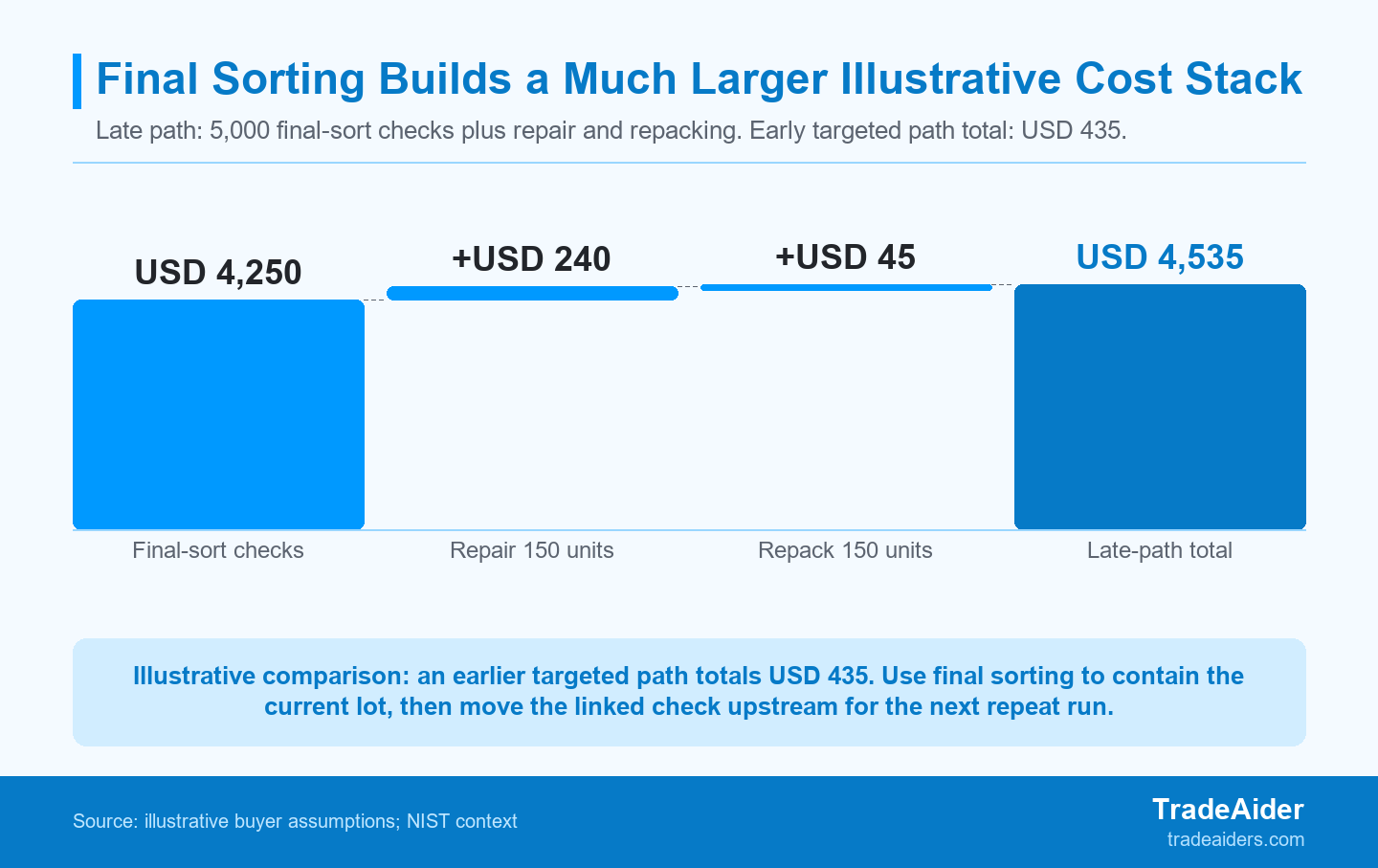
Illustrative late-path cost build-up: USD 4,535 versus a USD 435 targeted upstream path. Assumptions, not benchmarks.
The cost model is a buyer-defined comparison: it lists the scope checked, work already added, correction effort, and any release consequence without claiming a universal cost ratio. The model becomes useful when every line is tied to the product and the actual order conditions rather than copied from a benchmark. A low-cost check at the wrong point can be useless; a focused check at the point of change can prevent a much wider late-stage review.
| Detection point | Scope being checked | Work already added | Buyer decision enabled |
|---|---|---|---|
| Critical process step | Defined in-process sample and its record | Limited to the work completed before the signal | Stop, adjust, verify, then continue or hold |
| Final sort | Finished units or a defined final-inspection sample | Assembly, finishing, packing, and movement may be complete | Segregate, rework, reject, or release the presented lot |
| After shipment | Customer-reported or field-return scope | Distribution and customer handling may be added | Contain exposure and define the final ship-or-hold decision |
Use the table as a comparison prompt, not as an instruction to eliminate final inspection. A buyer may need two layers: an upstream point that creates an early signal and a final point that checks the shipment decision. The model is strongest when it makes the handoff between those layers explicit. If an upstream check fails, identify the affected time window, pause the defined scope, review the linked input record, correct the condition, and verify the first acceptable output before routine production resumes.
Move the Control Point Upstream on Repeat Orders
NIST control charts display a quality characteristic over time or sample order, which can help distinguish a process signal from an isolated final-inspection finding when comparable data exist. Its explanation of control-chart characteristics shows the basic logic: observations are read against a center line and control limits, rather than being treated as disconnected points.
A buyer does not need to impose a complex chart on every product to apply that logic. Start with the recurring risk: a charging-function failure, a loose assembly, a print-registration change, a fill-volume deviation, or a record that should accompany a critical step. Select a check that is early enough to influence the next output, repeatable enough to compare, and close enough to a decision owner that an unacceptable result changes what happens next.
For an order already in production, the practical next move may be to set a during-production inspection checkpoint around that specific risk. The brief should state whether the check is a targeted sample, a witness point, a document review, or a combination. It should also say which current production scope is affected if the result fails. “Inspect during production” is too broad to create a usable response; the buyer needs one named characteristic, one stated timing, and one reaction owner.
Link the Critical Check to a Process Input
NIST lists identifying important process inputs and outputs as part of process characterization, so a product check is more useful when linked to an input that can be acted on. In its description of process characterization, NIST also notes that understanding may need review after changes such as adjustment or maintenance.
Write the link in plain language. If the product characteristic is intermittent charging, the linked inputs could include the defined soldering setting, the solder joint inspection point, the component lot, and the electrical-test result. If the characteristic is a printed logo, the inputs could include approved artwork, print alignment, curing condition, and the first-piece signoff. The point is not to prove a single cause before evidence exists. It is to ensure that a failed product check triggers review of a process condition someone can inspect and change.
Set the Reaction Before Production Continues
FDA's process-validation guidance treats ongoing collection and evaluation of process information as a way to detect undesired variability and determine whether action is needed; this is a sector-specific reference, not a consumer-goods rule. In the guidance's discussion of continued process verification, the emphasis is on using ongoing information to detect undesired variation and decide whether action is required.
For a general consumer-goods order, use that idea as a management boundary rather than a regulatory prescription. Decide the reaction before the check starts: stop the line or the affected scope; segregate units since the last accepted result; review the named input record; correct the process condition; repeat the product check; and obtain the named buyer or factory approval before resuming. A reaction rule should identify the trigger, the immediate hold, the evidence to review, the person who owns the response, and the evidence required to close it.
Without this rule, an in-process check can become another report with no operational consequence. With it, the same check becomes a decision point. The buyer can then distinguish a contained exception from a verified return to routine production, even where the final release inspection remains in place.
Worked Example: An Intermittent Charger Defect Reaches Final Sort
The charger calculation is illustrative: it compares assumptions for an in-process check with assumptions for a final sort and does not report a client outcome or industry benchmark. It is an illustrative example, not a client case, supplier result, or measured TradeAider outcome. The example makes the timing decision visible without pretending that one product’s labor assumptions apply to every supplier or order.
Compare the Same Defect Scope at Two Control Points
The disclosed calculation compares 650 targeted upstream checks with a 5,000-unit final sort using the same assumed 150 affected chargers, so the comparison is about detection timing rather than a claimed defect rate. The figures below are illustrative buyer assumptions only. They are not a supplier quotation, a TradeAider price, an industry benchmark, or a prediction of a real order outcome.
A global consumer-electronics importer is repeating an order with a China supplier after two accepted charger runs. The illustrative order contains 5,000 USB-C wall chargers valued at USD 45,000. Assembly is underway with an approved reference sample and output check, but the soldering-station temperature record is not reviewed until finished cartons are presented. The buyer has a product requirement and an approved sample, yet no early decision point links the electrical result to that process record.
An intermittent charging failure appears on current production even though the approved reference sample performed as intended. The calculation assumes 150 affected units, 650 targeted upstream checks, and a 5,000-unit final sort if the signal is missed until release. The issue is not that every charger is defective. This illustrative example represents a sample-to-mass-production mismatch: the visible product signal is late, while the relevant production record has not been used to narrow the scope or trigger action.
The buyer uses final sorting to contain the current shipment, then conditionally releases a verified repeat build only after a targeted in-process electrical check and temperature-record review are in place. The supplier identifies the linked soldering input, records the agreed temperature window, checks a defined in-process sample, and documents a reaction when the electrical result or record does not agree. The current lot still needs a shipment decision; the next build needs evidence that the control point is working.
| Illustrative path | Assumed activity | Assumed calculation | Illustrative total |
|---|---|---|---|
| Earlier targeted check | 650 checks; repair of 150 affected chargers | 650 × USD 0.30 + 150 × USD 1.60 | USD 435 |
| Late final sort | 5000 checks; repair and repack of 150 affected chargers | 5000 × USD 0.85 + 150 × USD 1.60 + 150 × USD 0.30 | USD 4535 |
The illustrative difference is USD 4,100. It comes from the assumed checked scope and added repacking work, not from a claimed difference in product quality or defect rate. In a real order, the buyer would replace every amount and scope with the approved test method, labor assumptions, commercial terms, actual affected window, and the applicable safety and disposition requirements. The decision remains the same: contain the present lot, then require a verified upstream control before relying on the next repeat build.
Resume routine release only after the targeted check, process record, corrective action, and follow-up result are documented against the buyer’s requirement. The buyer must define the electrical test method, accepted record range, sample timing, affected scope, product safety obligations, and the final ship-or-hold decision. This illustrative example shows a control brief, not an automatic release rule.
Build a Repeat-Order Control Brief
A repeat-order control brief should make the check, timing, owner, reaction, record, and verification gate explicit before production continues. Keep it short enough to use on the factory floor and specific enough that the buyer, supplier, and inspector read the same decision rule. A useful brief can fit on one page when it focuses on the recurring risk rather than attempting to restate the entire product specification.
- Risk and scope: name the failure mode, product version, production step, and the units or time window affected if the trigger occurs.
- Check and timing: state the characteristic, method, reference sample or limit, sample timing, and person who records the result.
- Input and reaction: name the process input to review, the immediate containment action, the correction owner, and the approval required to restart.
- Verification and release: define the follow-up check, required record, final inspection role, and who may decide the lot’s disposition.
FDA's quality-system inspection guide describes corrective and preventive action as addressing an existing quality problem and preventing recurrence; its regulatory scope does not set a universal consumer-goods requirement. The FDA guide on corrective and preventive actions is a medical-device reference, not a mandate for this type of order. For a buyer, the practical lesson is narrower: record the present issue, state what will prevent recurrence, and verify that the new control actually operates.
If the product risk depends on records, set-up discipline, or a supplier process that has not been evidenced, add a focused factory audit when process evidence is missing. That review should test the agreed control against real production evidence, not merely collect a policy document. Once the brief is ready, the buyer can ask TradeAider to review the control brief for your next repeat order and align the inspection scope with the release decision.
Who Is TradeAider?
TradeAider is a quality inspection, testing, and certification service provider in China, operating across major manufacturing provinces including Guangdong, Zhejiang, Jiangsu, Shandong and Fujian. Its services can support buyer-defined quality checks from factory review through production and pre-shipment stages. It offers $199/man-day all-inclusive for Inspection & QA Services, and is an Amazon Service Provider Network (SPN) partner.
Frequently Asked Questions
Is end-of-line sorting still useful for repeat orders?
End-of-line sorting is still useful when a buyer must contain a known risk before shipment, but it does not replace control of the process that created the risk. Use it to establish the current lot’s release boundary, identify rework or rejection scope, and document what was checked. Then treat the finding as an input to the next-run control brief, with an earlier check and reaction rule tied to the failure mode.
How do you calculate a defect-escape cost?
Calculate defect-escape cost by listing the work already added before detection, the scope that must be checked, the correction and disposition work, and any downstream consequence that remains possible. Assign order-specific assumptions to each item and label them as assumptions. Compare the same defined risk at two detection points. The result is a decision aid, not a universal cost ratio or a promise of savings.
What belongs in an in-process quality check?
An in-process quality check should name the product characteristic, the linked process input, the timing, the method, the record owner, and the reaction if the result is unacceptable. It should also identify the affected production window and the verification needed before routine work resumes. The check is useful only when a failed result tells a named person what to hold, review, correct, and recheck.
Can a final inspection prove the process is controlled?
A final inspection can support a lot decision, but it cannot by itself prove that a production process remains controlled across time, inputs, and routine operating conditions. It shows what was observed within the agreed inspection scope at the release point. To understand process behavior, pair it with an upstream check, relevant production records, and a response that is triggered when the expected result no longer appears.
When should a repeat order trigger a process audit?
A repeat order should trigger a focused process audit when a critical input changed, a defect repeats, a required record is missing, or final sorting keeps finding the same failure mode. The audit should examine the specific control path: the approved requirement, the actual process step, the record, the owner, and the response to an exception. It does not need to become a broad audit when the evidence gap is narrow and well defined.

Related Articles

Grow your business with TradeAider Service
Click the button below to directly enter the TradeAider Service System. The simple steps from booking and payment to receiving reports are easy to operate.

