
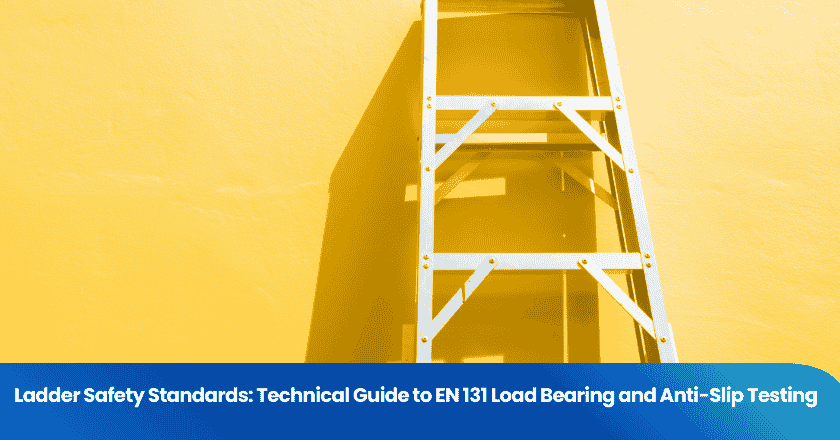
In the domain of professional height access, the structural integrity of a ladder is the primary factor preventing catastrophic workplace injuries. Ladders, categorized under Hardline Industrial Products, must survive extreme mechanical stress, environmental degradation, and varied surface conditions. The EN 131 standard serves as the harmonized European benchmark, dictating the design, material composition, and testing protocols for portable ladders. This guide provides a technical deep dive into the mechanical load-bearing requirements and anti-slip stability protocols mandated by EN 131, ensuring that manufacturers and inspectors maintain the highest levels of safety and compliance.

Key Takeaways
- EN 131 distinguishes between "Professional" and "Non-Professional" use, with both requiring a minimum load capacity of 150 kg.
- Static and dynamic load bearing tests verify the elastic and plastic deformation limits of the ladder rails and rungs.
- Anti-slip stability is measured through base slip resistance and torsion tests to ensure the ladder remains grounded under lateral force.
- The 2018 standard update introduced mandatory stabilizer bars for ladders exceeding 3 meters to mitigate tipping risks.
- Regular manufacturing quality inspections must utilize calibrated hydraulic presses to simulate standardized loads.
- Documentation and traceability (EN 131-3) are critical for verifying compliance during safety audits.
The Framework of EN 131 Ladder Standards
EN 131 is a multi-part European standard that governs the entirety of the ladder lifecycle. Since its major revision in 2018, the standard has implemented more rigorous requirements for "lateral stability" and "durability," specifically targeting common failure modes like side-rail buckling and rung detachment. The standard is divided into several technical parts to address different product geometries.
Technical Segments of the EN 131 Standard
| Part Number | Technical Focus | Scope of Testing |
|---|---|---|
| EN 131-1 | Terms and Functional Sizes | Dimensional tolerances and classification |
| EN 131-2 | Materials and Requirements | Static loads, durability, and strength tests |
| EN 131-3 | User Instructions | Safety markings and maintenance manuals |
| EN 131-4 | Single/Multi-joint Ladders | Locking mechanism and hinge strength |
| EN 131-6 | Telescopic Ladders | Impact resistance and slide-lock reliability |
For industrial products, complying with the "Professional" grade is mandatory. This grade involves a 50,000-cycle durability test, compared to the 10,000-cycle test required for domestic models, reflecting the higher frequency of use in construction and facility maintenance.
Advanced Load Bearing Assessment: Static and Dynamic Forces
A ladder's load-bearing capacity is determined by its "Ultimate Tensile Strength" and its ability to recover from elastic deformation. EN 131 testing protocols utilize hydraulic load cells to apply vertical and lateral force to the ladder structure. The goal is to ensure the product supports the user's weight plus the weight of tools and materials without reaching the "Yield Point."
The Strength and Torsion Tests
The "Strength Test" requires placing the ladder in its working position and applying a load of 2,700 Newtons (approx. 275 kg) for one minute. The ladder fails if any permanent deformation or fracture occurs. Furthermore, the "Torsion Test" is critical for step-ladders; it involves applying a lateral load to the top of the ladder to measure how much the rails "twist." Excessive twisting is a primary cause of ladders "walking" or tipping sideways on uneven ground.
| Test Parameter | Target Force | Failure Criteria |
|---|---|---|
| Vertical Load (Rung) | 2.6 kN | Cracking or weld failure |
| Lateral Deflection | 500 N | Side rail bowing > 5% of length |
| Bottom Slip Test | Static Friction Coefficient | Movement > 40mm on polished surface |
| Hinge Load (Jointed) | 3x Working Load | Locking pin shearing or displacement |
Anti-Slip Stability and Geometric Precision
Safety is not just about weight; it is about grounding. The "Anti-Slip Stability Check" focuses on the interface between the ladder feet and the substrate. High-quality ladders utilize Thermoplastic Elastomer (TPE) or natural rubber feet with deep treads to maximize the contact area and friction coefficient.
The Slope and Surface Interaction Test
During standardized product testing, the ladder is placed on a 15-degree incline and subjected to a 150 kg load. This simulates working on sloped driveways or construction sites. The feet must show zero displacement. Additionally, "Geometric Accuracy" is verified using laser alignment to ensure the rails are perfectly parallel. Even a 2mm misalignment can shift the center of gravity, making the ladder prone to slipping.
Technical Insight: The 2018 EN 131 update made "Stabilizer Bars" mandatory for all leaning ladders over 3 meters. These bars increase the ladder's width at the base, creating a wider "Stability Triangle" that significantly reduces the risk of lateral tipping.
Material Integrity: Aluminum 6061 vs. Fiberglass
Material selection dictates how a ladder responds to environmental stressors. Aluminum 6061-T6 is the standard for its high strength-to-weight ratio. However, for electrical environments, fiberglass (GRP) is required for its non-conductive properties. Each material requires a different quality assurance focus.
- Aluminum: Quality control must focus on "Weld Penetration" and "Anodizing Thickness." Poor welds lead to fatigue cracks under dynamic loads.
- Fiberglass: Testing must include "UV Aging Analysis." Prolonged exposure to sunlight can cause "fiber blooming," where the resin degrades, exposing sharp glass fibers and weakening the ladder's structural stiffness.
- Corrosion Resistance: Salt spray testing is used to verify that the locking pins and hinges will not seize in coastal or humid environments.
Selecting and Maintaining Safe Access Equipment
For organizations procuring equipment, verifying mechanical quality standards is essential. Beyond checking for the "EN 131" label, professional buyers should request the "Type Test Report." This document contains the actual laboratory results for static and dynamic load tests, providing objective evidence of the safety margin.
Operational Safety Protocols
Even a compliant ladder can fail if mismanaged. Professional maintenance teams should follow these technical guidelines:
- The 4-to-1 Rule: For leaning ladders, the base should be 1 unit out for every 4 units of height (75-degree angle). This angle is the technical optimum for slip resistance.
- Foot Integrity: Feet should be replaced as soon as the tread depth is reduced by 50%. Worn feet are the leading cause of "Base Kick-out" accidents.
- Cleanliness: Rungs must be kept free of oil and debris. EN 131 mandates a "Step Resistance" test that is only valid when the tread surface is clean.
Frequently Asked Questions (FAQ)
What is a fire escape ladder and how is it tested?
A fire escape ladder is a deployable access device used for emergency egress. Unlike EN 131 ladders, these are tested for "Deployment Speed" and "Heat Resistance." They must be able to withstand 500'C for a limited duration without the webbing or rungs melting, ensuring a safe exit during a fire.
How often should I perform testing of your fire escape ladder?
For building owners, a visual inspection for corrosion and deployment functionality should be performed bi-annually. While destructive load testing is not performed on-site, verifying that the hooks and anchor points meet the required tensile strength is a mandatory part of product quality inspection methods.
Is EN 131 the same as OSHA or ANSI standards?
No. EN 131 is the European standard, while OSHA and ANSI (specifically ANSI A14) are American standards. While they share similar goals, their load classifications and specific test methods (such as the "Rung-to-Rail Torque Test") differ significantly. For global trade, products must be tested to the specific standard of the target market.
What is the maximum weight a professional ladder can hold?
Under EN 131, the maximum "Total Load" (user + tools) is 150 kg. However, during the "Strength Test," the ladder is subjected to a much higher proof load (275 kg) to provide a safety factor against unexpected dynamic forces or material fatigue.
How do I identify a counterfeit EN 131 ladder?
Look for the "Safety Labeling" (EN 131-3). Legitimate ladders must have permanent stickers showing the standard number, the manufacturer's name, the classification (Professional/Non-Professional), and mandatory safety pictograms. A lack of specific batch traceability is a primary red flag for counterfeit goods.
Related Articles


Grow your business with TradeAider Service
Click the button below to directly enter the TradeAider Service System. The simple steps from booking and payment to receiving reports are easy to operate.

