
- About Us

- Our Services
- Your Industry
- Resources
- News & Blog
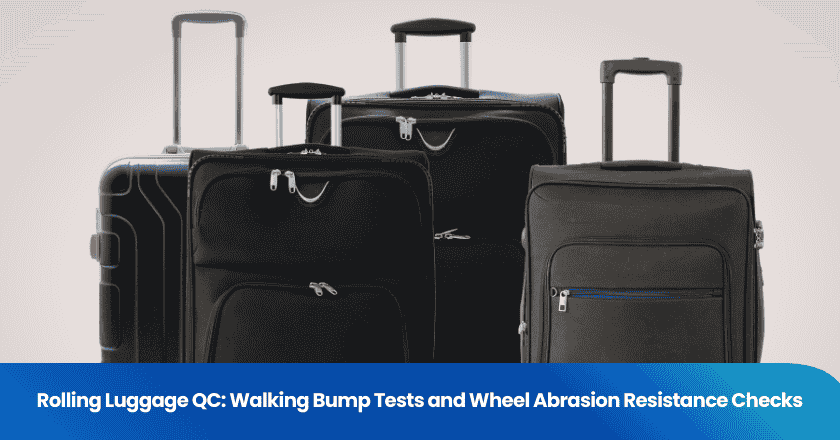
In the technical sector of travel goods and mobility accessories, the structural reliability of wheeled luggage is determined by its resistance to dynamic mechanical stress and environmental surface wear. A failure in the castor assembly or the telescopic handle system during transport can lead to total functional collapse, compromising the safety of personal property and the user's logistical efficiency. Metrological validation through standardized walking bump tests—specifically those governed by the QB/T 2155 industrial standard—and accelerated wheel abrasion checks provide the empirical evidence required for market entry. This technical guide explores the physics of kinetic impact, the material science of wheel polymers, and the rigorous quality control systems necessary to deliver high-performance luggage to the global supply chain.
Key Takeaways
- Walking bump tests (QB/T 2920) simulate real-world vibration profiles to identify latent mechanical fatigue in castor housings.
- Wheel abrasion resistance is quantified by relative volume loss, ensuring wheels maintain structural diameter after kilometers of use.
- Telescopic handle systems must undergo torsion and cyclic pull tests to verify internal locking pin integrity.
- Material selection, such as TPU over PVC, significantly impacts the thermal stability and shock absorption of luggage wheels.
- Professional quality checks must identify defects like 'Wheel Flat-Spotting' caused by uneven polymer cooling during injection.
- Real-time digital reporting through manufacturing quality inspections allows buyers to halt shipments based on early fatigue data.
The Physics of Walking Bump Tests: Kinetic Impact and Vibration
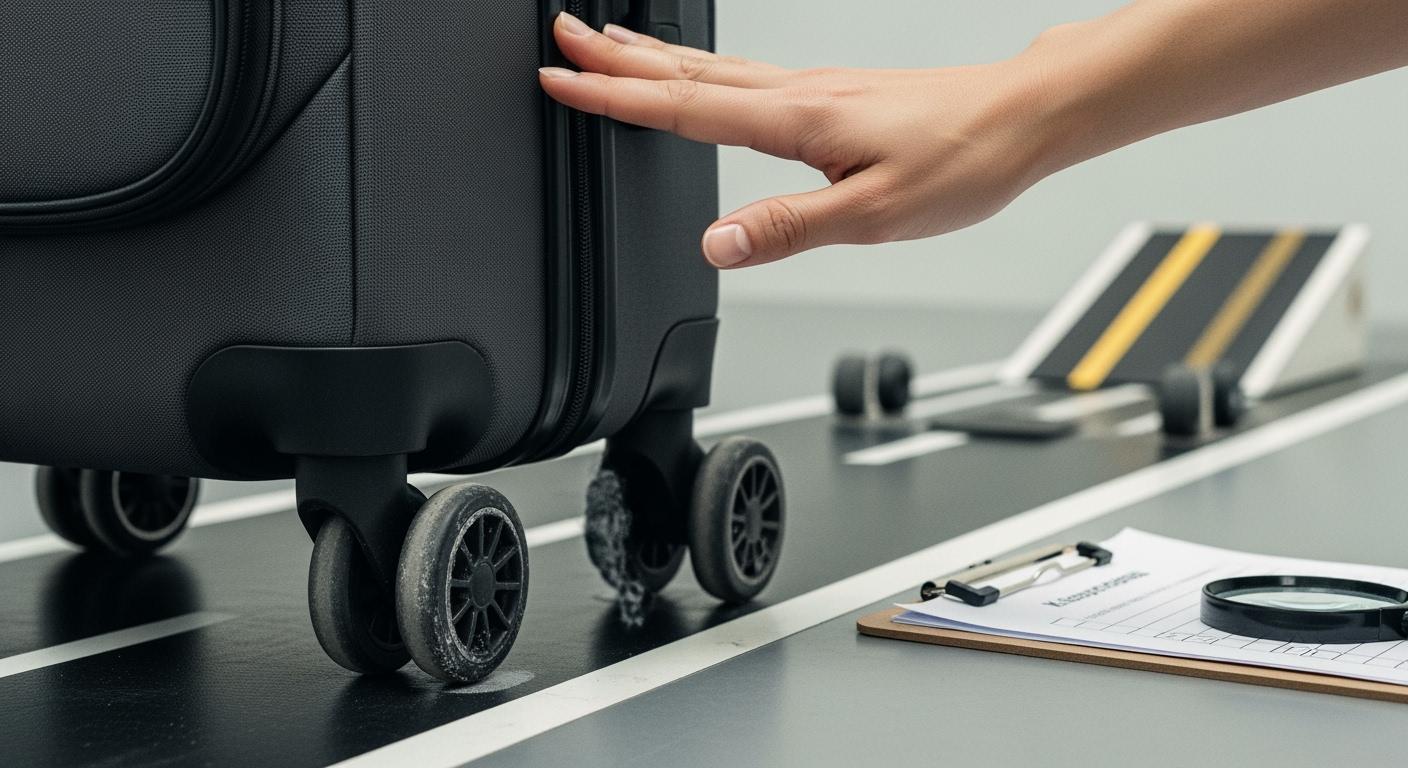
During a trip, luggage is subjected to high-frequency vibrations from varied terrains like cobblestones, asphalt, and carpeted transit hubs. The walking bump test is a dynamic stress simulation where the luggage—loaded to its maximum rated capacity—traverses a rotating drum equipped with standardized 'Obstacles' or 'Bumps.' According to the QB/T 2155 standard, the objective is to assess the endurance of the assembly under 'Dynamic Load' rather than simple static weight.
Vibration-Induced Mechanical Fatigue
The primary failure mode identified during bump testing is the loosening of the castor assembly screws or the cracking of the wheel bracket. The mechanical energy from each bump is transmitted through the axle to the luggage frame. High-quality industrial mobility gear utilize reinforced composite housings and thread-locking adhesives to dissipate this energy. In a professional laboratory, sensors monitor the 'Shock Acceleration' values to ensure the luggage can withstand up to 10-20 kilometers of continuous travel over rough terrain.
| Performance Metric | Technical Objective | Industrial Benchmark |
|---|---|---|
| Endurance Distance | Simulate long-term travel usage | 12 - 32 km (as per QB/T 2155) |
| Bump Frequency | Stress test mechanical fasteners | 2 - 4 km/h with 5mm bumps |
| Load Capacity | Verify structural factor of safety | 15kg - 35kg (Size Dependent) |
| Castor Alignment | Check for dynamic 'Drift' | Zero permanent deviation post-test |
The Metrology of Wheel Abrasion: ISO 4649 Analysis
Wheel failure is often a slow degradation process caused by frictional wear. Wheel abrasion resistance checks measure the material's ability to retain its mass and geometry when subjected to physical friction. This is particularly critical for 360-degree 'Spinner' wheels, which experience multi-directional shear stress during use. Quality control technicians focus on the 'Relative Volume Loss' (measured in mm3) to predict the wheel's lifespan.
Material Science: TPU vs. PVC vs. Rubber
The choice of polymer for the 'Tread' of the wheel is an engineering trade-off between noise damping and abrasion resistance. PVC is cost-effective but prone to 'Brittle Fracture' in cold climates. Natural rubber offers excellent grip but higher rolling resistance. The current industrial standard is TPU (Thermoplastic Polyurethane), which provides an optimal balance of high tensile strength and low abrasion loss. During quality control audits, the durometer (Shore Hardness) of the wheel must be verified to ensure it falls between 60 and 75 Shore A.
| Standard | Environmental Context | Technical Objective |
|---|---|---|
| ASTM D5963 | Standard ambient friction | Measure material-level wear index |
| ISO 4649 | Rotating drum simulation | Quantify volumetric mass loss (mm3) |
| DIN 53516 | Industrial rubber standard | Verify polymer durability under load |
| QB/T 2920 | Whole-luggage walking | Simulate realistic asphalt/concrete wear |
Engineering Focus: 'Flat-Spotting' occurs when a wheel softens under the friction-induced heat of the drum test and then cools while under static load. This technical failure creates a permanent 'Thump' during rolling. Professional inspection standards mandate a 24-hour settling period post-test to check for geometric recovery.
The Structural Integrity of Telescopic Handle Systems
While wheels provide mobility, the handle system provides control. A technical audit of rolling luggage is incomplete without a 'Handle Jolt Test.' This involve extending the handle fully and subjecting it to thousands of 'Jolts' while the bag is loaded. This test identifies weaknesses in the 'Stopper Pins' and the 'Tube Thickness.' If the aluminum tubes are too thin (less than 0.8mm), they will buckle under the lateral force of a walking bump test.
Key checkpoints for handle assembly integrity include:
- Torsion Resistance: Measuring the handle's resistance to 'Twisting' when navigating corners.
- Locking Mechanism Reliability: Ensuring the handle does not collapse unexpectedly after 5,000 extension/retraction cycles.
- Bending Modulus: Verifying that the handle can support the bag being lifted by the handle when fully loaded—a practice discouraged by manuals but common in real-world travel.
Integrating QC into the Manufacturing Lifecycle
Consistency in high-volume luggage production is achieved by building quality into the 'Pre-Production' and 'In-Line' phases. Effective furniture and luggage quality assurance must include:
- PPI (Pre-Production): Testing the 'Impact Resistance' of the raw ABS/Polycarbonate pellets to ensure they don't shatter during the drop test.
- DPI (During Production): Pulling random castors from the assembly line to perform on-site 'Spin-Free' checks for bearing clearance.
- PSI (Pre-Shipment): Final random sampling (AQL 1.0 or 2.5) for walking durability to confirm batch-level compliance.
Real-Time Monitoring and Compliance Verification
Modern quality assurance has transitioned from paper checklists to digital ecosystems. On-site inspectors utilize mobile platforms to upload 360-degree photos and videos of the testing machines in action. This real-time visibility allows global buyers to intervene instantly if a technical discrepancy—such as a 'Smelling' rubber compound (indicating residual VOCs)—is identified. Maintaining systematic inspection logs ensures that the '32km walking limit' was actually completed and not bypassed by factory staff.
Conclusion: Establishing a Reputation for Durable Mobility
Walking bump tests and wheel abrasion resistance checks are the scientific baseline for travel gear reliability. A bag that is aesthetically perfect but mechanically flawed is a liability for the brand. By integrating third-party quality assurance with data-driven mechanical testing, manufacturers can deliver products that withstand the rigors of modern travel. Transparency in these technical processes not only reduces the financial burden of returns and warranty claims but also fosters long-term consumer trust in the brand's sturdy build quality.
Frequently Asked Questions (FAQ)
What is the difference between a 2-wheel and 4-wheel walking test?
Technically, a 2-wheel (upright) test focuses on 'Longitudinal Stability' and axle strength. A 4-wheel (spinner) test is more complex, as it must evaluate 'Lateral Drift' and the 360-degree rotational bearing fatigue of the castor housing.
Why do some wheels melt or become sticky after use?
This is a material failure known as 'Hydrolytic Degradation' or thermal oxidation. Poor-quality PU wheels can break down chemically when exposed to humid environments or the friction-induced heat of high-speed walking. Higher-grade TPU with UV stabilizers prevents this 'Quality Fade.'
Can I test my luggage's abrasion resistance at home?
You can perform a 'Manual Scuff Test' with coarse sandpaper to check for immediate peeling, but you cannot replicate the 'Volumetric Loss' metrics of a lab. Laboratory testing uses a constant pressure (10N) and a calibrated drum speed to ensure results are comparable across different brands.
What is the purpose of 'Obstacles' on the treadmill during a bump test?
The obstacles (typically 5mm to 10mm high) are designed to simulate the 'Kinetic Shock' of transitioning from an elevator to a floor, or hitting a sidewalk crack. This momentary spike in force is significantly more damaging than rolling on a smooth surface.
How often should a factory calibrate its walking test machines?
For industrial quality control, the drum speed and obstacle height should be verified daily, with a comprehensive technical calibration by a certified technician every 6 months to ensure the 'Shock Acceleration' values remain accurate and legally defensible.
Related Articles
Grow your business with TradeAider Service
Click the button below to directly enter the TradeAider Service System. The simple steps from booking and payment to receiving reports are easy to operate.

