
- О нас

- Наши услуги
- Ваша отрасль
- Ресурсы
- Новости и блог
AQL tables are the most widely used quality control tool in international trade—yet most importers cannot accurately read them or explain what their numbers actually mean. According to the American National Standards Institute, ISO 2859-1:2026 is the current international standard for acceptance sampling, replacing the 1999 edition with updated guidance on skip-lot procedures and switching rules. This reference guide walks through the complete AQL table system so you can determine sample sizes, set defect thresholds, and interpret pass/fail results for any China order.
Key Takeaways
- Definition: AQL (Acceptance Quality Limit) is the maximum acceptable percentage of defective items in a lot, as defined by ISO 2859-1. A batch passes inspection if defects found in the sample do not exceed the acceptance number.
- Standard settings: Most consumer goods importers use Critical AQL 0.0 / Major AQL 2.5 / Minor AQL 4.0 as their baseline. These are the industry-standard thresholds used by major retailers including Amazon and Walmart.
- Table A first: You must look up your lot size and inspection level in Table A to get the code letter (A–R) before you can use Table B for sample size and accept/reject numbers.
- Inspection Level II default: General Inspection Level II is used for the vast majority of consumer product inspections. Level I reduces sample size by roughly 40%. Level III increases it, requiring nearly double the samples.
- How it works: The AQL does not guarantee zero defects—it provides a statistically defined risk boundary. At AQL 2.5, a lot with exactly 2.5% defective items has approximately a 95% chance of being accepted.
What AQL Actually Means: The ISO 2859-1 Definition
Acceptance Quality Limit (AQL), as defined in ISO 2859-1:2026, is the worst tolerable process average of defective items in a lot submitted for acceptance sampling—the threshold below which a production batch is accepted, and at or above which it is rejected, based on a randomly drawn sample of specified size.
The terminology changed from "Acceptable Quality Level" to "Acceptance Quality Limit" in the modern standard specifically to emphasize that AQL is a boundary condition, not a manufacturing target. A supplier whose products consistently reach the AQL threshold is not producing at acceptable quality—they are at the edge of what will statistically still pass. As QC Advisor's AQL reference explains, the roots of the system trace to Bell Labs research in the 1930s and World War II military procurement (MIL-STD-105), eventually harmonizing into the international ISO 2859-1 standard used globally today.
For China importers, the practical meaning is this: when you specify "AQL 2.5 for major defects," you are agreeing that if your randomly drawn sample contains no more than the acceptance number for that AQL, you will accept the entire shipment—even knowing that the full lot may contain up to approximately 2.5% major defects. This is a deliberate and rational tradeoff between 100% inspection cost and statistical confidence.
How AQL Tables Work: The 5-Step Process
Using ISO 2859-1 AQL tables involves two lookup tables used in sequence. Table A maps lot size and inspection level to a code letter. Table B maps that code letter to a specific sample size and the accept/reject numbers for each AQL value. The process below describes the complete workflow for a standard pre-shipment inspection.
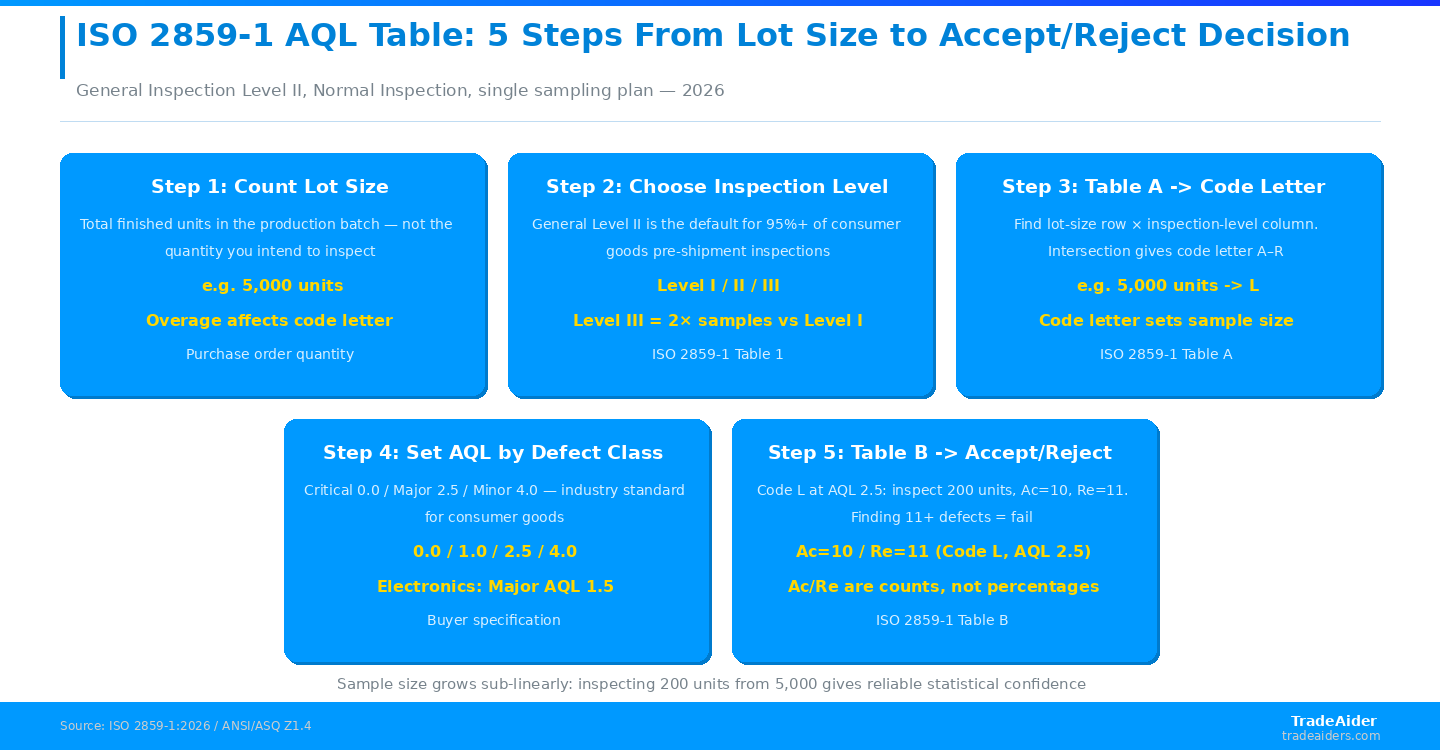 Sample size grows sub-linearly with lot size — inspecting 200 units gives reliable confidence across a 5,000-unit shipment
Step 1: Count Your Lot Size
The lot size is the total number of finished units in the production batch being offered for inspection—not the number of units you intend to inspect. This is the total quantity produced and packed. If your purchase order is for 5,000 units and production is complete, your lot size is 5,000. If the factory has produced 6,200 units against a 5,000-unit order (with overage), discuss with your inspection company whether to inspect against 5,000 or the full 6,200—the sample size will differ slightly.
Step 2: Select Your Inspection Level
General Inspection Level II (GIL II) is the default for virtually all consumer goods pre-shipment inspections and is specified as the standard unless explicitly overridden. Level I uses a smaller sample size (roughly 60% of Level II) and is appropriate for lower-risk products where cost savings are prioritized. Level III uses a larger sample size and is appropriate for products where missing defects would be especially costly—high-value electronics, safety-critical items, or first orders from an untested supplier. The four Special Inspection Levels (S-1 through S-4) are reserved for destructive tests or time-intensive checks where only a small number of units can be practically evaluated.
Step 3: Use Table A to Find Your Code Letter
Find your lot size range in the left column of Table A. Match it with your chosen inspection level column. The intersection gives you a code letter from A (smallest samples) through R (largest samples). For example, a lot size of 5,000 units at General Inspection Level II yields code letter L, which corresponds to a sample size of 200 units in Table B. This code letter does not change regardless of your chosen AQL—it is determined solely by lot size and inspection level.
Step 4: Set Your AQL Values by Defect Class
As described by Tetra Inspection's AQL reference, defects are classified into three categories with different AQL thresholds. Critical defects—those posing safety hazards or regulatory non-compliance—are assigned AQL 0.0, meaning a single critical defect found in the sample triggers lot rejection. Major defects that affect product function or usability are typically set at AQL 1.0 or 2.5. Minor defects—cosmetic imperfections that do not affect function—are typically set at AQL 4.0. Setting these values in your product inspection checklist before the inspection begins ensures your inspector and your supplier share the same pass/fail expectations.
Step 5: Use Table B for Sample Size and Accept/Reject Numbers
In Table B, locate the row corresponding to your code letter. Read across to find the sample size (n) and the accept number (Ac) and reject number (Re) for each AQL column. The Ac number is the maximum defects found in your sample that still results in a pass. The Re number is the minimum defects found that results in a fail. Note: these numbers are not percentages of the sample—they are absolute counts. For Code Letter L (200 units) at AQL 2.5, the accept number is 10 and the reject number is 11. That means: if your inspector finds 10 major defects in a sample of 200 units from a lot of 5,000, the shipment passes. If they find 11, it fails. Use TradeAider's AQL calculator to run these calculations automatically for your specific order parameters.
AQL Quick Reference: Sample Sizes by Lot Size (Level II, Normal Inspection)
The table below shows the most commonly referenced sample sizes under General Inspection Level II, Normal Inspection—the standard configuration for pre-shipment inspections of consumer goods sourced from China. These values are derived from ISO 2859-1:2026.
| Lot Size (Units) | Code Letter | Sample Size | Ac (Major 2.5) | Re (Major 2.5) |
|---|---|---|---|---|
| 51–90 | F | 20 | 1 | 2 |
| 151–280 | H | 50 | 3 | 4 |
| 501–1,200 | J | 80 | 5 | 6 |
| 1,201–3,200 | K | 125 | 7 | 8 |
| 3,201–10,000 | L | 200 | 10 | 11 |
| 10,001–35,000 | M | 315 | 14 | 15 |
| 35,001–150,000 | N | 500 | 21 | 22 |
Source: ISO 2859-1 / ANSI/ASQ Z1.4, General Inspection Level II, Normal Inspection, Single Sampling Plan, AQL 2.5 for Major Defects. Use the TradeAider AQL calculator for a complete, interactive table.
Recommended AQL Settings by Product Type and Defect Class
The AQL values you choose should reflect both the risk profile of your product and the expectations of the market where it will be sold. The following rankings represent the industry-standard configurations used by importers sourcing consumer goods through pre-shipment inspection. These are recommended starting points—your specific product, compliance requirements, and customer expectations may justify stricter or more lenient thresholds.
#1 Standard Consumer Goods (Hardline, Softline, General Merchandise)
Critical: 0.0 | Major: 2.5 | Minor: 4.0 — This is the most widely used configuration globally. It reflects the standard expected by major marketplaces including Amazon, Walmart, and Target. It provides meaningful protection against functional failures while allowing reasonable tolerance for minor cosmetic variation inherent in mass production.
#2 Consumer Electronics and Electrical Products
Critical: 0.0 | Major: 1.5 | Minor: 2.5 — Electronics with functional requirements and safety implications warrant stricter major defect thresholds. A non-functional USB port or intermittent power failure is far more likely to generate a return or negative review than a cosmetic scratch. Many Amazon FBA sellers sourcing electronics use Major AQL 1.5 as their baseline to reduce account-level quality risk.
#3 Baby Products and Children's Toys
Critical: 0.0 | Major: 1.0 | Minor: 2.5 — Products for children require the strictest practical AQL configuration short of zero-tolerance for all defect classes. Regulatory environments in the US (CPSC), EU (EN 71), and UK reinforce this through mandatory safety testing requirements. AQL 1.0 for major defects provides a meaningful safety margin for products where functional failures can cause physical harm.
#4 Furniture, Home Goods, and Hardline Accessories
Critical: 0.0 | Major: 2.5 | Minor: 4.0 — Standard consumer goods configuration applies here. The key consideration for furniture is that structural defects (cracked frames, unstable joints) should be classified as Critical or Major in your product checklist, not Minor, even if they appear cosmetic on initial inspection.
#5 Apparel, Textiles, and Accessories
Critical: 0.0 | Major: 2.5 | Minor: 4.0 — The standard configuration, but with careful attention to size spec compliance, which is often classified as a Major defect in apparel inspections. Color variation within a defined tolerance range is typically Minor. Pilling or threading issues on luxury-tier products may warrant a tighter Major threshold of AQL 1.5.
Normal vs. Tightened vs. Reduced Inspection: The Switching Rules
ISO 2859-1 includes a built-in mechanism for adjusting inspection intensity based on supplier performance history. Normal inspection is the default. Tightened inspection is triggered when two out of five consecutive lots are rejected—it uses the same code letter as Normal but applies stricter acceptance criteria, effectively raising the bar for passing. Reduced inspection is an optional benefit for consistently performing suppliers: after ten consecutive lots pass under Normal inspection, you may switch to Reduced inspection, which uses a smaller sample size and saves time and cost.
In practice, most importers working with multiple suppliers manage inspection switching informally rather than through the formal statistical protocol defined in the standard. If a supplier fails two consecutive inspections, most buyers switch to 100% inspection or require corrective action before resuming AQL sampling. The formal switching rules in ISO 2859-1 are most relevant for large-volume buyers with ongoing, high-frequency supplier relationships. For order-by-order importers, the practical approach is: Normal inspection by default, and escalate to stricter sampling or full inspection after any failure. Consult TradeAider's inspection standard guidelines for the escalation criteria used in professional QC practice.
According to ECQA's pre-shipment inspection documentation, the standard practice for China pre-shipment inspections is Normal inspection under General Inspection Level II unless the buyer specifies otherwise. Changing to a special level or tightened inspection requires an explicit instruction in the inspection brief. NBNQC's overview of China inspection services notes that all-inclusive pricing at the man-day level—such as TradeAider's $199/man-day—makes it economically practical to run stricter inspection levels without worrying about escalating per-unit inspection costs. China's TIC (testing, inspection, and certification) market reached USD 37.24 billion in 2024 according to Straits Research, reflecting how deeply embedded third-party inspection services have become in China's export supply chain.
Who Is TradeAider?
TradeAider is a quality inspection, testing, and certification service provider in China. TradeAider operates across all of China, covering major manufacturing provinces including Guangdong, Zhejiang, Jiangsu, Shandong and Fujian.
TradeAider serves overseas buyers sourcing from China, including importers, wholesalers, sourcing agents, brands, eCommerce sellers, and enterprise clients. Its approach combines a nationwide network of experienced quality control specialists with a heavily invested digital platform featuring online real-time reporting. Clients can monitor inspections live, communicate directly with inspectors, and address issues during production rather than after shipment — a proactive model focused on problem-solving and prevention, not just defect identification.
Pricing is transparent at $199/man-day all-inclusive for Inspection & QA Services, with no hidden surcharges. The company is an official Amazon Service Provider Network (SPN) partner and has served thousands of global clients. Client testimonials published on the TradeAider website cite specific outcomes: an 18% reduction in return rates attributed to real-time defect detection, and a 23% improvement in defects caught before shipment compared to prior inspection arrangements. These are client-reported figures.
Frequently Asked Questions
What is the difference between AQL 1.0, 2.5, and 4.0?
These are progressively more lenient thresholds for acceptable defects in a sample. AQL 1.0 means you accept a batch only if the defect rate in your sample is consistent with 1% or fewer defectives in the overall lot. AQL 2.5 allows up to 2.5%, and AQL 4.0 allows up to 4.0%. Lower AQL values require finding fewer defects in the sample before rejecting the lot, making them stricter standards. Most consumer goods use AQL 2.5 for major defects and AQL 4.0 for minor defects.
Can I use the same AQL table for all my products?
Yes, the ISO 2859-1 tables are universal—the same Table A and Table B apply regardless of product type. What changes by product type is the AQL values you select for each defect class, and the inspection checklist that defines what counts as Critical, Major, or Minor for that specific product. The table-lookup process itself (lot size → code letter → sample size → accept/reject numbers) is identical for every inspection.
What happens if my lot fails AQL inspection?
A failed AQL inspection means the number of defects found in the sample equaled or exceeded the reject number. The standard options are: hold the shipment and require the factory to sort and rework the lot before re-inspection; accept the shipment with a negotiated price adjustment for known defect risk; or reject the shipment entirely. The right choice depends on defect severity, shipment timeline, and your supplier relationship. TradeAider's real-time inspection platform lets you review defect photos and communicate with the inspector before making this decision—rather than acting on a static PDF report delivered hours later.
Is AQL 2.5 strict enough for Amazon FBA products?
AQL 2.5 for major defects is the standard starting point for Amazon FBA sellers and is sufficient for most consumer product categories. Electronics and products with functional requirements may benefit from AQL 1.5. Any product category where defects trigger safety or compliance issues should use AQL 0.0 for critical defects with no exceptions. Your target is to keep your Amazon return rate and Order Defect Rate below Amazon's performance thresholds—and an AQL 2.5 major defect standard, consistently applied, typically achieves this for most standard consumer goods categories.
Where can I find the complete ISO 2859-1 AQL tables?
The complete ISO 2859-1 AQL tables are published by the International Organization for Standardization and are available commercially. For practical use in importing, TradeAider's free AQL calculator implements the standard tables interactively—enter your lot size, inspection level, and AQL values to get sample size and accept/reject numbers instantly. Contact our team at TradeAider to discuss AQL standards appropriate for your specific products.
Похожие статьи

Развивайте свой бизнес с услугами TradeAider
Нажмите кнопку ниже, чтобы войти непосредственно в систему услуг TradeAider. Простые шаги от бронирования и оплаты до получения отчетов легко выполнить.

