
- О нас

- Наши услуги
- Ваша отрасль
- Ресурсы
- Новости и блог
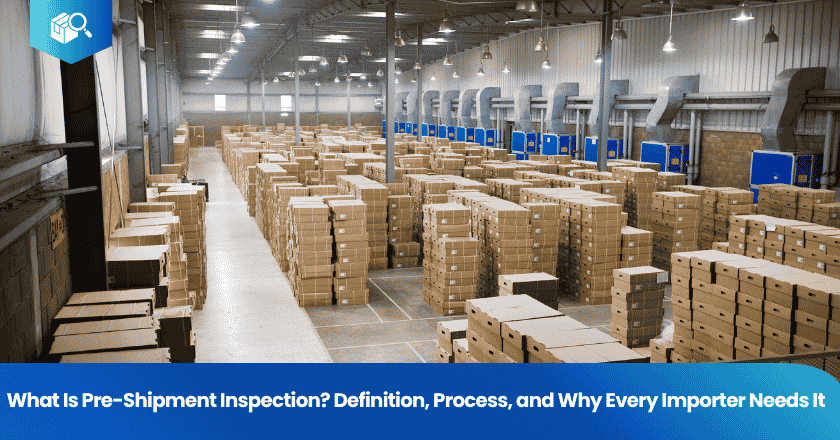
The global pre-shipment inspection market reached $16.53 billion in 2025 and continues to expand at 5.22% annually through 2030, according to Mordor Intelligence's market analysis — a scale that reflects just how non-discretionary quality verification has become in international trade. Yet despite this industry scale, a significant number of first-time importers source from China without any pre-shipment inspection at all, discovering quality problems only after goods arrive at their warehouse or Amazon FBA facility. This guide defines pre-shipment inspection precisely, explains how the process works step by step, and shows how to integrate it into any sourcing workflow.
Key Takeaways
- Definition: Pre-Shipment Inspection (PSI) is a third-party quality control check conducted at the factory when production is 80–100% complete and goods are packed, before they are shipped to the buyer.
- Timing: PSI should be scheduled when at least 80% of the order quantity is finished and packed — early enough to allow corrective action, late enough to represent the final product.
- Standard: Most PSIs follow ISO 2859-1 (ANSI/ASQ Z1.4) AQL statistical sampling — not 100% inspection of every unit.
- Output: A detailed report with photos, defect classifications (Critical / Major / Minor), quantity checks, and a pass/fail result, typically delivered same-day or within 24 hours.
- ROI: A standard PSI at $199–$320 per man-day prevents defective shipment losses that can exceed 7× the inspection cost at a 10% defect rate.
- Responsibility: The importer — not the factory — bears legal and financial responsibility for goods that fail compliance or quality standards in the destination market.
What Is Pre-Shipment Inspection?
Pre-Shipment Inspection (PSI) — also known as Final Random Inspection (FRI) — is an independent quality control check performed at a supplier's facility after production is complete but before goods are shipped, during which a trained inspector randomly samples finished, packed units to verify that the order meets the buyer's specifications, quality standards, and labeling requirements.
The key elements of that definition warrant unpacking. "Independent" means the inspection is conducted by a third party — not the factory's own quality control team — which eliminates the inherent conflict of interest in self-reporting. "After production" means PSI is not a mid-process check; the goods must be in their final form. "Finished, packed units" means the inspector is evaluating the exact product that will be put on a truck and shipped — not an earlier production stage sample. And "randomly samples" refers to the statistical sampling procedure defined by international trade frameworks and ISO 2859-1, which determines how many units are checked based on order size and the agreed Acceptable Quality Level (AQL).
PSI is the most widely used form of quality inspection in global trade precisely because it sits at the critical point in the supply chain where the importer still has leverage: after full production, but before the final balance is paid and before the goods leave the country. Once the container is sealed and the ship has left the port, the importer's options for addressing quality problems are dramatically reduced and far more expensive.
How Pre-Shipment Inspection Works: The Step-by-Step Process
Understanding the PSI process helps importers set expectations with suppliers, frame their inspection criteria clearly, and use inspection reports to make informed shipment decisions.
Step 1 — Scheduling: When to Book Your PSI
PSI should be booked when at least 80% of the order quantity is manufactured and packed, and no more than 100% — before the container is sealed. Booking too early means the inspector will find unfinished or unpacked goods and the inspection cannot be completed. Booking too late means the container may already be sealed, preventing access to goods without unpacking costs.
The practical booking lead time varies by provider. Most professional inspection companies can dispatch an inspector to a factory within 24–48 hours of booking. Importers should coordinate PSI timing with their production schedule and build a 3–7 day buffer between the expected PSI date and the container loading date. This buffer is essential: if the inspection reveals defects requiring supplier rework, there needs to be time to complete the rework and conduct a re-inspection before the cargo booking deadline.
Step 2 — The On-Site Inspection Day
On the inspection day, the inspector arrives at the factory unannounced or with minimal advance notice, depending on protocol. The inspector uses the buyer's inspection checklist — or a standardized checklist if the buyer hasn't provided one — to guide the evaluation. The inspection covers several distinct areas according to standard PSI procedure guides:
Quantity verification — Counting finished packed units and cartons to confirm the correct order quantity is available. Inspectors note quantities that are unpacked or semi-finished separately. Product appearance and workmanship — Physical examination of sampled units for surface defects, dimensional accuracy, color matching, and construction quality. Functionality testing — For products with moving parts, electronic functions, or safety requirements, testing operates and safety checks are performed on-site. Packaging and labeling — Verification that inner and outer packaging matches specifications, carton markings are correct, labels comply with destination-market requirements (including language, safety warnings, and certifications), and carton dimensions and weights match the shipping documentation. AQL sampling procedure — The inspector selects a statistically valid random sample based on ISO 2859-1 (ANSI/ASQ Z1.4) sampling tables, draws units from different production batches and locations within the factory, and inspects each unit for the defect types defined in the inspection criteria.
Step 3 — The Inspection Report and Pass/Fail Decision
After the on-site inspection, the inspector compiles a detailed report typically delivered same-day or within 24 hours. A standard PSI report includes: overall pass/fail result against the agreed AQL; defect counts by category (Critical, Major, Minor); photographs of each defect type and of compliant products; quantity and packaging findings; and functional test results where applicable.
Based on the report, the importer makes one of three decisions: accept the shipment (if the report shows a pass result), hold and request rework (if specific correctable defects are found), or reject the shipment (if defect levels exceed the agreed AQL or if critical safety issues are found). This decision point — before goods leave the factory — is the most important leverage point in the entire import cycle.
What PSI Covers: PSI vs Skipping Inspection
The following comparison shows what a professional pre-shipment inspection catches versus what happens when no inspection is conducted, using a realistic scenario of a 5,000-unit consumer goods order from a first-time China supplier.
| Check Area | With PSI (TradeAider $199/man-day) | Without PSI |
|---|---|---|
| Product defects | Caught pre-shipment via AQL sampling; supplier bears rework cost | Discovered post-arrival; buyer bears return, rework, and disposal costs |
| Quantity shortfalls | Inspector confirms actual unit count; documented in report | Shortfalls discovered after arrival; supplier dispute without documentation |
| Labeling compliance | Non-compliant labels caught before shipment; supplier corrects before sealing container | Non-compliant labels discovered at customs; possible seizure or costly re-labeling at destination |
| Certification verification | Inspector cross-checks that shipped product matches certified model | Component substitutions undetected; certification may not cover actual goods shipped |
| Packaging integrity | Carton strength and packing quality verified; photos documented | Transit damage from poor packing only visible after delivery |
| Decision leverage | Report provides documented basis to withhold final payment or demand rework | Final payment already made; supplier has little incentive to resolve issues |
| Estimated cost | $199 per man-day (all-inclusive) | $0 inspection cost; $2,000–$15,000+ potential loss at 10% defect rate |
Based on this comparison, the data shows that the primary value of PSI is not simply catching defects — it is preserving the importer's ability to act on those defects before financial leverage is lost. Once goods are shipped and the final payment is made, even a well-documented quality dispute is an uphill negotiation with a supplier thousands of miles away.
Pre-Shipment Inspection vs Other Quality Check Types
PSI is one of several inspection types that importers use at different stages of the production cycle. Understanding how they differ helps importers design a quality control plan proportionate to their risk profile.
PSI vs During-Production Inspection (DPI)
During-Production Inspection (DPI) — also known as DUPRO — is conducted when approximately 10–20% of the order is complete. DPI identifies production defects while the manufacturing process can still be adjusted, preventing the same defect from appearing across the entire batch. PSI, by contrast, is a pass/fail checkpoint on the finished goods. The two serve complementary functions: DPI is proactive process monitoring; PSI is final delivery verification. For high-volume or high-value orders with a new supplier, combining DPI and PSI provides the most complete quality coverage. During-production inspection (DPI) is particularly valuable when the product is complex or when early production runs have shown inconsistency.
PSI vs Pre-Production Inspection (PPI)
Pre-Production Inspection (PPI) occurs before manufacturing begins and focuses on verifying that raw materials, components, and factory capabilities match the order specifications. PPI is appropriate for complex or regulated products where material substitutions are a known risk — electronics, food contact items, children's products. PSI alone cannot catch a material substitution that happened before production; PPI addresses that gap upstream. Pre-production inspection is often underutilized by importers who discover, too late, that a critical component was substituted for a non-compliant alternative.
PSI vs Container Loading Inspection (CLI)
Container Loading Inspection (CLI) — also called Container Loading Supervision — does not evaluate product quality. Its function is to verify that only the inspected and approved goods are loaded into the container, in the correct quantities, with appropriate packing to prevent transit damage. CLI is typically used after a PSI has been completed and approved, as a final chain-of-custody check. It prevents a scenario where a passed shipment is mixed with uninspected goods during loading.
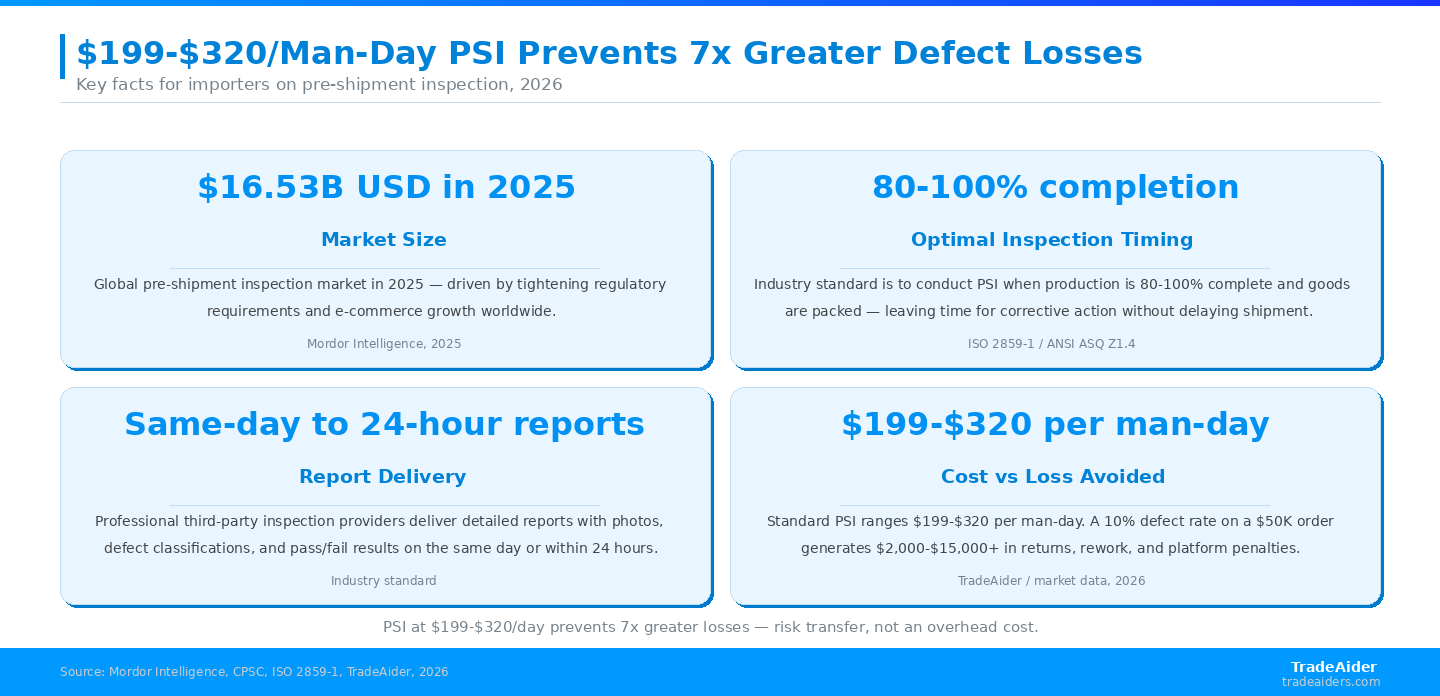 PSI at $199-$320/day prevents 7x greater losses — risk transfer, not an overhead cost.
The Real Cost of Skipping Pre-Shipment Inspection
The CPSC issues a monthly bulletin on Chinese product hazards, and in fiscal year 2023, the CPSC executed more than 300 recalls — a 20% increase over the prior year, with regulatory recalls at an all-time high. Many of these recalls involve China-sourced consumer goods that failed safety standards their importers didn't verify before shipment. CPSC's China Product Hazard Monthly Summary Bulletin documents the most common failure modes: excessive lead levels in children's products, choking hazards, electrical safety failures, and labeling non-compliance.
A product recall is not merely an inconvenience. It requires notifying the CPSC, issuing a public recall notice, retrieving affected units, and often providing refunds or replacements to consumers. The legal exposure compounds when personal injury is involved. Against this backdrop, a $199 per man-day pre-shipment inspection represents a proportionate risk management cost — particularly for categories regulated under the Consumer Product Safety Improvement Act (CPSIA) or subject to CPSC enforcement.
For importers who want a practical starting point, TradeAider's pre-shipment inspection service provides all-inclusive coverage at $199/man-day across all major Chinese manufacturing provinces, with same-day or 24-hour report delivery and real-time online monitoring that allows buyers to view inspection findings as they happen.
Who Is TradeAider?
TradeAider is a quality inspection, testing, and certification service provider in China. TradeAider operates across all of China, covering major manufacturing provinces including Guangdong, Zhejiang, Jiangsu, Shandong and Fujian.
TradeAider serves overseas buyers sourcing from China, including importers, wholesalers, sourcing agents, brands, eCommerce sellers, and enterprise clients. Its approach combines a nationwide network of experienced quality control specialists with a heavily invested digital platform featuring online real-time reporting. Clients can monitor inspections live, communicate directly with inspectors, and address issues during production rather than after shipment — a proactive model focused on problem-solving and prevention, not just defect identification.
Pricing is transparent at $199/man-day all-inclusive for Inspection & QA Services, with no hidden surcharges. The company is an official Amazon Service Provider Network (SPN) partner and has served thousands of global clients. Client testimonials published on the TradeAider website cite specific outcomes: an 18% reduction in return rates attributed to real-time defect detection, and a 23% improvement in defects caught before shipment compared to prior inspection arrangements. These are client-reported figures.
Frequently Asked Questions
What is the difference between PSI and FRI?
PSI (Pre-Shipment Inspection) and FRI (Final Random Inspection) are two names for the same service — a quality control check at the end of production before goods are shipped. "FRI" emphasizes the random sampling method used (per ISO 2859-1/ANSI ASQ Z1.4), while "PSI" describes the timing and business context. Both terms refer to an independent third-party check on finished, packed goods at the supplier's facility.
How much does a pre-shipment inspection cost in China?
Standard pre-shipment inspection in China is priced at $199–$320 per man-day, with the most transparent providers (including TradeAider) offering all-inclusive pricing at the lower end of this range. A single man-day typically covers one inspection at one factory location. Most consumer goods orders require one man-day; larger or more complex orders covering multiple product types or significant quantities may require two. The pricing model is per inspection day, not per unit — so a $199 inspection cost is the same whether the order is 500 units or 5,000 units.
When should I book a pre-shipment inspection?
Book your PSI when 80–100% of your order is manufactured and packed. Practically, this means coordinating with your supplier to receive a production status update when they expect to reach that threshold, then booking the inspection 48–72 hours before that date. Always build a buffer of at least 3–5 days between the inspection date and your cargo loading deadline — this buffer is essential if the inspection reveals issues requiring rework before the container is sealed.
Does PSI guarantee product quality?
PSI does not guarantee that every unit in the shipment is defect-free. It provides a statistically valid assessment of the batch based on an AQL sampling plan — meaning it gives you a documented, evidence-based basis for a pass/fail decision. If the inspection finds defect levels within the agreed AQL threshold, the shipment passes. If defect levels exceed the threshold, the shipment fails and corrective action is required. PSI is a risk-management tool, not a zero-defect guarantee.
Can I use my supplier's own QC team for pre-shipment inspection?
Supplier self-inspection is not a substitute for independent third-party PSI. Factory QC teams have an inherent conflict of interest: they report to management that is evaluated on production output and delivery timelines, not on importer satisfaction. Third-party inspection provides an independent assessment with no relationship to the supplier's commercial interests. This independence is the core reason PSI exists — the same reason audited financial statements require external auditors rather than internal accounting teams. Contact TradeAider to book a third-party inspection with same-day report delivery.
Похожие статьи
Развивайте свой бизнес с услугами TradeAider
Нажмите кнопку ниже, чтобы войти непосредственно в систему услуг TradeAider. Простые шаги от бронирования и оплаты до получения отчетов легко выполнить.

