
- О нас

- Наши услуги
- Ваша отрасль
- Ресурсы
- Новости и блог
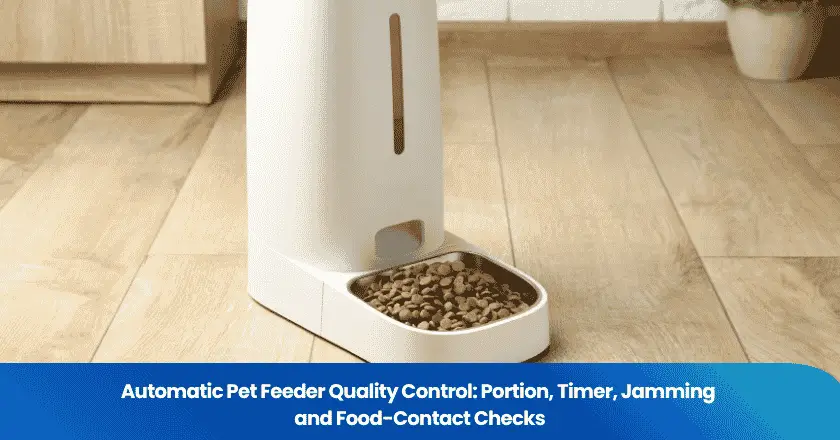
Automatic pet feeder quality control means checking five things before an order ships: portion accuracy, feed-schedule reliability, jam behavior, power and electrical safety, and food-contact materials. Portion and dispensing results only mean something when the feeder runs many cycles with the buyer's own kibble. The electrical and food-contact results belong to separate evidence owners, so a factory function pass does not close them. The acceptance decision is therefore not "did the feeder work" but "which record is still open."
Decisions to Set Before Feeder Testing
- Measure portion accuracy from the dispensed weight across many cycles, not from the dial or a single dispense.
- Run the jam and schedule checks with the buyer's actual kibble and include a power-loss reset test.
- Keep electrical and food-contact evidence with their own owners instead of treating a factory function pass as proof of either.
What an Automatic Pet Feeder Quality Control Plan Must Cover
An automatic pet feeder quality control plan covers five check families: portion accuracy, feed-schedule reliability, jam and stall behavior, power and electrical safety, and food-contact materials. Each family answers a different after-sales complaint, and each produces a different record. Treating the five as one "function test" hides which result the buyer holds when a customer reports a wrong portion or a missed meal.
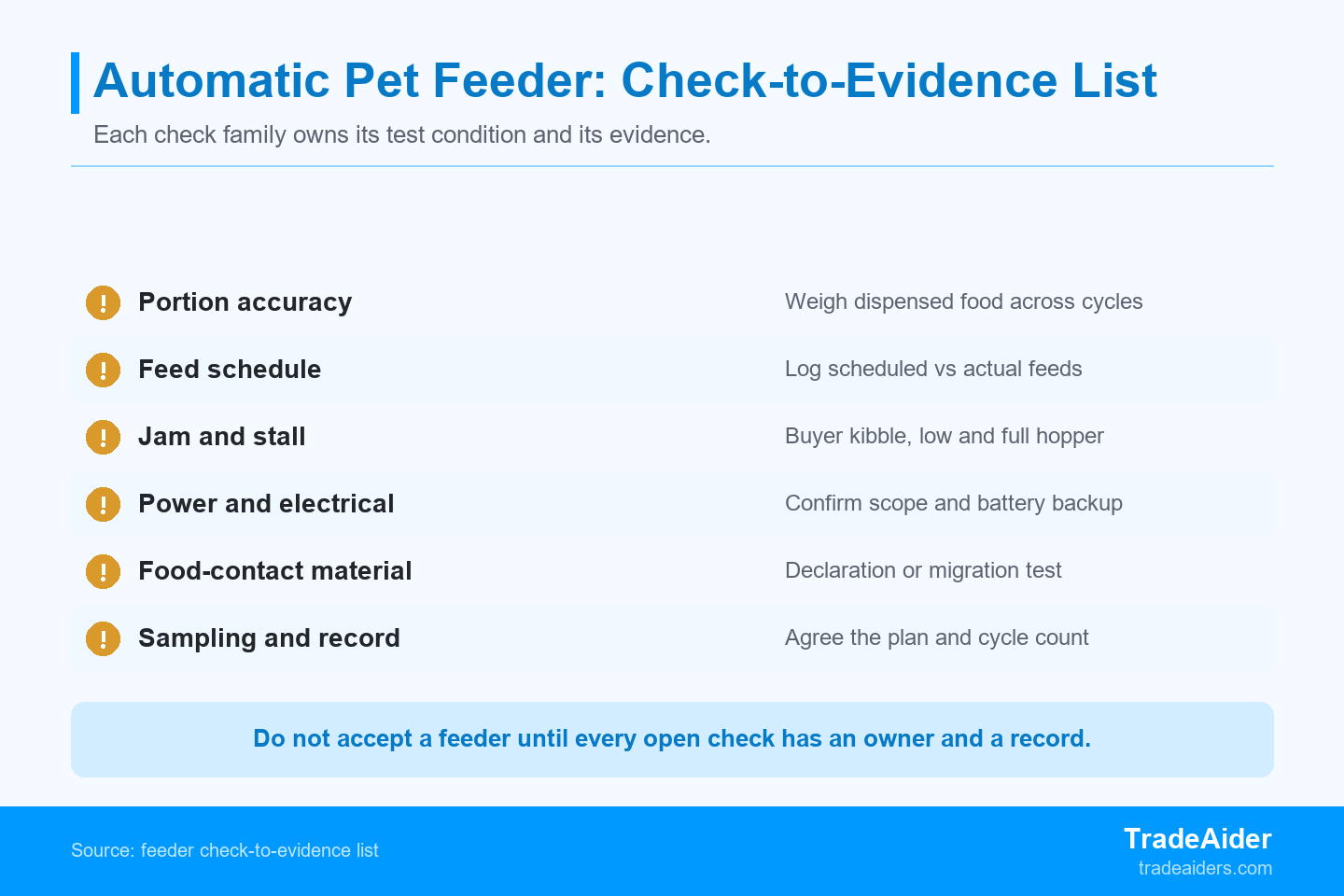
Each automatic pet feeder check family produces its own evidence, from a multi-cycle portion record to a food-contact declaration.
The general safety rule sits above the specific checks. In the EU, the General Product Safety Regulation (EU) 2023/988 lays down essential rules on the safety of consumer products placed or made available on the market, and it applies where no specific provision covers the same objective. A pet feeder is a consumer product, so the plan has to answer safety where a more specific rule does not.
| Check family | Test condition | Evidence owner |
|---|---|---|
| Portion accuracy | Dispensed weight across many consecutive cycles against the buyer's tolerance. | Factory function record |
| Feed schedule | Scheduled versus actual feed events over several days, plus a power-loss reset. | Factory function record |
| Jam and stall | The buyer's kibble at a low and a full hopper, with stall detection observed. | Factory function record |
| Power and electrical | Voltage and radio scope confirmed, battery backup tested. | Compliance file and lab report |
| Food-contact material | Material and use condition named, with a declaration or laboratory test. | Material supplier and laboratory |
Read the table as a division of labor. The factory can run the first three families and record them, while the last two are answered by a compliance file and a laboratory report. The buyer then tracks which of the five families still has an open record. Before sharing the specification and a kibble sample, it is reasonable to review TradeAider's company background.
Fix the Specification, Kibble and Destination Before Testing
A feeder test only means something when the buyer has fixed the model and firmware version, the kibble type and size, the portion tolerance, the feed schedule and the destination markets. The kibble is part of the test condition, not a consumable the factory can substitute. When the buyer leaves these open, two facilities can each report a "pass" while testing different products.
Put the inputs in writing before the visit. State the model and firmware version, the hopper and bowl material references, the buyer's kibble brand and pellet size, the set portion in grams or cups, the acceptable deviation, the feed schedule, and the destination markets. Add the cycle count and how many units run it. A factory that receives only a photo and a target price will test whatever sample is on the line.
Destination matters because it decides which electrical and food-contact rules apply, not just the label language. Confirm the market list with the buyer, then confirm which rules the file already answers. A supplier cannot scope the evidence without knowing whether the product is bound for the EU, the US or another market.
The Multi-Cycle Run Record: What to Write Down
A multi-cycle run record should log the cycle number, the set portion, the dispensed weight, the feed time, the motor or stall response and the kibble condition for each sampled unit. Log each cycle against the set value rather than writing a single "OK" for the unit. The record is what lets a reviewer see a trend instead of an opinion.
Record the unit identifier, the firmware version and the kibble batch at the top of each sheet. Then, per cycle, capture the set portion, the weighed dispensed amount, the commanded feed time, the observed feed time, whether the auger turned, whether the feeder flagged a stall, and any change in kibble condition such as caking or dust. A scale with a known resolution and a phone timer are enough for the functional record; note the instrument and units so the numbers stay interpretable.
Keep the raw cycle log with the inspection report. When a portion drifts or a stall appears, the log shows the cycle where it started and whether the factory's correction changed the result. Agree the defect categories and the treatment of an incomplete check before the visit, using the buyer's product limits and the planned sample size from the AQL calculator.
Portion Accuracy: Verify the Dispensed Weight, Not the Dial
Portion accuracy is a repeatability result. The check weighs the dispensed food across many consecutive cycles and compares the average and the spread with the buyer's tolerance. A dial, an app setting or a single dispense shows what the feeder was asked to do, not what it delivered. Auger fill varies with kibble flow, so the delivered portion changes from cycle to cycle even when the setting never moves.
A measured quantity needs a declared tolerance and a calibrated check before anyone can judge it. NIST Handbook 44 publishes specifications, tolerances and other technical requirements for weighing and measuring devices. That framework governs commercial weighing equipment rather than pet feeders, but the principle transfers: state the tolerance and the method before you call a portion accurate or inaccurate.
Run the portion check with the feeder's own bowl on a scale, using the buyer's kibble and the set portion. Weigh ten to thirty consecutive cycles, record each value, and report the average and the spread rather than one number. Decide in advance whether the tolerance applies to each cycle or to the average, because a tight per-cycle limit and a loose average limit describe very different products. Also check the first dispense after a full hopper refill and after the hopper runs low, since those are the conditions a customer meets at home.
Keep the tolerance with the buyer. There is no single legal portion figure for pet feeders, so the specification owns the number and the inspection measures against it. A factory that cannot state its own repeatability should be asked for the auger design and the motor control that produce it, not a verbal assurance that the feeder is accurate.
Timer and Feed-Schedule Reliability
Schedule reliability is verified by comparing each scheduled feed time with the actual feed event over several days and by a power-loss and clock-reset test. A timer that drifts by minutes a day, or a schedule that silently drops a feed, both look fine on a feature list and both create a missed meal. The timed log separates a slow clock from a dropped event.
Set the feeder to at least two feeds a day and let it run for several days on a table, with the bowl on a scale or a camera on the auger. Record the commanded time and the observed feed time for each event, and flag any scheduled feed that produced no dispensed food. Compare the drift against the buyer's specification. If the buyer has not set a drift limit, agree one before the test rather than after a failure.
Then run the power-loss test. Cut mains power, wait, restore it, and check whether the feeder keeps the schedule and completes the next feed. Also check whether it keeps the correct time or resets to a default. Repeat with the battery removed and with the battery fitted if the feeder claims backup. If the app shows a feed but the bowl is empty, treat the log as unverified until a dispensed weight or a sensor reading confirms it. Record the firmware version, because a schedule fix is often a firmware change rather than a hardware one.
Jamming, Stall Detection and the Dispensing Mechanism
Jam and stall behavior is tested by running the feeder with the buyer's kibble at a low and a full hopper and recording whether the auger stalls, whether the feeder detects it and whether the app reports a real feed. A stall is not the same as a stopped motor. A stall is a condition where the motor runs but the auger does not move food, so the feeder can report a completed feed while the bowl stays empty.
Use the buyer's actual kibble, because pellet size, shape and oiliness change how the auger moves food. Fill the hopper to its normal working level and run the agreed cycle count, then repeat with the hopper near empty. At each cycle, watch the auger and the bowl together, and record whether the feeder flagged a stall, whether it retried, and whether it locked out. A jam that clears itself on the second attempt is a different finding from one that needs a manual reset.
Ask the factory for the mechanism behind any claim of jam resistance: the auger or impeller geometry, the motor current limit, and the firmware rule that decides when to stop and retry. A feeder that only detects a stall by counting missed cycles will keep reporting feeds until a customer notices. Where the buyer wants anti-jam performance, agree how a stall is defined and what the feeder must do when it detects one, then test that behavior rather than the marketing description. Confirm the readiness condition and sample preparation when arranging the pre-shipment inspection service.
Power Supply, Battery Backup and Electrical Safety
The feeder's power rating decides which electrical rules apply. The EU Low Voltage Directive 2014/35/EU applies to electrical equipment designed for use with a voltage rating between 50 and 1000 V for alternating current, and between 75 and 1500 V for direct current. A mains-powered feeder with an adapter in that band sits inside the directive's scope.
A feeder that connects by Wi-Fi, Bluetooth or another radio link brings a second rule into scope. The EU Radio Equipment Directive 2014/53/EU harmonises the rules for making radio equipment available on the market and applies the electrical safety objectives to that equipment. Confirm the wireless function with the buyer, because an app-controlled feeder is not just an electrical product.
The electronic parts also carry substance limits. The EU RoHS Directive 2011/65/EU restricts the use of certain hazardous substances in electrical and electronic equipment, and its definition of a homogeneous material reaches inside the assembly. A factory inspection can record which compliance documents exist and flag gaps; it cannot substitute for the applicable conformity assessment.
Battery backup is a separate function check from the compliance file. Interrupt mains power, then confirm that the feeder keeps its schedule, completes the next feed and, if it claims backup, dispenses the correct portion on battery. Record how long the backup lasts and what the feeder does as the battery drains. A backup claim that is only printed on the box is not yet evidence, and a feeder that resets its clock on power loss can miss every feed until someone notices.
Food-Contact Materials and Migration Evidence
The hopper, auger and bowl touch food, so they are food-contact parts, not ordinary plastic. In the EU, Regulation (EC) No 1935/2004 requires food-contact materials to be manufactured so that, under normal or foreseeable conditions of use, they do not transfer constituents to food in quantities that could endanger health or change the food. For plastics, Regulation (EU) No 10/2011 sets an overall migration limit of 10 mg per 1 dm2 of surface area, which corresponds to 60 mg per kg of food for a cubic packaging containing 1 kg of food.
For the US market, the FDA's food contact substances program regulates food-contact substances and provides premarket routes such as Food Contact Notifications. The intended use of the part is part of the record, so a resin approval alone does not describe a finished, colored hopper. Match the evidence to the actual material and the actual use condition.
Migration is the transfer of substances from a food-contact material into food. A food-grade label is not a migration result, so ask for a material declaration that names the resin, the additives and the use condition, or a migration test that reflects the food and temperature the feeder will meet. Where the factory cannot produce that evidence, the buyer can route the part to an accredited laboratory with test conditions matched to the intended use. Keep the hopper, auger and bowl as separate line items, because one material report does not cover a different component.
Record the destination rules with the material evidence. EU rules, US rules and other national schemes set different documents and limits, so a file that satisfies one market may be incomplete for another. The buyer owns the decision about which evidence is sufficient; the inspection can only record what was supplied and flag what is missing.
Turning the Checks Into a Pre-Shipment Inspection
The checks become an inspection when a sample is selected by an acceptance sampling plan, each unit runs the agreed cycle count, and every observation is recorded against the buyer's specification. Individual checks answer a single question; a sampled, recorded plan answers the shipment question. Agree the sample size, the cycle count and the defect categories before the visit, so a finding has a defined consequence.
Sampling plans and defect classes set the frame. TradeAider's inspection-standard guidance follows ISO 2859-1 (ANSI/ASQC Z1.4-2003), the acceptance quality limit (AQL) method, and classifies defects as critical, major and minor. The buyer still owns the product-specific acceptance criteria, including the portion tolerance and the stall rule, and should not treat the sampling plan as a product limit.
TradeAider schedules pre-shipment inspection (PSI) when the order quantity is 100% complete and at least 80% packed for export. The packing threshold does not mean production is partly complete. For a feeder, that readiness matters because the multi-cycle run needs finished, stable units and enough time to observe several cycles, so an inspection planned before the run is complete will only produce a partial record.
Match the method to the check. Workmanship and the functional run use the sampled units, while a migration or electrical test needs its own sample and its own laboratory scope. Report uncompleted checks as coverage gaps so the buyer can decide whether to hold the shipment, run more checks or accept the remaining risk. A clean factory visit does not close a missing laboratory report, and a missing scale is a coverage gap rather than a passing result.
Illustrative Example: A Multi-Cycle Run That Exposes a Stall
In an illustrative order of 6000 automatic pet feeders for the US and EU markets, the buyer agrees a 30-cycle run on 20 sample units using its own kibble. Each unit runs 30 consecutive feed cycles at the buyer's set portion and schedule, with the dispensed weight and stall response logged per cycle. Every unit passes a single-dispense visual check and the app shows a normal feed, so the buyer assumes the sample is consistent. The first ten cycles of each unit dispense within the stated portion tolerance. By cycle 20, 3 of the 20 units dispense 12 to 18 percent below the set portion, and 1 unit stalls with the auger blocked by compacted kibble.
The single-dispense check hid both the portion drift and the stall, because auger fill changes over cycles and a running motor does not prove that food moved. Hold disposition on the sampled units, ask the factory for the auger tolerance, the motor current limit and the firmware stall logic, and do not extrapolate a lot failure rate from 20 units. The app's "completed feed" for the stalled unit is exactly the gap the run record was meant to expose.
The factory tightens the auger tolerance and adds a motor-current stall threshold, then rebuilds the affected units. The buyer approves the corrective action and the verification scope, and fresh units repeat the full 30-cycle run with the buyer's kibble. Confirm the portion spread and the stall response before any release; reseating a part on the stalled sample and showing one successful dispense would not complete that verification.
This is an illustrative 20-unit exercise, not an AQL sample size, a measured defect rate or proof that all 6000 units fail. The release decision also depends on the electrical and food-contact evidence, which this scenario does not test. The run record shows a trend in the selected units; it does not describe the whole order.
What to Send for a Scoped Feeder Inspection Plan
Send the feeder model and firmware version, the kibble sample, the portion tolerance and schedule, and the destination documents so the checks, the run record and the evidence owners can be agreed before production ends. Include the hopper, auger and bowl material references, the cycle count, the number of units to sample, and any open electrical or food-contact questions.
Ask TradeAider to confirm which observations can be completed during the factory visit and which need a laboratory or a different arrangement. Agree a report that links each selected unit to its cycle log, photographs and findings, with uncompleted checks and document mismatches identified. That gives the buyer a concrete basis for corrective action and evidence follow-up. Send the specification and the open questions for scope confirmation: Contact TradeAider to plan your automatic pet feeder inspection.
Frequently Asked Questions
What portion tolerance should an automatic pet feeder meet?
There is no single legal portion tolerance for pet feeders, so the buyer's specification sets the acceptable deviation and the check measures the dispensed weight against it. Decide whether the tolerance applies to every cycle or to the average across the run, and state both the scale resolution and the cycle count. If the buyer has not set a tolerance, agree one before the visit rather than treating the factory's own number as the standard.
If the app logs a successful feed, is the portion guaranteed?
No, because the app can log that the motor ran rather than that the auger moved food, so a stall can still appear as a completed feed. Treat the app entry as a command or a motor event until a dispensed weight, a bowl sensor or an observed feed confirms the result. This is why the run record pairs each cycle with a weighed portion and a visual check of the auger and bowl.
Does the kibble type change the test result?
Yes, because kibble size, shape and oiliness change how the auger moves food, so the run should use the buyer's actual kibble rather than a generic sample. A feeder can pass on a smooth pellet and stall on the buyer's brand. Record the kibble batch, and if the buyer sells with a recommended food, test that food rather than a laboratory pellet.
Is a food-grade material claim enough for the hopper and bowl?
No, because a material claim is not a migration result, so the file should name the material, the use condition and the supporting declaration or test. Check each food-contact component separately, because a report on the hopper does not cover the auger or the bowl. Where the factory cannot supply the evidence, route the part to an accredited laboratory and match the test conditions to the food and temperature the feeder will meet.

Похожие статьи
Развивайте свой бизнес с услугами TradeAider
Нажмите кнопку ниже, чтобы войти непосредственно в систему услуг TradeAider. Простые шаги от бронирования и оплаты до получения отчетов легко выполнить.

