
- О нас

- Наши услуги
- Ваша отрасль
- Ресурсы
- Новости и блог
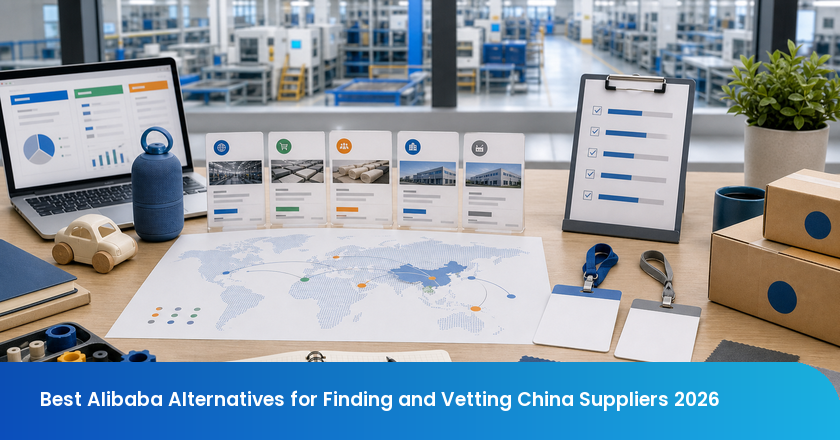
The best Alibaba alternative depends on sourcing goal: use B2B marketplaces for supplier discovery, trade shows for face-to-face validation, and third-party vetting before scaling orders.
Alibaba is still a major sourcing channel, but importers often need alternatives when they want different supplier pools, trade-show connections, category specialization, lower-MOQ discovery, or a second source for comparison. The right alternative is not the site with the biggest catalog; it is the channel that helps the buyer build a supplier shortlist that can be verified before money and production risk increase.
In 2026, the safer sourcing mindset is channel plus vetting. A marketplace can help you discover suppliers, but it does not replace supplier verification, factory audit, sample review, product testing, contract discipline, or shipment inspection. The buyer should treat every platform as the beginning of a due-diligence process, not the end of supplier selection.
Key Takeaways
- Best overall approach: Use multiple discovery channels, then vet suppliers with documents, samples, audits, and inspection evidence.
- Marketplace fit: Global Sources, Made-in-China, and HKTDC are useful for structured B2B supplier discovery.
- Trade-show fit: Canton Fair and other exhibitions are useful when buyers need face-to-face discussions and physical product review.
- Low-MOQ fit: DHgate and 1688 may help with small-quantity discovery, but supplier verification and export readiness need extra care.
- TradeAider use case: After the shortlist, buyers need factory audit, testing review, PPI, DPI, PSI, and release evidence before scaling orders.
Choose Alternatives By Sourcing Job
Alibaba alternatives should be chosen by sourcing job: find manufacturers, compare categories, meet exhibitors, validate trade-show leads, explore low-MOQ items, or build backup suppliers. A channel that works well for discovery may be weak for verification, negotiation, or quality control.
Use marketplaces for broad supplier discovery
Global Sources, Made-in-China.com, and HKTDC Sourcing are useful when the buyer needs to search product categories, compare supplier profiles, and build an initial shortlist. They can be especially helpful for buyers who want to compare the supplier pool outside Alibaba and identify companies that present themselves through different B2B channels.
These channels are strongest at widening the top of the funnel. They help buyers discover categories, compare product presentations, send inquiries, and identify suppliers that may not appear in the same way on Alibaba. They are weaker when the buyer treats profile claims as verified production capability. The shortlist still needs a separate evidence layer.
Use trade shows for product and relationship signals
The Canton Fair and other trade shows help buyers see products, ask technical questions, compare samples, and meet supplier representatives in person. A booth conversation is not verification, but it can reveal product focus, export experience, communication quality, and whether the supplier understands the buyer's market.
Trade shows are also useful for judging seriousness. Buyers can compare product ranges, ask who owns tooling, request factory address, review packaging examples, and identify whether the representative understands compliance, customization, and after-sales requirements. The limitation is that trade-show performance can be polished. The factory still needs to be checked before the buyer scales.
Use low-MOQ channels with stronger caution
DHgate, 1688, and similar channels can be useful for price discovery, sample exploration, spare parts, or low-MOQ testing. The caution is that not every supplier is export-ready, factory-direct, or suitable for scaled overseas orders. Buyers should be careful with product claims, compliance documents, labeling, payment terms, and after-sales expectations.
A buyer using these channels should separate learning orders from production orders. A learning order can test product feel, response speed, packaging basics, and supplier communication. A production order requires confirmed specifications, export documents, approved samples, inspection plan, and evidence that the supplier can repeat the quality at commercial scale.
Alibaba Alternative Platform Comparison Table
A practical comparison should focus on what each channel is good for and what the buyer must still verify. Discovery strength is not the same as supplier readiness.
| Channel | Best For | Watch Point | Vetting Step |
|---|---|---|---|
| Global Sources | B2B supplier discovery and online-to-offline sourcing | Category depth varies by product and show cycle | Confirm factory identity, samples, certificates, and production capability |
| Made-in-China.com | Broad China supplier search and RFQ comparison | Profiles and reports still need buyer review | Check business license, audit reports, samples, and quality history |
| HKTDC Sourcing | Hong Kong and China supplier discovery, trade fair connection | Supplier fit depends on category and export target | Compare product focus, export experience, and factory evidence |
| Canton Fair | Face-to-face sourcing and physical product review | Booth presence does not equal order readiness | Follow up with factory audit, sample approval, and production checks |
| DHgate | Low-MOQ experiments, small orders, accessory discovery | May not fit scaled private-label or compliance-heavy orders | Validate supplier role, product file, packaging, and export documentation |
| 1688 | Domestic China price discovery and supplier mapping | Language, payment, export, and compliance readiness can be difficult | Use local support, verify factory status, and inspect before scaling |
The comparison shows why buyers should avoid the phrase best platform without a sourcing context. A trade-show lead can be excellent for product understanding and weak on documentation follow-up. A marketplace supplier can look strong online and still need factory verification. A low-MOQ channel can be useful for learning, but risky for a regulated retail launch.
A good 2026 sourcing workflow uses discovery channels in sequence instead of treating them as rivals. The buyer may identify product ideas on a marketplace, compare supplier claims through another platform, meet shortlisted suppliers at a trade show, and then use third-party verification before the first serious PO. The important control is that each channel adds a different signal instead of repeating the same online profile.
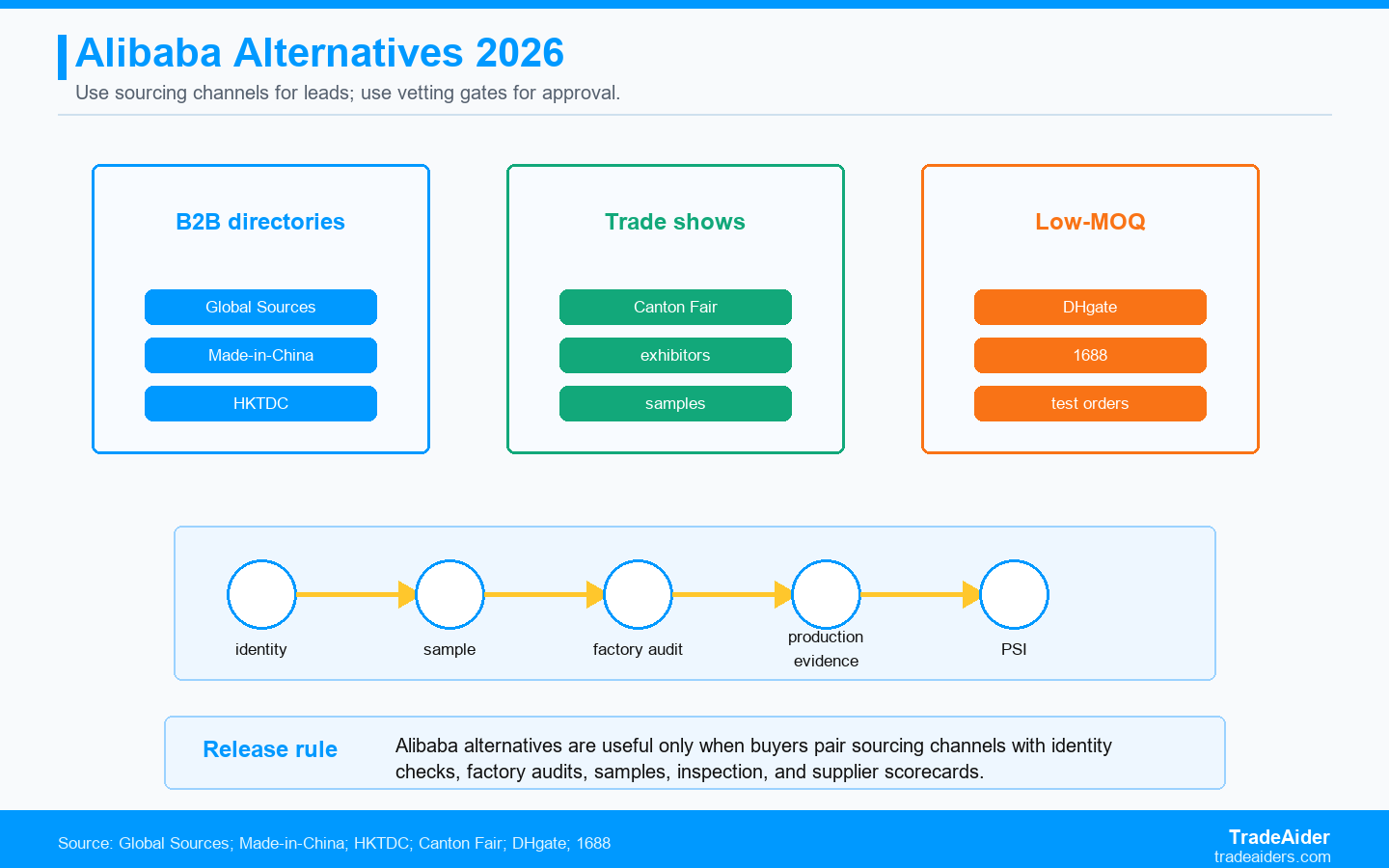
Alibaba alternatives help discover suppliers, but supplier vetting should connect documents, samples, audits, testing, and shipment inspection before scaling.
Supplier discovery finds options; supplier vetting decides which option deserves production money.
How To Vet Suppliers Found Outside Alibaba
Suppliers found outside Alibaba should be vetted with the same discipline as any other supplier. The channel may change, but buyer risk does not. The buyer still needs identity checks, sample control, capability review, compliance evidence, and shipment-level quality control.
Verify the company behind the profile
The buyer should confirm the legal company name, business license, export role, factory address, product scope, and whether the contact is the manufacturer, trading company, distributor, or service provider. A supplier can be useful in any of those roles, but the buyer needs to know who owns production risk.
Use samples to test both product and communication
Samples should test more than product appearance. They should test whether the supplier follows instructions, packs correctly, labels correctly, provides documents, responds to technical questions, and handles revisions in a controlled way. A sample that arrives with wrong color, wrong label, or missing accessory is a warning about future production.
Audit before scaling production
A factory audit is most valuable before a buyer scales order quantity or commits to a high-risk product. It can review production capability, quality system basics, records, equipment, process control, and whether the supplier's claims match the site. If the audit reveals weak traceability or process control, the buyer should adjust inspection scope before shipment.
Inspect the first real order before shipment
The first real order should not be released based only on a good sample. Pre-shipment inspection can verify quantity, workmanship, function, packaging, labels, accessories, and carton marks before export. During-production inspection may be better when defects can multiply across the run.
Keep a backup-supplier file before problems appear
Supplier diversification should happen before a quality crisis. Buyers can keep a backup-supplier file with contact history, product match, sample status, audit readiness, pricing range, and known risk points. When a current supplier fails inspection or misses capacity, the buyer then has options that are partly vetted rather than starting discovery from zero.
2026 Supplier Vetting Workflow
A practical 2026 supplier vetting workflow has four layers: discovery, identity, capability, and shipment evidence. Discovery finds possible suppliers. Identity confirms who the buyer is dealing with. Capability checks whether the supplier can actually make the product. Shipment evidence verifies the first order before release.
Layer 1: Discovery across multiple channels
The buyer builds a first list from marketplaces, trade shows, referrals, search, and existing supplier networks. At this stage, the goal is not to choose the winner. The goal is to collect enough candidates to compare product focus, communication quality, export experience, and willingness to provide evidence.
Layer 2: Identity and document review
The buyer checks legal name, business license, address, bank information consistency, export role, product category, certificates, and contact reliability. Any mismatch should be clarified before deposit payment. A supplier that cannot explain its identity clearly should not receive a scaled order.
Layer 3: Capability and sample verification
The buyer reviews samples, technical files, production photos, factory capability, quality-control records, and testing evidence. If the supplier is important to the sourcing plan, a factory audit can verify whether the claimed capability exists on site and whether process control is strong enough for repeat orders.
Layer 4: First-shipment release evidence
The first real shipment should be inspected against the approved sample and product file. If the report shows defects or mismatched evidence, the buyer should correct the issue before scaling. A supplier becomes more reliable after repeated evidence, not after one attractive online profile.
Where TradeAider Fits After Supplier Discovery
TradeAider fits after the buyer has found possible suppliers and needs evidence before committing, scaling, or releasing shipment. The service layer turns a supplier shortlist into a controlled sourcing decision.
Use factory audit to verify supplier readiness
After finding suppliers through Global Sources, Made-in-China, HKTDC, Canton Fair, DHgate, 1688, or other channels, buyers can use TradeAider's factory audit service to check whether the supplier has the claimed capability, quality system basics, production conditions, and records.
Use inspection to control the first production run
A Pre-Production Inspection, During Production Inspection, or Pre-Shipment Inspection can help buyers control the first order before the supplier relationship is proven.
Use testing and real-time reporting before scaling
If the product has safety, chemical, electrical, toy, textile, food-contact, or destination-market requirements, TradeAider can connect supplier vetting with product testing services. Buyers can send the supplier shortlist, product file, and target market to plan vetting before placing a larger order.
SPAR Scenario: A Supplier Found Outside Alibaba Still Needed Vetting
Situation: A buyer found a promising home decor supplier through a trade-show follow-up rather than Alibaba. The supplier had attractive samples, fast communication, and a better price than the buyer's current option.
Problem: The buyer almost placed a full production order based on the trade-show samples. The supplier's documents were incomplete, and the buyer did not know whether the booth company owned the factory or outsourced part of production.
Action: The buyer requested company documents, approved a controlled sample, arranged a factory audit, and used pre-shipment inspection for the first order. The audit found that packing was subcontracted, so the inspection scope added carton marks, retail packaging, and final quantity checks.
Result: The supplier was not rejected, but the buyer scaled more carefully. The alternative channel found the lead; the vetting process decided how much risk the buyer could safely take on the first order.
Who Is TradeAider?
TradeAider is a quality inspection, testing, and certification service provider in China. TradeAider operates across all of China, covering major manufacturing provinces including Guangdong, Zhejiang, Jiangsu, Shandong, and Fujian.
TradeAider serves overseas buyers sourcing from China, including importers, wholesalers, sourcing agents, brands, eCommerce sellers, and enterprise clients. Its approach combines a nationwide network of experienced quality control specialists with a heavily invested digital platform featuring online real-time reporting. Clients can monitor inspections live, communicate directly with inspectors, and address issues during production rather than after shipment - a proactive model focused on problem-solving and prevention, not just defect identification.
Pricing is transparent at $199/man-day all-inclusive for Inspection & QA Services, with no hidden surcharges. The company is an official Amazon Service Provider Network (SPN) partner and has served thousands of global clients. Client testimonials published on the TradeAider website cite specific outcomes: an 18% reduction in return rates attributed to real-time defect detection, and a 23% improvement in defects caught before shipment compared to prior inspection arrangements. These are client-reported figures.
Frequently Asked Questions
What is the best Alibaba alternative in 2026?
The best Alibaba alternative in 2026 depends on sourcing goal. Global Sources, Made-in-China, HKTDC, Canton Fair, DHgate, and 1688 can all be useful, but each needs supplier verification before production money increases.
Is 1688 good for international buyers?
1688 can be useful for China price discovery and domestic supplier mapping, but it is harder for many international buyers. Language, payment, export documentation, compliance, and supplier verification usually require extra support.
Can I trust suppliers from trade shows?
Trade-show suppliers can be strong leads, but booth presence is not enough proof for production. Buyers should verify company identity, factory capability, samples, documents, and shipment quality before scaling orders.
What should I do after finding a supplier?
After finding a supplier, verify the company, approve a controlled sample, review compliance documents, audit the factory if risk is material, and inspect the first shipment before release. Discovery should always lead into vetting.
Похожие статьи
Развивайте свой бизнес с услугами TradeAider
Нажмите кнопку ниже, чтобы войти непосредственно в систему услуг TradeAider. Простые шаги от бронирования и оплаты до получения отчетов легко выполнить.

