

The real costs of 3rd party quality inspection include the agreed inspection fee, any travel and documentation outside that fee, and separately authorized extra work. Pricing models, product complexity, location, timing and frequency affect how the job is quoted. Internal waiting, correction and delayed-shipment costs also matter, but they are not automatically items on the provider’s invoice.
Compare the full job scope and total, not a day rate in isolation. Prices and terms change, so a historical price comparison is not a current quotation. Use a dated, attributable rate only for the service it describes, and confirm the written terms for your product and location.
Compare the Job Total, Not Just the Rate
- Match work scope and billing units before comparing prices.
- Confirm travel, reports, testing and other inclusions.
- Add only extras excluded from the base quotation.
- Track business impacts and inspection charges separately.
- Agree who pays for changes and return visits.
3rd Party Quality Inspection Costs
The real cost of a third-party product inspection starts with the agreed work and billing unit. Add only the quoted items outside that base scope, then track internal handling, waiting and correction costs separately. A headline rate alone does not establish the job total.
Direct Fees
Direct fees pay for the agreed inspection work. The quotation should identify what will be checked, the billing basis and the workload allowed. It should also explain which preparation, standard equipment, report and communication activities are included; those boundaries cannot be inferred from the rate alone.
A provider may quote by day, hour, unit, lot or another defined job basis. Compare equivalent tasks before comparing the numbers. A property inspection, a specialist examination of an operating asset and a manufactured-product inspection are different assignments. Their prices do not establish a common market average for product quality inspection. Ask for a current quotation with a validity period and a clearly identified service scope.
Travel and Logistics
Travel and logistics may be included in the base price or listed separately. Confirm the factory address, inspector travel arrangements and any accommodation or other site-access expense before accepting the total. Do not add a travel allowance again when the written quote already covers that trip.
For multiple factories, identify whether each location creates a separate visit or billable travel segment. Ask how a changed address, delayed access or an overnight stay would be handled. Location alone does not prove that a particular surcharge applies, and there is no reliable universal local, regional or international travel-fee table for every inspection assignment.
Documentation Charges and Extra Services
The inspection standards resource can help frame the product criteria to agree before requesting prices. Documentation charges and extra services should follow the deliverables actually requested. Confirm whether the standard report, photographs, measurements and normal communication are included. Identify additional languages, special report formats, extra copies, translation, certificate review or separately commissioned laboratory work rather than treating them as an automatic fee schedule.
A quotation for visual workmanship checks is not equivalent to one containing extensive function tests, specialist measurements or document review. List the required activities and outputs explicitly. If a separate test or service is needed, ask who supplies it, what method applies and whether specimen handling or transport is included.
Understanding Direct vs. Indirect Costs
Keep provider invoice charges separate from business impacts. The invoice may include inspection work, agreed travel and additional tasks. The buyer or supplier may also incur handling, waiting, production interruption, correction or delayed-shipment costs. Accounting classifications differ, so define the boundary used in your own budget.
An item is not an extra merely because it is described as travel or documentation: first check whether it is already included. Equally, an estimated loss from delay is not automatically a charge owed to the inspector. Compare the full quoted scope, then consider the separate business exposure that the inspection decision can affect.
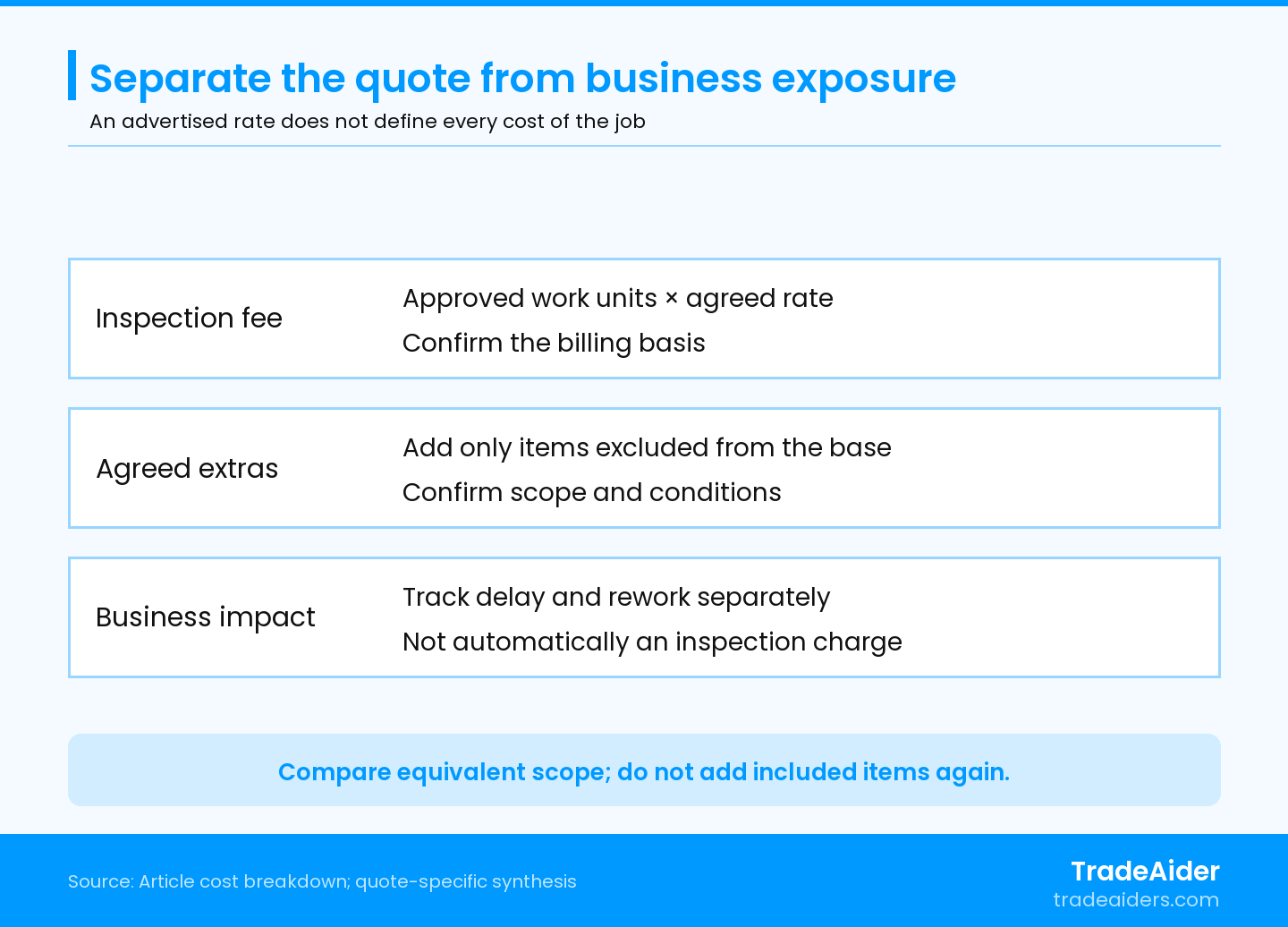
Confirm what the base fee includes before adding extras. Delay, internal handling and correction costs are separate business impacts, not automatically items on the inspection invoice.
Pricing Models
Pricing models describe what is billed and under which conditions. They do not guarantee the same coverage, resource level or inspection outcome. Match the model to the task before judging whether it is economical.
Man-Day Model and Time Billing
A man-day represents one inspector’s work for one billable day under the agreed terms. Confirm how the provider counts preparation, travel, on-site work, reporting, minimum charges and additional time. Hourly billing also needs clear boundaries; it does not necessarily mean that only the minutes spent examining products will be charged.
TradeAider’s pre-shipment inspection service publicly lists a service charge of $199 per man-day.
That advertised rate was checked on October 25, 2026. It is a service-specific public reference, not a 2025 market-average price or a binding quotation for every location and workload. Confirm the applicable rate, approved work units and inclusions for the actual job.
Illustrative example: two approved man-days at $199 per man-day produce a $398 base fee before any agreed extras.
The example assumes the workload has already been approved; it is not a customer invoice or a claim that this is the time your order requires. Add travel, testing or other charges only if the quote excludes them and authorizes them separately.
Per Unit/Lot
Per-unit or per-lot pricing should state both the quantity used for billing and the quantity actually examined. A lot fee does not necessarily buy inspection of every product in the lot. A unit-based fee also needs a definition of the unit and any minimum order or visit charge.
Specify the product mix, lot boundaries, inspection plan and allowed tests. If the order changes, ask whether the fee changes with quantity, product variants or required work. This model can make repeatable assignments easier to budget, but only when the quoted assumptions remain true. Predictable invoicing is not a substitute for an adequate inspection scope.
Subscription
A subscription or recurring service arrangement needs explicit limits: included visits or workload, locations, product categories, reporting and additional-task rates. Confirm the period, scheduling conditions, cancellation terms and treatment of unused work. A fixed recurring fee does not necessarily provide unlimited inspections or guaranteed priority.
This can be an option for buyers with a stable inspection schedule, if a provider actually offers it. Compare the committed spend and usable work with separate job quotations. Seasonal production, changing factories or uneven order volume may leave an allowance unused or create extra work outside it. Do not assume that TradeAider or another provider offers a particular subscription merely because the pricing model exists.
Factors Affecting Inspection Costs
Estimate resources from the actual inspection task, site and timing. Commercial order value is useful business context, but it cannot by itself determine the number of inspectors, work units or test activities required.
Inspection Type and Product Complexity
Inspection type changes the work: early material/readiness checks, in-process inspection and finished-product inspection observe different stages. Product complexity includes variants, assembly, measurements and functional checks. NIST describes acceptance sampling as using a random sample to support lot acceptance or rejection, rather than inspecting every unit. The agreed plan and tasks therefore matter when estimating effort.
Specialist equipment can be another scope item. NIST does not prescribe a single recalibration interval for all instruments; requirements, stability and environment influence the interval. If a quote lists equipment or calibration charges, ask which measurement needs them and what is included, rather than assuming a universal recurring surcharge.
Use the AQL calculator with agreed sampling inputs and verify the plan against the selected standard. Acceptance quality limit (AQL) is a plan parameter, not a price or a count of every unit examined. Provide product variants, quantities and required checks so the provider can estimate the actual workload.
Location and Urgency
Location and urgency can change how resources are arranged. Remote sites, multiple addresses, restricted access and a short booking window may require a different plan. Confirm the actual availability, travel assumptions, overtime or priority conditions in writing rather than assuming a standard premium percentage.
Give the factory location and the date when goods will genuinely be ready, along with the shipment deadline. Ask what happens if readiness changes or the visit must move. A cheap booking that cannot examine the intended goods may leave the buyer paying for another visit. Early communication helps clarify options; it does not guarantee availability or eliminate all additional charges.
Frequency
Repeated inspections may support a recurring arrangement, but neither a discount nor a reduced checking plan should be assumed. Ask whether volume terms depend on a minimum commitment, a stable location, repeat products or a specific schedule. Compare the entire commitment, not only the advertised fee per visit.
Keep commercial negotiation separate from the technical inspection decision. Repetition can reduce repeated preparation where the approved product file stays current, but a new design, supplier, material or problem may require different work. Inspection frequency should follow the actual risks and agreed control plan; fewer visits are not automatically a saving if the necessary evidence is lost.
Industry Costs
Industry labels are too broad to establish a dependable fee band. Ask what work distinguishes the actual product and destination. The following examples identify quotation inputs; they are not industry-average prices or a statement that one category always costs more.
| Product family | Work to define before pricing |
|---|---|
| Consumer goods | Product mix, workmanship, dimensions, function, labels and packaging |
| Industrial products | Drawings, tolerances, access, specialist competence and equipment |
| Food and agriculture | Commodity, condition, sampling, temperature needs and applicable hygiene or testing scope |
| Regulated products | Destination rules, relevant tests, competent laboratory and required documentation |
For a US example, CPSC’s initial-certification guidance explains that applicable children’s product tests vary with the product, intended use and materials, and that relevant third-party testing uses CPSC-accepted laboratories. Determine applicable requirements and exemptions for the actual product. A routine product inspection cannot simply replace that laboratory work.
Identify the organization and its actual service scope through TradeAider’s company background; confirm any specialist capability or testing arrangement for the particular assignment rather than inferring it from an industry label.
Hidden Costs in Third-Party Inspection
Hidden costs often arise outside the inspection invoice. An incomplete product file, inaccessible goods or unresolved correction can consume factory and buyer resources even when the provider’s quoted rate stays unchanged.
Downtime
Agree site readiness and access before the visit. Goods may need to be located, unpacked, moved to a suitable area or made available for a specified test. Equipment-dependent work may require a planned access window. Identify the people and materials needed so routine inspection does not wait for an avoidable preparation task.
Ask how waiting, an inaccessible lot or a changed production status affects the billable work and booking. Separately estimate the factory’s handling or interruption cost where relevant. Do not assume that all product inspections stop a production line, or that every hour of internal downtime becomes an inspector’s charge.
Data Access and Communication Gaps
Provide current specifications, approved samples or drawings, test instructions and the relevant document revisions. Confirm the report recipient, required language, format and acceptance needs. If different people supply conflicting instructions, resolve them before pricing and inspection rather than expecting the inspector to decide which commercial requirement controls.
Limit data access to what the job actually needs, while ensuring the necessary files, equipment records and contacts are available. Identify who can clarify a measurement or authorize a scope change during the visit. A report delivered in the wrong format or based on an obsolete specification may require extra work even if its photographs look complete. These are communication and preparation issues, not automatic separate reporting fees.
Re-inspection
A re-inspection needs a defined purpose and price. State what was corrected, which goods or features will be checked again and whether the task is a focused verification or a broader new inspection. Confirm readiness before a return visit; a verbal statement that the supplier has fixed everything may not be enough to plan the work.
Agree the rate, travel, reporting and cancellation terms for that visit. Also agree who pays and how the result affects the commercial decision. Failure in the first inspection does not automatically make the supplier liable for every later expense or entitle the buyer to a free return visit. Those terms need an actual agreement.
Who Pays for Inspection Costs
The buyer, supplier or both parties may fund inspection under their agreement. Keep the provider’s invoice arrangement, allocation of follow-up costs and the applicable product responsibilities distinct. Paying for a visit does not resolve all three questions.
Payment Structures and Contracts
Put payment and change terms in writing: the booked scope, payer, currency, taxes, payment timing, readiness conditions, cancellation or postponement terms and authorization for additional work. Include the treatment of a failed inspection and any return visit rather than leaving those costs to a dispute after the event.
Where the supplier agrees to reimburse a cost, document the trigger and evidence required. Confirm who receives the report and can give instructions, as well as who settles the provider invoice. An inspection booking and a purchase agreement may involve different parties; make sure the arrangements fit together. Commercial allocation of cost does not establish that a product meets all relevant requirements.
Regulations
Regulatory duties need their own assessment. EU CE-marking guidance states that CE marking is required only for products covered by EU rules that specifically mandate it, and explains relevant manufacturer responsibilities for conformity. It does not mean that every product needs CE marking or a paid notified-body assessment.
Determine the actual product classification, destination and applicable assessment route before adding compliance-related work to an inspection budget. Some questions concern product testing, technical documentation or certification rather than ordinary shipment inspection. Ask which organization will perform each task and what its output will establish. A contract assigning the inspection bill does not itself transfer every statutory obligation or turn a commercial report into a market-access approval.
Choosing a Third-Party Inspection Provider
Choose a provider by comparing equivalent work and deliverables, then its competence, communication and commercial terms. A high or low fee alone cannot demonstrate that the inspection will answer the buyer’s question.
Pricing Transparency
Request a quotation that makes the following fields explicit. Use the same product file and requested checks for each provider so differences in the totals can be explained. Ask for clarification where an item is described only as “included” without identifying its scope.
| Quotation field | Confirm |
|---|---|
| Work and workload | Products, stage, site, sample/test plan and approved billable units |
| Price basis | Rate, currency, minimum charge, validity and tax treatment |
| Inclusions | Travel, preparation, equipment, report, language and normal communication |
| Conditional charges | Additional tests, priority work, extra time, waiting and return visits |
| Change terms | Who authorizes changes; cancellation, postponement and readiness conditions |
Check the total against those fields before approval. A fee that excludes essential work is not directly comparable with one that includes it; a bundled item should not be added again as a separate allowance.
Accreditation and Reputation
Competence matters independently of pricing. ILAC explains accreditation as assessment of an accredited facility by an independent accreditation body against competence requirements. Verify the actual legal entity, current status and relevant scope rather than relying on a logo or a broad claim of certification.
Accreditation does not automatically establish that a particular report will meet every buyer or regulatory acceptance requirement. Inspection-body and laboratory scopes are different matters. Confirm the method, organization and recipient requirements for the work you need; do not infer TradeAider’s accreditation from this general explanation.
For reputation, review relevant references and sample reporting, and ask how findings and questions are handled. Testimonials can provide context, but they are not a guaranteed outcome for another job. Look for evidence relevant to the product and task instead of assuming that size, a familiar name or a premium fee resolves every quality concern.
Balancing Cost and Quality
A useful cost decision preserves the checks needed for the buyer’s actual quality question. Compare the quoted workload, inclusions, conditional charges and deliverables, then consider the separate cost of unresolved defects or delay. Avoid treating a low inspection price as a saving when it leaves essential work unperformed, or a high price as a guarantee against loss.
Contact our team with the product and order information available, factory location, production stage, timing, destination, product mix and proposed checks. TradeAider can discuss the scope and workload for a job-specific quotation. Ask for written inclusions and conditional charges; missing details can be clarified during the inquiry, with technical criteria and report-recipient requirements agreed before inspection.
FAQ
Can I use an old inspection quotation for a repeat order?
Only after confirming that its validity, scope and commercial assumptions still apply to the new job. Recheck the product revision, quantity, variants, factory address, inspection stage and timing. A repeat order can still require different work or logistics. Ask the provider to confirm the existing quotation or issue an updated one before relying on its total.
Does supplier-paid inspection mean the supplier owns the report?
Payment and report-access rights are separate contractual questions. Confirm who commissions the work, receives the report, may share it and can authorize instructions or changes. Supplier funding alone should not be treated as proof that the buyer will have the access or independence expected. Record those arrangements before booking so the commercial purpose of the inspection remains clear.
What if the inspection scope changes after booking?
Ask for a revised scope, workload and price before authorizing the additional work. Identify the new checks and whether they affect time, equipment, reporting or another visit. Keep the original and revised terms together, including who approved the change. If additional checks cannot be completed, the report should state the resulting limit rather than imply that the expanded scope was covered.

Похожие статьи


Развивайте свой бизнес с услугами TradeAider
Нажмите кнопку ниже, чтобы войти непосредственно в систему услуг TradeAider. Простые шаги от бронирования и оплаты до получения отчетов легко выполнить.