
A resilient supply chain can prepare for disruption, continue its most important activities where feasible and restore delivery when interrupted. For geopolitical risks, start by connecting critical orders to the suppliers, inputs and routes they depend on. Then select workable alternatives, assign decision authority and test how the response would operate.
The goal is to make practical choices under uncertainty. A backup supplier, extra stock or a risk dashboard can help, but each needs to address an actual exposure. The plan must also account for quality, trade requirements, capacity, customer commitments and the cash needed to carry out the response.
What geopolitical resilience needs to achieve
Geopolitical developments can affect market access, cross-border payments, transport routes or the availability of important inputs. Their business consequences depend on the actual product, parties, locations and timing. A major headline may have little immediate effect on one importer while a less visible restriction interrupts another’s critical component.
The UK Government Office for Science’s 2026 supply-chain foresight executive summary describes interconnected networks and interacting risks, including shared dependencies. It supports context-specific, continuing resilience work. Its scenarios are tools for thinking about possible futures, rather than forecasts or a statement of government policy.
Define success in operating terms: which customer orders or production activities matter most, what interruption they can tolerate and what would demonstrate recovery. Distinguish a geopolitical trigger from other hazards, while recognizing that weather, equipment failure or weak finances can compound its effects. Avoid building the whole plan around one predicted event.
Map exposures that could interrupt critical orders
Start the exposure map with important products and follow their material and delivery dependencies. NIST-hosted CIRAS manufacturing guidance describes mapping suppliers, upstream materials, geography and transport to identify concentration and interdependence. This is practical manufacturing guidance, rather than a mandatory NIST risk-scoring system.
For each important order, identify the producing site, critical purchased inputs, relevant subcontracted work and planned transport route. Include hubs, ports or service providers where losing access would interrupt the flow. Record the source and date of the information, and distinguish a confirmed relationship from an assumption.
Look for common dependencies across apparently different options. Separate commercial suppliers may buy from the same processor or ship through the same hub. Where an upstream identity is unavailable, mark it as unknown and assign someone to investigate. An incomplete map can still guide work if its gaps remain visible.
Prioritize business impact and recovery needs
Prioritize the effect on the business as well as the event’s likelihood. Ready.gov’s business impact analysis guidance considers operational and financial consequences, timing, duration, critical processes and resources, together with recovery costs. Apply that thinking to affected orders and activities before choosing the response.
Ask when the interruption would become consequential. Check customer need dates, work in progress, usable released stock, replenishment assumptions and dependencies on other materials. Stock awaiting a quality decision is different from goods available for shipment. A nominal production capacity figure is different from capacity reserved for the order.
Compare the consequences of delay, allocation, substitution and recovery expenditure. Include customers whose operations depend on the product and commitments that require early discussion. Keep uncertain demand or lead-time assumptions visible so that a change in those assumptions leads to a review of the response.
Compare sources, routes and demand choices
The UK supply-chain resilience framework presents options including diversification, international partnerships, stockpiling or surge capacity, domestic capacity and demand management. Data and visibility underpin the choices. These are planning options to assess in context, rather than a package every business must adopt.
Compare each option with the dependency it addresses. A qualified alternative source may reduce reliance on one production site. An alternative route may address transport exposure. Agreed allocation, a substitute product or a revised customer schedule may reduce immediate demand pressure when additional supply cannot arrive in time.
Different locations do not necessarily create independent supply. Check shared inputs, transport links and relevant restrictions before counting an alternative as available. Assess product fit, capacity, development work, delivery feasibility and commercial terms. A closer factory can still lack the required tooling or rely on an exposed imported component.
Retain promising options with their outstanding conditions and owners. Distinguish an identified candidate from an evaluated source and from an arrangement ready to activate. This makes diversification a practical sourcing decision rather than a supplier-count target or a ranking of countries.
Keep qualification and production controls usable
Urgency changes the schedule, but the proposed product and process still need an appropriate qualification decision. Review whether the supplier and production site can make the required item with the necessary materials, equipment and available capacity. Focus the assessment on the uncertainties that could prevent a usable delivery.
TradeAider’s factory audit scope includes supplier information, production lines and equipment, quality management and warehousing. A defined audit can provide findings about the proposed operation; those findings support the buyer’s assessment rather than guaranteeing continuity.
Where material readiness or sample-to-bulk consistency is uncertain, discuss a suitable pre-production inspection. Relevant checks can address raw or partly finished materials, process information, construction, dimensions or packing. Select the checks and timing around the actual order instead of requiring the same inspection bundle for every purchase.
Keep specifications, approved references and relevant test coverage current when changing a material, site or process. Identify which results remain applicable and which questions need reassessment. Assign technical approval for substitutions and record authorized changes. Product-quality evidence answers the agreed quality questions; it does not establish trade permission or predict geopolitical events.
Turn monitoring into verified decisions
Monitoring becomes useful when it changes a decision. Connect a dated, attributable alert to the affected sites, inputs, routes and orders. Confirm its relevance with appropriate sources, identify what remains uncertain and assign an action. A dashboard or predictive model cannot by itself establish complete visibility, accurate source data or recovered delivery.
Combine external updates with supplier status, inventory records, production progress and logistics information. Define who receives an alert, who checks it and who can approve the proposed response. Keep the underlying record accessible so that a revised report can be reconciled with earlier decisions rather than silently replacing them.
Production information belongs in this process too. TradeAider’s during-production inspection includes agreed process, appearance, dimensions, packing and functional checks. Relevant findings may help the buyer address emerging quality issues while reviewing delivery plans. Agree feasible access and reporting; an inspection report is a scoped observation, rather than continuous knowledge of every unit or supply-chain event.
Separate trade permission, product requirements and responsible sourcing
Keep trade permission, product requirements and responsible sourcing as distinct workstreams. A route that is physically open may still require a trade review. A supplier’s certificate may address a management system or material claim without establishing that the particular product can lawfully enter the destination market.
For transactions subject to applicable US Export Administration Regulations (EAR), Bureau of Industry and Security (BIS) Know Your Customer guidance addresses suspicious circumstances involving end use, end users or destination. Relevant red flags require inquiry and reevaluation; unresolved concerns should not be ignored. This limited EAR example is not a universal customer-background investigation requirement or a determination that a shipment is licensed or otherwise permitted.
Assign the relevant trade and product questions to competent owners using the actual parties, goods, destination and transaction. Review proposed changes before committing to an alternative. Keep an unresolved permission question open until the responsible person obtains the information or decision needed for that transaction.
Responsible sourcing also needs defined expectations and evidence. The public abstract of ISO 20400:2017 describes guidance for integrating sustainability into procurement across organizations. It does not make a supplier logo a product approval or a continuity guarantee. Specify the labor, environmental or material claims that matter and retain relevant evidence for the intended decision.
Balance stock buffers, capacity and cash
Buffer stock means additional inventory intended to absorb a supply interruption or variation in demand. Size and position it using actual demand, usable stock, replenishment exposure, storage constraints and the consequences of shortage. Consider deterioration, obsolescence and cash tied up in goods. There is no stock-days target that fits every importer.
Capacity arrangements can offer another buffer, but confirm what can actually be activated: the product, site, equipment, materials, people and scheduling conditions. Compare the cost of keeping that option available with the disruption it could address. A supplier’s general willingness to help is weaker evidence than an agreed, feasible arrangement.
Currency changes can affect the cost of an alternative. The International Trade Administration’s foreign-exchange risk guidance for US exporters explains that rates can change between contract and payment, and that dollar pricing can shift exchange exposure to the buyer. An importer should therefore identify the payment currency and timing of its own obligations rather than assuming the exposure disappears.
Review deposits, replacement purchasing, freight, payment terms, credit availability and the effect of delayed customer receipts with finance. Seek appropriate advice on currency arrangements and their conditions where needed. A financial hedge does not restore physical supply. A response that depends on funds or credit that are not available should remain conditional in the continuity plan.
Coordinate supplier, logistics and customer commitments
Agree how suppliers, logistics providers, customers and internal teams will communicate during a disruption. Establish named contacts and alternates, the information each must provide and who can change production, transport or customer commitments. Purchasing should not have to infer a new delivery promise from an informal message about factory capacity.
Ask suppliers for affected-order status and realistic constraints. Ask logistics providers for relevant route availability and shipment options. Coordinate the findings with quality, trade and finance owners before changing the plan. Give customers confirmed information, material uncertainties and the next update point appropriate to their orders.
Document decisions in one accessible response record, with controlled access to commercially sensitive information. Preserve changes to assumptions and commitments. Useful collaboration can include joint planning or capacity arrangements, but responsibilities and practical limits need to be agreed rather than assumed from a long relationship.
Write the response before the disruption
Prepare a response brief before the team is under immediate pressure. Copy the fields below for a critical order or plausible disruption. Fill them with current information, identify unknowns and name the people who must resolve them. The record should show what can be done, under which conditions, and what outcome the team expects to observe.
| Define | Fill in for this order or response | Decision use |
|---|---|---|
| Critical order and dependency | Product/order: ___; site/input/route: ___ | Identify the flow to protect |
| Event and evidence | Verified alert: ___; source/date: ___; unknowns: ___ | Establish relevance and open questions |
| Time and resources | Need date/demand: ___; usable stock: ___; supply gap: ___ | Assess urgency and available cover |
| Options and constraints | Route/capacity: ___; quality/trade: ___; cost/funding: ___ | Separate feasible options from pending ones |
| Trigger and authority | Condition/action: ___; owner: ___; approver: ___ | Make activation responsibilities explicit |
| Recovery proof | Actual receipt/usable goods: ___; commitments/review: ___ | Confirm the result and update the plan |
Make the activation condition observable. For example, a confirmed route suspension affecting a named shipment requires a different response from an unverified regional alert. Record any spending or allocation authority needed and the conditions for customer communication. If essential information is missing, assign its collection and a review point rather than treating the option as approved.
Illustrative example: a shared hub affects two supply routes
This is a hypothetical example, not client data. An importer buys stackable storage bins from factories in different locations. Both planned shipments use the same transit hub. The logistics provider confirms a temporary hub suspension, so the team identifies the orders and customer need dates affected. Merely moving the order between those factories would retain the shared route problem.
The team checks released inventory against priority demand and asks the logistics provider about an alternative route. Purchasing confirms available production and booking conditions; quality reviews whether any proposed packing or handling change affects the product. The trade owner reviews the actual transaction, and finance checks the additional cost and available funding.
An authorized allocation of usable existing stock can support immediate commitments where quantities permit. A revised shipment plan is activated only when the relevant capacity, route, quality, trade and funding conditions are resolved and the customer commitments have been reviewed. The team records who approves each decision.
If route feasibility or required trade information remains missing, that shipment option stays pending with a named owner. The team revises commitments using the supply it can substantiate. Recovery is confirmed through actual receipt, usable goods and updated customer delivery commitments, rather than a dashboard changing to green. The exercise may also reveal whether a genuinely different route or inventory position is worth maintaining.
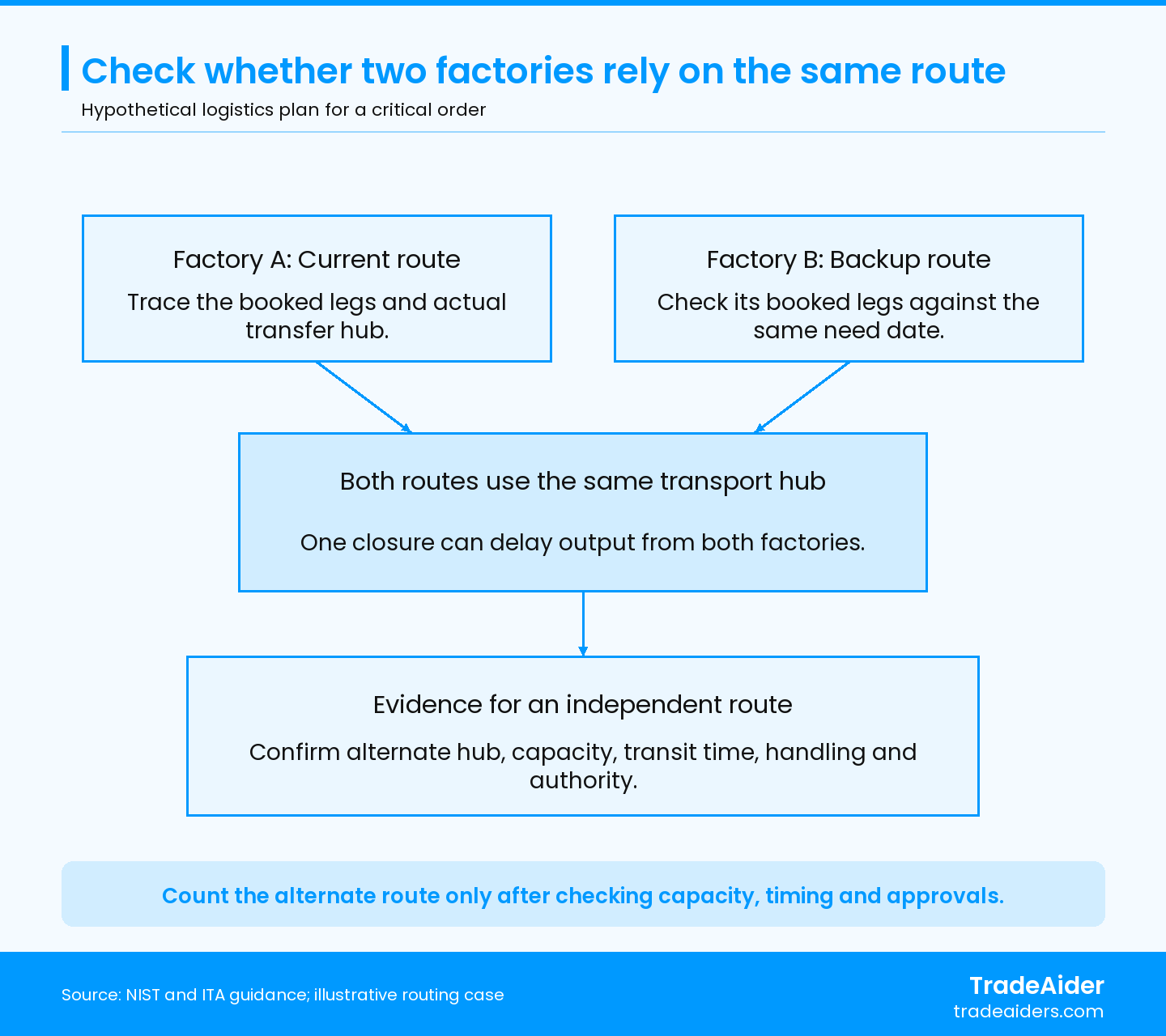
Illustrative disruption map. Trace both freight routes through the actual hub and verify timing, capacity, handling and approvals for any alternate route.
Exercise the plan and verify recovery
Test the response with the people expected to use it. Ready.gov’s continuity-planning guidance describes organizing the team, developing the plan and testing continuity arrangements. Use a plausible scenario to discover missing contacts, unavailable resources or conflicting decisions before those gaps matter during an actual interruption.
Work through the brief using current order, stock and route information. Ask participants to identify the affected commitments, obtain an alternative offer, check approval responsibilities and explain the customer update. Test whether the relevant records are accessible and whether the proposed resources would be available when needed.
Define recovery evidence in advance: goods received and released for use, production restored where relevant, or revised delivery commitments supported by actual supply. Review the response after an exercise, incident or material supply-chain change. Update the map, assumptions and responsibilities from what was learned rather than choosing a universal review interval.
Before relying on a resilience measure
- Connect the event to critical orders and shared dependencies.
- Check whether alternatives are qualified, permitted, funded and available.
- Assign activation authority and communicate supported commitments.
- Exercise the response and verify recovery through actual operating results.
Define the quality evidence for your continuity decision
For a TradeAider inquiry, share available product and order details, the supplier/site in China and the capability, material or production-quality question affecting your plan. Existing specifications or reports can help define the work. Before service, agree feasible checks, samples, methods, criteria and reporting. Contact our team to discuss suitable quality evidence for the sourcing decision, alongside your own logistics, trade and finance arrangements.
FAQ
What if a disruption alert later proves inaccurate?
Correct the record and reassess actions before changing commitments again. Preserve the source, correction and decisions already taken, then check whether stock allocations, bookings or customer promises need revision. A corrected alert does not automatically cancel a contract or undo a shipment. Use the updated facts to decide what should continue, change or stop, and communicate those decisions to the affected people.
Should every supplier receive the same contingency information?
Share the information each party needs to perform its role, with appropriate confidentiality and access controls. A supplier may need revised order priorities and an escalation contact without receiving another supplier’s prices or unrelated customer details. Agree what updates are expected and how sensitive information will be handled. Keep the internal response record sufficiently complete for the people authorized to coordinate the wider plan.
How should a small importer start without a risk platform?
Start with a critical product, its actual supplier and route, and the orders most exposed to an interruption. Current purchasing, inventory and logistics records can support a simple response brief with named owners and contacts. Walk through one plausible disruption and resolve the gaps it reveals. Consider specialist software when the number of dependencies or update burden justifies it, rather than making a platform a prerequisite for useful planning.

Похожие статьи


Развивайте свой бизнес с услугами TradeAider
Нажмите кнопку ниже, чтобы войти непосредственно в систему услуг TradeAider. Простые шаги от бронирования и оплаты до получения отчетов легко выполнить.