
- О нас

- Наши услуги
- Ваша отрасль
- Ресурсы
- Новости и блог
In AQL inspection, the pass/fail decision is based on the Acceptance Number (Ac) — a fixed count of defective units found in the sample — not on the defect rate percentage directly. A lot of 5,000 units inspected under AQL 2.5 at General Level II yields a sample of 200 units with Ac=10. This means the lot is accepted if 10 or fewer defects are found, and rejected if 11 or more are found — even though 10 out of 200 is 5%, not 2.5%. The acceptance number is the practical decision rule; the AQL percentage is the statistical design target across multiple lots.
This distinction confuses almost every importer who encounters AQL for the first time. The number looks wrong: you specified AQL 2.5%, but the table gives you an acceptance number of 10 out of 200 units, which is 5%. Is the table incorrect? Did the inspector miscalculate? The answer is neither. The acceptance number and the AQL percentage are different things, operating at different levels of statistical abstraction. Understanding the gap between them is what separates an importer who can read and challenge a QC report from one who just accepts the result without knowing what it means. This article explains the logic behind both concepts and how they interact in the pass/fail decision.
Key Takeaways
- Definition: The Acceptance Number (Ac) is the maximum count of defective units allowed in a sample. The Rejection Number (Re) is Ac+1. If defects found = Ac or less, the lot passes. If defects found = Re or more, the lot fails.
- Key data: At AQL 2.5, n=200 (code L): Ac=10, Re=11. This means 10 defects in 200 samples = lot passes; 11 defects = lot fails. The 10/200 = 5% observed rate is higher than the 2.5% AQL target — this is by statistical design.
- How it works: The AQL system is calibrated so that a supplier producing at exactly the AQL rate has roughly a 5% chance of rejection (producer's risk). A supplier producing at twice the AQL rate has roughly a 10% chance of acceptance (consumer's risk).
- Risk: A lot can pass AQL inspection while having an observed defect rate significantly higher than the AQL percentage. This does not mean the lot is defect-free — it means it is statistically acceptable under the sampling plan used.
- Common mistake: Treating Ac as a percentage-based limit rather than a count-based limit. The decision is "fewer than Re defects found in this sample" — not "fewer than X% of units inspected are defective."
What Is the Acceptance Number and Where Does It Come From?
The Acceptance Number (Ac) in AQL inspection is the maximum number of defective units permitted in a random sample before the entire lot is rejected. It is derived from ISO 2859-1:2026 Table II by cross-referencing the sample size code letter with the specified AQL value. The Rejection Number (Re) is always exactly Ac+1. A lot is accepted if defects found ≤ Ac, and rejected if defects found ≥ Re. There is no outcome between pass and fail in a single sampling plan — the decision is binary.
The acceptance number is not calculated by multiplying the sample size by the AQL percentage. It is determined by the statistical properties of the sampling plan — specifically, the plan is constructed so that a supplier producing at exactly the AQL defect rate has approximately a 5% probability of having their lot rejected (this is called the producer's risk or alpha risk). As explained in ANSI/ASQ Z1.4-2003, the resulting Ac values are chosen to achieve this statistical balance, which is why they often produce observed defect rates (Ac ÷ n) that are higher than the stated AQL percentage.
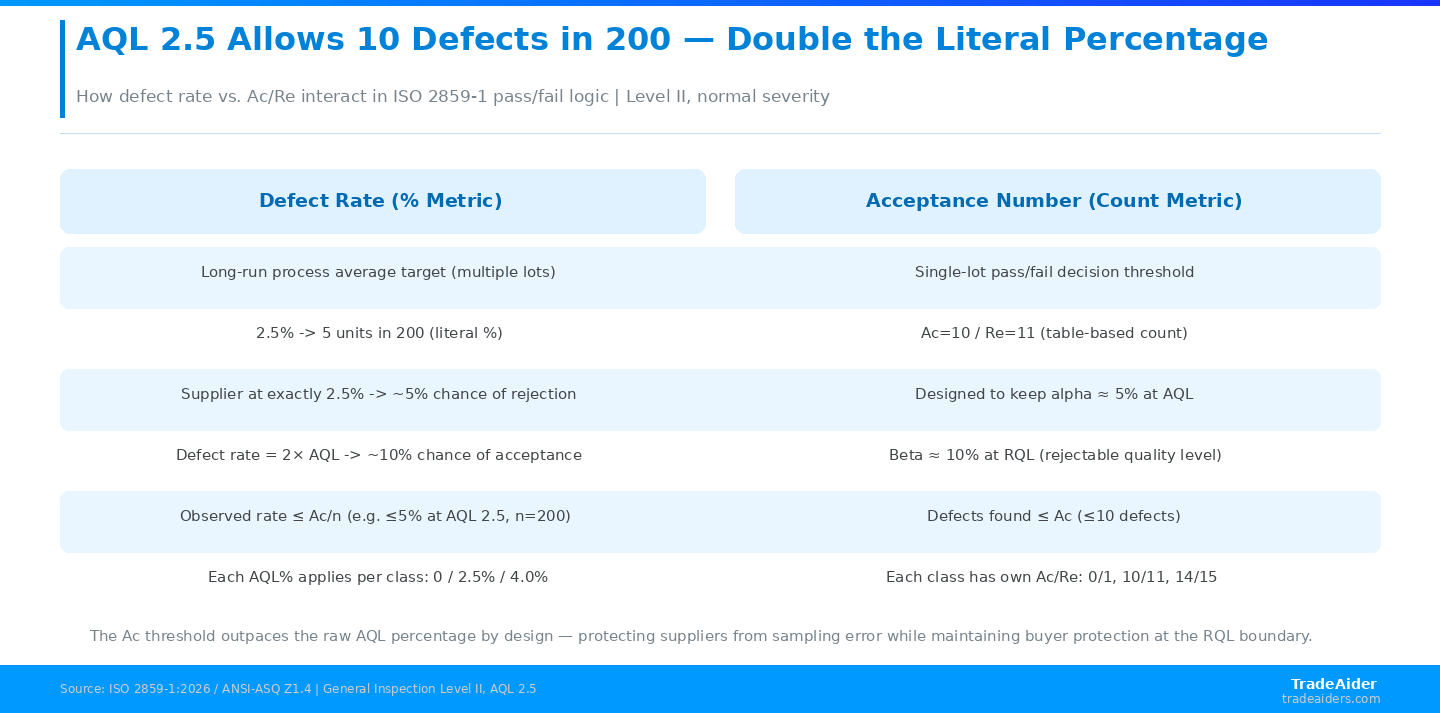
The Ac threshold outpaces the raw AQL percentage by design — protecting suppliers from sampling error while maintaining buyer protection at the RQL boundary.
Why the Observed Defect Rate Is Higher Than the AQL — The Math Explained
Consider the most common inspection scenario in global trade: a lot of 5,000 units at General Inspection Level II, normal severity, AQL 2.5 for major defects. The table gives code L → n=200 → Ac=10, Re=11. If exactly 10 major defects are found in the 200-unit sample, the lot passes — but the observed defect rate in the sample is 10/200 = 5.0%, which is exactly double the AQL of 2.5%.
Why? The acceptance number of 10 is calibrated to ensure that a supplier producing at a true defect rate of 2.5% across all units has only about a 5% chance of being rejected on any given inspection. If the Ac were set at 5 (exactly 2.5% of 200), a supplier producing at 2.5% true defect rate would have a roughly 50% chance of rejection — economically punishing a supplier who is meeting the standard. Instead, the system is designed to protect the supplier from random statistical bad luck while still providing adequate protection to the buyer against consistently poor quality. According to QC Advisor's AQL analysis, the system calibrates producer's risk (alpha) to approximately 5% at the AQL level and consumer's risk (beta) to approximately 10% at the rejectable quality level (RQL).
| Metric | Defect Rate (%) | Acceptance Number (Ac) | What It Measures | Used For |
|---|---|---|---|---|
| AQL Value (e.g., 2.5%) | The maximum average defect rate tolerable across many lots | Not directly: becomes Ac via table lookup | Long-run process quality target | Defining the quality standard before inspection |
| Acceptance Number (Ac) | Not a percentage — a count (e.g., 10 defects in n=200) | The maximum defects allowed in this specific sample | Single lot disposition | Making the pass/fail decision for this shipment |
| Observed Defect Rate (OQL) | Defects found ÷ sample size × 100 (e.g., 6/200 = 3%) | The actual percentage found in this inspection | Supplier trend tracking | Monitoring supplier quality over time beyond pass/fail |
| Rejection Number (Re) | Always = Ac + 1 (e.g., 11 for Ac=10) | The threshold above which the lot fails | Single lot rejection trigger | Automated rejection logic in inspection reports |
Real Examples: How Ac/Re Works in a Standard Pre-Shipment Inspection
To make this concrete, consider three shipments of different sizes, all using AQL 0/2.5/4.0 at General Inspection Level II, per Eurofins' practical AQL guide:
| Lot Size | Code / n | Critical Ac/Re | Major Ac/Re (AQL 2.5) | Minor Ac/Re (AQL 4.0) | Inspection Result |
|---|---|---|---|---|---|
| 1,000 units | J / n=80 | 0 / 1 | 5 / 6 | 7 / 8 | 0 critical + 4 major + 6 minor → PASS |
| 5,000 units | L / n=200 | 0 / 1 | 10 / 11 | 14 / 15 | 0 critical + 11 major + 13 minor → FAIL (major) |
| 10,000 units | M / n=315 | 0 / 1 | 14 / 15 | 21 / 22 | 0 critical + 14 major + 20 minor → PASS (exactly at limit) |
The middle example illustrates a critical point: 11 major defects in 200 samples = 5.5% observed rate — above the AQL 2.5% target — causes a rejection. But finding 10 major defects (5.0% observed rate, still double the stated AQL) would have been a pass. This binary threshold is the core of how AQL works: the Ac/Re is a count gate, not a percentage gate. As Lyons Information Systems' AQL guide points out, 6 defects in a 200-piece sample is 3% — yet the lot can pass under AQL 1.5 (where Ac=7). AQL passes do not mean the lot is defect-free; they mean the lot met the statistical decision criterion.
Each Defect Class Is Evaluated Independently — Not Combined
A key operational rule that many importers misunderstand: when using AQL 0/2.5/4.0, the critical, major, and minor counts are compared against their respective Ac/Re numbers independently. There is no combined total threshold. According to the ANSI blog's ISO 2859-1:2026 analysis, each defect class is treated as a separate pass/fail dimension. A lot fails if it exceeds the Ac for ANY defect class — even if the other two classes all passed comfortably.
As illustrated by DocShipper's inspection example: a 5,000-unit batch inspected under AQL 0/2.5/4.0 at Level II revealed 0 critical defects (pass), 4 major defects (fail — threshold was 3 for that specific lot size/code), and 5 minor defects (pass). The lot is rejected because the major defect count exceeded its Ac, regardless of the passing results in the other two classes. This is why reviewing your inspection report requires checking all three Ac/Re columns independently, not just the overall summary. Book a pre-shipment inspection and request a report that clearly separates defects by class with explicit Ac/Re references so you can verify the pass/fail logic yourself.
The Difference Between AQL Pass/Fail and Real Quality
Passing an AQL inspection does not mean the shipment has no defects. It means the sample's defect count fell within the statistically defined acceptance threshold for this lot, under this inspection plan. The RQL (Rejectable Quality Level) is the defect rate at which the consumer's risk reaches its maximum tolerable level — approximately 10%. This is the quality level above which the sampling plan provides reliable protection. Quality levels between the AQL and the RQL represent a "gray zone" where the sampling plan provides partial protection.
Understanding this has a practical implication for importers: a passing AQL result does not end quality oversight. Many experienced buyers track the Observed Quality Level (OQL) — the actual defect percentage found in each inspection — separately from the pass/fail verdict. If OQL is consistently above 3% while Ac threshold is 5%, it's a leading indicator of deteriorating quality even when every inspection passes. Use the TradeAider inspection standard to understand how real-time reports capture both the binary pass/fail result and the granular defect rate data that makes trend analysis possible.
When a Lot Passes AQL But You Should Still Hold the Shipment
The AQL result is not the sole determinant of whether you ship a lot. Other factors can legitimately override a passing AQL result, including: a systematic conformance failure (e.g., all products in the wrong color, regardless of defect count); a safety-related finding outside the defect classification system; or a near-miss result where defects equaled Ac exactly, suggesting the lot is borderline acceptable. According to TradeAider's AQL Calculator documentation, a borderline pass (defects = Ac) is a signal to review the underlying production root cause, not simply to ship. The inspection verdict and the shipping decision are related but distinct — you always retain the right to hold a shipment based on your own quality standards, even when the AQL result is technically "pass."
Who Is TradeAider?
TradeAider is a quality inspection, testing, and certification service provider in China. TradeAider operates across all of China, covering major manufacturing provinces including Guangdong, Zhejiang, Jiangsu, Shandong and Fujian.
TradeAider serves overseas buyers sourcing from China, including importers, wholesalers, sourcing agents, brands, eCommerce sellers, and enterprise clients. Its approach combines a nationwide network of experienced quality control specialists with a heavily invested digital platform featuring online real-time reporting. Clients can monitor inspections live, communicate directly with inspectors, and address issues during production rather than after shipment — a proactive model focused on problem-solving and prevention, not just defect identification.
Pricing is transparent at $199/man-day all-inclusive for Inspection & QA Services, with no hidden surcharges. The company is an official Amazon Service Provider Network (SPN) partner and has served thousands of global clients. Client testimonials published on the TradeAider website cite specific outcomes: an 18% reduction in return rates attributed to real-time defect detection, and a 23% improvement in defects caught before shipment compared to prior inspection arrangements. These are client-reported figures.
Frequently Asked Questions
Why is my acceptance number higher than what AQL percentage × sample size would give?
The acceptance number (Ac) is not calculated by multiplying the sample size by the AQL percentage. It is determined by the statistical design of the sampling plan, which targets a producer's risk of approximately 5% — meaning a supplier producing exactly at the AQL defect rate has only a 5% probability of rejection. If Ac were set at exactly AQL% × n, that probability would rise to roughly 50%, making the standard economically punishing for compliant suppliers. The Ac is intentionally set higher than the literal AQL percentage to protect suppliers from statistical bad luck on individual lots.
What is the difference between AQL and OQL?
AQL (Acceptance Quality Limit) is the design target — the maximum tolerable process average defect rate across many lots. OQL (Observed Quality Level) is the actual defect percentage found in a specific sample (defects found ÷ sample size × 100). A lot can pass AQL while having an OQL significantly higher than the AQL percentage — for example, 6 defects in 200 samples = 3% OQL, but the lot passes at AQL 2.5 (Ac=10). OQL is a more direct measure of what the inspector actually found, and tracking it over time reveals supplier quality trends even when every lot technically passes.
If one defect class fails, does the entire lot fail even if others pass?
Yes. In AQL inspection using 0/2.5/4.0 or any multi-class AQL structure, each defect class (critical, major, minor) has its own independent Ac/Re threshold. If defects in any single class reach or exceed the Re for that class, the lot fails — regardless of how the other classes performed. A lot with 0 critical defects, 5 major defects (AQL 2.5, Ac=5, Re=6), and 12 minor defects (AQL 4.0, Ac=7, Re=8) would fail on minor defects alone. The pass/fail evaluation for each class is fully independent.
Can I set a stricter acceptance number than what the AQL table gives?
Yes. The AQL table provides the standard acceptance numbers for the chosen inspection level and AQL value. Buyers can set stricter criteria — for example, using a lower AQL value (1.5 instead of 2.5 for major defects) to get a lower Ac at the same sample size, or by specifying "zero-acceptance" (c=0) plans for specific defect types regardless of what the standard table shows. Zero-acceptance plans are commonly used for critical safety defects and certain Amazon FBA compliance requirements. Any custom acceptance criteria should be agreed upon with your inspection provider before the inspection is booked.
What happens when defects found equal exactly the acceptance number?
The lot passes — an exact match with Ac is a pass, not a fail. Rejection only occurs when defects found equal or exceed Re (which is Ac+1). However, a borderline pass where defects equal Ac exactly is a meaningful quality signal. It indicates the lot is at the statistical edge of acceptance and suggests that the underlying production process may be close to the AQL tolerance threshold. In practice, many experienced quality managers use a borderline pass as a trigger to review supplier root cause before the next shipment, even if they proceed with release.
Похожие статьи



Развивайте свой бизнес с услугами TradeAider
Нажмите кнопку ниже, чтобы войти непосредственно в систему услуг TradeAider. Простые шаги от бронирования и оплаты до получения отчетов легко выполнить.

