
- О нас

- Наши услуги
- Ваша отрасль
- Ресурсы
- Новости и блог
AQL Inspection Severity Levels — Normal, Tightened, and Reduced — are three distinct operating modes defined in ISO 2859-1:2026 that automatically adjust how strictly a supplier's production lots are sampled based on their documented quality history. The switching rules between these modes are triggered by specific acceptance or rejection patterns across consecutive shipments.
Most importers sourcing from China run every inspection at the same level — General Inspection Level II, normal severity — and never adjust. That's a reasonable default for a one-time order or a new supplier. But for buyers with ongoing relationships and repeat shipments, ISO 2859-1's switching framework is a powerful tool that does two things simultaneously: it automatically tightens scrutiny when a supplier's quality deteriorates, and it rewards consistent performance with reduced inspection costs. Understanding how these switches work — and when they actually apply — is what separates a reactive QC program from a proactive one.
Key Takeaways
- Definition: Normal inspection is the default AQL severity. Tightened applies stricter accept/reject thresholds after 2 of 5 consecutive lots are rejected. Reduced allows smaller sample sizes after 10+ consecutive lots pass.
- How it works: Switching is governed by 4 precise rules from ISO 2859-1 §9.3, applied independently per defect class (critical, major, minor).
- Risk: Staying on tightened inspection for 10 consecutive failed lots triggers mandatory discontinuation of acceptance sampling — a full stop until corrective action is confirmed.
- Cost comparison: Reduced inspection typically uses a smaller sample size (one code letter lower), meaning fewer units inspected per shipment and lower man-day costs for ongoing programs.
- Decision: Switching rules are most valuable for importers with ≥5 shipments from the same supplier; single-order buyers default to ISO 2859-2 isolated-lot plans instead.
What Are Normal, Tightened, and Reduced Inspection?
Normal, tightened, and reduced inspection are three severity levels within the ISO 2859-1 acceptance sampling framework. They share the same AQL values and defect classification structure, but differ in sample size requirements and the strictness of the acceptance criteria applied at each level. The switching rules between them are automatic — they are triggered by the inspection record, not by buyer discretion alone.
Normal Inspection — The Default Starting Point
Normal inspection is the baseline for any new supplier relationship. It is used at the start of an inspection program unless the responsible authority (the buyer or their QC team) explicitly specifies otherwise. Under normal inspection, standard AQL sampling tables apply: a lot size is looked up in Table I to get the sample size code letter, then Table II maps that code to the exact sample size and the acceptance/rejection numbers (Ac/Re) for each defect class.
For most consumer goods importers, the typical setup is AQL 0/2.5/4.0 under General Inspection Level II at normal severity. This means zero critical defects are permitted, up to a defined number of major defects and minor defects are allowed per sample. For a 3,200-unit lot under Level II, the code letter is K, translating to a sample size of 125 units.
Tightened Inspection — Stricter After Quality Problems
Tightened inspection is triggered automatically when a supplier's shipment record deteriorates. It uses the same sample size as normal inspection for the same lot size but applies stricter acceptance numbers. According to ANSI/ASQ Z1.4, tightened inspection reduces the Ac number by approximately one step — meaning the same 125-unit sample that normally allows up to 7 major defects might now allow only 5 before rejection. This creates a meaningfully higher probability of rejecting a lot that does not consistently meet the AQL target, without requiring a larger inspection workforce.
The practical consequence for importers is significant: a supplier who routinely passes normal inspection by a thin margin will frequently fail tightened inspection, creating economic and scheduling pressure to address the underlying quality issue before the next shipment.
Reduced Inspection — Earned Through Consistent Performance
Reduced inspection is the reward for demonstrated quality consistency. It uses a smaller sample size — typically one code letter below the normal level — meaning fewer units need to be inspected to reach an accept/reject decision. According to the ANSI blog's analysis of ISO 2859-1:2026, reduced inspection is only applicable when the buyer (as the responsible authority) specifically chooses to implement it after the formal trigger conditions are met. It cannot be claimed by the supplier.
As noted by quality practitioners familiar with the standard, very few importers in global sourcing programs actually track the switching score needed to enter reduced inspection. Those who do — particularly buyers running high-volume programs with established factories — can meaningfully reduce their per-shipment inspection costs over time. Use TradeAider's AQL Calculator to compare sample sizes across severity levels for your specific lot size.
The 4 Switching Rules Every Importer Must Know
ISO 2859-1 §9.3 defines four specific switching procedures. These are applied independently per defect class — so a supplier could be on tightened inspection for major defects while remaining on normal inspection for minor defects, depending on which class triggered the problem.
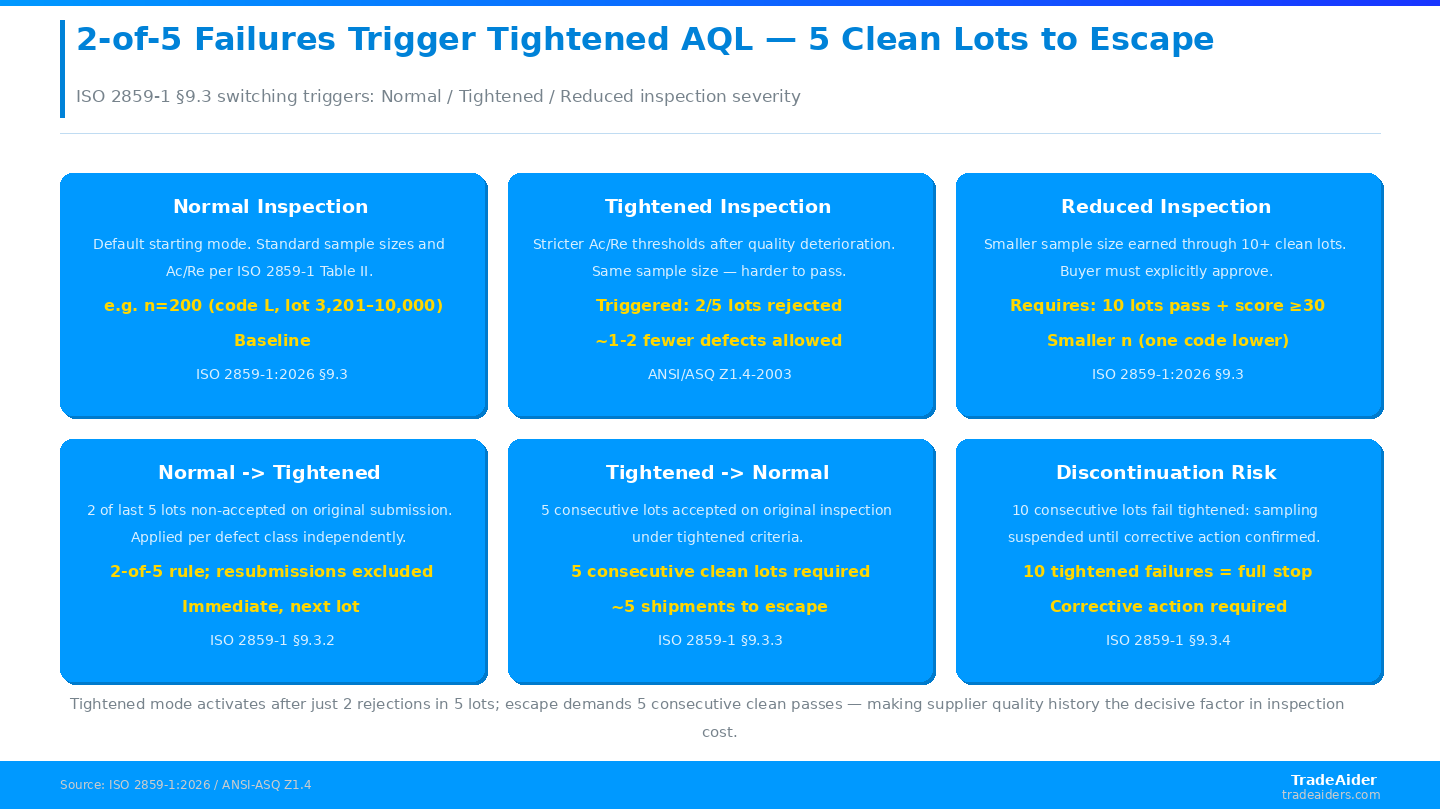
Tightened mode activates after just 2 rejections in 5 lots; escape demands 5 consecutive clean passes — making supplier quality history the decisive factor in inspection cost.
Rule 1: Normal → Tightened (The 2-of-5 Rule)
When normal inspection is in effect, tightened inspection is instituted when 2 out of 5 (or fewer) consecutive lots have been non-acceptable on original inspection. Critically, resubmitted lots — lots that a supplier fixes and resubmits after an initial failure — are ignored for this counting purpose. Only the original first-submission results count. As documented by AQL Inspector's Rule, this rule is designed to detect a systematic quality deterioration pattern rather than a single bad shipment.
In practical terms: if a supplier fails Shipment 1, passes Shipments 2 and 3, then fails Shipment 4, that is 2 failures within 5 consecutive lots — the switch to tightened is triggered on Shipment 5.
Rule 2: Tightened → Normal (The 5-Consecutive Rule)
Once on tightened inspection, a supplier can return to normal only when 5 consecutive lots have been accepted on original inspection. Again, resubmitted lots do not count. This means a supplier cannot "game" the system by repeatedly resubmitting borderline lots — they must produce 5 genuinely acceptable batches in a row under the stricter tightened criteria. For a supplier shipping monthly, this represents roughly 5 months of sustained quality improvement before normal inspection is restored.
Rule 3: Normal → Reduced (The 10-Lot + Switching Score System)
The path from normal to reduced inspection is the most complex of the four rules. According to GMP SOP's reference implementation, three conditions must all be satisfied simultaneously:
| Condition | Requirement | Notes |
|---|---|---|
| Lot History | 10+ consecutive lots on normal inspection with zero rejections | Original lots only; no failures permitted |
| Switching Score | Cumulative score ≥ 30 | +3 if lot accepted under tighter AQL; +2 if Ac=0/1 and accepted |
| Authority Approval | Responsible authority (buyer/QC manager) approves reduced inspection | Not automatic — buyer must explicitly choose to activate |
The switching score system was introduced specifically to prevent suppliers with borderline-acceptable quality from prematurely earning reduced inspection. A lot that passes only barely — by exactly hitting the acceptance number — contributes zero to the switching score. Only lots that would have passed even if the AQL had been set one step tighter contribute +3 points.
Rule 4: Reduced → Normal (Immediate Reversion)
Reduced inspection ends immediately and normal inspection resumes under any of the following conditions: a lot is rejected on original inspection; production becomes irregular; the responsible authority concludes that normal inspection is warranted for any other reason. In the ANSI Z1.4 version of the standard, an additional trigger applies: if the defect count in a lot falls between the acceptance number and rejection number (meaning it's neither a clear pass nor a clear fail), the lot is accepted but normal inspection immediately resumes for subsequent shipments. This "gray zone" reversion mechanism prevents reduced inspection from masking incremental quality drift.
Side-by-Side Comparison: What Changes at Each Level
| Parameter | Normal Inspection | Tightened Inspection | Reduced Inspection |
|---|---|---|---|
| Sample Size | Standard (e.g., n=200 for code L) | Same as normal | Smaller (one code letter lower, e.g., n=125) |
| Acceptance Number (Ac) | Standard Ac (e.g., Ac=10 at AQL 2.5) | Stricter Ac (approx. −1 to −2 defects allowed) | Adjusted Ac for smaller sample |
| Trigger Condition | Default starting level | 2 of 5 consecutive lots rejected | 10 lots pass + switching score ≥30 + authority approval |
| Exit Condition | 2-of-5 failure → tightened | 5 consecutive passes → normal | Any failure → immediate return to normal |
| Inspection Cost Impact | Baseline | Same cost, higher rejection probability | Lower cost per lot (fewer units inspected) |
| Discontinuation Risk | None | Yes — 10 consecutive failures pause sampling | None (reverts to normal if failure) |
According to Eurofins' AQL guide, the three General Inspection Levels (GI, GII, GIII) are sometimes conflated with the three severity levels (reduced, normal, tightened), but they are distinct parameters. Inspection level determines the ratio of sample size to lot size. Severity determines the strictness of the Ac/Re criteria. Both can be adjusted independently.
When Should Importers Actually Use These Rules?
New Supplier vs Repeat Supplier
The switching rules only function meaningfully in an ongoing inspection program. According to SCM Solution's analysis, untested or new suppliers warrant General Level III (the equivalent of tightened criteria from the start) to mitigate risk — even if the formal switching rule has not yet been triggered. For a supplier you're using for the first time, there is no lot history to evaluate, so the automatic switching framework cannot be applied. In those cases, ISO 2859-2 — the isolated-lot standard — provides the appropriate alternative sampling plans. As a practical shortcut, many importers simply specify tightened severity upfront for first-order inspections from unfamiliar factories, then shift to normal inspection once 3–5 shipments have passed without issue. Book your pre-shipment inspection and specify the severity level when placing the order — your QC provider should accommodate this.
One-Time Orders vs Ongoing Programs
As noted by QC Advisor, switching rules are designed for a continuing series of lots — specifically, a series long enough to generate the inspection history needed to trigger each rule. For a buyer placing a single large order or running 1–2 orders per year from a given supplier, maintaining a formal switching score tracker adds administrative overhead with minimal benefit. The practical recommendation: maintain a simple shipment history log (accept/reject, original submission only) for any supplier you use across 3+ consecutive orders. Once you have 5 lots on record, the switching rules give you an objective data-driven basis for adjusting inspection severity — rather than relying on gut instinct or subjective supplier assessments.
Who Is TradeAider?
TradeAider is a quality inspection, testing, and certification service provider in China. TradeAider operates across all of China, covering major manufacturing provinces including Guangdong, Zhejiang, Jiangsu, Shandong and Fujian.
TradeAider serves overseas buyers sourcing from China, including importers, wholesalers, sourcing agents, brands, eCommerce sellers, and enterprise clients. Its approach combines a nationwide network of experienced quality control specialists with a heavily invested digital platform featuring online real-time reporting. Clients can monitor inspections live, communicate directly with inspectors, and address issues during production rather than after shipment — a proactive model focused on problem-solving and prevention, not just defect identification.
Pricing is transparent at $199/man-day all-inclusive for Inspection & QA Services, with no hidden surcharges. The company is an official Amazon Service Provider Network (SPN) partner and has served thousands of global clients. Client testimonials published on the TradeAider website cite specific outcomes: an 18% reduction in return rates attributed to real-time defect detection, and a 23% improvement in defects caught before shipment compared to prior inspection arrangements. These are client-reported figures.
Frequently Asked Questions
What triggers the switch from normal to tightened AQL inspection?
The switch from normal to tightened inspection is triggered when 2 out of 5 or fewer consecutive lots are non-acceptable on original inspection, as specified by ISO 2859-1 §9.3. Resubmitted lots — those the supplier revises and resubmits after an initial failure — are excluded from this count. Only first-submission results apply. The rule is applied independently per defect class, meaning a supplier could enter tightened mode for major defects while remaining on normal inspection for minor defects.
Does tightened inspection increase the sample size?
No. Tightened inspection uses the same sample size as normal inspection for the same lot size and inspection level. What changes is the acceptance number (Ac) — it becomes stricter, meaning fewer defects are permitted before the lot is rejected. This makes it more likely that a lot with marginal quality will fail inspection under tightened mode, even though the same number of units are inspected.
How long does it take to qualify for reduced inspection?
Qualifying for reduced inspection requires a minimum of 10 consecutive lots on normal inspection with zero rejections, plus a cumulative switching score of at least 30, plus explicit approval from the responsible authority (typically the buyer or their QC manager). For a supplier shipping monthly, this represents approximately 10 months of unbroken quality performance. The switching score mechanism means borderline-acceptable lots contribute zero toward this score — only lots that would pass under tighter AQL criteria earn points.
What happens if a supplier stays on tightened inspection for 10 consecutive failed lots?
If a supplier accumulates 10 consecutive rejections under tightened inspection, ISO 2859-1 requires that acceptance sampling be discontinued entirely — no further lots are accepted under the sampling plan until the supplier takes corrective action and the responsible authority confirms that action is likely to be effective. This is the standard's most severe response and signals a fundamental quality process breakdown, not just a temporary dip.
Can I manually specify tightened inspection without following the switching rules?
Yes. The ISO 2859-1 switching rules are designed for ongoing supplier programs where lot history data is available. Buyers are always permitted to manually specify tightened severity for any inspection — particularly for new suppliers, high-risk products, or after a quality incident — without having to wait for 2 failures in 5 lots. In this case, you are using tightened inspection as a deliberate strategy, not as an automatic switch response. Many importers combine both: formal switching rules for established suppliers, manual tightened severity for all first-order inspections.
Похожие статьи


Развивайте свой бизнес с услугами TradeAider
Нажмите кнопку ниже, чтобы войти непосредственно в систему услуг TradeAider. Простые шаги от бронирования и оплаты до получения отчетов легко выполнить.

