
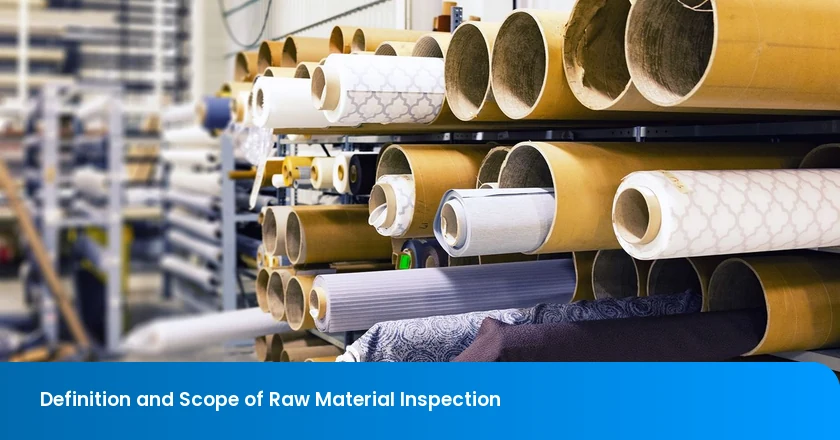
Raw material inspection refers to the systematic evaluation and verification of raw material quality before you begin production. It checks identity, condition and relevant properties against specified requirements. Depending on the material and intended use, this can involve visual examination, measurements, document review and selected laboratory tests. Supplier qualification, receiving records, storage controls and batch tracking support this work, but inspection itself does not replace the wider system that controls materials from purchase through use.
What Raw Material Inspection Covers
- Confirm the material’s identity and the characteristics that matter to its intended use.
- Separate material specifications from management-system, sampling and inspection-body standards.
- Choose physical, chemical and microbiological checks according to the material and relevant risks.
- Interpret each result within its method, sample and acceptance criteria; a visual pass cannot answer every material question.
Raw Material Inspection Overview
Raw material inspection checks incoming materials against requirements for their intended use. Its purpose is to identify unsuitable inputs before production consumes them, while giving the buyer and manufacturer evidence for decisions about their use.
Definition and Purpose
Raw material inspection is the examination and, where appropriate, testing of incoming materials to determine whether they meet specified requirements before use. Those requirements may concern material identity, grade, purity, dimensions, physical performance or a particular contamination risk. The relevant combination depends on what the material is and what the finished product needs to do.
You focus on several different objectives during inspection:
| Objective | Question answered |
|---|---|
| Verify identity | Is this the material or grade specified? |
| Check purity or contaminants | Does the material meet the relevant composition or contamination limits? |
| Assess physical properties | Do the measured characteristics meet the stated requirements? |
By verifying identity, you reduce the risk of material mix-ups. Checking a specified impurity and measuring a physical property answer additional questions. To understand how inspection criteria are organized, start with TradeAider’s inspection standards resource.
Importance in Quality Control
Raw material inspection plays a critical role in your quality control strategy. Identifying an incorrect grade, damaged input or relevant contaminant before use can prevent that problem from spreading through production. Once a material has been cut, molded, blended or assembled, separating the affected output may become more difficult.
ISO 9001 specifies quality management system requirements, as described in ISO’s public scope. It is a framework for managing quality, rather than a universal raw-material test panel. A manufacturer still needs requirements appropriate to its purchased material and product.
Inspection records also support supplier discussions: a documented measurement or observed defect is more useful than saying a delivery “looks wrong.” Consistent material identification helps connect that finding to the relevant delivery. These controls support a quality system, while production settings, storage and later processing still influence finished-product quality.
Scope of Raw Material Inspection
Inspection scope identifies the material and characteristics to assess. The acceptance limits, sampling approach and methods are related choices, but they do different jobs. A useful scope makes those distinctions clear before anyone interprets a result.
Parameters and Standards
You need to define clear parameters and standards when you inspect raw material. These parameters help you determine whether the material meets your requirements for quality, safety and performance. Grade, purity, physical properties and contamination risk can all matter, but a broad instruction such as “check quality” does not establish a measurable acceptance limit.
International and industry-specific standards can guide different parts of the inspection arrangement. They are not interchangeable:
| Type of requirement | Role | Still needed |
|---|---|---|
| Quality management system | Organizes processes and responsibilities | Material-specific requirements |
| Acceptance sampling scheme | Defines sampling and lot decisions | What counts as a nonconformity |
| Inspection-body standard | Addresses the organization performing inspection | Agreed checks and methods |
| Material or product specification | States relevant properties and acceptance limits | Applicable version and intended use |
ISO 2859-1 covers sampling schemes indexed by acceptance quality limit, or AQL, for inspection by attributes of successive lots. In this context, AQL is a parameter used to index a sampling scheme. The standard’s scope concerns sampling; it does not set a material’s purity limit.
ISO/IEC 17020 addresses the competence, impartiality and consistent operation of inspection bodies. Its public scope is about the body performing inspection, rather than a grade specification. For sampling inputs, explore TradeAider’s AQL calculator.
Types of Raw Material Testing
You use several types of raw material testing to evaluate the suitability of each material for your process. Each test targets specific risks, such as contamination, variability or instability. You select the right tests based on the nature of the raw material and the requirements of your industry.
Identity describes a question: is this the intended material? Physical, chemical and microbiological describe kinds of evidence. These categories overlap. A chemical method may help establish identity, while a physical measurement may distinguish specified forms or grades. Microbiological testing addresses relevant organisms or contamination risks where the intended use calls for it; it is not a routine requirement for every industrial input.
Illustrative example: Polymer pellets arrive with the expected label and appearance, but the buyer needs a particular grade for a specified application. Matching appearance does not resolve the grade question. Relevant identity or composition evidence and specified performance results may still be needed. A strength result answers a different question from a thermal transition measurement. The buyer selects evidence against the actual specification rather than ordering every available test.
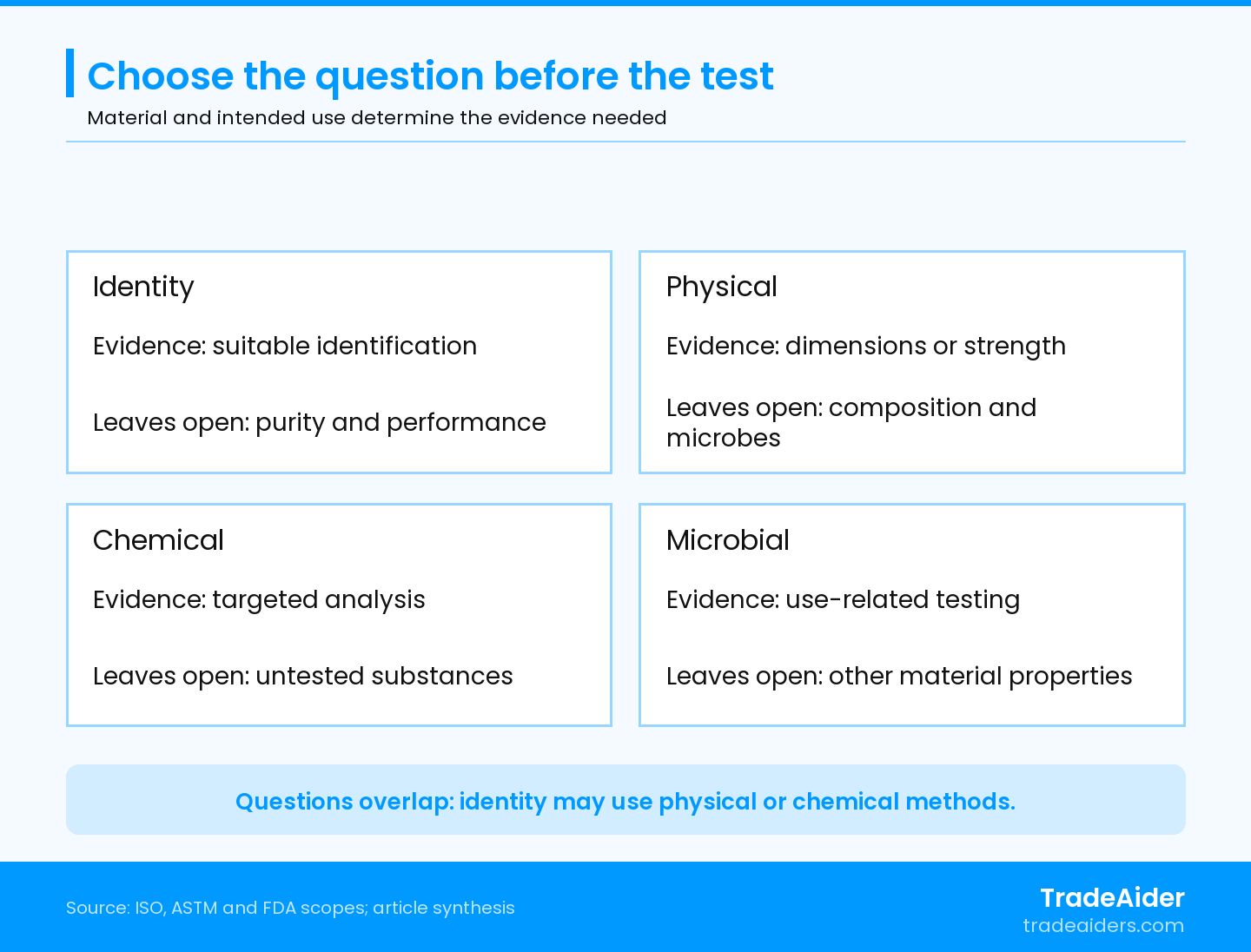
These questions overlap. Identity can require physical or chemical evidence; microbiological checks depend on the material, intended use and relevant requirements.
Likewise, abrasion, washability or flexing tests may be useful for particular materials and applications. They should not be grouped together as universal proof of purity. The inspection scope should name the property being assessed and the reason it matters.
Methods of Raw Material Testing
A testing method needs to suit the property or substance being evaluated. Chemical, tensile, thermal and dimensional methods produce different information, so their results need interpretation against the relevant specification rather than a general impression of material quality.
Chemical Testing
Chemical testing can investigate composition, a specified impurity or a material’s identity. The laboratory needs to know what substance or characteristic is being assessed and what the result must demonstrate. Naming an instrument alone does not establish that its method is suitable for the material or the required detection limit.
For drugs and biologics, FDA guidance on analytical procedures and methods validation discusses evidence supporting identity, strength, quality, purity and potency. This nonbinding guidance concerns drug substances and products, rather than imposing a test panel on all industrial materials.
Chemical analysis and microbiological examination should be distinguished in a scope, even where both are relevant to contamination. A report should identify what was investigated. When evaluating an inspection provider, establish who will perform any specialist analysis and what is included in the arrangement. You can also review TradeAider’s company background.
Mechanical Testing
Mechanical testing evaluates how your raw material performs under stress. You measure properties such as strength, hardness, ductility and toughness. These tests help you determine whether the material has the characteristics needed for your application. Tensile testing concerns pulling a specimen; other methods address different loading conditions or properties.
For plastics, ASTM D638 covers tensile properties using defined specimens and test conditions. Specimen preparation, testing speed and environment can influence the results. A number from a different preparation or condition may therefore be an unsuitable comparison.
Read a mechanical result together with its method and the applicable acceptance criterion. Strength measured on a prepared specimen does not automatically establish the behavior of a finished assembly, which may also depend on geometry, joints and processing. This distinction helps a buyer ask for relevant material evidence without treating it as a complete product-performance assessment.
Thermal Testing
Thermal testing reveals how your raw material responds to temperature changes. Different techniques investigate different responses, so a request for “thermal testing” needs a more precise purpose. A material’s transition behavior, dimensional response and performance under a load are distinct questions.
Differential scanning calorimetry measures differences in heat flow as temperature changes. ASTM D3418 describes its use for polymer transition temperatures and the enthalpies, or heat changes, of fusion and crystallization. The method provides defined thermal information; it does not replace a mechanical-strength test.
For a buyer comparing polymer grades, the useful question is whether the thermal evidence addresses the property in the specification. A recognizable transition alone does not settle every composition or service-temperature claim. Material selection for a hot environment may require additional evidence about the actual application and conditions of use.
Visual and Dimensional Checks
Visual and dimensional checks form the first line of defense in raw material inspection. You inspect for surface defects, color consistency and dimensional accuracy using suitable tools, such as calipers or cameras. These checks can reveal damaged packaging, visible contamination, an incorrect dimension or differences from an agreed reference.
A photograph records what is visible; a measurement records a particular characteristic. Neither automatically establishes chemical composition or microbiological suitability. Automated visual inspection also needs defined features and detection conditions. Its use does not justify a claim that every possible defect will be found.
For an importer, the report should make the inspected material and the checks understandable to the person who will use the findings. Confirm the recipient’s language, format and acceptance requirements when planning the work. A laboratory result or certification review may need a separate agreed scope.
TradeAider’s pre-production inspection service describes raw materials and components checks before production and a formal inspection report. Confirm the particular material checks and any specialist testing arrangements before booking.
Applications Across Industries
The scope changes across industries because materials serve different purposes and failures have different consequences. Manufacturing, food and beverage, pharmaceuticals and construction all use incoming-material controls, but their requirements should be read in their own product and regulatory context.
Manufacturing
In manufacturing, relevant material characteristics follow the product function and the production process. A sheet’s thickness, a molded part’s material grade and a fabric’s surface appearance answer different questions. Strength, fit and finish may all matter, but passing one check does not establish the others.
Effective quality management also includes supplier assessment and approval. A certificate of analysis can provide supplier-reported results for identified characteristics; its usefulness depends on the material, methods and specification to which it refers. It should be reviewed alongside the agreed incoming controls, rather than treated as an unrestricted substitute for them.
Early findings can help prevent unsuitable materials from being processed and support a clearer discussion with the supplier. Production checks remain relevant because processing can introduce other defects. Material inspection supports product reliability as one part of that broader control system.
Food and Beverage
Food and beverage inspection focuses on the hazards relevant to the ingredient and its use. These can include biological contamination, chemical contaminants, allergens and physical foreign matter. A supplier document, packaging check and laboratory test each contribute different information.
For covered U.S. human-food facilities, the FDA preventive-controls rule calls for hazard analysis of known or reasonably foreseeable biological, chemical and physical hazards. Controls follow the hazards that warrant them. This does not mean every ingredient requires the same microbiological or chemical panel on every delivery.
Consider an ingredient’s source, handling and intended processing when defining the evidence needed. A visible foreign-matter check cannot establish the absence of an invisible contaminant. Supplier controls, receiving information and relevant testing need to fit the food-safety plan and applicable local requirements.
Pharmaceuticals
Pharmaceutical raw-material controls operate within specific good manufacturing practice requirements. The rules governing a drug component should not be generalized to construction materials or ordinary consumer-goods inputs.
For U.S. drug components, 21 CFR 211.84 requires at least one identity test for each component of a drug product. Conditional reliance on a supplier’s analysis for other specified characteristics requires the manufacturer’s identity testing and appropriate validation of the supplier’s reliability. Microbiological testing applies to lots with potential for objectionable contamination in view of their intended use.
The distinction matters when someone offers a certificate as sufficient evidence: the applicable rule determines whether and under what conditions that reliance is allowed. The responsible pharmaceutical quality unit needs an appropriate component-control system. A general field-inspection report should not be presented as replacing that system or the required laboratory work.
Construction
Construction uses material checks to assess relevant properties such as dimensions, condition and specified strength. The applicable product standard, project specification and intended structural or nonstructural use determine the evidence needed. Surface condition and a strength result serve different purposes.
Incoming construction-material evidence can support acceptance of the identified material against specified properties. Structural design, installation, workmanship and site conditions still require their own controls. Material inspection alone cannot guarantee the safety or durability of the completed structure.
To discuss an inspection scope, start with the product or material details and order information you already have, along with the intended use and destination. Missing technical requirements can be identified during the discussion. Before inspection, agree on the checks, methods and acceptance criteria, plus the report recipient’s needs. Contact our team.
Frequently Asked Questions
How often should raw materials be inspected?
Receiving checks and test frequency depend on the applicable requirements, material risk and supplier history. Distinguish examining an arriving delivery from repeating every laboratory test. A new source, changed specification or evidence of deterioration may change the appropriate scope. Where sector-specific rules apply, use those requirements rather than a general frequency recommendation.
Can a passed receiving check remain valid after poor storage?
A receiving result may no longer support use if storage or transport has changed the material’s condition. Moisture exposure, damaged packaging or a temperature excursion can create a new concern after the original examination. Assess the changed condition against the relevant material requirements and determine whether further examination or testing is needed before use.
Does a matching material name prove the correct grade?
A matching name alone does not establish that the material meets the specified grade or intended-use requirements. Materials sharing a general name may have different compositions, forms or performance characteristics. Compare the grade designation and supporting evidence with the actual specification; neither a familiar label nor a similar appearance settles all of those questions.
Похожие статьи


Развивайте свой бизнес с услугами TradeAider
Нажмите кнопку ниже, чтобы войти непосредственно в систему услуг TradeAider. Простые шаги от бронирования и оплаты до получения отчетов легко выполнить.