
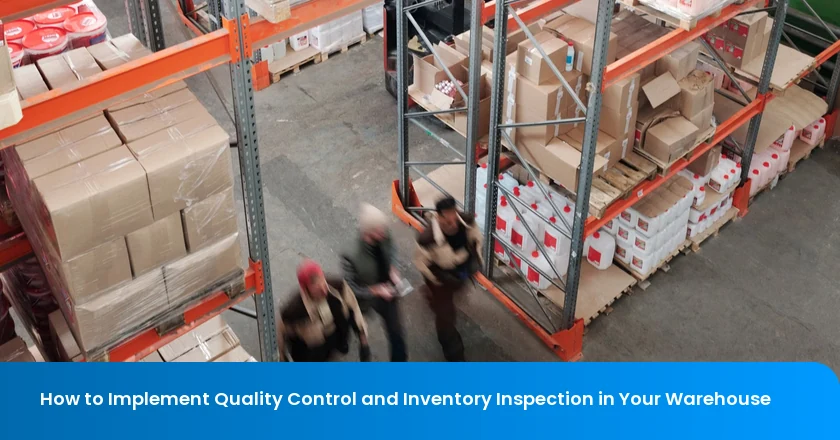
Implement warehouse quality control and inventory inspection by defining product and handling criteria, checking goods at receiving, storage and dispatch, reconciling physical counts with recorded movements, and assigning exception decisions. Keep item identity, quantity, location, condition and stock status connected throughout the routine.
For an importer, brand or warehouse supervisor, success means knowing what arrived, where it is, whether it can be picked and what remains unresolved. A correct count does not establish product acceptance. Begin with clear procedures and responsibilities, then use technology and review data to support them.
Keep Stock Records and Quality Decisions Aligned
- Define the item, counting unit, quality criteria and decision authority.
- Record checks and movements from receiving through dispatch.
- Separate physical quantity from held and available stock.
- Investigate discrepancies before authorizing an adjustment.
- Test system restrictions and verify corrective actions.
Setting Quality Control Standards
Warehouse quality control sets the product and handling requirements. Inventory inspection checks the identity, quantity, location and condition of stock. Use both: a correct count alone cannot establish that the goods are acceptable.
Defining Warehouse Quality Criteria
Define warehouse quality criteria separately for identity, quantity, condition, location and status. Start with the SKU—stock-keeping unit, or warehouse item code—and its product variant. Specify the counting unit, such as each or carton, so a correct-looking number cannot hide a unit-of-measure mismatch.
Add the applicable product, packaging and handling requirements: acceptable condition, label version, storage instructions, expiry controls where relevant, and the evidence needed to assess them. Do not invent one temperature, shelf-life rule or defect tolerance for every product. The buyer’s quality lead should agree the criteria with warehouse operations and retain the current references. Each check should answer a defined question rather than a vague instruction to “check quality.”
Establishing Inspection Points
Place inspection points where goods change custody, location or availability: receiving, put-away and storage, stock verification, then picking, packing and dispatch. A receiving check establishes what arrived; later checks can reveal handling damage, misplaced stock or a mismatch between the order and the goods selected.
The warehouse supervisor should identify who checks each handoff and what record proves it occurred. Put-away needs the actual destination location and stock status, not only a completed receipt. Storage checks should address the agreed conditions and visible deterioration. A stock count needs a defined population and time reference. Outbound checks need the correct order, item, quantity and packaging. Record exceptions at the point they arise so the next shift does not have to infer what happened.
Acceptance and Rejection Guidelines
Agree acceptance, hold and rejection rules before goods arrive. Define who can make each decision, what evidence is required and how the decision changes stock availability. An unresolved result should remain visibly pending; it should not become accepted simply because the delivery has been booked into the system.
Separate physical receipt from permission to pick. Rejection may require a supplier return, sorting, rework or another disposition, but the authorized decision and affected quantity need a record. The warehouse team should not change a buyer’s product criterion to clear space or meet a dispatch deadline. Use the inspection standards resource to help frame product-specific criteria, then agree the actual requirements and exceptions for the order.
Warehouse Conformity Inspection Procedures
Implement warehouse conformity inspection as a repeatable routine: prepare the references, examine the goods, reconcile quantities and movements, then route exceptions to an owner. Here, conformity means meeting the agreed warehouse and product criteria.
Step-by-Step Inventory Inspection
Keep product and logistics-unit identity connected through the routine. The warehouse example in GS1’s Global Traceability Standard links product identifiers and batch/lot information to pallet identifiers, then compares received-unit data with preregistered information. That traceability helps locate the relevant goods; physical condition still needs the agreed checks.
| Stage | Check and record | Exception action |
|---|---|---|
| Receiving | Match delivery/order reference, item, variant, unit and quantity; note visible damage and relevant lot data. | Record shortages, excess or damage before making stock available. |
| Storage | Record actual put-away location, stock status and movements; check the product’s agreed storage conditions. | Identify affected goods and arrange safe segregation or a status hold. |
| Count | Define locations, items and cutoff; count in the stated unit and compare with the system snapshot. | Recount and reconcile receipts, transfers, picks and open transactions before adjustment. |
| Dispatch | Match the order to eligible stock; verify item, quantity, pack, label and recipient requirements. | Stop the affected release, resolve the mismatch and retain the handoff record. |
Prepare current product references and a suitable check area before starting. Record who performed each task, when it occurred and what remained unverified. For a count discrepancy, investigate movement timing and counting units before assuming that goods are missing. For a condition problem, identify the affected stock and route the quality decision separately from the arithmetic.
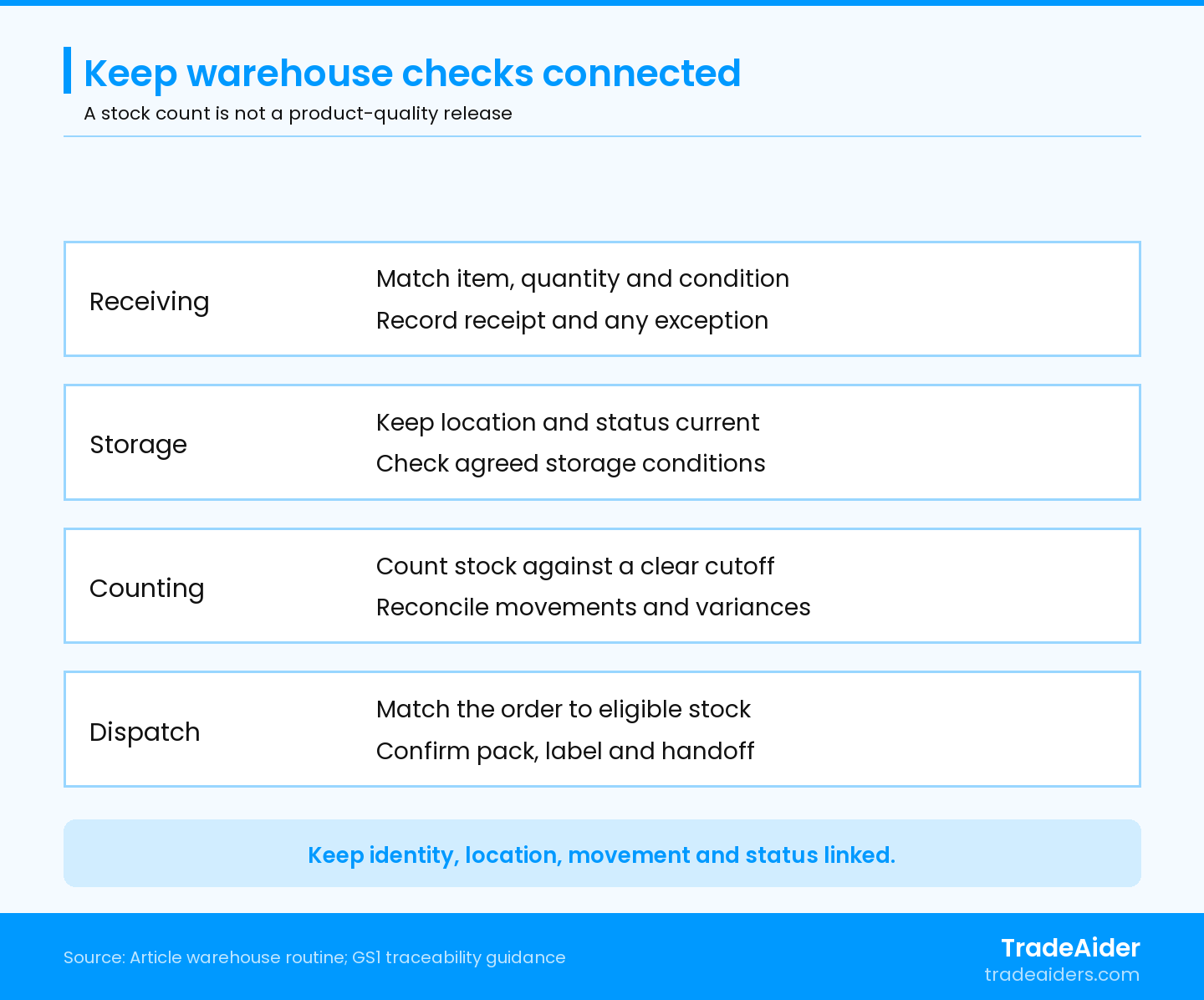
Use the same item, lot, location, unit and status references across receiving, storage, counting and dispatch. Counting stock does not by itself establish product acceptance or permission to ship.
Documentation and SOPs
A standard operating procedure (SOP) should state when a check starts, how it is performed, which record is used and who resolves an exception. Keep the applicable revision available to every shift. A short, usable procedure is more valuable than a long document that leaves the status decision undefined.
Illustrative example: a record shows 100 units available. A physical count finds all 100, including 8 damaged units. Assuming the remaining 92 are otherwise eligible and there are no reservations or other restrictions, the working record should distinguish 100 physically present, 8 held and 92 available. The damaged units are not automatically a count shortage. Confirm the actual system treatment before posting a quantity adjustment.
Use this exception record, completing the decision and approval fields after review:
| Field | Entry |
|---|---|
| Identity | Item/variant: ____ Lot: ____ Location: ____ Counting unit: ____ |
| Count basis | System snapshot/time: ____ Physical count/time: ____ Movement cutoff: ____ |
| Condition and status | Affected quantity: ____ Finding/evidence: ____ Physical hold: ____ System restriction: ____ |
| Resolution | Recount or movement check: ____ Decision/action: ____ Owner/due date: ____ Approval/reference: ____ |
Assigning Inspection Roles
Assign inspection roles explicitly. Receiving staff establish what arrived, inventory staff count and reconcile stock, and the quality reviewer assesses condition against the agreed criteria. Identify who may approve a stock adjustment, change a hold status or authorize dispatch. Those permissions should not be inferred from who entered the receipt.
For a small team, one person may perform several tasks, but the record should still distinguish the observation from the approval. A supervisor can review significant variances or quality decisions where independent verification is useful. Give each shift a contact for unresolved questions and a handover route for open holds. This prevents an exception from losing its owner when staff change or a delivery arrives outside normal hours.
Best Practices for Warehouse Conformity Inspection
Good warehouse inspection practices combine accessible references, safe handling, identifiable goods and repeatable records. Start with one product family or zone, test the routine and correct unclear steps before extending it. Keep the buyer, warehouse team and supplier aligned on what each check can establish.
Warehouse safety also needs its own competent review. OSHA’s US warehousing guidance identifies hazards involving forklifts, ergonomics, material handling, chemicals and slips, trips and falls. This is US workplace-safety context, not a worldwide legal checklist or proof of product conformity. Arrange checks without creating unsafe access or handling.
Where warehouse findings point to a recurring supplier-origin issue, pre-shipment inspection can provide relevant product evidence before dispatch from the supplier. Agree that upstream scope while retaining receiving, storage and stock-control checks at the warehouse.
Leveraging Technology in Inventory Inspection
Technology should support the warehouse routine already defined. Reliable item data, locations, units, movements and status rules matter as much as the scanning device or software dashboard.
Using Inventory Management Systems
A warehouse management system (WMS) can organize stock records and work instructions, but its configured behavior needs verification. Microsoft’s Dynamics 365 cycle-count documentation separates creating count work, physically counting and resolving differences. It also states that creating the count work does not itself block the associated on-hand stock. This is a product-specific example, not a rule for every WMS.
Before rollout, test the actual receiving, transfer, count, hold and dispatch workflows. Confirm who can post changes, whether movements remain possible during counting, and how pending differences appear to the reviewer. Reconcile failed or delayed transactions instead of assuming that a real-time screen reflects every physical movement. A system balance is useful evidence only when the relevant transactions and master data are reliable.
Barcode Scanning and Digital Tools
Barcode scanning helps connect a physical reference to its stored data. GS1 defines the Serial Shipping Container Code (SSCC) as an identifier for a logistics unit, such as a case, pallet or parcel. Identifying that unit does not prove that every item inside has the correct quantity or condition.
Check the relationship between the scanned identifier, the item record and any relevant batch/lot data. Confirm the unit of measure and what happens after repacking, partial picking or relabeling. A readable label on the wrong carton still points the process in the wrong direction. Test missed scans, duplicate scans and incorrect mappings before relying on the workflow; scan speed alone is not a useful acceptance test for inventory accuracy.
Automating Quality Alerts
Automated quality alerts need a defined trigger, a responsible person and an expected response. An alert about damage, an unapproved status, a count variance or a missed storage-condition check is useful only if someone can identify the affected stock and act on it. Agree escalation when the first recipient does not respond.
Test whether the intended restriction actually works: can held stock still be selected, can a transfer bypass the check, and does the next shift see the unresolved issue? Record false alarms and missed conditions so the rule can be corrected. If you are considering external inspection support, confirm the actual responsibilities and capabilities through TradeAider’s company background. Do not assume that an inspection provider operates your warehouse or integrates with its software.
Practical Quality Control Measures in the Warehouse
Practical warehouse quality control combines suitable condition checks, packaging and label review, and controlled handling of suspect stock. Keep those activities distinct from verifying the recorded quantity.
Spot Checks and Random Sampling
Spot checks can target a known concern, while an agreed acceptance-sampling plan addresses a defined lot. NIST explains acceptance sampling as drawing a random sample to support accepting or rejecting that lot. A convenient sample from the nearest cartons is not equivalent to random selection.
Identify the product, lot boundaries, inspected characteristics and decision criteria before selecting units. Record restrictions on access and checks that could not be completed. Sampling for visible product defects does not establish that every warehouse location has the correct recorded stock, and cycle counting does not prove product conformity. Use the method appropriate to the question, with additional investigation when a finding changes the scope. A sample-based pass should retain its limits when it is summarized for the buyer.
Packaging and Label Inspection
Packaging and label inspection should compare the goods with the approved product and order requirements. Check the item and variant, pack quantity, label version, placement and readability, plus the required content for the actual destination and recipient. Avoid treating one marketplace’s requirements as a universal warehouse standard.
Examine relevant cartons and protective packaging for visible damage, moisture, crushing or signs of compromised contents. Agree any performance test and sampling scope separately; a visual check cannot establish every transport or product characteristic. Retain photographs linked to the affected item, lot and location, and identify what was actually opened or tested. If goods are repacked or relabeled, verify the resulting identity links and approved content before the warehouse returns them to the normal dispatch flow.
Handling Defective Inventory
Defective inventory needs both physical control and an appropriate recorded status. Identify the affected goods, segregate them safely or otherwise prevent unintended handling, and assign a reviewer. Stock can remain physically present while being unavailable for picking; quantity and availability need not be the same number.
Microsoft’s inventory-blocking documentation shows how its system can prevent stock from being processed or consumed through different blocking methods. The behavior depends on the selected method and configuration. Test the actual hold against your warehouse’s picking and transfer workflows rather than assuming that changing a status field prevents every release.
Record the finding, quantity, location, restriction, owner and disposition decision. Agree whether sorting, rework, return or further inspection is needed, and verify the result before lifting the relevant restriction. Where sample-based re-inspection is appropriate, use the AQL calculator to review the agreed plan inputs. AQL means acceptance quality limit; the tool neither chooses the appropriate plan nor replaces a stock count.
Continuous Improvement and Process Review
Continuous improvement requires checking whether the routine is followed, why discrepancies occur and whether the chosen actions work. A completed count or audit form is only part of that evidence.
Regular Warehouse Audits
Set warehouse audit and count frequency according to the product, transaction volume, discrepancy history, process changes and applicable contractual or regulatory requirements. There is no universal six-to-twelve-month interval established by the sources used here. A recurring problem may need attention before the next scheduled review.
The warehouse supervisor should audit actual work as well as records: follow a receipt to its storage location, trace a held item through the system and compare a dispatch with the authorized order. Include relevant safety review by competent personnel. Record scope, findings, owners and due dates, then verify closure. Prioritize repeat problems and high-consequence failures rather than repeatedly checking only the easiest locations or most complete files.
Analyzing Inspection Data
Define warehouse metrics before comparing them. State the numerator, denominator, counting unit, population and review period. Inventory-record accuracy, damaged-stock incidence and picking errors answer different questions; combining them into one “quality score” can hide the action needed.
For example, a count-line accuracy measure needs a definition of a line, what counts as a match and how pending movements are handled. A damage measure needs a defined unit and reporting point. Track unresolved holds and closure time alongside the observed errors, and separate supplier, transit, storage and handling evidence where the records support that distinction. Investigate changes in the method or population before declaring improvement. Use the findings to update procedures, equipment arrangements or training, then check whether the same issue recurs.
Staff Training and Quality Culture
Train staff on the warehouse tasks and exceptions they will actually encounter. Have them demonstrate receiving identity checks, location transfers, counting-unit selection, damaged-stock holds and escalation of an unclear result. Practice shift handovers so an open issue remains visible when its original observer is absent.
After a relevant product, procedure or system change, refresh the affected skill and check performance. Use staff feedback to find confusing instructions and make it practical to report an exception instead of quietly correcting a balance without evidence.
For supplier-stage product concerns, Contact our team with the available product and order details, factory, production stage, timing, destination and relevant warehouse findings or photographs. TradeAider can discuss an appropriate inspection scope and a report of the agreed checks, results and limitations. Identify the report recipient and agree technical criteria, language, format and acceptance needs before inspection. You can begin the inquiry with available information; the warehouse team retains its own stock-control and release responsibilities.
FAQ
Should stock movements stop during a warehouse count?
Either control movements during the count or reconcile them to a clear cutoff. The appropriate method depends on the operation and system. Record receipts, picks and transfers that occur around the count time so the reviewer compares like with like. Confirm whether the system actually restricts movements; an open count task does not necessarily create that restriction.
Who owns quality decisions when a 3PL runs the warehouse?
The buyer and third-party logistics provider (3PL) should assign those decisions explicitly in their operating agreement. State who supplies criteria, approves holds and disposition, authorizes adjustments or release, and receives evidence. The warehouse can perform agreed checks without automatically taking over every product-conformity or commercial responsibility. Review exceptions against that allocation rather than assuming the party holding the goods has unlimited decision authority.
Can a small warehouse start without a WMS?
Yes, a controlled manual record can support a basic routine before a WMS is introduced. Use consistent item, location, unit, movement and status fields, with access control, review and a clear current version. Test whether the process still works across shifts and concurrent transactions. Introduce software when it supports the actual workload and controls; installing it alone does not establish accurate inventory.
Похожие статьи


Развивайте свой бизнес с услугами TradeAider
Нажмите кнопку ниже, чтобы войти непосредственно в систему услуг TradeAider. Простые шаги от бронирования и оплаты до получения отчетов легко выполнить.