
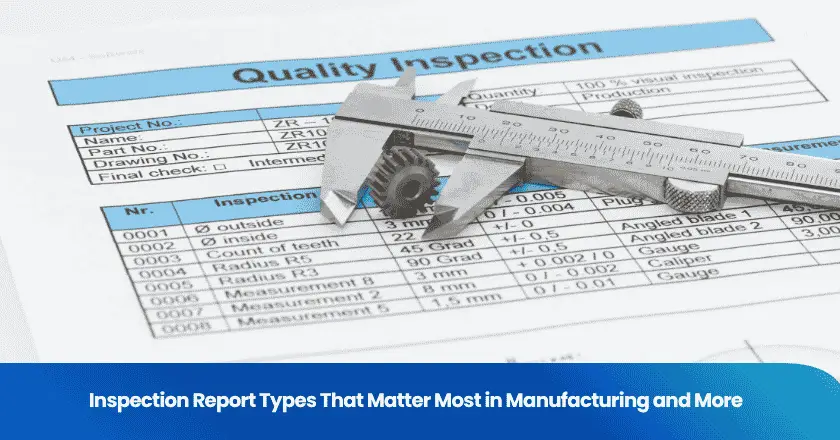
The main inspection report types in manufacturing cover pre-production, in-process and final inspections, with container loading reports recording a later shipping stage. Beyond product quality, maintenance reports describe equipment condition and repairs, while workplace safety reports document hazards and follow-up. Choose the report according to what was inspected, when it was inspected and the decision its findings need to support. A report’s title alone does not establish its coverage or prove compliance with every applicable requirement.
Match the Report to the Inspection Purpose
- Manufacturing reports describe materials, work in progress, finished products or loading conditions.
- Maintenance reports distinguish scheduled upkeep, corrective work and condition monitoring.
- Safety reports document workplace hazards and actions; they answer different questions from product inspection.
- Useful reports connect the inspected object, criteria and findings to a clear conclusion, with limitations and follow-up visible.
Why Inspection Reports Matter
An inspection report records what was examined, the scope of the work, the findings and the conclusion. It gives the responsible reader information for a decision rather than leaving the result as an undocumented conversation.
Purpose of Inspection Reports
You use inspection reports to document and evaluate processes, products and environments across industries. These reports serve as a foundation for decision-making and continuous improvement. A buyer may use findings to discuss a delivery with a supplier; a maintenance manager may use them to plan equipment work.
ASQ’s definition of inspection connects examining, measuring or testing characteristics with comparing the results against specified requirements. The report preserves that connection: what was checked, what it was compared with and what was found. For the criteria behind product checks, review TradeAider’s inspection standards resource.
Impact on Safety and Quality
Inspection reports support safety and quality action, but documenting a problem does not itself correct a defect or control a hazard. A useful finding identifies the affected product, equipment or location and explains the condition observed. The responsible person can then decide on an appropriate response.
For example, a photograph of damaged packaging can help a buyer discuss repacking, while a record of a damaged machine guard serves a different safety decision. Follow-up evidence shows what happened after the finding. Keeping that distinction clear makes reports more useful than a general claim that inspections “ensure safety” or eliminate future failures.
Main Types of Inspection Reports
Each inspection report serves a particular purpose and relates to a defined object or stage. Manufacturing reports commonly distinguish incoming materials, work in progress and finished goods. Specialized methods can be used at more than one stage, so a method name and a production-stage name describe different aspects of the work.
| Report type | Typical object | Main use |
|---|---|---|
| Incoming or pre-production | Materials, components and agreed readiness checks | Assess inputs before use |
| In-process | Work at the inspected production stage | Identify problems while production can change |
| Final | Finished goods within the inspection scope | Assess the lot against agreed criteria |
| Specialized examination | A specified material, component or structure | Answer a method-specific technical question |
Nondestructive testing evaluates materials, components or structures without harming them, as explained by ASNT. A report from such an examination needs its actual method and scope identified; the label does not imply that every possible defect was detectable.
The same distinction applies beyond manufacturing. An equipment-condition report supports maintenance decisions, while a workplace inspection identifies hazards and needed controls. These report families can complement one another, but a result for one object cannot establish an unrelated condition.
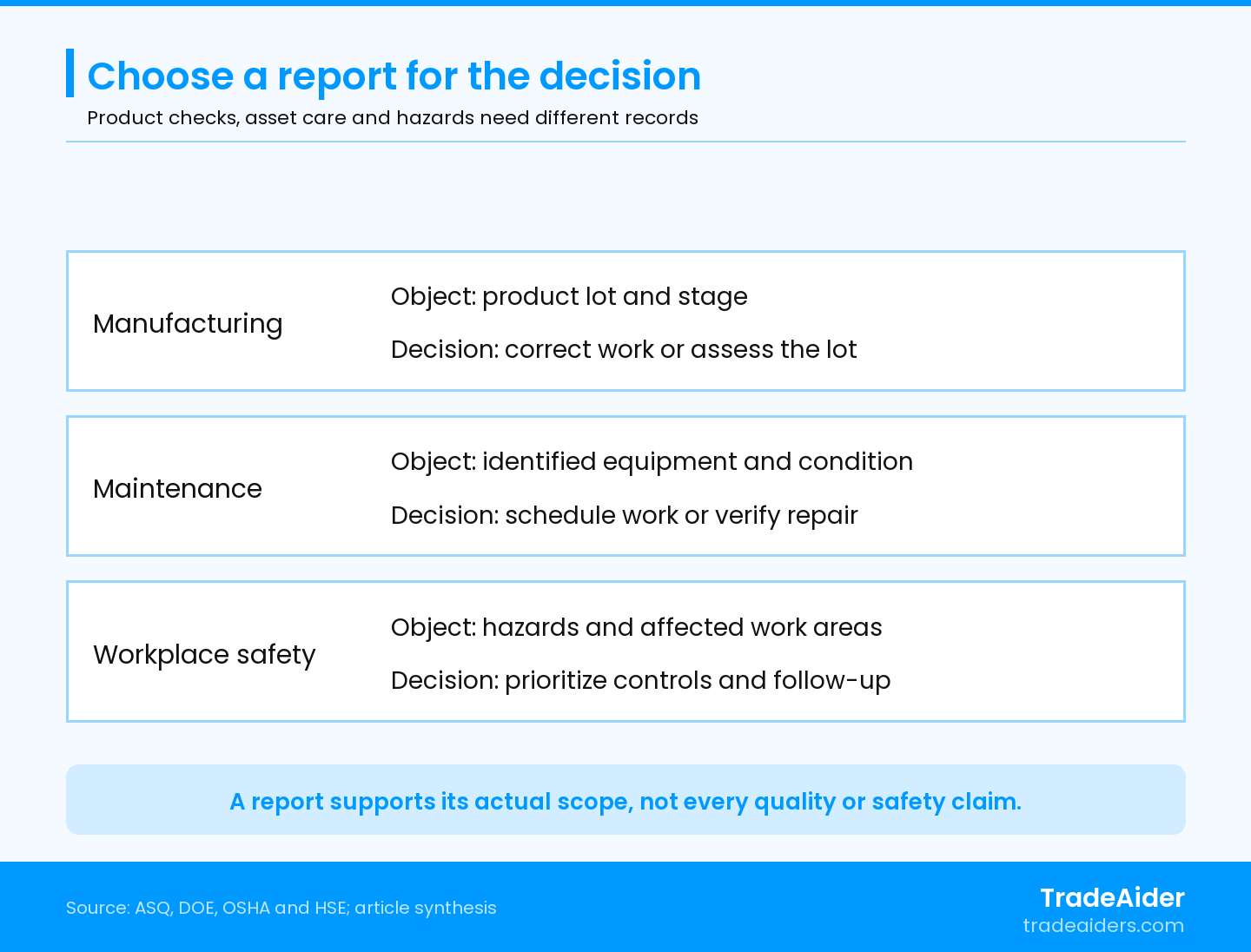
The report family tells you what was examined and which decision it can inform. A different object or scope needs appropriate evidence.
Pre-Production Inspection Report
A pre-production inspection report records the materials, components and agreed readiness checks examined before manufacturing begins. It should identify the inputs inspected, the specification or reference used and any differences found. Incoming-material inspection may form part of this scope, but the two labels do not always mean identical coverage.
A material observation, component measurement and setup-record review provide different information. Machine calibration or process qualification should appear only if actually included and supported. Recording an unchecked item as “not assessed” is clearer than allowing a general readiness conclusion to imply that every machine and process has been verified.
In-Process Inspection Report
An in-process inspection report describes the production stage and the units actually examined. Dimensions, weight, appearance, assembly and workmanship may be relevant, depending on the product. The report should show where an issue was observed so the manufacturer can assess whether other work may be affected.
This is a snapshot of production at the inspection time. A finding on partially completed goods and a finding on finished units should remain distinguishable. When a factory reports a correction, the later verification should refer to that issue and the relevant work. An early favorable result does not establish the condition of goods that had not yet been produced.
Final Inspection Report
The final inspection report describes finished goods checked against the agreed release criteria. It can include product identification, inspected quantity, observed defects, measurements and packaging findings. The conclusion is meaningful only alongside those criteria and the stated inspection coverage.
NIST explains acceptance sampling as supporting a decision about lot acceptability, rather than estimating the lot’s quality. A sampled final report therefore needs its lot and sampling basis visible. A favorable sample result is not a statement that every unit is defect-free.
Where an acceptance sampling scheme is agreed, record the inputs and decision criteria used. TradeAider’s AQL calculator can help you explore sampling inputs. AQL means acceptance quality limit, a parameter indexing the sampling scheme; it does not replace the product specification.
Quality Inspections in Manufacturing
Timing determines what a manufacturing report can help change. Materials, work in progress, finished goods and loading conditions are different inspection objects. Agreeing the stage helps the buyer request evidence that will still be useful when received.
Pre-Production Quality Inspections
Pre-production findings are most useful before materials are consumed or setup problems become repeated production problems. Arrange the scope around the inputs and readiness questions that can be examined at that point. Product specifications and approved references help define the comparison.
The buyer and factory also need to understand what happens if a required material, reference or document is unavailable. A report can record that limitation and the outstanding question. Treating an incomplete check as complete would hide the issue rather than resolve it. The timing and scope should leave the responsible parties an opportunity to respond before the affected work proceeds.
During Production Quality Inspections
During Production Inspection, or DPI, examines work while manufacturing is underway. You monitor relevant characteristics to identify issues such as assembly errors or inconsistent workmanship. The practical value comes from connecting findings to work that can still be changed.
A during-production finding can guide corrections to remaining work, while the manufacturer assesses already-produced goods for the same issue. Later evidence should show whether the correction addressed the observed problem. For an importer or purchasing agent, knowing the production stage and affected units makes the report more useful when discussing the next inspection or corrective action with the supplier.
Pre-Shipment Quality Inspections
Pre-Shipment Inspection, or PSI, is a finished-order checkpoint before dispatch. Product appearance, relevant measurements or tests, quantity and packaging checks can support the buyer’s shipment decision within the agreed scope. It is important to distinguish production completion from packing readiness.
For PSI, TradeAider describes its pre-shipment inspection service as taking place when the order quantity is 100% complete and at least 80% is packed for export, using randomly selected samples. That packing threshold concerns packed goods, not incomplete production.
Confirm which checks the order requires and who will review the findings. A product inspection report can record the checks performed; laboratory tests, certification or destination-specific documents may require additional evidence rather than being assumed from a PSI result.
Container Loading Inspections
Container loading inspections focus on the loading event. Depending on the agreed scope, the report may record quantity, packaging condition, container condition, handling and sealing observations. It helps explain what was observed while the identified goods were loaded, rather than repeating every finished-product check.
Illustrative example: A metal storage cabinet order may have a pre-production record for specified sheet material, an in-process record for assembly observations and a final record for finished cabinets and packaging. A loading record then documents the observed loading event. Each report answers a different question; the later document does not automatically replace the earlier evidence.
A loading report should also identify limitations, such as areas or activities not observed. It cannot guarantee the conditions throughout the subsequent journey or the condition of every product inside sealed packaging.
Maintenance Inspections and Reports
Maintenance reports focus on equipment and systems rather than on accepting a product lot. Useful records identify the asset, the reason for the inspection and the work or monitoring that follows.
The U.S. Department of Energy’s DOE maintenance guide distinguishes preventive maintenance based on time or machine operation from predictive maintenance based on the actual equipment condition. That distinction explains why scheduled-check records and condition-monitoring reports contain different information.
Preventive Maintenance Inspections
Preventive-maintenance records describe scheduled checks and upkeep for identified equipment. The schedule may reflect time, operating hours or the equipment’s maintenance instructions. The report can show which tasks were completed, what deterioration was observed and whether further work is needed.
A maintenance inspection checklist helps cover the relevant components, but a completed tick box is more useful when exceptions are recorded clearly. Note an inaccessible component or an overdue task rather than implying that the entire asset was examined. Manufacturer recommendations, operating demands and the applicable safety requirements help determine the work; one generic schedule will not suit every machine.
Corrective Maintenance Inspections
Corrective maintenance addresses an identified fault or failed condition. The starting point may be an alarm, a worker’s observation or a problem found during a scheduled check. Its records connect the reported issue with the work performed.
A useful corrective-maintenance record describes the fault, the affected equipment, the repair or adjustment and the verification performed afterward. Replacing a part is an action; confirming that the relevant function now operates as intended is a separate finding. Where safe operation depends on additional examination or approval, keep that outstanding requirement visible instead of treating the repair description alone as proof that the equipment is ready.
Condition Monitoring Reports
Condition-monitoring reports compare relevant readings and operating conditions over time to support equipment assessment. Depending on the asset and method, the information might concern vibration, temperature or lubricant condition. A trend can prompt further investigation without guaranteeing the exact date of a future failure.
For a comparison to be useful, identify the measurement location, operating state and method. A reading taken under a different load may need explanation before it is compared with an earlier one. Record the observation, the interpretation and the recommended response separately. This lets the maintenance team understand why further monitoring, investigation or planned work is proposed.
Safety Inspection Report Types
Workplace safety reports examine hazards affecting people and work activities. Their findings serve a different purpose from a report assessing whether finished products meet a buyer’s specification.
Workplace Safety Inspections
Workplace inspections look for hazardous conditions in work areas, equipment and activities. Hazard reports can record concerns raised between inspections. Incident reports describe events that have occurred, including near misses. These are related safety records, but an incident report is not simply another name for a routine inspection.
In its U.S. recommended practices, OSHA advises documenting inspections so hazardous conditions can later be verified as corrected. The record should make the location and observed condition understandable to the person addressing it. Photographs can help explain a finding, while follow-up establishes whether the reported problem was actually resolved.
Health and Safety Inspection Reports
Health and safety inspection reports organize observations, priorities and recommended actions. The response to a hazard depends on its nature and the potential exposure, rather than on applying product-defect labels to every workplace issue. Responsibilities and target dates help the relevant team follow the work through.
ISO 45001 specifies requirements for an occupational health and safety management system. Its scope is broader than an individual inspection report. A report can contribute to that system, but its existence alone does not establish certification, prove every legal requirement has been met or show that a hazard has been controlled.
Inspection Report Fields and Best Practices
Useful report fields identify what was checked, the criteria applied, the findings and the resulting conclusion or action. Adapt the detail to the report type and any applicable contractual or legal requirements.
Essential Inspection Report Fields
Start by identifying the object: an order and product lot, a particular asset or a workplace location. For a buyer arranging an inspection service, identify the reporting organization as well. To assess the provider, review TradeAider’s company background.
| Information | What to make clear |
|---|---|
| Identity and dates | Report reference, inspected object, location, inspection date and report issue date |
| People and authorization | Inspector or responsible organization and relevant report authorization |
| Scope and criteria | Checks, methods, specifications, inspected quantity or areas, and limitations |
| Findings and evidence | Observations, measurements, photos and attachments linked to the finding |
| Conclusion and follow-up | Result, recommendations, responsible person and relevant next action |
The information should connect the object, inspection and report dates, scope, criteria, methods, findings, limitations and conclusion. Include the relevant authorization; applicable requirements may specify additional fields. A signature authorizing the report and a buyer’s acceptance decision are different records, so do not imply that every signature means every party approved the goods.
Agree on the recipient’s language, format and institutional requirements before the work. An overseas buyer, platform, regulator or equipment owner may need different supporting documents. Confirm the intended use rather than promising that any report will be accepted.
Tips for Effective Reporting
Set clear inspection criteria before the inspection. Use procedures and suitably competent people for the work, and document findings accurately. Consistent descriptions help readers compare related findings without forcing every report into the same checklist.
Distinguish observations from interpretations and recommendations. “A dent was observed on the identified unit” describes a finding; deciding whether it is acceptable requires the relevant criterion. Identify the responsible recipient’s decision separately. Where a severity or priority rating is used, explain its basis and apply the scheme appropriate to the report type. Record a correction and its verification without erasing the original finding.
Digital Tools for Inspection Reports
Digital tools can support consistent fields, linked photographs, controlled versions and sharing. Check whether the chosen system preserves the records and access the recipient needs. A digital format does not verify a measurement, resolve an ambiguous criterion or turn an incomplete inspection into a complete one.
For covered work-equipment inspections in Great Britain, HSE guidance allows secure computer records and says the inspection record should be retained at least until the next inspection. This is a specific work-equipment context, not a retention rule for all report types; the simplest pre-use checks do not normally require records.
For a product inspection inquiry, begin with available product and order details, the current stage, destination and report recipient’s needs. Missing technical information can be identified during discussion. Agree on the inspection criteria and report scope before the work. Contact our team.
Frequently Asked Questions
Does a passed inspection report authorize shipment?
A passed result does not by itself authorize shipment unless the agreed decision process gives it that role. Confirm who has release authority and whether other conditions remain outstanding. The buyer may still need to review contract requirements, unresolved findings or documents outside the inspection scope before instructing dispatch.
How long should inspection reports be retained?
Retention depends on the applicable law, contract, equipment or product context and your organization’s record policy. Identify the rules for the particular report rather than adopting one period for every inspection. Keep related attachments and revisions accessible so the retained conclusion can still be understood with its supporting evidence.
When does an inspection report need updating?
A new inspection or supplementary report may be needed when the inspected object, condition or scope has materially changed. Rework, equipment damage or a changed requirement can create a new question. Preserve the earlier record and make the scope and date of the later examination clear, rather than quietly replacing historical findings.
Похожие статьи

Развивайте свой бизнес с услугами TradeAider
Нажмите кнопку ниже, чтобы войти непосредственно в систему услуг TradeAider. Простые шаги от бронирования и оплаты до получения отчетов легко выполнить.