
- О нас

- Наши услуги
- Ваша отрасль
- Ресурсы
- Новости и блог
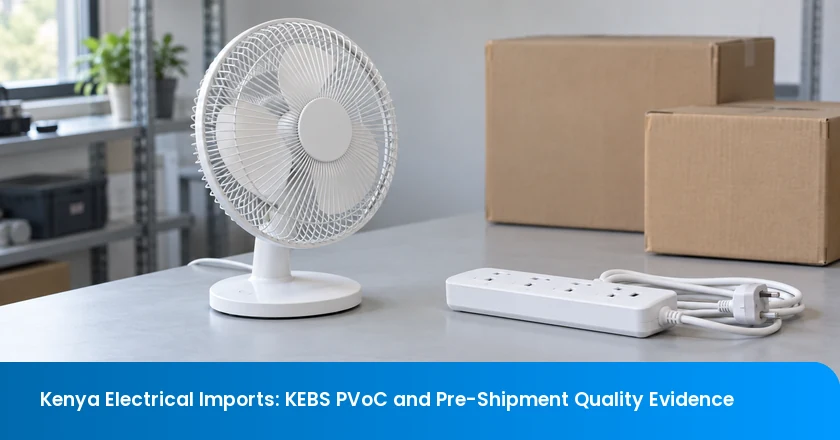
For electrical goods entering Kenya, confirm the applicable Kenya Bureau of Standards (KEBS) conformity route, then verify the quality of the actual order before dispatch. Pre-Export Verification of Conformity (PVoC) and the buyer’s factory inspection have related but different purposes. A conformity document does not explain whether a later repair was checked, whether the specified accessories are packed, or which units an inspection covered. Prepare both sets of evidence, and keep unresolved findings visible until the responsible party closes them.
Two Evidence Checks Before Electrical Goods Leave the Factory
A Kenyan electrical shipment needs both the applicable conformity documentation and evidence that the supplied lot meets the purchase requirements.
- Confirm the exporting-country route and the contractor’s current appointment.
- Match technical reports and product references to the ordered models.
- Plan appliance labeling and the Import Standardization Mark as separate tasks.
- Record which goods were inspected and what happened after repairs.
- Reconcile the final export and import documents before instructing dispatch.
Confirm the Current KEBS Route for the Exporting Country
The Kenya Bureau of Standards (KEBS) PVoC Manual Version 15, dated February 19, 2026, assigns contractors by export zone and separately identifies countries whose goods undergo destination inspection. Check that country-level distinction before selecting an assessment provider.
The manual describes Routes A, B, and C, with the contractor selecting the applicable route through risk assessment. Route A combines consignment inspection and testing; Routes B and C concern registered and licensed products. A supplier’s repeat-export history does not, by itself, answer which route or intervention applies to your order.
Give the contractor the appliance function, model schedule, manufacturer, country of manufacture and export, and intended use. Ask which Kenya Standards or approved specifications apply, which evidence it will accept, and what must happen before shipment. Obtain a written response for the transaction, especially when goods are consolidated or the exporting location differs from the factory location.
Use current KEBS instructions rather than an old contractor list or a temporary notice from the February 2026 contract transition. The requirements cited were checked on September 8, 2026. Medical equipment, vehicles, and connected devices can involve additional technical or regulatory obligations; establish those separately for the actual product.
A commercial inspection provider should be evaluated for the agreed quality checks separately from the PVoC appointment. For provider background, review TradeAider’s company profile.
Assemble the Electrical Product and Consignment File
The Kenya Revenue Authority (KRA) import guidance lists the Import Declaration Form (IDF), customs entry, a Certificate of Conformity (CoC) for regulated products, the applicable import mark, and invoices among the documents to prepare. A CoC is the consignment conformity document; it should not be confused with a factory’s internal test sheet.
Create a file register with the document owner, issue date, model coverage, and outstanding action. The supplier normally holds much of the technical material, while the importer and clearing agent manage the Kenyan import information. Agree who will collect each item and who will resolve discrepancies. A folder containing many certificates is still incomplete if none identifies the purchased model.
Keep the pro forma invoice, final commercial invoice, packing list, and required transport records under revision control. Link quantities to the model descriptions used in the application. The current PVoC manual also includes a Free Sale Certificate requirement: establish the acceptable issuing authority and obtain it through the exporter before the contractor’s CoC decision. Do not substitute a supplier’s informal sales statement without confirmation.
Give the Evaluator a Model-Specific Technical File
KEBS advises importers to obtain the relevant Kenya Standards and communicate the requirements to suppliers before importing. Use that discussion to settle the technical reference against which the product will be evaluated.
Provide the full model identification, ratings, construction details requested by the evaluator, test-report references, and the proposed cord, plug, and accessories. Ask whether reports cover the actual configuration and the required standard editions or deviations. The fact that two products share a plastic housing does not establish that their electrical design is identical.
For a family of models, obtain a clear explanation of the differences and how the evaluator treats them. Differences in motor, heating element, protective device, or intended use may change the evidence needed. The factory should disclose those differences; the importer should not ask an inspector to decide technical equivalence from a product photograph.
Translate the settled references into purchase instructions. Name the controlled drawing or specification rather than writing only “Kenya compliant.” If a reference changes, identify which production units use the new version and have the responsible technical party review its implications before the factory substitutes parts.
Separate Appliance Labels from the Import Standardization Mark
The Import Standardization Mark (ISM) is a KEBS-controlled mark for imported products intended for local sale. KEBS’s marks-of-quality guidance describes an importer application supported by copies of the CoC, IDF, and customs entry. It is a different task from approving the appliance’s rating label.
Do not tell the factory to reproduce a KEBS logo from an online image and place it on every box. Have the importer confirm the current ISM requirements, authorized supply or application process, and who will perform the marking step. Record whether that step is expected before export or through the confirmed import process; a factory inspection must not report completion of a step scheduled for later.
Separately approve the product and packaging artwork required for the actual appliance. Check the model, declared electrical ratings, warnings, instructions, and any other specified information against the technical reference. Examine legibility and consistency across the unit, manual, and retail packaging. A correct import sticker cannot correct an incorrect rating, and a neatly printed rating label cannot establish that the underlying product passed its required evaluation.
Turn Purchase Requirements into Observable Factory Checks
Develop the physical checklist from the settled specification and an inspection-standard resource. Agree what can be checked during the visit and what needs a laboratory or other qualified technical assessment. The following checks help define useful observations; they do not constitute a universal electrical safety test protocol.
| Check area | Reference | Evidence to record | Unresolved finding |
|---|---|---|---|
| Product identity | Model schedule and approved configuration | Unit labels, variant and sample origin | Different or unidentified build |
| Cord and assembly | Specified components and construction | Condition, routing and accessible assembly details | Damage, substitution or unsafe-looking assembly |
| Function and electrical checks | Agreed methods, equipment and limits | Actual results and unavailable checks | Failed result or missing test evidence |
| Accessories and instructions | Approved pack contents and artwork | Counts, versions and photographs | Missing or incorrect item |
| Packing and traceability | Carton allocation and packing specification | Carton IDs, condition and model quantities | Mixed or untraceable goods |
| Repairs | Defect record and approved correction | Repaired-unit identity and fresh verification | Closure based only on a supplier claim |
A useful inspection report connects each observation to the specified product, test method, and inspected population. An electrical check answers the question defined by its method; a photograph of assembly cannot show a missing retest result. Request the evidence that resolves the remaining quality question.
Keep two decisions visible in the release record: whether the applicable conformity process is resolved, and whether the buyer accepts the actual goods under the purchase specification. Give each decision an owner. Neither should become a general “approved” box that hides a pending repair, unavailable test, or unexamined model.

Conformity documentation and factory-quality findings answer different questions; neither closes the other automatically.
Specify the competent operator and suitable equipment for any electrical work. Do not ask unqualified personnel to improvise live tests at the packing table. Where the agreed test cannot be performed, record that limitation and arrange the missing work. A brief demonstration that a fan turns on is useful functional evidence, but it does not answer every electrical safety question.
For each finding, preserve the affected model and unit or carton identifiers. That detail makes corrective action reviewable: the buyer can distinguish an isolated packaging omission from a recurring assembly problem. Without it, a repeat visit may inspect a convenient set of good units while leaving the original affected goods unresolved.
Coordinate PVoC Assessment, Quality Inspection, and Loading
TradeAider describes its pre-shipment inspection service readiness as 100% of the order complete and at least 80% packed. Confirm both conditions with the factory when arranging the final visit.
Build the schedule around when each question can be answered. Technical qualification belongs before reliance on the production design. Checks of internal assembly may be useful while the relevant work remains accessible. Final quality inspection belongs when the finished population and packaging can be meaningfully examined.
Share the same model list and quantity breakdown with the commercial inspector and the appointed PVoC contractor, but confirm their assignments separately. Ask which samples, records, access, or attendance each needs. An ordinary buyer inspection report should not be described as a substitute CoC or as proof that all government-required activities occurred.
Include loading obligations in the schedule. Under the manual’s Route A provisions, containerized cargo from China and the United Arab Emirates must be sealed by the PVoC contractor, with container and seal numbers recorded on the CoC. A warehouse seal applied independently does not establish that this contractor requirement was met.
Leave a decision point after findings become available and before the goods are made inaccessible. If repairs are needed, record the affected units, who approves the method, and what evidence will close the finding. Moving the loading date without assigning those tasks creates more time but does not create a verified correction.
Require New Evidence After Electrical Rework
Correcting a visible assembly problem does not prove that the relevant electrical checks passed afterward.
Ask the qualified technical owner or evaluator to define the post-rework checks. Preserve both the original finding and the repair record so the next inspection can examine what changed. If the correction affects construction or a certified configuration, involve the appointed contractor in deciding whether additional conformity work is needed.
Workmanship sampling and repair verification serve different purposes. The AQL calculator can help select a sampling plan after the lot, inspection level, and Acceptance Quality Limit (AQL) are agreed. Those parameters do not decide which checks a particular electrical repair requires.
Illustrative Example: Repaired Fans Without Retest Records
In this illustrative example, a Kenyan importer buys 900 desk fans. A production check identifies a cord-routing problem in 90 traceable units. Before final release, the supplier sends photographs showing the revised routing and a register identifying the repaired fans. It provides no post-repair results for the agreed relevant electrical checks.
In this illustrative example, the buyer holds the 90 repaired fans because photographs of corrected assembly do not establish post-rework test results. The photographs may show that the cord was moved, but they cannot show whether the agreed electrical verification passed after the product was reopened.
Keep those units identified and segregated while the competent technical owner confirms the applicable retest requirements. Ask for records that connect the repaired-unit identities to the method, date, equipment, operator, and actual results. Do not accept an earlier test sheet unless the responsible evaluator establishes that it answers the post-repair question; chronology is part of the evidence.
Close the finding only after the repair is checked against the approved instruction and the required fresh results are available. Ask the appointed contractor about any effect on the conformity file before treating it as settled. This illustrative example specifies no universal voltage, test duration, or sample size. It also does not automatically release the other 810 fans: assess whether the original problem could extend beyond the recorded repair group and confirm that the rest of the order has its own satisfactory evidence. The release boundary follows traceability and the technical findings, not a convenient subtraction.
Reconcile Export Records with the Kenyan Import File
KRA’s Finance Act 2026 guidance states that from September 1, 2026, importers must obtain and retain an export declaration, export entry, customs export certificate, or equivalent document from the exporting country. Its guidance calls for retaining the records for at least five years.
Request that export-side document early enough for the supplier to identify the responsible exporter and provide the appropriate record. KRA identifies party details, goods description, quantity, value, tariff classification, and country of export as information to check. This is an additional documentation task; a CoC or commercial inspection report does not take its place.
Have the importer and clearing agent reconcile the final documents with the goods authorized for shipment. If repaired stock is held back, the packing list and other affected records must describe the actual consignment. Resolve amendments through the responsible issuer or process rather than editing a certificate locally to make the figures agree.
Keep the quality-release decision alongside, but distinct from, the customs file. The first explains the buyer’s acceptance of the goods and any unresolved conditions. The second supports the applicable import procedure. A complete folder helps coordination only when its documents describe the same transaction and their status is clear.
Brief the Inspector on the Remaining Quality Decision
Send the inspector settled references and the unresolved quality questions, while the importer and appointed contractor handle the applicable conformity process.
Include the model schedule, product photographs, agreed specification, label and packaging artwork, order quantity, carton allocation, and factory packing status. Add previous findings, the repair register, and any technically approved follow-up checks. Identify unavailable references before booking so the scope reflects what can actually be verified.
Ask TradeAider to confirm the feasible inspection work and timing. Request findings and photographs tied to the inspected goods, with actual check results, exclusions, and open issues stated. Give the report reviewer the authority and references needed to decide what happens next; an inspector should not have to guess whether a supplier’s proposed deviation is acceptable to the buyer.
The resulting inspection evidence can support the importer’s quality decision alongside the resolved conformity documentation. Keep certificate issuance and regulatory determinations with the appropriate parties, and use the factory visit to answer the remaining product and lot questions.
Contact our team to schedule your inspection.
Frequently Asked Questions
Can a CE declaration replace a KEBS Certificate of Conformity?
No. A CE declaration does not replace the applicable Kenyan consignment conformity document. Supply the underlying technical reports to the appointed contractor and ask whether they are acceptable for the exact product and requirements. Their relevance depends on scope, configuration, and the required evaluation, rather than the presence of a CE logo alone.
Does routing goods through another country create an exemption?
Do not assume a transit or consolidation point changes the applicable conformity route. Give KEBS or the appointed contractor the actual manufacturing, supply, and export details and obtain guidance for that transaction. An invoice issued from a different country is not enough to establish a different route or an exemption for the goods.
Can an industrial machine use the same evidence as a household fan?
Not automatically. Establish the correct product category and accepted evidence with the appointed contractor. The KEBS manual distinguishes consumer products from machinery and other categories in its testing guidance. Describe the equipment’s intended function and use accurately; calling an appliance “industrial” on the invoice does not determine which technical requirements apply.
Can I ask another contractor to certify goods after an NCR?
The KEBS manual says goods issued a Non-Conformity Report (NCR) must not be presented to another PVoC contractor for certification. Follow the required corrective and review process with the responsible parties. Keep that regulatory NCR distinct from a buyer’s commercial inspection finding, and do not conceal either when arranging corrective work or discussing the next shipment decision.
Похожие статьи
Развивайте свой бизнес с услугами TradeAider
Нажмите кнопку ниже, чтобы войти непосредственно в систему услуг TradeAider. Простые шаги от бронирования и оплаты до получения отчетов легко выполнить.

