
- О нас

- Наши услуги
- Ваша отрасль
- Ресурсы
- Новости и блог

Magnetic phone accessories are often approved from one satisfying attachment check, then sold across several phones, cases, and retail packs. That shortcut can hide a different magnet orientation, an uncured adhesive process, or a case stack that changes the seating position after the sample was approved.
Magnetic accessory release is the buyer control process that confirms one accessory SKU, its magnet layout, adhesive bond, named phone-and-case stack, and packed version before that configuration is released.
The practical goal is not to promise universal holding performance. It is to make the configuration, the evidence, and the cartons describe the same release decision.
The Release Unit Is the Magnet, Bond, Device Stack, and Pack Together
The release unit is the magnet-bond-device-pack combination, not a generic magnetic claim. In plain language, it is one accessory SKU tied to its magnet layout, adhesive bond, named phone-and-case stack, and packed version. A pull or rotation result only represents that named combination; it does not automatically cover a revised ring layout, another case thickness, or a carton packed after a process change.
Begin the supplier brief with one identity line per sellable configuration: SKU and drawing revision, magnet grade and orientation, adhesive and cure record, reference phone and case, golden sample, retail-pack artwork, and carton code. That makes a later change visible. It also prevents a team from using an acceptable bare-phone sample to release a case-mounted configuration or an untraceable packed lot.
Misalignment, bond condition, device fit, and transport survival are related but separate questions. The buyer should assign a record and acceptance boundary to each one, then decide whether the finished population remains identifiable.
- Release a named magnet-bond-device-pack combination, not a product category.
- Keep retention, bond process, device alignment, and transit evidence on separate routes.
- Hold a configuration when its records no longer identify the units being offered for release.
Use the Magnet-Bond-Alignment Release Framework
The Magnet-Bond-Alignment Release Framework separates magnet retention, bond process, device alignment, and transport condition. It is a practical way to stop one attractive result—such as a strong initial attachment—from being treated as proof that the accessory is correctly positioned, properly bonded, and still intact after shipment.
Use four routes in the inspection brief. The magnet route confirms the approved layout and retention observation; the bond route records how that layout is attached; the alignment route checks the named phone-and-case stack; and the transit route rechecks the packed configuration after the agreed condition. A mismatch on any route has its own owner and next action.
Record the routes in the inspection standard for magnetic accessory acceptance criteria. That gives the supplier a clear evidence list before production and keeps inspection observations distinct from product testing or regulatory conclusions.
Magnet Route: Confirm Orientation, Retention, and Device Location
Qi version 2.0 introduced a Magnetic Power Profile with magnetic attachment and alignment of transmitter and receiver. According to the Wireless Power Consortium (2023), that profile introduced magnetic attachment and alignment for the power transmitter and receiver. For an accessory buyer, the relevant lesson is to name the intended device relationship rather than describe retention as a generic strength claim.
Apple says a strong magnetic field can interfere with OIS and closed-loop AF. According to Apple Support (2024), strong magnetic fields can affect those camera mechanisms, so a magnetic accessory with a rear-device placement should have a buyer-defined camera-clearance and functional-check boundary. This is device-specific guidance, not proof that every magnetic accessory creates interference.
Lock the pole orientation, ring or plate location, reference-device position, test direction, conditioning state, and pass/fail rule. Photograph the approved layout beside the golden sample. Before a supplier starts volume output, use Pre-Production Inspection for the approved magnetic configuration to preserve that physical reference and the approved packaging version.
Bond Route: Define Surface Preparation, Cure, and Peel Boundary
ASTM D3330/D3330M includes 180-degree and 90-degree methods for measuring peel adhesion of pressure-sensitive tape. According to ASTM International (2002), those methods define peel-adhesion observations at stated angles. They provide a comparable method boundary; they do not establish a universal force target, lifetime attachment, or product-specific acceptance limit.
A bond result is useful only when the substrate, surface preparation, adhesive lot, cure state, direction, and result criterion are linked to the observed unit. A cure window is the stated time and conditions an adhesive needs before its bond is evaluated. Record it with the fixture setting, operator or station, and result image so recurring edge lift can be traced to a process route rather than called a random cosmetic defect.
Use During Production Inspection for bond-process control when surface preparation, adhesive storage, placement, or cure timing could drift across stations. The check should capture the agreed process evidence; questions about long-term performance remain a separate testing decision.
Alignment Route: Verify the Named Phone-and-Case Stack
A compatibility claim should be converted into one checkable accessory-phone-case pairing per named stack. A reference-device stack is the named phone, case, and accessory combination used for an approved alignment check. It turns “fits this phone family” into a finite list of physical checks: seating position, camera clearance, orientation, claimed function, and visible gap or rocking.
Keep bare-phone and cased-phone results separate. The Wireless Power Consortium describes the Qi2 Magnetic Power Profile as helping align a phone and charger; see its Qi2 certification release (2023). That profile description does not approve a third-party accessory or every case, which is why the buyer should test only the named stacks carried in the listing claim.
Transit Route: Recheck the Packed Configuration After Drop and Vibration
ASTM D5276 evaluates containers and inner packing under sudden shock from free-fall drop impact. According to ASTM International (2019), its scope addresses the container and inner packing during free-fall shock. A packed-drop result should therefore be recorded as packaging evidence, not as an in-use phone-mount claim.
ASTM D999 covers vibration testing of filled shipping containers and their interior packaging, closure, and contents. According to ASTM International (2023), vibration can affect the shipping container, its interior packaging, closure, and contents. After the agreed drop or vibration sequence, recheck the same named accessory, pack, and reference-device stack for rotation, separation, alignment, scratches, and missing components.
State the pack format, carton condition, test sequence, sample identity, and post-test observations in the record. A transit recheck can reveal whether the packed configuration changed; it cannot replace a defined in-use load or device-compatibility test.
Route Each Magnetic Finding to the Evidence That Can Answer It
16 CFR Part 1262 defines subject magnet products by specified intended uses, including entertainment, jewelry, mental stimulation, and stress relief. According to 16 CFR Part 1262, that scope depends on the product and intended use. A phone accessory should not be assigned a magnet-rule conclusion merely because it contains a magnet; its design, marketing, separability, and applicable market requirements need their own review.
Use an evidence-owner map. The supplier supplies drawings, magnet and adhesive records, and change history. The buyer defines the reference phone-and-case stacks, permitted listing claims, and release boundary. The inspection team records the agreed product, process, and pack observations. Where a question exceeds those observations—such as material, magnetic component, device-interference, or performance analysis—route it to product testing for magnetic accessory performance questions.
Every finding log should state the affected configuration, what was observed, the missing or conflicting evidence, the owner, and the verification gate. This keeps an adhesive lifting finding from being closed by a carton photograph, or a compatibility concern from being closed by a single pull-force result.
Worked Scenario: Repeated Bond Rotation Turns a Local Finding Into a Process Hold
Repeated bond rotation from more than one station should be treated as a process-defined hold until the cause and corrected population are traceable. In the following illustrative case, the recurring pattern changes the decision from sorting individual units to holding the defined supplier scope while its records and correction are verified.
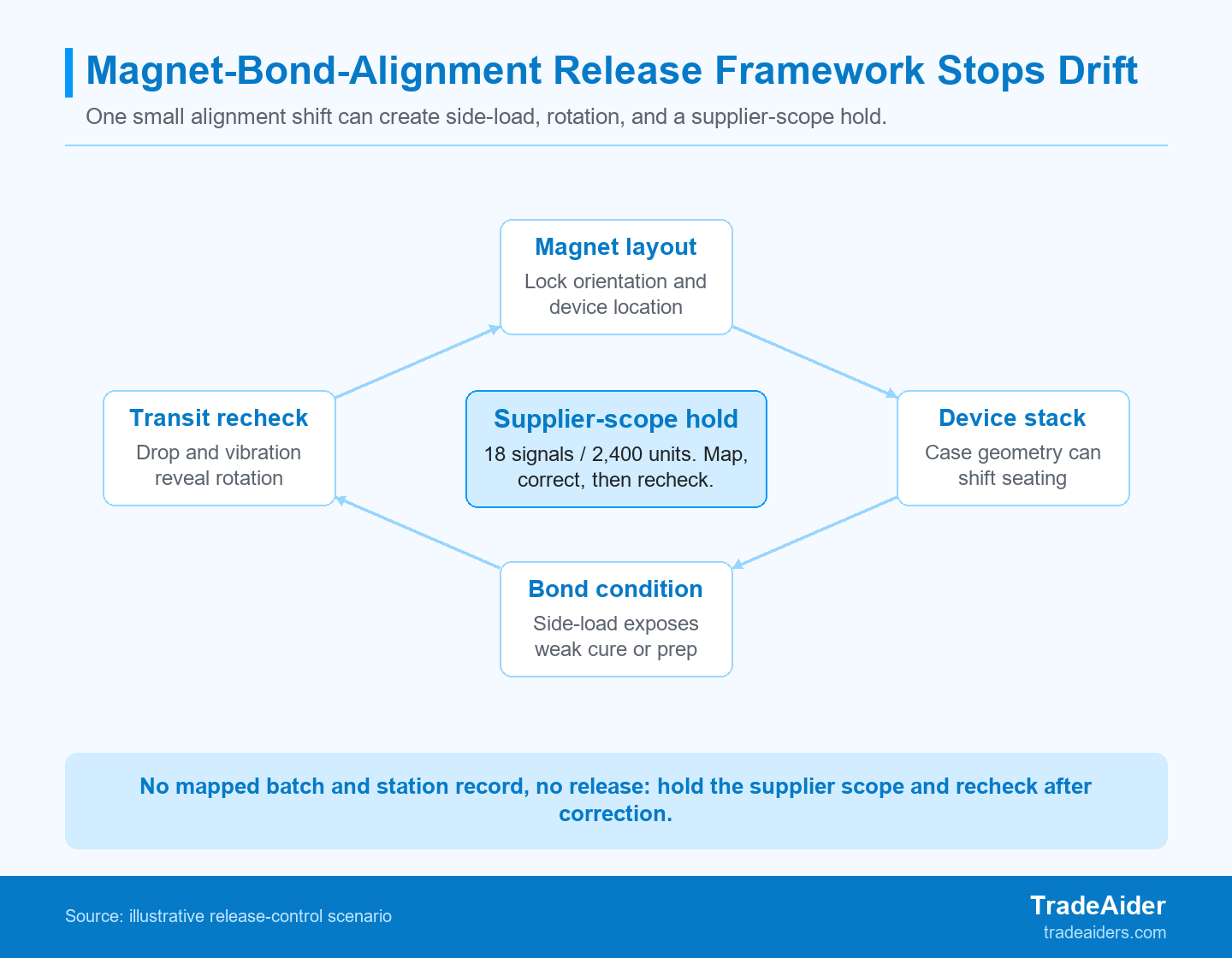
When a seating change exposes bond rotation, release waits for traceable correction and post-cure rechecks—not another isolated attachment result.
A released population also needs to stay separate from the held one in marketplace handoff. e-commerce quality checks for the released magnetic accessory family can focus on the identity, artwork, and carton map that support that separation.
Situation, Problem, Action, and Result
The illustrative bond-drift scenario requires batch mapping, process review, controlled correction, and post-cure retention and alignment rechecks before release is reconsidered. It is a buyer-control example, not a universal force, cure, or safety requirement.
Situation: A global marketplace seller is preparing a magnetic vent-mount accessory with an adhesive-backed magnetic plate and compatibility claims for three named phone-and-case stacks. The illustrative order contains 2,400 magnetic mounts in 60 export cartons, with 18 units showing rotation after the agreed conditioning sequence. The buyer has an approved magnet layout, golden sample, and reference-device matrix, but the supplier does not map adhesive batch and cure records to each assembly station.
Problem: Six of fifteen sampled mounts from two stations rotate after the agreed retention check, while mounts sampled from a third station remain aligned. Twelve additional units from the two affected stations show edge lifting after the same conditioning sequence, although their carton labels are identical. This is process drift, not a single cosmetic defect. The buyer cannot use carton labels to isolate the risk because the adhesive and station records do not identify the finished population. The aligned third-station samples are useful diagnostic evidence, but they do not create a releasable population while the original supplier-scope map remains incomplete.
The decision is a full hold on the 2,400-unit supplier scope. The team records the apparently aligned third-station cartons separately for later comparison, but does not release them under the same event until the adhesive-batch map, station history, and finished-carton identity are rebuilt. Action: The supplier documents adhesive storage and batch use, confirms surface preparation, resets the placement fixture, and prepares controlled corrective samples for the same reference-device stacks.
Result: Release can be reconsidered only after post-cure rechecks show the agreed retention and alignment result across the corrected supplier scope and the carton map identifies that corrected population. The initial 18 findings remain a trigger for investigation, not a universal defect rate. The quantities and checks are illustrative. They do not prescribe a universal pull force, adhesive grade, device certification, or product-safety conclusion.
Build a Configuration-Specific Release Packet Before Marketplace Handoff
A conditional release packet should name the magnet layout, adhesive lot and cure record, reference-device stack, post-test result, and carton population. It should also name the released quantity, held quantity, current artwork, and the exact evidence needed to close an unresolved hold. That makes the decision intelligible to the supplier, warehouse, marketplace team, and buyer.
For every released family, retain the approved drawing, golden-sample reference, magnet layout, adhesive and cure record, device-and-case matrix, package-test observation, retail artwork, and carton map. For every held family, state the owner, corrective action, recheck condition, and version that will replace the unapproved one. This prevents corrected units from being mixed with a visually similar but unverified configuration.
Pre-Shipment Inspection for the completed magnetic accessory lot can focus on the finished population when those records are ready. If the supplier's configuration list needs to be converted into a checkable scope, request a magnetic accessory inspection brief.
Who Is TradeAider?
TradeAider can use the buyer's supplier packet to scope inspection observations and separate testing escalations. For magnetic phone accessories, that means connecting the approved layout, bond record, reference-device stack, and pack map to an on-site inspection plan while keeping certification or device-performance questions on their own evidence route. TradeAider supports sourcing and quality work across Guangdong, Zhejiang, Jiangsu, Shandong and Fujian, with $199/man-day all-inclusive for Inspection & QA Services. Client-reported results include an 18% reduction in returns and 23% more defects caught; results depend on the product, scope, and corrective-action follow-through. TradeAider is an official Amazon Service Provider Network (SPN) partner.
Frequently Asked Questions
What should a magnet retention specification include?
A useful magnet retention specification should identify the magnet layout, reference-device stack, test direction, force or rotation limit, conditioning state, and acceptance boundary. It should also name the sample identity, fixture or handling setup, and the evidence to retain, such as images or measurement records. Do not write only “strong magnet” or “no movement.” Those phrases cannot show which orientation, case, surface, or condition the result represents. If the accessory and case stack change, review whether the original specification still applies.
Can a peel test prove an accessory will never detach?
No, a peel test can compare an agreed bond condition, but it cannot by itself prove lifetime attachment across every device, case, temperature, and use pattern. Its useful role is to make one adhesive observation comparable when the substrate, surface preparation, cure state, direction, and result criterion are recorded. Keep in-use loads, case geometry, transport conditioning, and device interaction on separate routes. A negative peel result may trigger a hold or further investigation, but it is not a stand-alone durability certificate.
How should phone-case compatibility be checked?
Phone-case compatibility should be checked as named phone, named case, and named accessory combinations rather than as a broad device-family claim. Build a matrix that lists each stack, the intended placement, seating and orientation criteria, camera-clearance check where relevant, and the approved result. Keep bare-phone checks separate from cased-phone checks, because case thickness and geometry can alter position. If a new case, phone revision, magnet layout, or listing claim is added, treat it as a new row until it has evidence of its own.
When should a magnetic accessory lot remain on hold?
A magnetic accessory lot should remain on hold when the affected magnet, adhesive, or alignment configuration cannot be linked to a current record and a completed recheck. A pass from another station, carton, case stack, or pack format cannot close that gap. Define the held population, preserve its identity, identify the corrective action and owner, and state the exact recheck gate. Release only the configuration whose layout, process record, reference-device stack, and finished-carton map point to the same evidence-backed population.

Похожие статьи



Развивайте свой бизнес с услугами TradeAider
Нажмите кнопку ниже, чтобы войти непосредственно в систему услуг TradeAider. Простые шаги от бронирования и оплаты до получения отчетов легко выполнить.

