
- О нас

- Наши услуги
- Ваша отрасль
- Ресурсы
- Новости и блог
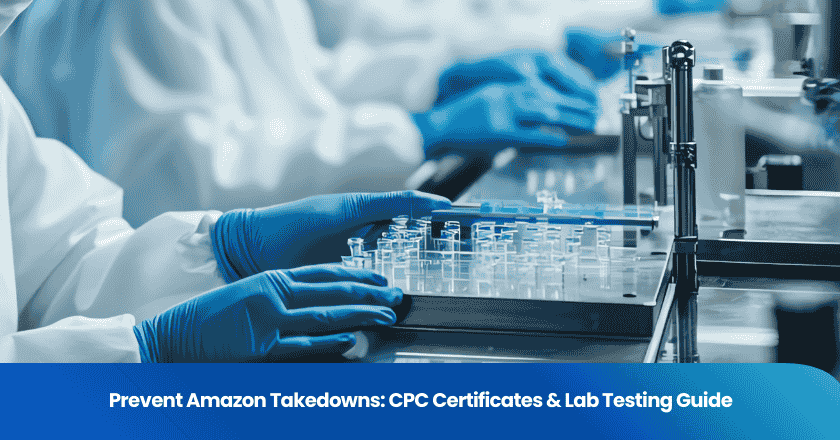
Many sellers face sudden Amazon takedowns each year, with approximately 18% experiencing at least one compliance-related restriction or suspension. These disruptions can halt revenue and erode customer trust. Leveraging third-party lab testing and securing valid CPC certificates plays a vital role in meeting strict safety standards. Companies that prioritize proper documentation and product safety build stronger relationships with their buyers and maintain a stable presence on the marketplace.

Key Takeaways
- Proactive compliance is essential. Regularly review your product listings and documentation to prevent listing removals.
- Third-party lab testing is crucial. Use accredited labs to verify product safety and quality, especially for children's items.
- Accurate documentation is key. Ensure all compliance documents are complete and up to date to avoid delays.
- Proper packaging and labeling matter. Follow Amazon's FBA packaging rules to protect your products.
- Stay informed about changes. Regularly check policy updates to keep your business aligned with new requirements.
Understanding Amazon Takedowns and Compliance
What Triggers Amazon Takedowns
Listing removals often result from a variety of issues that affect both sellers and buyers. Common triggers include complaints about products being used but sold as new, unsubstantiated medical claims, and accusations of price gouging. Sellers also face product removals due to inauthentic complaints (counterfeit claims), high order defect rates, and operating multiple accounts without approval. Intellectual property violations can lead to immediate suspension. Amazon enforces these regulations strictly to protect customers.
Tip: Sellers should regularly review their listings for accuracy and avoid claims that cannot be verified.
Product categories most at risk include children's toys, health supplements, cosmetics, electronics, and household chemicals. These categories require extra attention to safety regulations and compliance documentation.
Key Amazon Compliance Requirements
Amazon compliance requirements cover a wide range of safety and quality standards. The table below summarizes the main areas:
| Key Compliance Requirements | Description |
|---|---|
| CPSIA | Governs chemical hazards in products, especially children's toys. |
| CFR | Covers safety, quality, and other requirements for consumer goods. |
| ASTM, UL, ANSI, ISO Standards | Mandatory when referenced in regulations. |
| Test Reports | Accredited lab reports verifying product compliance. |
| Certificates | CPC for children's toys, GCC for other goods. |
| Labeling Criteria | Country of origin, tracking labels, and standard-based labels. |
The Role of Product Compliance
Product compliance plays a critical role in preventing account suspensions. Sellers who follow safety regulations and provide accurate documentation reduce the risk of violations. Compliance ensures that children's toys and other regulated items meet all safety standards before reaching customers. Metrics such as intellectual property complaints, product authenticity, and safety issues directly impact seller reputation and account standing.
Third-Party Lab Testing for Product Compliance
CPSIA and CPC Certificate Basics
The Consumer Product Safety Improvement Act (CPSIA) sets strict rules for children's products sold in the US. Products intended for children (aged 12 or younger) must meet these standards. Examples include toys, baby bottles, pacifiers, and clothing. Sellers must use a CPSC-approved lab for testing. After testing, they must compile documents to prove compliance and upload the Children's Product Certificate (CPC) to Amazon Seller Central.
The CPC must include:
- Product identification
- Applicable CPSC safety rules
- Importer or manufacturer details
- Contact info for records custodian
- Manufacturing/Testing dates and locations
- The third-party lab's identity
Note: CPSIA tracking labels are mandatory for all children's products.
Chemical and Physical Safety Testing
Safety testing protects buyers and helps sellers avoid takedowns. Testing typically falls into these categories:
| Type of Safety Test | Description |
|---|---|
| Chemical Safety Testing | Checks for harmful substances like lead, cadmium, and mercury. |
| Physical Safety Testing | Verifies strength and durability, especially for children's products. |
| Mechanical Safety Testing | Looks for sharp edges or loose parts that could cause injury. |
| Fire Safety Testing | Tests resistance to flammability. |
| Electrical Safety Testing | Ensures electrical parts meet safety standards. |
Choosing Amazon-Approved Labs
Amazon requires sellers to use accredited third-party testing labs (ISO 17025 accredited). These labs must be certified to test against the specific standards for your product category. The general process involves:
- Select a qualified CPSC-accepted laboratory.
- Coordinate with the lab to define the testing plan.
- Submit samples for testing.
- Receive test reports.
- Generate the CPC based on passing reports and upload to Amazon.
Lab testing results are often shared with Amazon through compliance portals. Using approved labs helps sellers meet safety standards and avoid listing suppression.
Steps to Achieve and Maintain Compliance
Preparing for Product Testing
Sellers must prepare carefully for product testing. This includes understanding the specific standards applicable to the product before manufacturing begins. Step-by-step guide for preparation:
- Identify all relevant regulations (e.g., ASTM F963 for toys).
- Select appropriate testing tools and labs.
- Conduct pre-production inspections to catch issues early.
- Analyze test results to identify trends or failures.
- Implement successful changes and plan for ongoing improvements.
Documentation and Certificate Submission
Proper documentation is essential. Sellers must gather and organize all required documents before submitting them. The table below outlines the main types:
| Documentation Type | Requirements |
|---|---|
| Test Reports | Must match product description, images, and contain age grading. |
| Compliance Markings | Proof of compliance markings (e.g., tracking labels) appropriate for the product type. |
| Product Instructions | Complete manuals with mandatory safety statements. |
| Tracking Labels | Permanently attached, including manufacturer info, location, and date. |
Ongoing Compliance Monitoring
Maintaining compliance is not a one-time task. Sellers must monitor their products and documentation continuously. Amazon's compliance algorithms are strict and constantly evolving.
- Regularly check Amazon's policy updates and compliance reference tool.
- Maintain a central digital repository of compliance documents.
- Document every product change (material, factory, design).
- Respond promptly and completely to Amazon compliance requests.
Alert: Amazon's compliance standards for certifications change frequently. Sellers who monitor these changes protect their business.
Packaging, Labeling, and FBA Compliance
Amazon FBA Packaging Rules
Amazon sets strict packaging rules. Each unit must be individually wrapped and sealed. Sellers must attach an FBA barcode label (FNSKU) to every item. Compliance ensures products are not rejected at the fulfillment center.
- Products must be packaged to prevent damage during transit.
- Fragile items require bubble wrap.
- Each box must have a visible FNSKU label.
Labeling and Warning Requirements
Labeling plays a key role in safety. Products sold as sets must display a "Sold as set" label. Poly bags with openings over 5 inches must display a suffocation warning.
| Requirement | Details |
|---|---|
| Expiration Date Format | MM-DD-YYYY or MM-YYYY on master carton and units. |
| Suffocation Warning | Mandatory on poly bags with openings >= 5 inches. |
| Heavy Package Label | "Team Lift" or "Mech Lift" labels for heavy boxes. |
Inspection and Real-Time Reporting
Using independent inspections helps verify compliance before shipping to Amazon. Sellers can monitor inspections to ensure FBA labels are correct and packaging meets standards.
| Step | Description |
|---|---|
| 1 | Independent inspections verify FNSKU and packaging compliance. |
| 2 | Real-time reporting lets sellers monitor quality live. |
| 3 | Detailed reports include images of labels and boxing. |
Overcoming Common Compliance Challenges
Amazon sellers face many obstacles. The table below highlights some of the most common issues:
| Compliance Challenge | Description |
|---|---|
| Increased Scrutiny | Regulatory bodies (FDA, FTC, CPSC) are pressuring marketplaces. |
| AI-Powered Enforcement | Automated bots often flag listings by mistake. |
| Precise Claims | Listings must avoid unverified claims (e.g., "cure", "treatment"). |
| Testing Costs | High fees for testing and documentation can impact margins. |
Avoiding Documentation Errors
Documentation mistakes are a primary cause of rejection. Common errors include:
| Error Type | Description |
|---|---|
| Mismatched Info | Test reports must exactly match the product listing name/model. |
| Wrong Supplier Name | The company name on reports must match the invoice/Seller Central info. |
| Incomplete Standards | Reports must cover 100% of the required safety standards. |
| Expired Reports | Tests generally need to be renewed annually (ISO 17025 requirement). |
Proactive compliance protects sellers from Amazon takedowns. By utilizing third-party lab testing, ensuring accurate documentation (like CPC certificates), and adhering to FBA packaging rules, sellers can safeguard their account health. Staying informed about compliance rules builds trust with buyers and supports long-term success on the platform.
FAQ
What is a CPC certificate and who needs it?
A CPC (Children's Product Certificate) is a document certifying that a children's product complies with all applicable US safety rules. Any seller offering products intended for children 12 and under in the US must provide this.
How often should sellers update compliance documents?
Sellers should review and update compliance documents annually. You must also retest and update documents immediately if there is any material change to the product, such as a change in suppliers, materials, or manufacturing processes.
Why does Amazon require third-party lab testing?
Amazon requires testing from ISO 17025 accredited labs to ensure products meet federal safety standards. Independent labs provide unbiased verification, protecting Amazon from liability and customers from harm.
What happens if a product fails a compliance test?
If a product fails, the seller cannot list it. You must identify the failure point, correct the manufacturing or material issue, and retest the product until it passes all required safety checks before selling.
Похожие статьи
Развивайте свой бизнес с услугами TradeAider
Нажмите кнопку ниже, чтобы войти непосредственно в систему услуг TradeAider. Простые шаги от бронирования и оплаты до получения отчетов легко выполнить.

