
- О нас

- Наши услуги
- Ваша отрасль
- Ресурсы
- Новости и блог
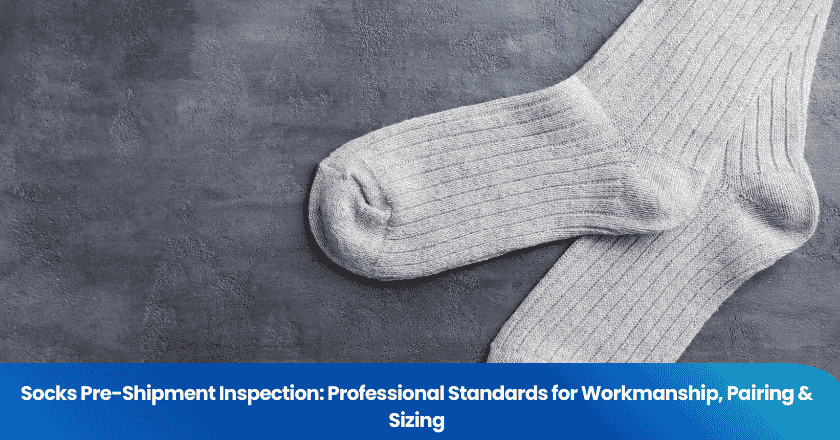
Socks Pre-Shipment Inspection (PSI) represents the final and most critical barrier against quality non-conformities in the hosiery supply chain. In bulk manufacturing, socks are subject to numerous mechanical and human-led processes—from high-speed circular knitting to heat-setting (boarding) and manual pairing. These stages often introduce defects such as excessive thread tails, pairing mismatches, and sizing inconsistencies. By utilizing systematic AQL sampling and rigorous workmanship standards, brands can ensure that their shipments align with international retail expectations and avoid the financial strain of returns.
Key Takeaways
- Structural Integrity: PSI focuses on toe closing quality, rib elasticity, and heel construction.
- Workmanship Standards: Thread ends exceeding 3mm are generally classified as major defects in premium hosiery.
- Pairing Precision: Length differences between a pair of socks should not exceed 5mm to maintain aesthetic and functional symmetry.
- Size Verification: Dimensions must be measured both 'relaxed' and 'on-form' to confirm accurate fit after boarding.
- Metal Safety: 100% needle detection is mandatory to prevent consumer injury and comply with global safety regulations.
Technical Workflow of Hosiery Inspection
The inspection of socks differs from standard garment auditing due to the elastic nature of the knit fabric. A professional quality control program involves several distinct phases to capture defects at both the macro and micro levels.
AQL Sampling and Batch Validation
Inspectors utilize the ANSI/ASQ Z1.4 (AQL) standard to determine the sample size. For a typical order of 10,000 pairs, an inspector might pull 200 pairs for a level II audit. Any critical defect—such as a broken needle fragment—results in immediate batch rejection. Major defects, such as holes or incorrect yarn count, are limited based on the client's risk appetite (typically 1.5 or 2.5).
| Inspection Phase | Technical Objective | Common Verification |
|---|---|---|
| In-Process Check | Audit knitting machine settings. | Needle count and plating consistency. |
| Toe Closing Audit | Verify seam smoothness. | Check for "Dog-ears" or irritation points. |
| Final Random (FRI) | Assess aesthetic and packing. | Pairing symmetry and size tolerance. |
| Needle Detection | Safety compliance. | 1.0mm ferrous metal detection scan. |
Thread Ends and Workmanship Precision
In hosiery, the management of thread ends is a direct reflection of a factory's finishing capability. Excessive yarn tails on the inside of the sock can cause discomfort and potential tripping hazards, while tails on the outside are an immediate aesthetic failure.
Internal and External Workmanship Standards
Inspectors perform an 'Inside-Out' audit on a subset of the samples. For jacquard or patterned socks, the 'Floats' (the threads carrying color across the back) must be trimmed according to the specified density. If floats are too long, they can snag during wear. Professional standards dictate that thread tails at the welt (top) and toe should be no longer than 2mm to 3mm.
| Defect Type | Visual Indicator | Severity (AQL) |
|---|---|---|
| Long Thread End | Tail > 5mm on exterior. | Major |
| Dropped Stitch | Small hole or 'run' in the knit. | Critical/Major |
| Oil Stain | Discoloration from machine lube. | Major |
| Uneven Plating | Elastic yarn visible on the surface. | Major |
"Workmanship in socks is defined by the invisible details. A perfectly closed toe and a flush-trimmed welt indicate a manufacturer that values long-term durability over rapid throughput."
Pairing Accuracy and Symmetry
Pairing is often a manual process where workers match two socks of the same size and color. Errors here lead to the most frequent retail complaints—customers receiving one sock longer than the other or slight shade differences (Shade Banding) within the same pair.
Dimensional Symmetry and Shade Matching
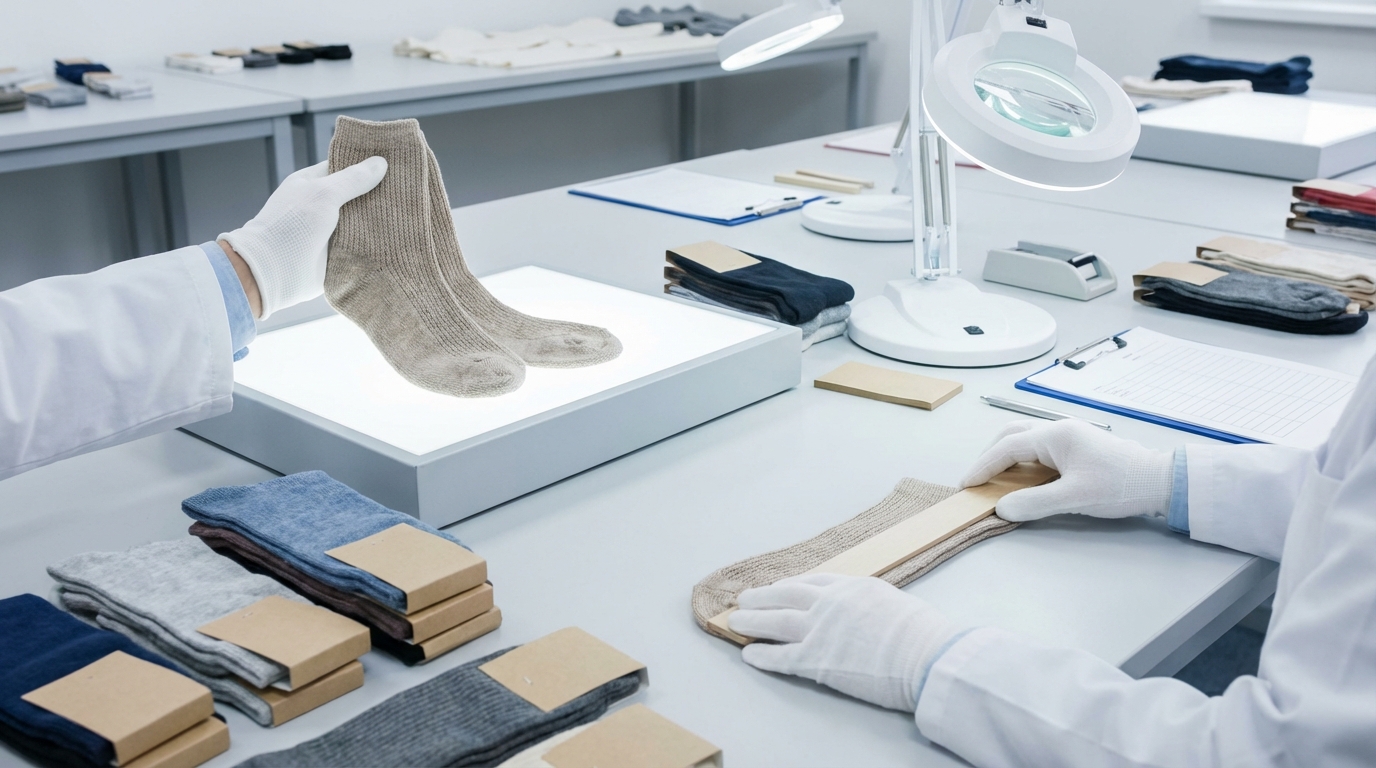
During the Socks Pre-Shipment Inspection, the auditor places pairs flat on a measuring table. The heel-to-toe length and the total height must match between the left and right socks. Additionally, 'Metamerism' checks are performed under D65 daylight to ensure that the dye lot is consistent across the entire assortment.
- Heel Alignment: Heels must be perfectly matched to prevent one sock from sliding down the foot.
- Logo Placement: Embroidered or printed logos must be at the same vertical height (±3mm) on both socks.
- Color Shade: No visible difference (Shade 4-5 on the gray scale) allowed between paired units.
Size Tolerance and Measurement Protocols
Unlike woven garments, socks rely on 'Stretchability' for fit. However, the 'Relaxed' (static) dimensions are still the baseline for quality control. These dimensions are heavily influenced by the 'Boarding' process—where socks are stretched over metal forms and blasted with steam to set their final shape.
Flat Measurements vs. Stretch Recovery
Inspectors measure three key points: Welt Width, Leg Length, and Foot Length. A common industry tolerance for adult socks is ±5mm for length. More importantly, the 'Stretch & Recovery' test is conducted. If a sock is stretched to its maximum width and does not return to its original relaxed state within 3mm, the elastic yarn (Spandex/Lycra) may be of inferior quality or damaged during the heat-setting phase.
| Measurement Zone | Relaxed Tolerance | Stretch Requirement |
|---|---|---|
| Total Foot Length | ± 5 mm | Min. 2x relaxed length. |
| Welt (Top) Width | ± 3 mm | Must recover to within 95%. |
| Ankle Width | ± 3 mm | Must prevent 'Sagging' during use. |
Digital Transparency and Real-Time Reporting
The hosiery industry is moving toward digital oversight to eliminate the delays of paper reports. Through TradeAider's inspection services, clients not only receive an official inspection report within 24 hours, but can also view inspection progress and identified issues during the inspection via TradeAider’s online service system.
By reviewing the Online Real-time Report, brands can make timely decisions on how to handle defective products—whether to accept them commercially, require on-site rectification by suppliers with the support of TradeAider inspectors, or reject them before shipment. This approach helps ensure that only quality-approved products are packed, shipped, and paid for, reducing unnecessary losses and improving supply chain control.
Corrective and Preventive Actions (CAPA)
If a batch fails due to pairing inaccuracies, a CAPA is issued. The factory must then perform 100% re-pairing of the affected batch under the supervision of a third-party auditor. This ensures that the root cause—usually a breakdown in manual sorting—is addressed before the goods are containerized.
The Importance of Metal Detection in Socks
Broken needle fragments are a critical safety risk in knitted products. A fragment trapped in a toe seam can lead to severe injury. Every professional socks inspection includes a verification of the factory's needle detection protocol. All socks must pass through a 1.0mm or 1.2mm ferrous metal detector after the final packing stage. Auditors verify the detector's calibration records and perform a '9-Point Sensitivity Check' to ensure the machine is functioning correctly.
Ready to secure your product quality before shipment?
As your third-party inspection, testing & certification partner in China, TradeAider supports brands and sourcing teams across the entire production process, helping you identify quality risks early, ensure compliance, and strengthen your team’s capabilities before shipment.
Book an Inspection or Testing Service with TradeAider today, or for tailored solutions and expert guidance, contact us at services@tradeaider.com.
FAQ
What is the most common reason for socks failing PSI?
The most common failure is 'Shade Variation.' Because yarn is dyed in batches (dye lots), slight temperature or chemical differences can cause one carton of socks to be darker than the next. Pairing matching shades is the key challenge in hosiery QC.
What is 'Rosso' toe seaming vs. 'Hand-linked'?
Rosso is a machine-sewn seam that creates a slightly raised ridge, often resulting in thread tails that need trimming. Hand-linked (or seamless) is a method where each loop is joined, creating a perfectly flat seam. Hand-linked socks require a much higher level of inspection for 'dropped stitches' at the join.
Can socks shrink after the pre-shipment inspection?
Yes, if the boarding (heat setting) was not performed at the correct temperature for the specific fiber blend (e.g., Cotton/Nylon/Spandex). Inspectors check the 'Shrinkage' test report to ensure dimensions remain stable after a standard wash cycle.
Why is Spandex/Lycra 'Grinning' a defect?
'Grinning' occurs when the elastic core yarn becomes visible on the surface of the sock, often appearing as tiny white loops. This is a major aesthetic defect and indicates poor tension control on the knitting machine.
What is the standard tolerance for socks weight?
Socks are often sold by weight (e.g., 40g per pair). A tolerance of ±3% is standard. If the socks are too light, it may indicate a lower yarn density or incorrect needle count, impacting the product's warmth and durability.
Похожие статьи

Развивайте свой бизнес с услугами TradeAider
Нажмите кнопку ниже, чтобы войти непосредственно в систему услуг TradeAider. Простые шаги от бронирования и оплаты до получения отчетов легко выполнить.

