
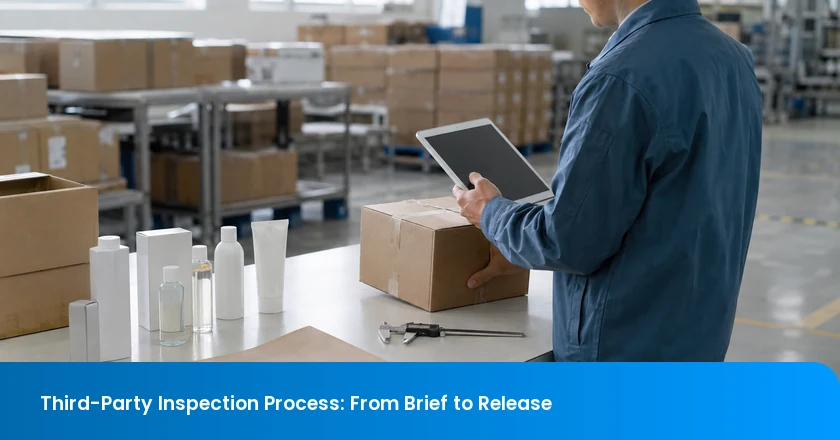
Third-party inspection starts with a buyer-owned decision rule, not a factory visit. A purchase order can identify the product and quantity yet still omit the controlling revision, the finished population represented by the result, the check method, the acceptance rule, and who may approve an exception. If the inspector has to invent those inputs on site, the report may be detailed but still unable to support a safe ship, hold, correct, or accept-with-concession decision.
A workable third party inspection process therefore joins commercial intent and technical evidence before anyone travels. The buyer defines what the report must decide, selects the earliest useful stage, freezes the product reference, identifies the lot, sets sampling and defect rules, and states the inspector's authority. The supplier then declares actual readiness, while the inspection body confirms it can execute the scope. The report closes the loop by showing what was checked, how it was checked, what population the evidence represents, and what remains unresolved.
Start With the Decision the Inspection Must Support
A third-party inspection starts when the buyer defines the decision and evidence boundary, not when an inspector reaches the factory. “Check quality” is not a decision. “Confirm whether the current finished lot matches drawing revision C, packaging specification P-04, and the agreed workmanship limits before the balance payment” is. It identifies the object, the controlling files, the timing, and the commercial question that the report must inform.
The decision determines the stage. A material approval needs evidence before the material is consumed. A concern about process drift needs observations while production is running. A shipment-release review needs an identifiable finished population and its actual export packing. A prior failure needs a correction record and a reinspection scope that can distinguish corrected units from unresolved units. Booking “an inspection” without this distinction invites a visit at the wrong time.
Write the intended decision at the top of the brief, then state the limits. The inspector may record facts, classify findings under the agreed rules, and escalate a conflict. The supplier may explain, correct, or present additional evidence. Neither party should silently change the buyer's specification, accept a deviation, redefine the lot, or authorize shipment unless the buyer has granted that authority in writing.
A report is useful only when its evidence answers the decision that caused the inspection to be booked.
Lock Six Inputs Before the Inspector Travels
Six connected inputs make the assignment executable: decision, stage, product reference, represented lot, check and acceptance method, and exception authority. The represented lot means the identifiable units or cartons to which the result can reasonably apply. Acceptance sampling is a sample scheme plus rules used to decide the disposition of a defined lot; NIST explains that its purpose is lot acceptability, not estimating exact lot quality. Exception authority means the named person who may approve a deviation, request correction, stop the visit, or escalate a finding.
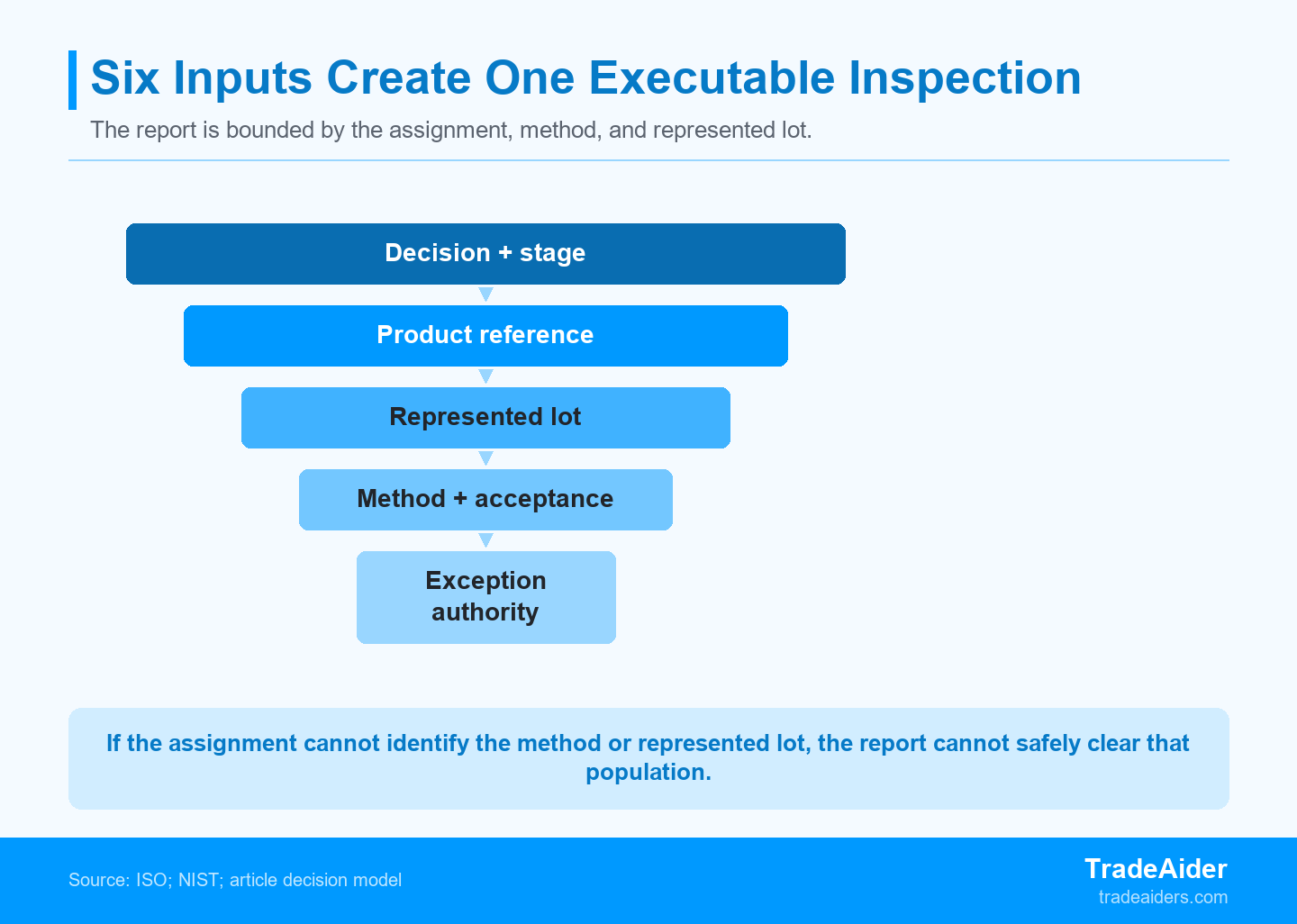
The report can support only the checks, methods, and represented lot fixed in the controlled assignment.
- Join the decision and stage. Inspect when the named risk is visible and a useful action is still possible.
- Join the product reference and represented lot. The approved model, drawing, sample, bill of materials, label, and pack revision must map to the units presented.
- Join the check method and acceptance rule. State what the inspector does, under which condition, how the result is recorded, and how defect counts affect the defined lot.
- Name exception authority. Give the inspector a fast escalation route without transferring the buyer's concession or release decision.
The lot boundary is not administrative. A result cannot safely travel from the declared lot to a warehouse balance, later production, another supplier, or an untraceable revision merely because the product name is the same.
These six inputs also reveal when the assignment is not ready. If the factory cannot state the completed quantity, the buyer cannot define the population. If two drawings claim to be current, the inspector cannot choose the acceptance reference. If a method requires laboratory equipment that is unavailable on site, the buyer must change the evidence route rather than leave the check to interpretation.
Choose the Inspection Stage Before You Book
The correct stage is the earliest practical point at which the named risk can be observed and corrected without pretending that one visit controls the entire order. The following choices answer different questions; they are not interchangeable labels for the same factory visit.
| Inspection stage | Decision it can support | Readiness evidence needed | What it cannot prove alone |
|---|---|---|---|
| Pre-production | Whether named inputs and references are ready for bulk production | Materials or components available, approved references, production plan | Conformity of a finished shipment that does not yet exist |
| During production | Whether a live process and emerging output need correction or containment | Meaningful production progress, identifiable work in process, current controls | The final packing and full finished-lot status |
| Pre-shipment | Whether the identifiable finished and packed lot matches the agreed scope | Declared completed and packed quantities, locations, SKU and carton map | Earlier process control or unperformed compliance testing |
| Reinspection | Whether an agreed correction is complete for a defined population | Correction record, isolated population, revised status, verification method | Unmapped units outside the correction and verification record |
Use an Early Stage When Inputs or Process Conditions Are Unsettled
Pre-production inspection is useful when material, component, approved sample, tooling, or production-readiness evidence can still prevent a wrong build from spreading. It should not be booked simply because it comes first in a process diagram. Name the risky input, the approved reference, the observation or document required, and the action that follows a mismatch.
For example, a buyer worried about substituted fabric should identify the fabric article, color, composition evidence, approved swatch, roll or batch identity, and any check that can validly be performed on site. A buyer worried about a changed electronic component needs the current bill of materials, component marking, approved alternative rule, and traceability record. TradeAider's pre-production inspection route is relevant when those inputs can be reviewed before bulk output makes correction wider and more expensive.
The output is a bounded readiness decision: proceed, correct an input, obtain missing evidence, or pause. It is not a guarantee that later production will remain conforming. The buyer should carry any high-risk input forward into during-production or final checks when subsequent substitution, setup drift, assembly, packing, or labeling can change the result.
Move Later Only When the Decision Depends on Production or Finished Goods
During-production inspection follows a live process and emerging output, while pre-shipment inspection should examine a sufficiently complete, identifiable finished lot; reinspection verifies an agreed correction rather than repeating the original visit blindly. The buyer should define a readiness threshold in operational terms, such as completed quantity, packed quantity, locations, SKU mix, and outstanding rework.
A production-stage visit can compare output from different lines, shifts, tools, or component batches while the factory can still contain the cause. A finished-lot visit can examine workmanship, quantity, function, labels, packaging, and carton identity under the approved scope. A reinspection should concentrate on the failed characteristic and correction population, while repeating other checks only when the correction could have affected them. This sequence prevents a narrow fix from being presented as proof that every original requirement was retested.
Build a Brief the Inspector Can Execute
An executable brief connects controlled product references to named checks, methods, defect classes, evidence requirements, and escalation rules. Place one revision number and issue date on the packet. List the order, supplier, factory, product, destination, inspection stage, and requested date, but do not mistake those administrative fields for the inspection method.
The brief should state document priority. If the drawing conflicts with the approved sample, the PO conflicts with the packaging specification, or a supplier message proposes a late change, the inspector should not decide which source wins. The conflict must go to the named buyer authority. Record any approved deviation as a controlled addition to the packet so that the supplier, inspector, and buyer use the same revision.
| Brief field | Minimum content | Failure it prevents |
|---|---|---|
| Product control | SKU or model, drawing, approved sample, bill of materials, label and pack revisions | Checking the right product against the wrong reference |
| Lot declaration | Completed and packed quantities, locations, batches, carton ranges, outstanding work | Applying a sample result to an unidentified population |
| Check instruction | Characteristic, method, condition, unit, expected result, evidence format | Subjective wording and inconsistent execution |
| Decision rule | Sampling scheme, defect classes, acceptance numbers, critical escalation | Creating acceptance logic after findings are visible |
| Authority and communication | Contacts, response window, stop-work limits, concession and release owner | Supplier or inspector assumptions becoming buyer decisions |
Use TradeAider's inspection standard resource to frame defect classes and sampling questions, then have the buyer approve the product-specific plan, limits, and escalation rules.
Freeze the Product Reference Before Writing the Check Method
Each check needs an identifiable SKU or model, current drawing or approved sample, characteristic, method, condition, and expected result. “Check dimensions” is incomplete. A useful instruction names the drawing point, measuring tool, unit, tolerance, sample allocation, and required photograph or result entry. “Check function” needs the operating sequence, load or setup condition, expected response, and any safety limit.
Separate observations from tests that need another evidence route. An inspector can compare controlled artwork, operate a specified feature, measure accessible dimensions, and record workmanship. Do not present that visit as proof of chemical composition, long-cycle durability, electrical safety, or certification unless the assigned method and competent resources support it. For every result, record the item or carton identity, reference, method, unit, photograph, classification, and limitation; explain any check that could not be completed.
Define the Lot, Sampling Plan, and Acceptance Rule Together
Sampling is interpretable only when the lot, random selection method, defect classes, sample scheme, and decision rules are defined before results are seen. NIST distinguishes single, double, multiple, sequential, and skip-lot plans; the choice changes the workload and later decision steps. For a single plan, NIST connects sample size n with acceptance number c, showing why sample size alone is not an acceptance rule. Write the approved plan, inspection level where relevant, defect classes, and accept/reject numbers into the brief instead of sending only an AQL value.
AQL is an index within the chosen sampling plan, not a promise that exactly that percentage of the shipment is defective. Nor does a sample result erase a critical issue whose contract rule requires immediate escalation. Define critical, major, and minor classifications against product-specific consequences, then state whether any safety, regulatory, identity, or unauthorized-substitution finding overrides the ordinary count decision.
Match the Inspection Body to the Actual Scope
Provider selection should test competence for the product and method, impartial conduct, geographic coverage, reporting discipline, and the ability to handle samples, records, confidentiality, complaints, and escalation. The UKAS transition bulletin for ISO/IEC 17020:2026 highlights impartiality, independence, competent personnel, and monitoring, while ISO CASCO's overview of inspection bodies identifies competence, equipment, processes, records, confidentiality, and complaints. Use a competent laboratory or product testing service for destructive analysis, controlled laboratory conditions, specialized instruments, or formal test-report requirements; an on-site observation is not a laboratory result. Ask who performs the work, which instructions and equipment they use, how subcontracting is controlled, and who reviews unusual findings. Accreditation may be relevant when its scope covers the activity, but it does not replace checking the assigned provider and method.
Confirm Factory Readiness, Access, and Exception Authority
A booking is not ready until the supplier confirms the actual lot status, inspection location, access, equipment, product availability, responsible contact, and limits on rework or sample handling. Request a dated readiness statement close enough to the visit to reflect reality, then compare it with what the inspector finds on arrival.
For a finished-lot visit, the declaration should name completed and packed quantities by SKU, batch or production date where relevant, warehouse and floor, carton range, units still in rework, units already shipped, and any goods stored off site. If the actual status falls below the agreed threshold, the inspector should record it and escalate. The buyer can then proceed with a disclosed limitation, change the scope, or reschedule.
Access includes more than a gate pass. Confirm safe working space, power, water, lighting, handling help, opening and resealing permission, equipment, approved samples, production records, and units across the lot. Give the inspector a response window and named contacts. If a late factory instruction conflicts with the brief, the inspector pauses the affected check and asks the buyer. This preparation is part of a controlled pre-shipment inspection.
Illustrative Scenario: A Correction Claim That Did Not Cover the Lot
A supplier's correction statement cannot close a failed inspection when its records cover only half the order and the corrected and uncorrected cartons have been mixed. The following scenario is illustrative, not a TradeAider client case.
The Rework Log Proved Only 50 Percent Coverage
In a 3,200-unit order, a rework log naming 1,600 units proves at most 50 percent documented coverage; four old-revision findings among 24 checked cartons show the correction is not contained, not the exact defect rate of the full order.
An importer is preparing 3,200 electric kettles in two carton designs for one destination market. The current buyer reference requires a revised power-rating label and updated instruction sheet. The original inspection finds old labels and missing revised manuals. The supplier later reports that every carton was opened and corrected, but its rework log identifies only 1,600 unit numbers. Before reinspection, cartons from two packing zones are moved into common staging. Four of 24 cartons selected across the staged order still contain the old label or manual revision. The affected scope is 1600 units named in the rework log, 1600 units outside it, and 4 old-revision findings among 24 checked cartons after mixed staging.
The arithmetic is useful but narrow: 1,600 divided by 3,200 equals 50 percent documented correction coverage. The four findings prove that the claimed correction boundary failed after mixed staging. They do not establish an exact 16.7 percent defect rate for the full order, and 20 conforming cartons do not prove that every corrected unit is identifiable. The buyer holds all 3,200 units because neither population can be reliably separated from the current records.
The supplier reconstructs carton identities from production and rework records, separates both populations, replaces every old label and manual, and reseals under a traceable status. Reinspection records selected carton IDs, revisions, correction status, results, and the unit range represented by each population. Only that evidence can support a later split or conditional buyer decision. This is an illustrative example, not a real defect-rate estimate or a prescribed sample size, AQL, or legal labeling rule.
Separate, Correct, and Verify Before Narrowing the Hold
The supplier must map carton identities to correction records, isolate both populations, correct every affected unit, and present the defined population for a targeted reinspection. The verification instruction should name the failed characteristic, current reference, check method, evidence format, and population. Other checks are repeated only when the rework could have changed them or the buyer's rule requires it.
A broad supplier declaration is inexpensive to produce because it does not reveal where correction stopped. A unit-level or carton-range record creates a testable boundary. That boundary lets the buyer narrow the hold after evidence is complete; without it, a split release would be based on confidence rather than identity.
Read the Report as Evidence, Not a Release Order
A report supports a buyer decision only to the extent that it identifies the assignment revision, date and place, lot status, sample selection, checks performed, results, exceptions, photographs, and limitations. Review the factual layer before the status label. For one market-specific boundary, the CPSC's certificate guidance says the U.S. manufacturer or importer remains responsible for the applicable certificate even when another party assists. Outside evidence therefore does not automatically transfer buyer responsibility.
Next review the decision layer. A “pass” may mean counts stayed within the agreed sampling rule, yet a pending document, unperformed laboratory test, inaccessible SKU, critical finding, or unauthorized change can remain outside that status. A “fail” identifies a rule outcome; it does not decide whether the buyer demands rework, negotiates a concession, cancels, or accepts a limited commercial risk. Record those buyer actions separately from the inspection result.
Close every exception with one of five statuses: accepted evidence, correction required, reinspection required, qualified testing or review required, or buyer concession pending. Name the affected product and population for each status. This prevents an overall headline from hiding a narrower unresolved block and gives the supplier a precise correction target.
Send One Controlled Inspection Handoff
The final handoff should package the decision, current files, lot declaration, sampling and acceptance instructions, evidence format, contacts, authority limits, and post-report actions in one controlled revision. Attach only the files that govern this visit, or mark superseded versions clearly. The supplier and inspection provider should acknowledge the same revision before the booking is treated as confirmed.
- State the buyer decision and inspection stage.
- List the product, order, destination, current references, and document priority.
- Declare the identifiable lot, locations, completed and packed quantities, and unresolved work.
- Define checks, methods, sample plan, defect classes, acceptance numbers, and critical escalation.
- Specify photographs, measurements, records, report format, and turnaround.
- Name supplier, inspector, buyer, and exception contacts with response times and authority limits.
- Predefine the actions for pass, fail, incomplete scope, correction, reinspection, and pending evidence.
TradeAider can review a scope after those inputs are available. Include the current product references, declared lot status, checks, acceptance rules, factory location, and target date. The response should confirm what can be performed, which evidence or equipment is missing, and which questions remain with the buyer, supplier, laboratory, or legal adviser. When the packet is complete, send the inspection handoff to TradeAider.
Do not release the assignment for travel until the supplier and provider can identify the same product, lot, method, and decision authority.
Frequently Asked Questions
How early should a third-party inspection be booked?
Book after the inspection decision, product references, lot status, checks, and acceptance rules are stable enough to issue one controlled brief. The provider may need lead time for location coverage, inspector competence, equipment, and document review, so send the proposed scope before the target visit. Do not lock travel while the factory still cannot declare readiness or the buyer has unresolved drawing, sample, method, or authority conflicts.
Can the supplier choose the inspection sample?
The supplier should make the entire declared lot accessible, but the inspector should select the sample according to the agreed random-selection method and sampling plan. Supplier-picked “best” cartons can bias the evidence and break the connection to the lot. If access, stacking, safety, or warehouse layout prevents the planned selection, the report should disclose the limitation and the buyer should decide whether to proceed, change the scope, or reschedule.
Does an AQL pass mean the lot has that defect rate?
No, an AQL-based result applies the chosen sampling scheme and decision rules to the defined lot; it is not an exact estimate of the lot's defect rate. The result depends on the valid lot, random selection, sample size, defect classifications, acceptance numbers, and switching rules where applicable. Critical findings may also require separate escalation under the buyer's contract or safety rules even when ordinary defect counts remain within their limits.
What happens if the factory is not ready on inspection day?
The inspector should record the actual readiness, access, and available quantity, then escalate before silently reducing the scope or substituting another population. The buyer can authorize a disclosed partial inspection, revise the purpose, or reschedule. If work proceeds, the report must identify what was unavailable and prevent the result from being applied to uninspected SKUs, unfinished units, off-site stock, later production, or cartons still in rework.
Who decides whether goods can be released after inspection?
The buyer or its authorized representative makes the release decision using the report, contract terms, applicable obligations, concessions, and unresolved exceptions. The inspector records findings and applies the agreed classification and sampling rules; the supplier explains or corrects them. Unless the buyer has expressly delegated authority, neither an inspection-company status label nor a factory promise should authorize shipment, balance payment, acceptance of a deviation, or closure of pending laboratory and compliance evidence.
Похожие статьи

Развивайте свой бизнес с услугами TradeAider
Нажмите кнопку ниже, чтобы войти непосредственно в систему услуг TradeAider. Простые шаги от бронирования и оплаты до получения отчетов легко выполнить.

