
Manage Tier 2 and Tier 3 supplier risks by mapping the suppliers and sites behind important inputs, checking the evidence for those relationships and reviewing changes before relying on old approvals. Supply chain transparency supports quality, continuity and responsible sourcing when it shows what is known, what remains uncertain and who will act.
For an importer or brand, the starting point is the actual product and direct supplier. Work upstream where dependencies or potential adverse impacts justify closer attention. Use inspections, testing, audits and monitoring for the questions they can answer, and keep their findings connected to a current supplier map.
Make Lower-Tier Supplier Information Useful
- Define tiers relative to the buyer and the actual supply path.
- Link suppliers and sites to products, materials and supporting records.
- Separate declarations, corroborating evidence and unknown relationships.
- Match verification to the quality, continuity or responsible-sourcing concern.
- Assign an owner and update the map when relevant conditions change.
Understanding Tier 2 and Tier 3 Suppliers
Supplier tiers describe positions in a buyer’s supply network. Map the actual product and supply path before assigning a label; a company’s business type alone does not establish its tier.
Supplier Tiers Explained
Tier 1 supplies the buyer directly; Tier 2 supplies Tier 1; Tier 3 supplies Tier 2 along the defined supply path. The same organization can occupy a different position in another buyer’s network.
| Position relative to the buyer | Illustrative garment supply path | Relationship to record |
|---|---|---|
| Tier 1 | Garment assembler supplying the buyer | Order and product supplied directly. |
| Tier 2 | Fabric mill supplying that assembler | Fabric supplied for the identified garment. |
| Tier 3 | Yarn spinner supplying that fabric mill | Yarn used in the identified fabric supply. |
This is an illustrative path, not a fixed model for every garment. Ginning, farming, dyeing, trading or subcontracted processing can create additional or different links. A raw-material producer is not automatically a third-tier supplier, and a supplier approval grade should not be confused with a network position.
Start with the product and direct supplier, then ask who supplies the important materials, components and outsourced processes. Record the legal entity and actual operating site separately where they differ. Draw the supply relationship between named sites and inputs rather than place unconnected company names in a spreadsheet. Where a link is only declared or remains unknown, show that status instead of inventing a complete chain.
Why They Matter
Lower-tier suppliers matter because upstream material, processing, capacity and responsible-sourcing problems can affect downstream orders. The direct factory may assemble the product correctly while depending on an input or process that needs further review.
A material substitution can alter performance; a processing bottleneck can delay delivery; and a serious labor or environmental concern can require action beyond an appearance check. These exposures have different consequences and evidence needs. An attractive finished sample does not explain the origin, capacity or working conditions of every organization behind it.
Use the map to find dependencies that could change a purchasing decision. Ask which inputs have difficult-to-replace sources, which processes occur outside the approved factory, and where evidence is weak for a significant concern. This helps procurement, quality and responsible-sourcing staff work from the same relationships while keeping their technical and commercial decisions distinct.
Supply Chain Transparency and Its Importance
Supply chain transparency connects relevant supplier, site, product and material information with evidence that supports decisions. Its value depends on what the information establishes, how current it is and who can access it.
Risk and Compliance
OECD’s responsible-business-conduct guidance describes due diligence as risk-based, with measures proportionate to the severity and likelihood of adverse impacts. In this context, risk concerns impacts on people, the environment and society, rather than only financial loss to the buyer.
Keep those impact priorities visible alongside commercial concerns such as capacity, delivery and dependence on a shared source. A low-value component can still involve a serious adverse impact. Conversely, a delivery concern does not by itself establish a human-rights violation. Decide which question needs investigation and assign the appropriate reviewer.
Compliance obligations depend on the product, business, activity and destination market. Sustainability reporting, due diligence, product testing and import documentation answer different questions; they should not be treated as one universal certificate of an ethical supply chain. Identify applicable requirements with competent reviewers and retain the evidence needed for that purpose. The OECD guidance provides a due-diligence approach, not proof that a particular supplier meets every law.
Quality and Performance
Quality and performance review should connect supplier and site relationships to approved inputs, affected lots and change decisions. A downstream inspection result should not be extended to substitutions that were never reviewed.
Use the inspection standards resource to help frame relevant product checks, then agree the actual specification, references and acceptance criteria. Keep the material or component identity with the order so a later finding can be traced to the supply under review.
Illustrative example: a garment assembler proposes moving fabric finishing to another site while retaining the same fabric description. The buyer needs to know which fabric and orders are affected, what process has moved and whether existing quality or test evidence covers the change. Update the mapped processing site, request relevant records and assign any further checks before accepting the substitution. This hypothetical example illustrates a review decision; it is not a TradeAider customer case or a measured result.
Overcoming Transparency Challenges
Transparency gaps arise when supplier names, operating sites, supply relationships or supporting records are missing, outdated or uncorroborated. A long supplier list can still leave the buyer unable to identify the source of an important input.
Data and Documentation Gaps
GS1’s Global Traceability Standard organizes traceability around critical tracking events and key data elements, including what, who, where, when and why. For a buyer, these distinctions help connect a material movement or processing event to an identifiable product and supply relationship.
Use a supplier-map record such as the following. The fields are a practical working template, not a certification scheme. Separate a supplier declaration from information corroborated against specified evidence, and keep unknown relationships visible.
| Record field | What to enter |
|---|---|
| Entity and operating site | Legal name, relevant address, identifiers and role in the supply path. |
| Supply relationship | Who supplies whom; component, material or outsourced process involved. |
| Product connection | Order, product, material specification and relevant lot or batch reference. |
| Evidence and status | Document or observation, source and date; declared, corroborated against named evidence, or unknown. |
| Update responsibility | Owner, last review, unresolved question, next review and change trigger. |
| Access limits | Who may view or share the information and any necessary confidentiality controls. |
“Corroborated” should identify the evidence checked and its limits; it is not a guarantee that every upstream statement is true. Keep the underlying records retrievable so another reviewer can understand the conclusion.
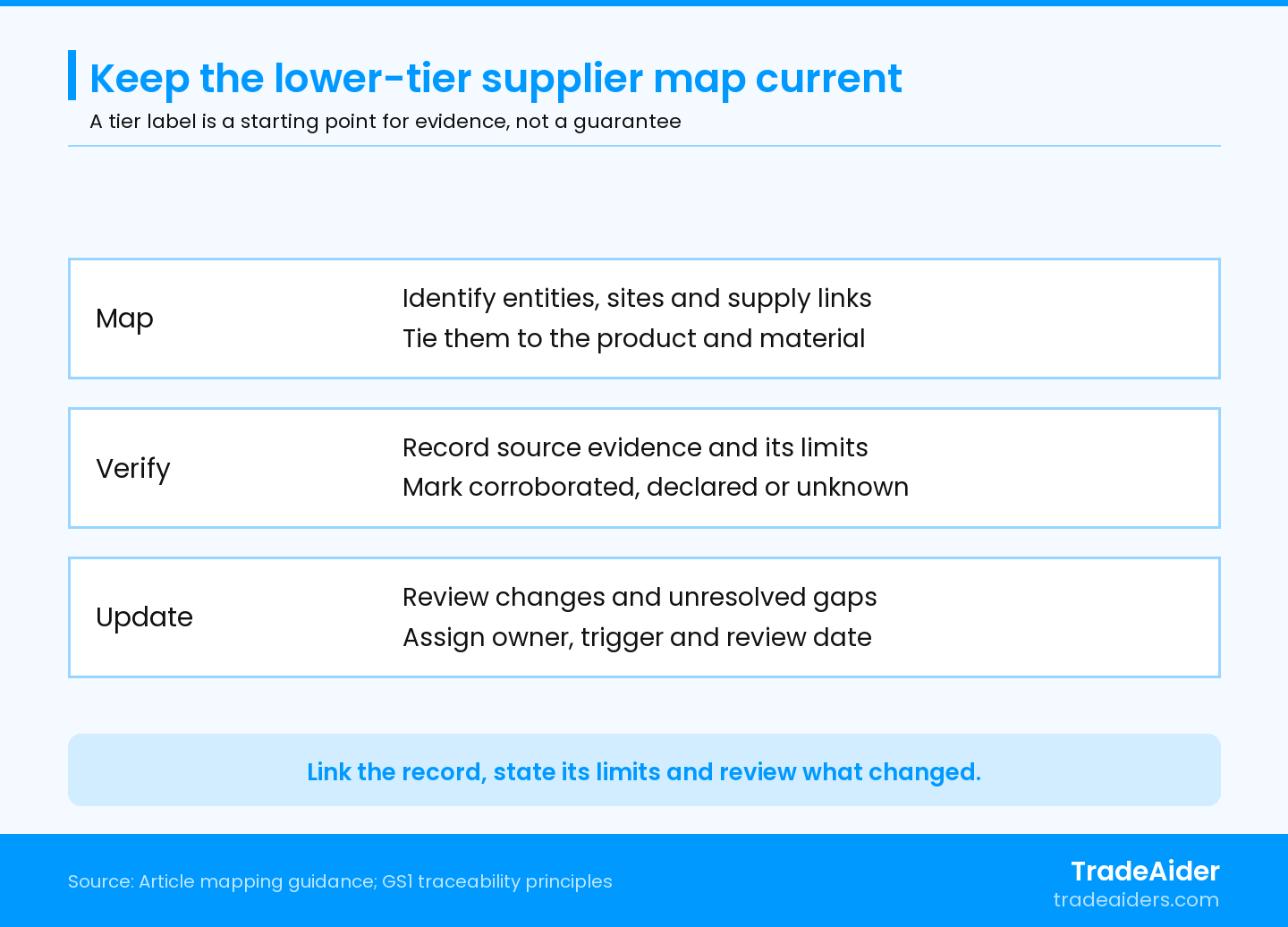
A useful map links the product and inputs to specific suppliers and sites. Keep declarations, corroborating evidence and unknown relationships distinguishable, and assign responsibility for updates.
When choosing an outside evidence provider, review its relevant experience, scope and reporting arrangements. TradeAider’s company background provides organizational context; agree the actual assignment separately. A provider’s name on a record does not establish that it visited every mapped site.
Software can help reconcile names and retrieve records, and a digital ledger can retain an event history. Neither corrects an inaccurate declaration automatically. Check who supplied the data, which site or lot it concerns and whether later changes were captured before treating the record as current.
Supplier Management Issues
The UN Guiding Principles on Business and Human Rights describe human-rights due diligence as ongoing and address impacts linked through business relationships. Supplier management therefore needs a way to learn about changes and concerns after initial onboarding.
Explain why particular upstream information is needed and who will receive it. Agree notification duties for material substitutions, subcontracting and site changes through the appropriate purchasing arrangements. Where confidentiality limits direct disclosure, explore controlled access or an agreed verification route rather than assume a blank field has been resolved.
Assign responsibility across the direct supplier and the buyer’s teams. Procurement can seek missing relationship information, quality staff can assess an input change, and responsible-sourcing reviewers can address relevant adverse impacts. Record the outstanding question and escalation route when cooperation or evidence remains inadequate. For example, agree who will compare an updated source declaration with the purchase or processing records and who will notify the order team if the evidence conflicts. Record a due date and the purchasing decision that depends on that response. A request sent to the factory is not the same as a reviewed answer, and a closed administrative task should not hide an unresolved supply relationship.
Practical Steps for Supply Chain Transparency
Pre-production inspection, material testing, factory audit and on-site monitoring contribute different evidence. Choose each measure for a defined product, site and question, then assign responsibility for reviewing its findings.
Pre-Production Inspection (PPI)
A pre-production inspection can examine available materials, components and readiness against agreed references before mass production. It does not automatically verify the entire upstream network or compel disclosure from every supplier.
For pre-production inspection, provide the relevant product specification, approved references, material concerns and available source records. Confirm what stock and documents will be accessible at the booked site. Record which inputs were actually examined, their identification and any difference from the agreed reference.
A useful finding distinguishes a visible material mismatch from a missing document or a relationship that could not be checked. The buyer may need a corrected reference, further evidence or another verification route before deciding what to accept. Agree that response rather than allow an unexplained “ready” status to cover every upstream question.
Timing also matters: inputs that have not arrived cannot be observed as though they were present. State any unavailable stock or restricted access in the report and decide what follow-up is needed when the relevant materials become available.
Component and Material Testing
Component and material testing should answer a defined property or conformity question. Select the applicable method, criteria and competent laboratory for the actual product and market. Identify the sample, collection conditions and relationship to the material or goods being supplied.
ILAC’s accreditation FAQs explain that accredited laboratories and inspection bodies work within their accreditation scope. They also distinguish recognition under the relevant arrangement from guaranteed acceptance by every party in a foreign market. Check the actual scope and the intended recipient’s requirements rather than rely on a logo alone.
Keep the test report, sample identity, tested property, method and relevant product configuration together. A report for a previous material or unrelated batch may not resolve a current substitution. If the supplier changes a constituent, source or processing step, ask the competent technical reviewer whether the existing evidence still applies.
A composition or performance result should not be presented as proof of all upstream origins, labor conditions or production controls. Those questions can require different records and methods. Testing supports transparency when the buyer can explain what was tested and which decision the result informs; it loses value when a narrow pass is used as a blanket supplier approval.
Factory Audit Practices
Factory audit practices should address the agreed site and review purpose. For workplace topics, the ILO MNE Declaration provides enterprise guidance covering employment, training, conditions of work and life, and industrial relations. It is guidance, not an ILO factory certificate.
An audit of the direct factory can examine how that site selects suppliers, maintains source information, authorizes changes and follows up problems. Review the relevant procedures alongside available records and observations. Ask how the factory handles outsourced processing and whether its records identify the actual locations involved.
The factory audit standard can help frame the discussion, but agree the actual audit scope, access, evidence methods and reporting limits. Visiting the direct factory does not mean an auditor has also assessed every upstream workplace. A separate upstream visit requires its own arrangement and access.
For significant concerns, determine what additional evidence or competent assessment is needed and who will review corrective action. A favorable finding about a documented procedure does not establish how every supplier operates. Keep site-specific results distinguishable from wider conclusions about the network.
On-Site Monitoring
On-site monitoring records what was observed and should prompt review when materials, sites, subcontracting, records or processes change. It cannot guarantee continuous control of every supplier in the network.
Use agreed updates from the direct supplier alongside relevant observations. The following triggers help keep the map connected to current work; they do not prescribe a universal visit frequency.
| Trigger | Record to revisit | Owner and next action to assign |
|---|---|---|
| Material or component substitution | Affected specification, source and orders or lots. | Quality reviewer: assess approval and further inspection or testing needs. |
| New site or subcontracted process | Entity, location, supply relationship and accessible evidence. | Procurement and relevant specialists: clarify access and required assessment. |
| Process route, legal name or ownership change | Changed role, identifiers and continuing links to existing records. | Supplier-data owner: reconcile the change and escalate its implications. |
| Conflicting records, incident or capacity concern | Affected supply path, dates, evidence status and dependencies. | Named risk owner: investigate, decide interim controls and record follow-up. |
Keep both a review date appropriate to the risk and an event-based update route. Record the change, the affected link, the decision, its evidence and any unresolved limitation. Notify the teams relying on the old information, including anyone preparing inspection instructions or reviewing evidence for the affected order. This makes monitoring useful even where the buyer cannot observe every activity continuously.
Contact our team with available product and order details, known suppliers or sites, production stage, timing, destination and the evidence gap. TradeAider can discuss an appropriate inspection scope and a report of agreed checks, findings, documents reviewed and limitations. Identify the final report user and confirm technical criteria, access, language, format and acceptance needs before inspection.
FAQ
What if a supplier will not disclose an upstream site?
Record the gap and seek a proportionate way to verify the relationship. Explain the information need, confidentiality arrangements and possible controlled-access options. Refusal alone does not prove either compliance or misconduct, but it can leave an important question unanswered. Escalate the unresolved issue to the appropriate purchasing or risk owner rather than label the chain fully verified.
What if different direct suppliers share the same upstream source?
Record the shared source and assess the resulting concentration or common-cause exposure. Separate purchase orders do not necessarily mean independent upstream supply. Identify the relevant site, input and affected products, then review how a disruption or concern there could affect each supply path. Any proposed alternative also needs assessment; a different direct factory may still depend on the same upstream source.
Does transparency require publishing every supplier detail?
No; internal verification and public disclosure are different decisions. Determine what applicable law, contracts and the intended review require, then control access appropriately. Commercial sensitivity can justify careful handling, but should not conceal information that must be provided. Record who has checked restricted evidence, what it establishes and which questions remain open without publishing unnecessary personal or commercial details.
Похожие статьи

Развивайте свой бизнес с услугами TradeAider
Нажмите кнопку ниже, чтобы войти непосредственно в систему услуг TradeAider. Простые шаги от бронирования и оплаты до получения отчетов легко выполнить.