
- О нас

- Наши услуги
- Ваша отрасль
- Ресурсы
- Новости и блог
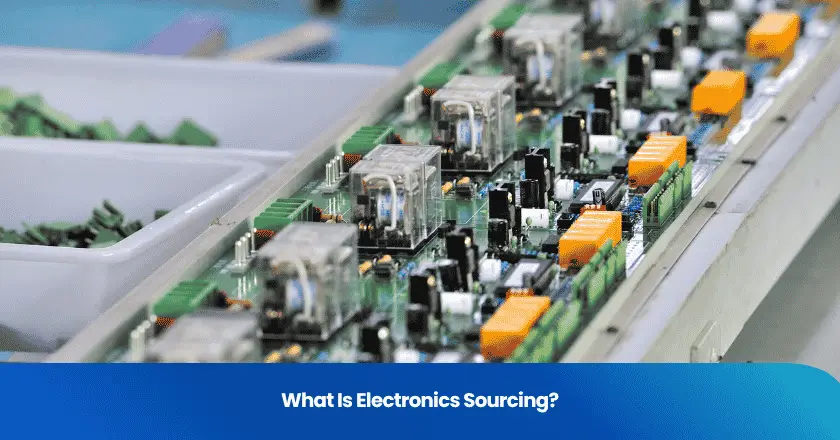
Electronics sourcing decides what a product is made of, which suppliers provide it, and how the buyer confirms that what arrives matches what was ordered. It covers the components, parts, and equipment that go into an electronic product, from a single resistor to a finished assembly, and it treats those purchases as one connected chain rather than a series of unrelated orders. The sections below explain the concept, the key factors that decide a sourcing program, the components and equipment involved, the challenges buyers meet, and the trends changing how the work is done.
What Electronics Sourcing Means
Electronics sourcing refers to the purchase of the components, parts, and equipment a product needs, together with the work of qualifying the suppliers who provide them. Its scope runs from simple consumer electronics, such as phones and chargers, to complex industrial electronics, such as circuit boards and sensors. What holds the definition together is the chain: a written specification connects to a supplier, the supplier builds from a parts list, and a verification step confirms the build. Read that way, sourcing is a sequence of decisions, and the first two, the specification and the applicable compliance route, belong before any supplier is chosen.
The work is easier to manage when one party owns the records. When a buyer shares a specification, a supplier list, and incoming inspection records with an outside provider, the engagement should make clear who performs which check and who keeps the evidence. For information about the organization handling a proposed engagement, review TradeAider's company background.
Sourcing and procurement are often used interchangeably, but they answer different questions. Sourcing asks which supplier and which part should be used and whether the evidence supports that choice; procurement usually means the transaction that places, tracks, and pays for the order once those choices are made. A buyer can run a clean procurement process and still have a sourcing problem, because the order was placed before the supplier and the part were qualified. Keeping the two steps separate is what makes the records useful later.
Key Factors in Electronics Sourcing
The key factors in electronics sourcing are the product specification, cost, supplier capability, delivery, quality control and inspection, contract terms, and after-sales support, and they interact rather than rank in isolation.
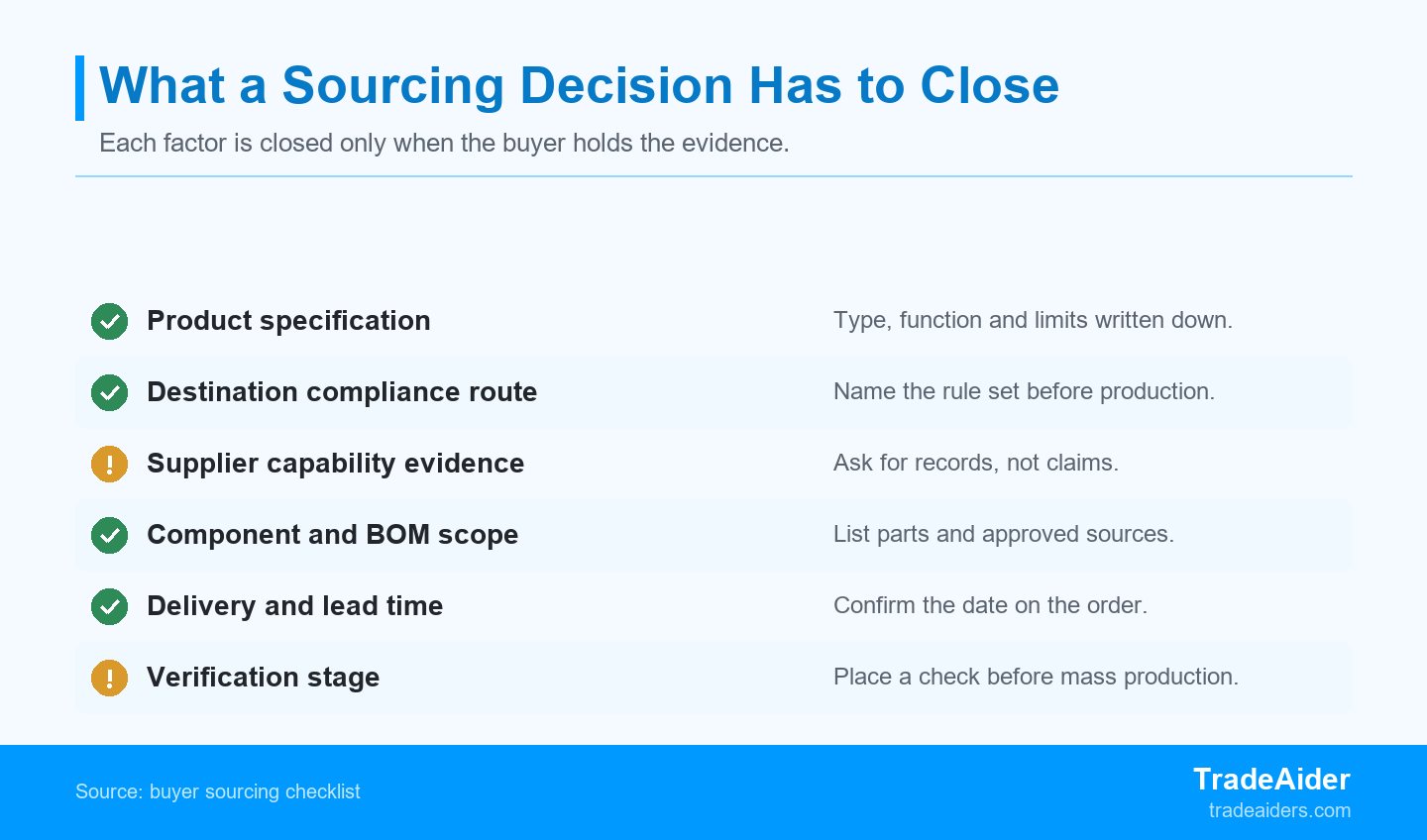
Each sourcing factor is only closed when the buyer holds the evidence, so specification and compliance come before supplier choice and verification.
Product requirements and specification come first, because every other factor is measured against them. A buyer who has not written down the type, function, and technical limits of the needed part cannot judge a quote, a sample, or a substitute. Budget and cost follow, but as a total rather than a unit price: tooling, testing, freight, and the cost of a correction all belong in the comparison. Supplier selection and evaluation weigh reputation, production capability, delivery record, and the evidence a factory can actually show. Delivery and lead time decide whether the order reaches the market on schedule, while quality control and inspection set how the build is checked. Contract terms allocate the risk when something goes wrong, and after-sales support decides how quickly a problem is resolved.
These factors are connected, and a sourcing plan that optimizes one of them alone stays fragile. A lower price from a factory that cannot show incoming component records is not a saving if it moves the cost of a correction back onto the buyer, and a fast delivery promise is only useful if the specification was fixed first. When a supplier's claims need testing, start from the audit-standard guidance to see how a factory audit is scoped and what it can and cannot prove. Treat the factors as one set of trade-offs, and write down who owns each one.
Illustrative Example: Sourcing a Rechargeable Desk Lamp
An illustrative case shows how the factors work together. A consumer brand sources a rechargeable LED desk lamp for its first electronics order, 8,000 units, from a factory in China. The buyer writes a specification for battery capacity, charging input, LED output, and housing, names the destination market, and asks two factories for quotes.
Both factories quote a similar unit price, so price alone does not separate them. The lower quote comes from a factory that cannot show incoming component records or a first-article process. The higher quote includes a documented specification review and agrees to a pre-production check before mass production, and the buyer approves a sample lamp and sets the release condition against that sample and the written specification.
Unit price answered only the cost factor, while the specification, the supplier evidence, and the compliance route still had to be checked, so the cheaper quote is not the cheaper sourcing decision. The buyer selects the supplier that can show the evidence and conditions the release on a first-article check against the approved specification.
The first production units differ from the approved sample in the housing fit, so the factory corrects the mold and rebuilds the first 600 affected units before the order continues. The buyer re-checks the corrected first article against the specification, then inspects the packed order before release and keeps the records with the order file. This is an illustrative sourcing example, not measured defect data, a supplier rating, or a compliance result.
How to Evaluate an Electronics Supplier
An electronics supplier is evaluated on its production capability, its quality system, and the evidence it can show, using published standards as a common reference for acceptable quality.
Capability questions are concrete: can the factory make this product at the required volume, with the required process, and on the required schedule? Quality-system questions ask what controls exist and whether they leave records, including incoming inspection, in-process checks, calibration, and how non-conforming units are handled. Evidence questions ask for the documents behind those answers rather than the answers alone. A supplier that answers with a file is easier to compare with the next supplier than one that answers with confidence.
Shared standards give the buyer a public reference for what acceptable quality means. A global electronics industry association advances product quality, compliance, and workforce capability through IPC standards and certifications, which is why a supplier that can name the standard it builds to is easier to check than one that only describes its own process. Ask which standard applies to the product, and then ask for the record that shows it was followed.
Quality Control and Compliance in Sourcing
Quality control in electronics sourcing means checking a product and its components against the written specification and the destination-market rules, and EU rules place the conformity duties on the manufacturer.
Conformity assessment is the process a manufacturer uses to show that a product meets the rules that apply to it. For products under the relevant EU legislation, the manufacturer carries out the conformity assessment, sets up the technical documentation, issues the EU declaration of conformity, and affixes the CE marking. The buyer's job in sourcing is to confirm who performs that work and to keep the declaration with the order file.
Inspection then turns the specification into a check: an acceptable quality level (AQL) is the defect level a sampling plan is set up to accept with a high probability, and it sets the plan rather than guaranteeing individual units. TradeAider's pre-production inspection checks raw materials and components against the buyer's specifications and compares samples with bulk production before production begins, which is the stage where a mismatch is still cheap to correct.
Safety rules have a scope, and the scope decides whether they apply at all. The Low Voltage Directive (2014/35/EU) covers electrical equipment operating at an input or output voltage between 50 and 1000 V for alternating current and 75 and 1500 V for direct current, so a buyer should confirm whether the product falls inside that range before assuming which route applies.
What Components and Equipment Electronics Sourcing Covers
Electronics sourcing covers active components, passive components, power supplies and batteries, connectors and cables, storage devices, and input or output devices.
The bill of materials is the list of parts, quantities, and reference designators that make up a product, and it is the document that turns a specification into the parts a supplier must buy. Active components, such as transistors and integrated circuits, process or switch signals, while passive components, such as resistors, capacitors, and inductors, shape current and voltage. Beyond those two groups sit the parts that power, connect, store, and operate a device.
| Category | What it includes | What the buyer specifies |
|---|---|---|
| Active components | Transistors, diodes, integrated circuits | Function, ratings, package, tolerance |
| Passive components | Resistors, capacitors, inductors | Value, tolerance, temperature range |
| Power and battery | Adapters, switching supplies, battery packs | Input and output voltage, capacity, safety route |
| Connectors and cables | USB, HDMI, network and power connections | Interface type, pinout, current rating |
| Storage devices | Solid-state drives, flash, memory cards | Capacity, interface, endurance |
| Input and output devices | Keyboards, mice, displays, printers | Compatibility, dimensions, performance |
Substance rules attach to the product, not only to the finished assembly. EU RoHS restricts the use of ten hazardous substances in electrical and electronic equipment, and all products with an electrical or electronic component have to comply unless they are specifically excluded. Map each category to the specification and the evidence it needs, and keep the acceptance criteria separate from the method used to check them; the inspection-standard guidance explains how those two are kept apart.
Challenges Facing Electronics Sourcing
Electronics sourcing faces structural challenges such as supply chain disruption, fast technology change, counterfeit and low-quality parts, compliance divergence, cost volatility, and complex bills of materials.
Supply chain disruption follows from concentration: a single component, a single factory, or a single shipping lane can stop an order, and the effect arrives long before the cause is visible. Fast technology change means a part specified today may be near the end of its life before the order ships. Counterfeit and substandard parts enter through channels that look legitimate, and compliance diverges by market, so the same product can need different evidence for different destinations. The cost of raw materials and chips moves with the market, and a complex bill of materials multiplies all of it, because every line is a supplier and a risk. Many buyers now add environmental and social questions to the same list.
The response to a non-conforming product has a legal floor, which is why the challenges are planned for rather than absorbed. In Great Britain, economic operators must take corrective measures to bring a non-conforming product into conformity, or withdraw or recall it. A sourcing plan should assume that route exists, because acting on it is more expensive than the check that could have caught the problem earlier.
How Electronics Sourcing Is Changing
Electronics sourcing is moving toward digital decision support, more transparent and traceable supply chains, and greener sourcing, which raises the value of measured and recorded data.
Digital tools are moving from spreadsheets to shared systems that track a part from quotation to shipment, and buyers increasingly expect a supplier to provide data rather than a narrative. Transparency and traceability follow from the same records: a chain that can show where a component came from and when it was built is easier to audit and easier to correct. Green sourcing adds substance, energy, and end-of-life questions to the specification, and collaborative purchasing lets smaller buyers share supplier capacity and demand signals. Each trend points in the same direction, toward a buyer who can compare evidence across suppliers and across orders.
That is also why the trends reward the buyer who already keeps records. NIST's Engineering Laboratory advances measurement science, standards, and technology for engineered systems, which is the same discipline a buyer applies when a sourcing decision rests on a measured result rather than an assurance. A recorded measurement survives a change of supplier, a change of staff, and a later dispute.
Turn the Definition Into a First Sourcing Checklist
Turn the definition into a first checklist: send the specification, the compliance route, and the supplier list with the request so the sourcing plan and the inspection scope can be reviewed together.
- Write the specification before comparing quotes.
- Name the destination market and its compliance route.
- Ask each supplier for the records behind its claims.
- Agree the inspection stage before production starts.
- Keep the approved sample and the order records together.
A review needs four inputs: the product and model identity, the specification and destination market, the candidate suppliers and their evidence, and the order quantity and planned delivery window. TradeAider can review those inputs, agree which inspection stage applies, and return a scoped proposal with an agreed check list and a reporting deliverable. To scope that work, contact TradeAider about your electronics sourcing scope.
Frequently Asked Questions
Is electronics sourcing the same as procurement?
No. Sourcing is the broader activity of finding and qualifying the right suppliers and parts, while procurement usually means the transaction that places and manages the order with a supplier that has already been chosen. A buyer can run a clean procurement process and still have a sourcing problem if the supplier and the part were never qualified. Treat the two as separate steps: qualify first, then place the order, and keep the evidence for each.
What should a first-time buyer check before placing an electronics order?
Fix the specification and the destination-market compliance route first, then screen suppliers for evidence, then set the inspection stage where a defect can still be corrected. In practice that means writing the product requirements, naming the market and the rules that apply, asking each candidate for records rather than assurances, and agreeing the check that will be run before mass production. The order of those steps matters more than the speed of the first quote.
Do I need a different sourcing plan for each destination market?
Often yes, because substance, safety, and labelling rules differ by market, so the compliance route is part of the sourcing decision rather than a task added at the end. A product that meets one market's requirements may still need different evidence, a different declaration, or a different mark for another. Confirm the destination before production, not after, because a change to the compliance route can change the part, the documentation, or the test plan.
How much supplier evidence should I ask for before ordering?
Ask for the records that match the factors you cannot check yourself, such as component sourcing, incoming inspection, and a first-article process, and treat unverifiable claims as open items rather than settled ones. The right amount is the evidence that answers the question you actually have: can this factory build this product to this specification, on this schedule, and show it. More documents are not better if they do not change the decision.
Похожие статьи

Развивайте свой бизнес с услугами TradeAider
Нажмите кнопку ниже, чтобы войти непосредственно в систему услуг TradeAider. Простые шаги от бронирования и оплаты до получения отчетов легко выполнить.

