
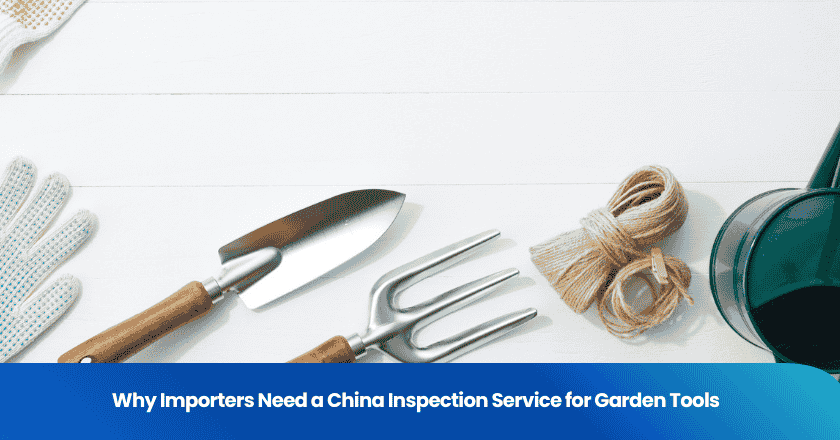
Garden tools seem simple. A shovel is a shovel, right? Not when your customer receives one with a loose handle that splits on the first dig, or pruning shears with blades so dull they crush stems instead of cutting cleanly. Garden tools are exposed to moisture, soil chemicals, and physical stress every time they are used — and small manufacturing defects that pass visual inspection at a Chinese factory can become warranty nightmares in your customers' backyards.
This is why importers who source garden tools from China need a dedicated inspection service that understands the specific failure modes of outdoor equipment. A generic quality check is not enough when rust resistance, blade hardness, and handle durability determine whether your product earns a five-star review or a one-star return.
Key Takeaways
- Garden tools face unique environmental stress — moisture, soil chemistry, and repeated mechanical load expose defects that indoor products never face.
- Rust, weak joints, and dull blades are the top defects — catching these at the factory prevents returns and protects your brand reputation.
- Safety compliance is non-negotiable — garden tools with sharp edges or moving parts must meet ASTM, EN, and CPSC standards to clear customs and protect users.
- On-site inspection with real-time reporting lets you approve, rework, or reject your order before it ships — saving weeks and thousands of dollars.
The Unique Quality Challenges of Garden Tools
Material and Finish Defects
Garden tools live outdoors. Steel blades get wet. Wooden handles absorb moisture. Rubber grips degrade under UV exposure. Every material choice in a garden tool must be validated for environmental resistance — and this is where Chinese manufacturers sometimes cut corners.
The most common material defects found during garden tool inspections include:
| Defect Type | Common Cause | Customer Impact |
|---|---|---|
| Surface rust on blades | Insufficient chrome plating or missing anti-rust coating | Product appears used or defective out of the box |
| Paint peeling on metal parts | Poor surface preparation before powder coating | Accelerated corrosion and cosmetic failure |
| Cracked or warped wooden handles | Improperly dried or low-grade wood stock | Handle breaks during use, potential injury |
| Rubber grip deterioration | Low-quality rubber compound, no UV stabilizer | Grip becomes sticky, cracks, or flakes off |
| Plastic connector brittleness | Wrong resin grade or excessive regrind content | Snap-on hose connectors break under water pressure |
Each of these defects can be identified during a pre-shipment inspection when the inspector performs salt spray testing, adhesion cross-hatch testing, and visual examination under proper lighting conditions.
Functional Failures That Frustrate Customers
A garden tool that looks perfect but does not work is worse than one that looks rough but performs. Functional failures are the fastest path to negative reviews. Here are the most common ones that inspectors catch:
- Dull or uneven blade edges on pruners, loppers, and hedge shears. The factory may have skipped the final sharpening step or used a grinding wheel that creates a rounded edge instead of a sharp bevel. Inspectors test blade sharpness using standardized paper-cut and stem-cut tests.
- Loose handle-to-blade joints on shovels, spades, and hoes. The rivet or socket connection between the handle and the metal blade must withstand significant leverage. Inspectors apply torque and pull tests to verify joint integrity.
- Locking mechanism failures on folding saws and telescopic pruning poles. A lock that slips under load is a safety hazard. Inspectors cycle the lock mechanism 50+ times and apply load testing to verify it holds.
- Leaking hose connections on garden hose reels and quick-connect fittings. Inspectors pressurize the system to 1.5x the rated working pressure and check for leaks at every joint.
These functional tests require product-specific knowledge and the right test equipment — which is exactly what a specialized China inspection service provides.
Safety and Compliance Requirements for Garden Tools
US and EU Market Standards
Garden tools are not just consumer products — many of them are regulated for safety. Sharp blades, moving parts, and potential chemical exposure from materials mean your products must comply with specific standards depending on your target market:
United States: The Consumer Product Safety Commission (CPSC) requires that garden tools with sharp edges or moving mechanisms meet applicable safety standards. Products found to be hazardous can be subject to recall, and importers bear the liability. ASTM International publishes voluntary standards for hand tools and garden equipment, including requirements for blade guards, handle strength, and warning labels.
European Union: Garden tools sold in the EU must carry the CE mark where applicable and comply with the General Product Safety Directive (GPSD). The EN 847 series covers safety requirements for machines with cutting blades used in forestry and gardening. Power-assisted garden tools may also fall under the Machinery Directive (2006/42/EC).
Non-compliant products can be stopped at customs, requiring expensive returns to the factory or outright destruction — costs that fall entirely on the importer.
How Inspection Ensures Compliance
A qualified inspection service does not just look for cosmetic defects — it verifies that your products meet the safety requirements of your target market. During a pre-production inspection, the inspector checks that raw materials and component specifications match your compliance documentation. During pre-shipment inspection, they verify that finished products carry the correct labels, markings, and safety features.
For example, if your garden pruners require a blade lock that meets EN 847 standards, your inspector will verify the lock engages positively, holds under specified load, and releases only with a deliberate action — not just visually, but with physical testing.
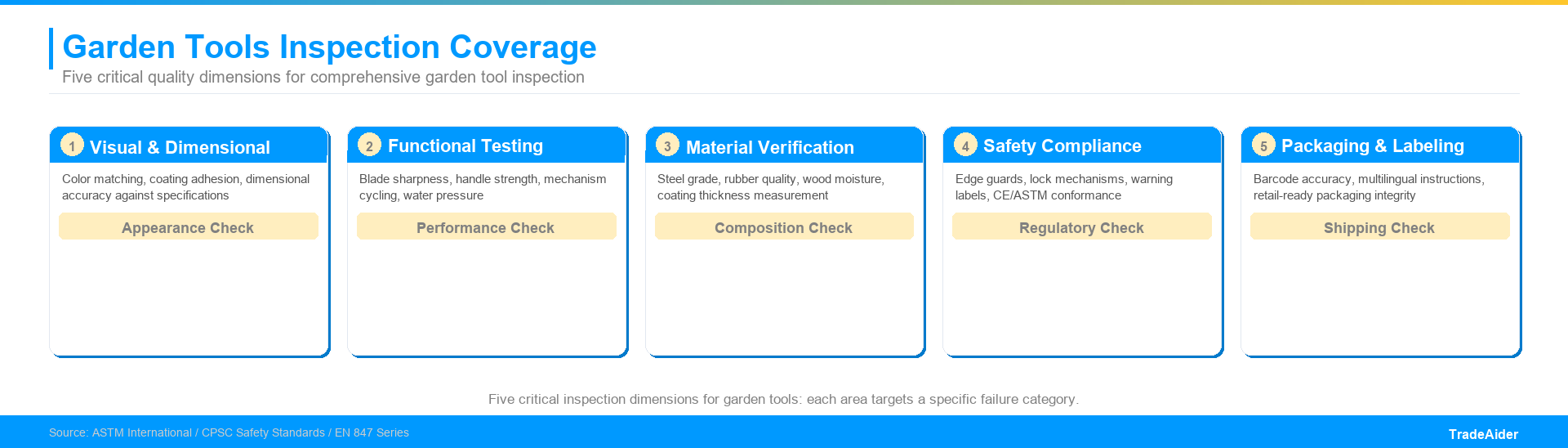
Five critical inspection dimensions for garden tools: each area targets a specific failure category that directly affects customer satisfaction and product safety.
What a Garden Tool Inspection Covers
Visual and Dimensional Checks
Every garden tool inspection starts with visual and dimensional verification:
- Appearance consistency — Color matching against approved samples, checking for scratches, dents, or tool marks on metal surfaces, and verifying that printing or laser engraving is legible and correctly positioned.
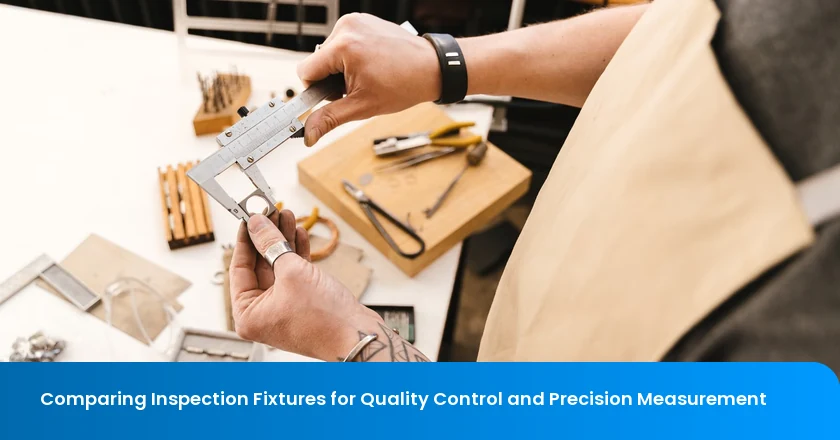
- Dimensional accuracy — Measuring blade length, handle diameter, overall tool length, and joint dimensions against your specifications using calipers and tape measures. Even small deviations (a blade 3 mm shorter than spec) can indicate tooling wear or material substitution.
- Surface finish — Checking chrome plating thickness, powder coating adhesion, rubber grip texture, and wood handle smoothness. Inspectors use cross-hatch adhesion tests for coatings and visual comparison against approved golden samples.
- Assembly quality — Verifying that rivets are properly set, screws are tightened to specification, and there is no excess adhesive, solder splatter, or welding slag.
Functional and Mechanical Testing
This is where garden tool inspection differentiates from generic product checks:
- Blade sharpness testing — Using standardized test media (paper, twine, or green wood stems) to verify cutting performance. Inspectors measure the force required to make a clean cut.
- Handle strength testing — Applying bending and torsional loads to simulate real-world use. A shovel handle that flexes more than your specification allows will feel flimsy to the user.
- Corrosion resistance — For tools claiming rust resistance, inspectors may perform accelerated salt spray testing (per ASTM B117) or check that protective coatings meet specified thickness using magnetic gauges.
- Water pressure testing — For hose-end products, connectors, and reels, pressurizing to verify no leaks at working pressure.
- Mechanism cycling — For tools with moving parts (ratcheting pruners, telescopic poles, folding saws), cycling the mechanism repeatedly to verify durability and consistent performance.
All results are documented with measurements and photographs. Use the AQL calculator to determine sample sizes for your order based on lot size and acceptable quality level.
The Cost of Skipping Inspection
Let us put real numbers on the risk. Consider a Shopify brand importing 5,000 garden tool sets (pruner + trowel + rake) at a landed cost of $12 per set:
- Without inspection: You receive the shipment and discover 12% of pruners have loose locking mechanisms and 8% of trowels have rust spots on the blade. That is 600 defective pruners and 400 defective trowels in one shipment. If 60% of those defect units trigger returns at a cost of $8 each (return shipping, restocking, disposal), you lose $4,800 on returns alone — plus the brand damage from 600 negative reviews.
- With inspection at $199/man-day: A two-day inspection catches these defects before the container is loaded. You work with the factory to rework or replace the defective units. Total inspection cost: $398. Savings: $4,400+ and your brand reputation stays intact.
The math is straightforward. A single inspection pays for itself many times over by preventing even one batch of defective garden tools from reaching your customers.
How Real-Time Inspection Protects Your Brand
Traditional inspection services deliver a static PDF report 2-3 days after the inspection. If a problem is found, the factory may have already loaded your container. TradeAider takes a different approach: inspectors upload results in real-time through the online platform, so you see defects as they are discovered.
This means you can:
- Make immediate decisions — Approve the lot, request rework on specific defects, or reject the shipment while the factory still has time to act.
- Direct the inspection in real-time — Ask the inspector to test additional samples, focus on a specific defect category, or verify corrective actions on the spot.
- Detect systemic vs. isolated issues — When you see defect patterns forming across samples in real-time, you can identify whether a problem is isolated or affects the entire batch.
For garden tools specifically, real-time reporting is valuable because functional tests (blade sharpness, handle strength, corrosion resistance) produce immediate, visual results. You see the rust, the dull blade, or the loose joint as the inspector finds it — not in a summarized table three days later.
If you are importing garden tools from China, contact our team to schedule an inspection that covers both visual and functional quality checks. At $199 per man-day with real-time reporting, the question is not whether you can afford inspection — it is whether you can afford to skip it.
Frequently Asked Questions
What types of garden tools can be inspected in China?
Virtually all garden tools are covered: hand tools (pruners, shears, trowels, cultivators), long-handled tools (shovels, rakes, hoes, forks), watering equipment (hoses, connectors, reels, sprinklers), and power-assisted tools (electric hedge trimmers, chainsaws). Inspectors apply product-specific test protocols for each category.
How long does a garden tool inspection take?
A standard pre-shipment inspection for garden tools typically takes one man-day for orders up to 5,000 units. The inspector performs visual checks on the full AQL sample size, plus functional testing on a subset of 3-10 units depending on the product type and test complexity. Large orders or products requiring extensive functional testing may need two man-days.
Can inspectors perform corrosion resistance testing on-site?
Basic corrosion checks (visual inspection for existing rust, coating adhesion cross-hatch testing, coating thickness measurement with magnetic gauges) are performed on-site. Full salt spray testing per ASTM B117 requires laboratory equipment and is arranged through product testing services. Your inspector can coordinate sample submission to an accredited lab.
What if the inspection reveals that my factory substituted materials?
Material substitution — using a lower grade of steel, switching from stainless to chrome-plated carbon steel, or reducing rubber grip thickness — is one of the most common issues in garden tool manufacturing. If your inspector identifies material substitution, they document it with photographs and measurements. You then have the option to request rework with the correct materials, negotiate a price adjustment, or reject the lot. Learn why importers choose TradeAider for transparent, real-time inspection that catches substitution before it costs you money.

Похожие статьи
Развивайте свой бизнес с услугами TradeAider
Нажмите кнопку ниже, чтобы войти непосредственно в систему услуг TradeAider. Простые шаги от бронирования и оплаты до получения отчетов легко выполнить.

