- About Us

- Our Services
- Your Industry
- Resources
- News & Blog
IEC 62133
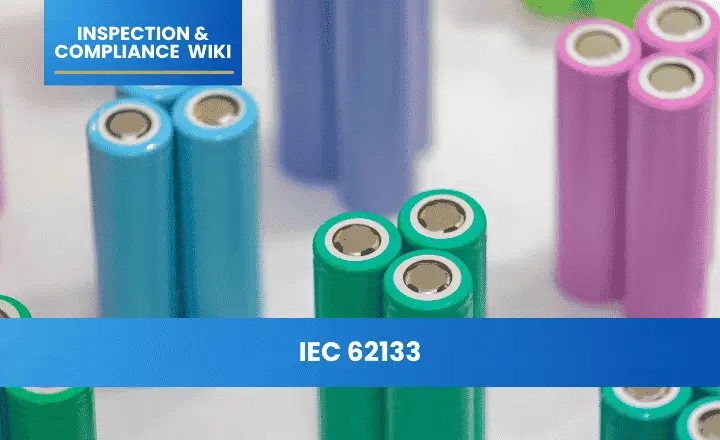
Published by the International Electrotechnical Commission (IEC), IEC 62133 is the primary international safety standard governing secondary (rechargeable) sealed cells and batteries containing alkaline or other non-acid electrolytes. Divided into IEC 62133-1 (nickel systems) and IEC 62133-2 (lithium systems), compliance with IEC 62133-2 is mandatory for lithium-ion and lithium-polymer batteries used in portable electronic devices—including smartphones, laptops, medical devices, power tools, wearable tech, and e-bikes.
Because lithium chemistry possesses high energy density and volatile organic electrolytes susceptible to thermal runaway, compliance with IEC 62133-2 testing and obtaining IECEE CB Scheme certification is compulsory for market entry across the European Union (CE Marking), North America (UL 62133 / OSHA NRTL), Japan (PSE Mark), and global customs clearance.
Regulatory Scope: IEC 62133-2 vs. UN 38.3 Transport Testing
Importers and battery pack integrators must distinguish between safety testing for product compliance and transport safety regulations:
- IEC 62133-2 (Product Safety Certification): Evaluates the operational safety of cells and battery packs under normal use and foreseeable misuse/abuse conditions. Required for product sale, CE marking technical files, and consumer device safety approval.
- UN 38.3 (Dangerous Goods Transport Testing): Enforced under UN Manual of Tests and Criteria for logistics safety. Evaluates battery stability during air, sea, and land transport under altitude simulation, extreme vibration, shock, and thermal cycling.
- Co-Existence Mandate: Portable electronic devices containing rechargeable lithium batteries must comply with both UN 38.3 (for transport) and IEC 62133-2 (for consumer safety).
Core Electrical and Mechanical Abuse Test Protocols
IEC 62133-2 subjects both individual cells and assembled battery packs to severe electrical, mechanical, and thermal abuse tests to ensure zero fire, explosion, or chemical leakage:
| Abuse Test Category | Applicable Test Level | Test Execution & Environmental Parameters | Pass/Fail Evaluation Criteria |
|---|---|---|---|
| External Short Circuit | Cell & Battery Pack | Short circuit applied across positive/negative terminals (< 80 m\Ω) at 55℃ until casing cools | No fire, no explosion; case temperature must remain < 150℃ |
| Thermal Abuse | Cell Level Only | Fully charged cell placed in gravity convection oven heated to 130℃ ± 2℃ for 10 or 30 mins | No fire, no explosion |
| Overcharge Testing | Battery Pack Level | Fully discharged pack charged at a current exceeding manufacturer specs with voltage boosted to 1.4 X Vmax | No fire, no explosion |
| Mechanical Drop | Cell & Battery Pack | Released from a height of 1.0 meter onto a smooth concrete surface (3 total drops) | No fire, no explosion, zero electrolyte leakage |
| Forced Internal Short Circuit | Cell Level (Regional) | Cell crushed by a small nickel pressure block inside a controlled chamber at elevated temperatures | Simulates internal separator puncture; no fire, no explosion |
Battery Management System (BMS) Control and Component Safety
Achieving IEC 62133-2 compliance at the battery pack level relies heavily on the design and execution of the Battery Management System (BMS) protective circuit:
- Overcharge & Over-discharge Protection: Dual-redundant integrated circuits (ICs) that immediately disconnect charging or load currents when individual cell voltages exceed maximum threshold limits (e.g., 4.25V) or drop below minimum cutoff limits (e.g., 2.5V).
- Overcurrent & Short Circuit Cutoff: High-speed MOSFET switches that cut power within microseconds when short circuits occur on output terminals.
- Thermal Protection (NTC Thermistors): Negative Temperature Coefficient (NTC) thermistors embedded inside the cell pack that monitor temperature in real time, signaling the host system to throttle power if temperatures exceed 60℃.
Verify Quality Before Shipment: Rigorous On-Site AQL Inspections.Don't risk battery fires, customs holds, or non-compliant electronics. Verify physical safety, electrical parameters, and packaging compliance through our transparent, on-site inspection services. ➔ Get a Free Inspection Plan
Practical Module: On-Site Battery Verification & QC Practice
Quality control inspectors conducting Pre-Shipment Inspections (PSI) or factory audits on battery-powered electronics must execute the following physical verification checks on the manufacturing line:
Step 1: Cell Material and CB Certificate Reconciliation
- Cross-check raw lithium cell brand names, model codes, and capacity ratings against the CB Test Certificate and IEC 62133-2 laboratory test report.
- Verify that battery pack assembly lines source cells strictly from approved vendor lists (AVL) to prevent cell substitution with uncertified, low-grade cells.
Step 2: BMS Protection Circuit Testing
- Audit 100% functional testing stations on the assembly line to confirm that BMS boards are tested for short-circuit trip response, overcharge voltage cutoff, and over-discharge protection.
- Inspect soldering quality on cell nickel tabs, balancing wires, and thermistor contacts for cold solder joints or insulation gaps.
Step 3: Battery Marking and Caution Labeling Audit
- Verify that battery pack casings display permanent safety markings, including official IEC designation (e.g., 1ICR19/66), polarity icons (+/-), nominal voltage, rated capacity (mAh/Wh), and caution warnings.
- Confirm that shipping cartons display official UN 3481 / UN 3480 Lithium Battery Handling Labels with emergency contact numbers per dangerous goods rules.
Frequently Asked Questions (FAQ)
Q1: What is the main difference between IEC 62133-1 and IEC 62133-2?
IEC 62133-1 applies specifically to nickel-based secondary battery systems (NiCd and NiMH). IEC 62133-2 applies exclusively to secondary lithium-based systems (lithium-ion and lithium-polymer), featuring updated abuse test protocols tailored to lithium chemistry risks.
Q2: Is a UN 38.3 test report sufficient to prove product safety under IEC 62133-2?
No. UN 38.3 is a transport safety requirement governing dangerous goods shipping regulations. IEC 62133-2 is a product safety standard evaluating electrical, mechanical, and thermal abuse under consumer use conditions. Both are required for global market entry.
Q3: What is the Forced Internal Short Circuit test in IEC 62133-2?
The Forced Internal Short Circuit test is a specialized procedure (mandatory in Europe and Japan) where a cell is disassembled, a tiny nickel particle is placed inside the electrode layer, and pressure is re-applied to simulate internal manufacturing defects (such as separator burrs) that cause internal shorting and thermal runaway.
Q4: Can a battery pack be certified to IEC 62133-2 if the individual cells are not certified?
While possible, it is economically impractical. If individual cells already hold an IEC 62133-2 CB Certificate, the pack-level testing requires testing only the BMS circuitry and pack casing. If cells are uncertified, the entire cell-level test suite must be repeated, significantly increasing testing costs and timelines.
Q5: What happens if a battery pack fails the IEC 62133-2 Thermal Abuse test?
If a cell catches fire or explodes during 130℃ thermal baking, the battery fails certification. The manufacturer must redesign the cell separator, adjust electrolyte chemistry, or select higher-grade certified cells before re-testing.
References
[1] International Electrotechnical Commission. IEC 62133-2:2017 Secondary cells and batteries containing alkaline or other non-acid electrolytes — Safety requirements for portable sealed secondary lithium cells[S]. Geneva: IEC, 2017. https://www.iec.ch/
[2] United Nations. Recommendations on the Transport of Dangerous Goods: Manual of Tests and Criteria, Section 38.3 (UN 38.3)[S]. New York and Geneva: United Nations, 2026. https://unece.org/
[3] IECEE System. CB Scheme Certification Rules for Portable Batteries (BAT Category)[R]. Geneva: IECEE, 2025. https://www.iecee.org/
Reference Notes
- IEC 62133-2 specifies binding international safety testing requirements for portable secondary lithium cells and battery packs.
- UN 38.3 standards establish mandatory transport safety testing criteria for shipping lithium batteries by air, sea, and land.
- IECEE CB Scheme guidelines govern international mutual recognition of battery safety laboratory test reports across participating member countries.
Related Knowledge Base
TradeAider