
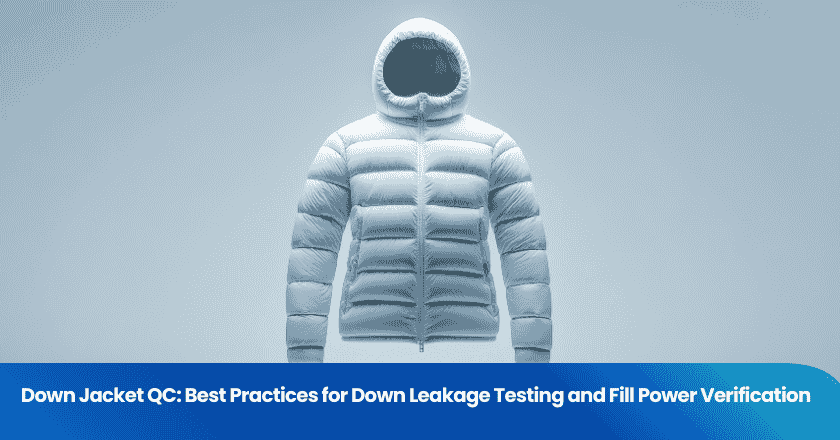
In the technical evaluation of high-performance winter apparel, Quality Control (QC) is the definitive factor for insulation efficiency and consumer satisfaction. For premium down jackets, performance is not solely determined by aesthetic design but by the mechanical properties of the fill and the structural integrity of the shell fabric. Ensuring warmth and durability requires a multi-faceted engineering approach: Fill Power Verification to quantify volumetric loft and Down Leakage Testing to prevent the migration of clusters through seams and pores. As global standards such as IDFB and GB/T 14272-2021 evolve, manufacturers and importers must adopt rigorous on-site inspection protocols and statistically sound sampling plans to maintain product fidelity in the cold-weather gear market.
Key Takeaways
- Fill Power (FP) is the primary technical metric for insulation, measuring the volume occupied by one ounce of down.
- Down leakage is mitigated through high-density shell fabrics (low air permeability) and precise SPI (Stitches Per Inch) management.
- Structural integrity checks, including seam slippage and air permeability, prevent fill loss over prolonged operational cycles.
- TradeAider utilize the globally trusted ANSI/ASQ Z1.4-2008 (AQL) Single Sampling Plan for all on-site evaluations.
- Defect classification (Critical, Major, Minor) serves as the technical gatekeeper for batch acceptance in apparel quality control.
- Real-time Online Reports provided by TradeAider within 24 hours ensure immediate supply chain transparency and rectification feedback.
The Science of Fill Power: Volumetric Integrity and Loft
Fill power is a measure of the "loft" or fluffiness of a down product and its ability to trap insulating air. Technically, it is the volume in cubic inches occupied by one ounce (28.4 grams) of down. Higher fill power indicates larger down clusters, which provide superior warmth-to-weight ratios and better compressibility recovery. In industrial QC, verifying these claims is essential for justifying the price-performance bracket of the garment.
Laboratory Protocols for Fill Power Analysis
Standardized procedures, such as those defined by the International Down and Feather Bureau (IDFB), require specific conditioning environments. The down sample is typically pre-conditioned using a steam cycle to "re-loft" the clusters after being compressed in bales. The sample is then placed in a standardized cylinder where a weighted piston applies a precise force. The height of the piston determines the final fill power index. Accuracy depends on controlling ambient humidity (usually 65 +/- 5%) and temperature (20 +/- 2'C).
| Fill Power Rating | Technical Classification | Ideal Application |
|---|---|---|
| 500 - 600 | Standard Utility | Heavy urban coats, low-cost insulators |
| 600 - 750 | Premium Grade | High-performance hiking and skiing gear |
| 800 - 900+ | Ultra-High Loft | Expedition gear, ultralight alpine apparel |
Mitigating Down Leakage: Fabric and Seam Engineering
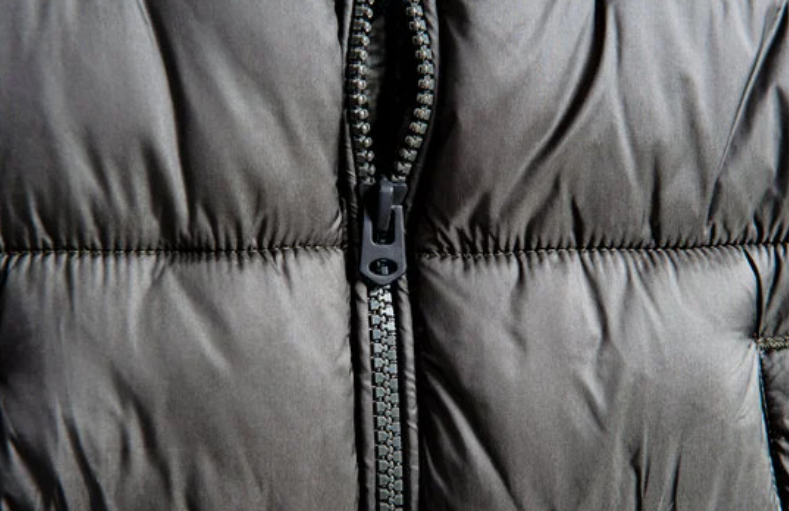
Down leakage occurs when individual plumules or feathers penetrate the shell fabric or migrate through needle holes. This is often a result of insufficient "Down-Proof" finishing or improper sewing parameters. High-quality textile quality control must evaluate the air permeability of the fabric, which should ideally be below 10 mm/s under standard pressure to ensure fill retention.
Seam Strength and SPI Management
The "Needle-hole Effect" is the primary source of leakage in completed garments. To minimize this, manufacturers must use thin ball-point needles and high-quality polyester threads with internal lubrication. TradeAider inspectors verify the **SPI (Stitches Per Inch)**, which should typically range between 12 and 14 for down products. If the SPI is too high, the fabric may be weakened; if too low, the gaps allow down clusters to escape during compression.
| Testing Method | Technical Objective | Industrial Benchmark |
|---|---|---|
| Tumble Box Test | Simulate abrasive wear and leakage | Max 5-10 clusters lost per cycle |
| Air Permeability | Measure fabric "tightness" | ISO 9237: < 10 mm/s |
| Seam Slippage | Check stitch integrity under load | ASTM D434: < 6 mm opening |
| Penetration Resistance | Assess fabric surface density | GB/T 12705.1-2009 |
On-Site Quality Evaluation and TradeAider Protocols
TradeAider assigns inspectors with extensive experience in finished-product inspections to visit the factory and conduct on-site evaluations. The inspection process follows established international protocols and specific customer requirements, covering sampling methodology, defect classification, and on-site product assessment to ensure that products meet quality standards and specifications. This process mitigates the risk of "quality fade" during mass production.
TradeAider Sampling Plan: ANSI/ASQ Z1.4-2008
Inspections can be performed as either random sampling or 100% full inspection. At TradeAider, we use the globally trusted ANSI/ASQ Z1.4-2008 (AQL) Single Sampling Plan for all inspections. This standard, aligned with ISO 2859-1 and equivalents such as BS6001 and DIN 40080, ensures consistent, reliable quality checks. For a 500-piece order, a General Inspection Level II (G-II) might involve checking 50 units; sampling quantities can also be customized according to client requirements.
AQL Defect Classification:
- Critical: Safety risks (e.g. needles in fill), tolerance 0.
- Major: Functional issues (e.g. failed fill power, significant down leakage). Tolerance 1.5.
- Minor: Aesthetic issues (e.g. slight shading, uncut threads). Tolerance 4.0.
Key On-Site Inspections and Data Measurement
TradeAider inspectors perform a comprehensive suite of tests determined by the characteristics of each product. Beyond visual workmanship, key checks include:
- Quantity and Packaging: Verification of product counts, carton dimensions, and shipping marks.
- Workmanship: Inspecting visual defects such as scratches, dents, or dirty marks on the shell fabric.
- Data Measurement: Inspecting by performing carton drop tests, barcode scan tests, and rubbing tests for safety labels.
- Functional Tests: Power measurement for heated down jackets, durability tests for zippers, and actual use tests for hood adjustments.
- Internal Checks: verifying fill species (Goose vs. Duck) and ensuring no "heavy" feathers or contaminants are present.
Real-Time Documentation and Reporting Systems
Data transparency is the cornerstone of effective quality assurance. TradeAider inspectors document findings with photos, videos, and precise measurements, leading to a conform, non-conform, or pending verdict. All results are uploaded in real time to the TradeAider Service System.
Clients can access an Online Real-time Report while the inspection is still in progress. This allows for immediate decision-making—pending or non-conforming items are communicated instantly, enabling the client to decide whether products are acceptable or need on-site rectification by the supplier. An Official Report detailing the final situation is provided within 24 hours as standard practice.
Supply Chain Integrity: RDS and Material Traceability
Reliable Down Jacket QC must extend to the source. The **Responsible Down Standard (RDS)** ensures that the down originates from ethical sources. Auditors verify that "virgin" down is not blended with "recycled" or lower-quality duck down to hit fill power targets artificially. Effective factory audits include reviewing the "Net Weight" of the fill per batch, ensuring the garment provides the promised thermal insulation throughout the entire size range.
Practical QC Guidance for Winter Gear Maintenance
While factory QC ensures initial performance, longevity depends on user care. Technical buyers and facility managers should follow these protocols:
- Loft Recovery: After removal from vacuum-sealed packaging, jackets should be hand-fluffed or tumbled on "no-heat" to restore the Si-O molecular alignment of the down clusters.
- Surfactant Management: Only specialized down detergents should be used. Standard detergents strip the natural oils from the down, causing the clusters to become brittle and shatter, leading to increased leakage.
- Storage Environment: Breathable bags are mandatory. Prolonged compression causes "loft fatigue," where the down permanently loses its ability to trap air, reducing the fill power rating.
By prioritizing products that have undergone rigorous Softline Product testing and professional inspection, organizations can ensure they provide garments that are as safe and warm as they are durable.
Ready to secure your product quality before shipment?
As your third-party inspection, testing & certification partner in China, TradeAider supports brands and sourcing teams across the entire production process, helping you identify quality risks early, ensure compliance, and strengthen your team’s capabilities before shipment.
Book an Inspection or Testing Service with TradeAider today, or for tailored solutions and expert guidance, contact us at services@tradeaider.com or submit the request form on the right. →
Frequently Asked Questions (FAQ)
What is the difference between Goose Down and Duck Down?
Goose down clusters are generally larger and more durable than duck down, allowing for higher fill power ratings (800+). Duck down is more common in mid-range jackets and is more prone to developing an odor if not properly processed during the sterilization phase.
How does TradeAider verify the "Down Percentage"?
During the product quality inspection, samples are taken for composition analysis. A "90/10" jacket must contain 90% down clusters and no more than 10% feathers. If the feather content is higher, the jacket will feel "pokey" and be more susceptible to leakage.
Can I access the inspection results while the inspector is still at the factory?
Yes. Through the TradeAider Service System, clients have access to an Online Real-time Report. This enables immediate feedback and on-site rectification by the supplier under inspector guidance if defects are identified.
Does a high fill power mean the jacket is warmer?
Not necessarily. Warmth is a function of both fill power (quality) and fill weight (quantity). A 600-fill jacket with 300 grams of down can be warmer than an 800-fill jacket with only 100 grams of down.
What is the most common reason for a batch failing inspection?
The most frequent "Major" defect is a failed down-proofness test or inconsistent fill distribution, followed by "Minor" defects such as uncut threads or shading issues between fabric panels.
Related Articles
Grow your business with TradeAider Service
Click the button below to directly enter the TradeAider Service System. The simple steps from booking and payment to receiving reports are easy to operate.

