
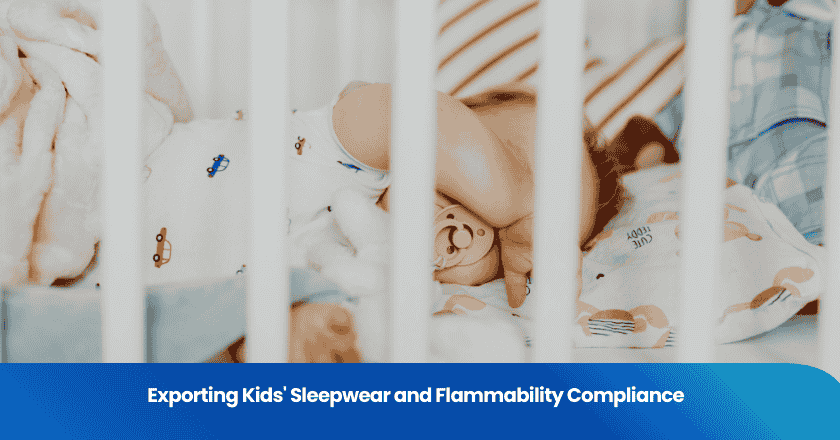
Exporting children's apparel to the United States necessitates adherence to some of the world's most rigorous safety frameworks. For kids' sleepwear, flammability compliance is the technical cornerstone, governed by specific federal regulations designed to prevent severe burn injuries. The U.S. Consumer Product Safety Commission (CPSC) enforces standards under 16 CFR Parts 1615 and 1616, which mandate that garments either be manufactured from flame-resistant textiles or adhere to strict "snug-fit" dimensional criteria. Beyond flammability, exporters must also navigate the chemical restrictions of the Consumer Product Safety Improvement Act (CPSIA). Failure to achieve total compliance can lead to prohibitive penalties, widespread product recalls, and irreparable brand damage. Professional quality control, integrating on-site inspections and standardized sampling plans, is essential for mitigating these operational risks.

Key Takeaways
- 16 CFR 1615/1616 requires fabrics to self-extinguish within seconds during a vertical flame test.
- Snug-fitting sleepwear is exempt from flammability testing if it meets specific CPSC dimensional charts for infants and toddlers.
- CPSIA compliance mandates Lead content ≤ 100 ppm and Phthalates ≤ 0.1% for children's care articles.
- Permanent tracking labels and Children's Product Certificates (CPC) are mandatory legal documents for entry into the U.S. market.
- TradeAider's utilization of the ANSI/ASQ Z1.4-2008 (AQL) standard provides a statistically sound foundation for batch acceptance.
- Professional apparel quality control must cover Pre-Production (PPI) and Pre-Shipment (PSI) stages to ensure material and construction fidelity.
The Technical Framework of U.S. Flammability Standards
The U.S. regulatory landscape for children's nightwear is bifurcated by garment size. The primary objective is to protect children from ignition sources, such as matches or lighters, by ensuring that the fabric chars rather than burns rapidly. These standards apply to all items intended for sleeping, including robes, nightgowns, and pajamas.
Vertical Flame Testing Parameters
Compliance is verified through the Vertical Flame Test. During this procedure, five fabric specimens from a single batch are exposed to a gas flame for exactly three seconds. The "Char Length"—the distance from the burned edge to the tip of the tear—must not exceed an average of 7.0 inches (17.8 cm). If the fabric continues to burn after the flame is removed, it is considered non-compliant. This testing must be conducted on both the original fabric and after 50 laundering cycles to ensure the flame-resistant properties are durable.
| Regulation | Applicability | Technical Threshold |
|---|---|---|
| 16 CFR Part 1615 | Sizes 0 to 6X | Average Char Length < 7.0 inches; Max individual < 10 inches |
| 16 CFR Part 1616 | Sizes 7 to 14 | Mandatory self-extinguishing within specific timeframes |
| Snug-Fit Exemption | 9 months to Size 14 | Strict adherence to CPSC size-specific dimensional charts |
| Infant Exemption | Sizes 0 to 9 months | Exempt from 1615 if they are one-piece garments |
Chemical Safety and CPSIA Compliance for Sleepwear
In addition to flammability, the Consumer Product Safety Improvement Act (CPSIA) imposes strict chemical limits on textiles and trims. These bioaccumulative toxins can leach into a child's skin or be ingested through grooming habits, making chemical safety a core pillar of garment quality assurance.
Lead and Phthalate Limits
The total Lead content in any accessible part of a children's product must not exceed 100 parts per million (ppm). This applies to zippers, buttons, rivets, and screen-printing inks. For phthalates—plasticizers often found in PVC-based decorative elements—the limit is ≤ 0.1%. Exporters must utilize CPSC-accepted third-party laboratories to verify these levels before issuing the mandatory Children's Product Certificate (CPC).
| Component | Test Type | Technical Limit |
|---|---|---|
| Main Fabric | Vertical Flame / Lead | Char < 7.0" / Lead < 100 ppm |
| Zippers / Snaps | Tension / Lead | 90N pull force / Lead < 100 ppm |
| Screen Prints | Phthalates / Lead | Phthalates < 1000 ppm / Lead < 90 ppm |
| Drawstrings | Mechanical safety | Prohibited in hoods/necks for certain sizes |
The Logistics of Compliance: FPU and GPU Batches
Flammability testing is managed through "Units." A Fabric Production Unit (FPU) typically consists of up to 5,000 yards of fabric. A Garment Production Unit (GPU) consists of up to 6,000 pieces of finished clothing. Testing must be performed at both levels. For example, if a seam or trim changes the combustion profile of the garment, the GPU may fail even if the FPU passed. Effective apparel inspection procedures must account for these batch-to-batch variations.
Practical Tips for Exporters to Avoid Recalls
Reducing the risk of U.S. port rejections or recalls involves a proactive compliance strategy. Consider these technical guidelines:
- Verify "Snug-Fit" Labels: If using the snug-fit exemption, the garment must have a yellow tag stating "Wear snug-fitting. Not flame resistant." Missing this tag is a major regulatory violation.
- Monitor Fiber Content: Cotton-blend fabrics that are loose-fitting are high-risk. Ensure that your suppliers are not mixing non-flame-resistant cotton into "flame-resistant" polyester batches.
- Audit Sub-Suppliers: Chemical contamination often comes from sub-suppliers of zippers or dyes. Conduct a factory audit to ensure your primary manufacturer maintains a strict approved vendor list (AVL).
- Digital Traceability: Maintain digital copies of all lab reports and CPCs linked to your shipping manifests for easy customs clearance.
TradeAider's On-Site Evaluation and Inspection Protocols
TradeAider assigns inspectors with extensive experience in finished-product inspections to visit the factory and conduct on-site evaluations. The inspection process follows established international protocols and specific customer requirements, covering sampling methodology, defect classification, and on-site product assessment to ensure that products meet quality standards and specifications.
Statistically Sound Sampling (AQL ANSI/ASQ Z1.4)
Inspections can be performed as either random sampling or 100% full inspection. At TradeAider, we use the globally trusted ANSI/ASQ Z1.4-2008 (AQL) Single Sampling Plan for all inspections. This standard, aligned with ISO 2859-1, ensures consistent, reliable quality checks. For a 500-piece order, a General Inspection Level II (G-II) typically involves checking 50 units. Sampling quantities can also be customized according to client requirements to address high-risk SKU concerns.
AQL Defect Classification:
- Critical: Safety risks (e.g., failed flame test, broken needles, or exceeding Lead limits). (Tolerance: 0).
- Major: Functional issues (e.g., incorrect sizing, failed zippers, or major color shading). (AQL 1.5).
- Minor: Aesthetic issues (e.g., uncut threads, minor scratches, or slightly crooked labels). (AQL 4.0).

Key Inspection Checks and Data Measurement
TradeAider's inspectors perform comprehensive checks determined by the characteristics of each product. Beyond visual workmanship (inspecting for scratches, dents, or dirty marks), our data measurement and on-site tests include:
- Quantity and Packaging: Verification of product counts, carton dimensions, and shipping marks.
- Packing & Marking: Detailed check of inner carton packing, assortment, safety marks, and warning marks.
- Product Conformity: Ensuring style, color, and documentation align with purchase orders and data forms.
- Functional Tests: Barcode scan tests, rubbing tests for safety labels, durability tests, and battery assembly tests for light-up pajamas.
- Mechanical Safety: Tension tests for small parts (buttons/rivets) to ensure they do not pose a choking hazard.
Real-Time Documentation and Feedback Systems
Modern quality control technology has transformed how exporters manage factory compliance. TradeAider inspectors document findings with photos, videos, and measurements, leading to a conform, non-conform, or pending verdict. All results are uploaded in real time to the TradeAider Service System.
Clients can access an Online Real-time Report while the inspection is still in progress. This allows for immediate communication: pending or non-conforming items are identified, and clients can decide whether products are acceptable or need on-site rectification by the supplier under inspector guidance. Following the site visit, an Official Report is provided within 24 hours as standard practice, providing a transparent audit trail for regulatory compliance.
Ready to secure your product quality before shipment?
As your third-party inspection, testing & certification partner in China, TradeAider supports brands and sourcing teams across the entire production process, helping you identify quality risks early, ensure compliance, and strengthen your team’s capabilities before shipment.
Book an Inspection or Testing Service with TradeAider today, or for tailored solutions and expert guidance, contact us at services@tradeaider.com or submit the request form on the right. →
Frequently Asked Questions (FAQ)
What is the difference between flame-resistant and flame-retardant?
Flame-resistant materials are inherently non-flammable due to their chemical structure (like high-quality polyester). Flame-retardant materials are treated with chemicals to resist fire. In kids' sleepwear, inherent resistance is generally preferred to avoid chemical leaching concerns.
Are infants' clothes exempt from flammability rules?
Garments sized for infants aged 9 months or younger (one-piece only) are exempt from 16 CFR 1615, provided they meet certain length requirements. However, they must still comply with the general clothing flammability standard (16 CFR 1610).
What is a Children's Product Certificate (CPC)?
A CPC is a legal document where the importer or manufacturer certifies that the product complies with all applicable safety rules. It must be based on passing test results from a CPSC-accepted laboratory.
Can TradeAider help with on-site rectification?
Yes. If an inspection identifies non-conforming items, pending items are communicated in real time. Our inspectors can guide the supplier through on-site rectification for minor or reworkable defects, ensuring the batch meets standards before shipment.
What is the average char length for a passing flame test?
According to 16 CFR 1615, the average char length for five specimens cannot exceed 7.0 inches. No individual specimen can have a char length that exceeds 10 inches (full specimen length).
Related Articles
Grow your business with TradeAider Service
Click the button below to directly enter the TradeAider Service System. The simple steps from booking and payment to receiving reports are easy to operate.

