
- О нас

- Наши услуги
- Ваша отрасль
- Ресурсы
- Новости и блог

Pet food quality control procedures should protect three things at once: the safety of the animal food, the truthfulness of the label, and the integrity of the specific batch being shipped. For importers, that means supplier approval, ingredient and batch records, preventive controls, sampling, laboratory testing, packaging checks, label verification, traceability, and release rules must work together instead of sitting in separate files.
This is a higher-risk topic than ordinary product appearance inspection. The FDA pet food page says animal foods, including pet food, must be safe, produced under sanitary conditions, contain no harmful substances, and be truthfully labeled. That means a buyer cannot treat pet food QC as only carton inspection.
For U.S. animal food, 21 CFR Part 507 covers current good manufacturing practice, hazard analysis, risk-based preventive controls, supply-chain programs, verification, corrective actions, records, and related requirements for food for animals. Importers should build QC around those control points, not only around finished packaging appearance.
Label control is also central. FDA notes that pet food labeling includes product identity, net quantity, manufacturer or distributor information, and ingredient listing, while many state rules use AAFCO model labeling requirements. Label verification belongs in inspection because wrong labels can create both commercial and regulatory risk.
Sampling still has a place. ISO 2859-1:2026 can support lot-by-lot attribute inspection for packaging, label, quantity, and visible condition checks. It does not replace microbiological, contaminant, nutrition, stability, or other food-safety testing.
- Separate visible inspection from safety proof: packaging and labels can be inspected; hazards and nutrition usually need documents or testing.
- Control the batch identity: lot code, production date, formula, ingredient source, and COA must match the goods shipped.
- Verify labels before release: ingredient list, net weight, claims, feeding directions, and distributor details must match the approved file.
- Hold until evidence is complete: unresolved test, label, lot, or supplier-document gaps should stop release.
What Should Pet Food Quality Control Procedures Include?
Pet food quality control procedures should include supplier approval, ingredient verification, hazard analysis, GMP checks, batch and lot traceability, preventive-control records, sampling plans, laboratory testing where required, packaging and seal checks, label verification, storage and transport controls, complaint or recall readiness, and a written release rule for ship, hold, reject, retest, or reinspect.
For an importer, the practical goal is not to inspect quality into the pet food after production. The goal is to make sure the supplier's food-safety controls, batch records, label files, test evidence, and shipment condition all point to the same released batch.
A finished-goods inspection can verify lot codes, carton condition, label placement, retail pouch sealing, net weight sampling, barcode readability, packaging cleanliness, count, and document availability. It cannot prove that the food is nutritionally adequate, free from pathogens, or compliant with every destination rule unless the required testing and records are present.
The AAFCO pet food consumer resource helps explain why label and nutrition claims matter to buyers. For importers, the so-what is clear: the label is not a decoration; it is part of the quality file that must match the formula, batch, and market.
Pet Food QC Procedures by Control Point
The procedure should define what is inspected, what is documented, and what needs laboratory evidence.
| Control Point | What to Verify | Evidence Needed | Release Impact |
|---|---|---|---|
| Supplier approval | Facility capability, GMP, hazard controls, audit status | Audit, questionnaire, licenses, corrective actions | Approve or block supplier |
| Ingredient and formula | Approved ingredient list, source, allergen or hazard concerns | COA, formula version, supplier record | Hold if identity or source is unclear |
| Batch identity | Lot code, production date, batch record, traceability | Batch sheet, lot photos, carton and pouch code | Release only matched batch |
| Testing and documents | Microbiology, contaminants, nutrition, stability where required | Lab report, COA, spec limits, sample plan | Hold, retest, or reject |
| Label and claim check | Ingredients, net weight, claims, feeding directions, distributor | Approved artwork and label photos | Relabel or hold shipment |
| Packaging and shipment | Seal, pouch, can, carton, pallet, moisture, count | Inspection photos, counts, weight checks | Ship, repack, sort, or reinspect |
The table shows why pet food QC is broader than product inspection. Inspection can confirm many shipment-level facts, but supplier controls and testing evidence decide whether hidden safety and composition risks are adequately covered.
A buyer should therefore avoid approving shipment only because cartons look clean. Clean cartons with missing batch identity, wrong label claims, or incomplete test evidence are still a release problem.
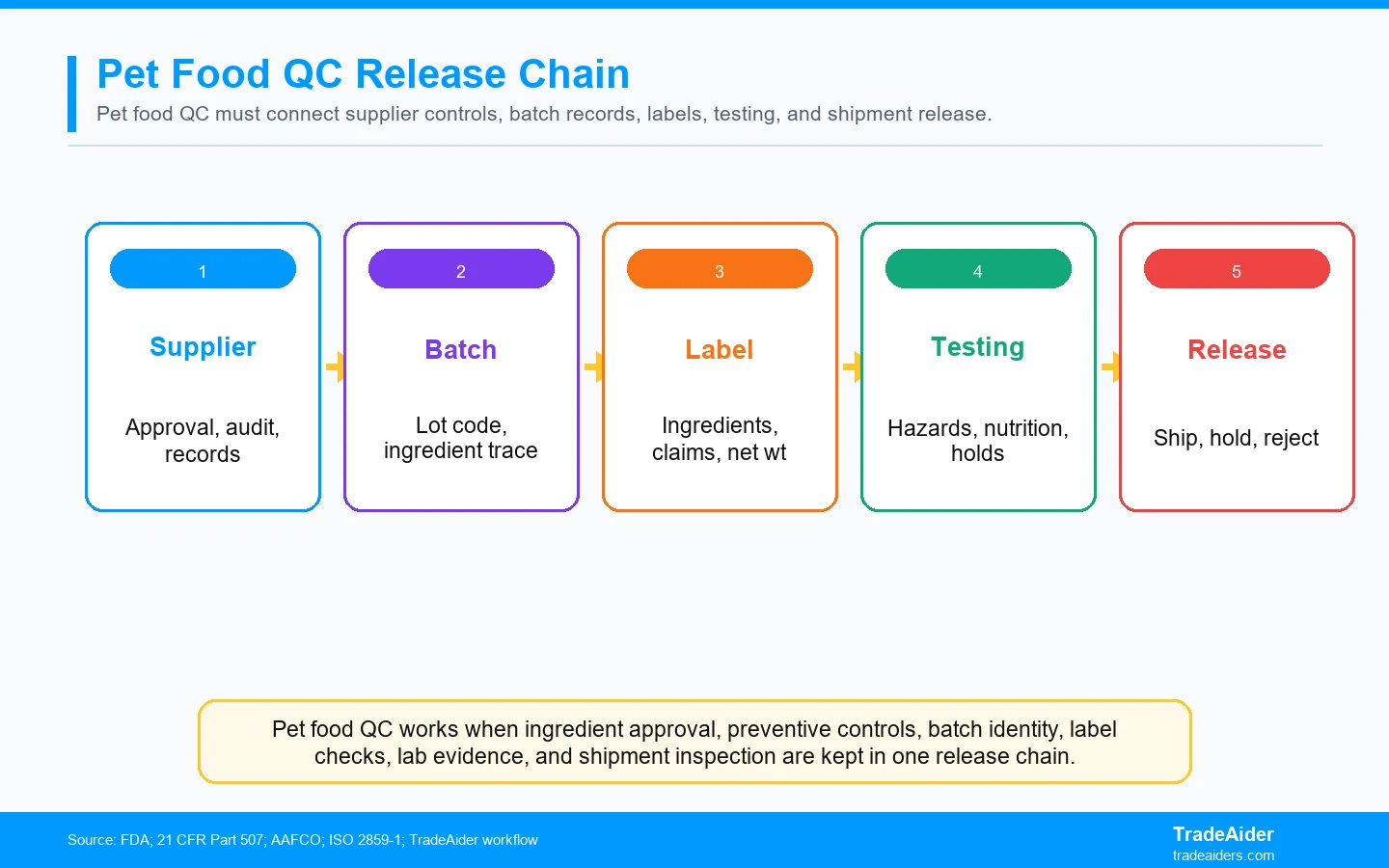
Pet food QC works when ingredient approval, preventive controls, batch identity, label checks, lab evidence, and shipment inspection are kept in one release chain.
Pet Food QC Procedures Must Separate Inspection From Food Safety Proof
Shipment inspection is useful, but pet food safety depends on supplier controls, records, and testing evidence that visual checks cannot replace.
Inspection verifies the visible shipment file
An inspection can check whether the shipped batch matches the purchase order, approved artwork, lot code, carton marks, unit count, pouch or can condition, seal appearance, label placement, net weight sample, barcode, pallet condition, and documents presented by the supplier.
This evidence is valuable because commercial failures often start with wrong labels, mixed batches, poor packaging, moisture exposure, damaged cartons, unsealed pouches, or missing lot codes. Those problems can affect traceability and customer trust even when the formula itself is correct.
Testing and preventive controls prove hidden risks
Microbiological contamination, mycotoxins, heavy metals, nutrient levels, rancidity, shelf-life stability, and other hidden risks cannot be closed by a visual inspection. The buyer needs appropriate laboratory reports, COAs, preventive-control records, or destination-specific compliance evidence.
The procedure should state which hazards or claims require test evidence, who collects samples, which lab method applies, what limit is used, and whether the batch is on hold until results are approved. If those points are missing, inspection should flag the gap rather than approve the lot.
Supplier and Ingredient Controls Come Before Finished Goods
Pet food QC starts upstream because unsafe or mislabeled animal food cannot be fixed by checking cartons after packing.
Supplier approval should match product risk
A dry kibble factory, wet canned food processor, freeze-dried treat supplier, supplement blender, and private-label packer can carry different hazards and records. The buyer should know which facility makes the product, whether production is subcontracted, and which process step controls the main risks.
Under 21 CFR Part 507, animal food controls include areas such as GMP, hazard analysis, preventive controls, monitoring, corrective actions, verification, supply-chain programs, and records. A buyer does not need to quote the regulation in every PO, but the QC procedure should reflect those control categories.
Ingredient records should connect to the batch
The approved formula, ingredient supplier, incoming lot, production batch, finished lot code, and shipment carton should connect. If the supplier cannot trace an ingredient lot to the finished batch, the buyer may not have enough evidence for release or recall readiness.
Ingredient COAs should be reviewed against the approved specification, not merely collected. A document with the right supplier logo but the wrong batch, wrong date, or missing parameter does not close the quality file.
Label, Claim, and Packaging Checks Are Shipment-Level QC
For pet food, label accuracy and package integrity can be as important as appearance.
Labels should match formula and market file
The inspection file should include approved artwork, ingredient statement, net quantity, manufacturer or distributor details, feeding directions, nutrition or guaranteed analysis information where applicable, lot code location, barcode, claim wording, and destination-specific requirements.
If the supplier changes the formula, ingredient order, claim wording, label material, pouch size, or distributor details, the label check must change too. A clean label photo is not enough if it matches an outdated artwork file.
Packaging protects safety, shelf life, and traceability
Packaging checks should cover seal condition, pouch or can integrity, oxygen or moisture barrier concerns where relevant, carton strength, pallet protection, lot code readability, inner packing, count, net weight spot checks, and visible contamination.
If canned pet food is involved, FDA notes that canned pet foods must follow low-acid canned food rules, and 21 CFR Part 113 covers thermally processed low-acid foods in hermetically sealed containers. That is a process-control and documentation issue, not only a can appearance check.
Sampling and Release Rules Should Be Written Before Production Ends
Pet food QC becomes risky when the buyer decides what to sample only after a problem appears.
Sampling must distinguish lab samples from inspection samples
A lab sample is collected to test a hazard, nutrient, contaminant, shelf-life, or claim requirement. An inspection sample is selected to verify attributes such as label, packaging, count, visual condition, weight, or carton spread. The two samples may be collected differently and should not be confused.
The buyer should define who collects samples, when they are collected, how they are sealed, how chain of custody is controlled, and whether the batch is held pending test results. For visible checks, the report should show carton and lot-code spread.
Release rules need hold points
A release rule should say what happens if test results are missing, labels are wrong, lot codes are unreadable, cartons are wet, net weight samples fail, or documents do not match the batch. Pet food QC should include hold, retest, relabel, repack, reject, or reinspect decisions.
The buyer should also define who can approve release. A supplier shipping because production is complete is not the same as a buyer release based on complete evidence.
Scenario Estimate: One Label Mismatch Can Break Traceability
A small artwork or lot-code mistake can become a recall-readiness problem.
Assume a pet treat order contains 18,000 retail pouches and 3% carry an old lot-code format that does not match the batch record. That is about 540 pouches that may be hard to trace if a complaint or test issue appears later.
If correction at the supplier costs $0.16 per pouch for relabeling and handling, the direct cost is about $86.40. If the issue is found after import, the buyer may face warehouse holds, relabeling labor, inventory quarantine, and traceability uncertainty that can cost far more than the label work.
This estimate is illustrative. The decision lesson is that label and lot-code verification should be part of pet food QC before shipment, not a warehouse discovery after the batch enters inventory.
Where TradeAider Fits in Pet Food Shipment Control
TradeAider can support shipment-level pet food QC by verifying batch identity, labels, packaging, carton condition, quantity, visible defects, document availability, and sampling coordination, while keeping food-safety testing and regulatory approval as separate evidence paths.
For finished shipments, Pre-Shipment Inspection can check lot codes, carton spread, packaging condition, label artwork, count, net weight samples, visible contamination, pallet condition, and documents presented at the factory.
For earlier process risk, During Production Inspection can verify whether batch identity, label use, packing condition, and corrective actions are visible before the whole order is packed.
If the buyer needs hazard, nutrition, contaminant, or shelf-life proof, the next step is not a visual pass; TradeAider can help coordinate product testing services and keep the shipment release decision tied to the required lab evidence.
SPAR Scenario: The Shipment Looked Clean, but the Batch File Was Not Ready
The buyer used inspection to stop a document and label mismatch before shipment release.
Situation: A private-label buyer ordered 22,000 pet treat pouches from a supplier in China.
Problem: Cartons looked clean, but one production date used old artwork and the COA did not match the lot code on the pouches.
Action: TradeAider photographed affected lot codes, checked carton spread, verified artwork versions, and marked the shipment as hold pending corrected documents and relabeling.
Result: The buyer released 17,600 matched pouches, held 4,400 for relabeling and document correction, and kept the batch on hold until the supplier provided matching evidence.
Pet Food QC Release Checklist
Use this checklist before authorizing a pet food shipment.
- Approved supplier, facility, formula, ingredient, and batch records are available.
- Required hazard, nutrition, contaminant, or shelf-life test evidence is complete.
- Lot code, production date, carton mark, and COA match the shipped batch.
- Label artwork, ingredient list, net weight, claims, and distributor details match the approved file.
- Packaging seals, pouches, cans, cartons, pallets, and moisture protection pass inspection.
- Release, hold, retest, relabel, repack, reject, or reinspect rules are written.
A pet food shipment should not be released only because appearance is acceptable. The release file should connect supplier controls, batch records, test evidence, label proof, and shipment condition.
When one part of that chain is missing, the safest business decision is usually to hold the affected batch until the evidence is complete.
If your pet food order is packed but the batch file, label evidence, or test reports are not fully aligned, send TradeAider the PO, product specification, approved label file, lot code list, COA or test reports, and shipment status. The next step is to review pet food shipment evidence before release and decide what must be held, corrected, tested, or reinspected.
Frequently Asked Questions
Can visual inspection prove pet food is safe?
No. Visual inspection can verify packaging, labels, lot codes, carton condition, and visible contamination, but safety hazards and nutrition claims usually require records or laboratory testing.
What records matter most in pet food QC?
Important records include supplier approval, formula version, ingredient COAs, batch records, preventive-control records, test reports, label approvals, lot codes, and release decisions.
Should pet food be held until lab results are complete?
If the buyer requires lab evidence for hazards, nutrition, contaminants, or claims, the batch should remain on hold until results match the specification and release rule.
How does AQL apply to pet food inspection?
AQL can support attribute checks such as packaging, labels, count, visible condition, and carton spread. It does not replace food-safety testing or regulatory documentation.
What should importers check on pet food labels?
Check product identity, ingredient statement, net quantity, distributor information, lot code, feeding directions, claims, barcode, and any destination-specific labeling requirements.
Похожие статьи
Развивайте свой бизнес с услугами TradeAider
Нажмите кнопку ниже, чтобы войти непосредственно в систему услуг TradeAider. Простые шаги от бронирования и оплаты до получения отчетов легко выполнить.

