
- О нас

- Наши услуги
- Ваша отрасль
- Ресурсы
- Новости и блог
Third party quality control procedures are the steps an importer uses to get independent evidence before accepting, releasing, correcting, or rejecting an order. For beginners, the procedure should be simple but complete: define the purpose, prepare the product file, choose the inspection timing, agree the sampling rule, conduct the on-site check, review the report, and turn findings into release, hold, sort, rework, testing, or reinspection action.
The procedure starts with independence. ISO/IEC 17020:2026 explains inspection as determining conformity with requirements and emphasizes competence, impartiality, and consistent operation. A beginner should therefore focus on requirements first, not on booking a visit as quickly as possible.
When finished goods are sampled, ISO 2859-1:2026 provides a current AQL-indexed framework for lot-by-lot attribute inspection. AQL is helpful, but only after the buyer defines the lot, sample spread, defect classes, and release rule.
The BLS quality control inspector profile describes inspectors as people who examine products and materials for defects or deviations from specifications. That sentence contains the beginner lesson: without specifications, the inspection cannot reliably identify deviations.
O*NET also lists tasks such as measuring products, collecting samples, recording inspection data, writing reports, and recommending corrective actions. A third-party QC procedure should connect those tasks to a buyer decision rather than leaving the beginner with photos and uncertainty.
- Do not start with the factory visit: start with the buyer file and the decision you need after inspection.
- Choose timing by risk: PPI for setup, DPI for process drift, PSI for finished-lot release, audit for supplier capability.
- Make sampling visible: lot size, carton spread, SKU spread, sample count, and defect severity should appear in the report.
- Use the report as an action file: release, hold, sort, rework, test, or reinspect based on evidence.
How Does Third Party Quality Control Work for Beginners?
Third party quality control works by giving an independent inspection provider the buyer's product requirements, choosing the right inspection stage, sampling the lot, checking products or supplier conditions against the agreed criteria, documenting defects and evidence, and using the report to decide whether to release, hold, sort, rework, test, audit, or reinspect the order.
A beginner should not treat third-party QC as outsourcing all quality decisions. The agency can inspect and report, but the buyer must define the product file, defect severity, acceptable evidence, and action rule. Without those inputs, even a careful inspector may produce a report that is hard to use.
Third-party QC is especially helpful when the buyer is not physically present at the factory, the supplier is new, the order is high-value, the product has prior defects, the packaging or labels are important, or the buyer needs independent evidence before paying a balance or approving shipment.
The ASQ quality glossary helps beginners separate quality assurance, quality control, inspection, and corrective action. The so-what is practical: inspection is one procedure inside a larger buyer-controlled quality system.
Beginner Third Party QC Procedure
Use the procedure as a checklist before, during, and after the inspection.
| Step | What the Beginner Does | What the Agency Does | Decision Created |
|---|---|---|---|
| 1. Define purpose | Choose setup, process, final, audit, testing, or loading question | Confirms service scope and feasibility | Right QC service is selected |
| 2. Prepare file | Sends PO, sample, specs, labels, packing, defect examples | Builds checklist and evidence plan | Inspector knows what to verify |
| 3. Map lot | Confirms quantity, cartons, SKUs, packing status | Plans sample size and spread | Sample represents the shipment |
| 4. Inspect on site | Stays available for urgent questions | Checks, measures, photographs, classifies defects | Findings become evidence |
| 5. Review report | Reads identity, severity, concentration, and photos | Explains result and open gaps | Release or hold decision is possible |
| 6. Follow up | Requests correction, testing, sorting, or reinspection | Verifies correction if booked | Problem is closed or escalated |
The beginner's role is not passive. The buyer controls the inspection file and release rule. The agency controls the on-site evidence collection and report quality. Both sides must be clear before the factory visit.
If one step is skipped, the report becomes weaker. A missing product file creates subjective judgment. A missing lot map creates weak sampling. A missing action rule creates delay after findings appear.
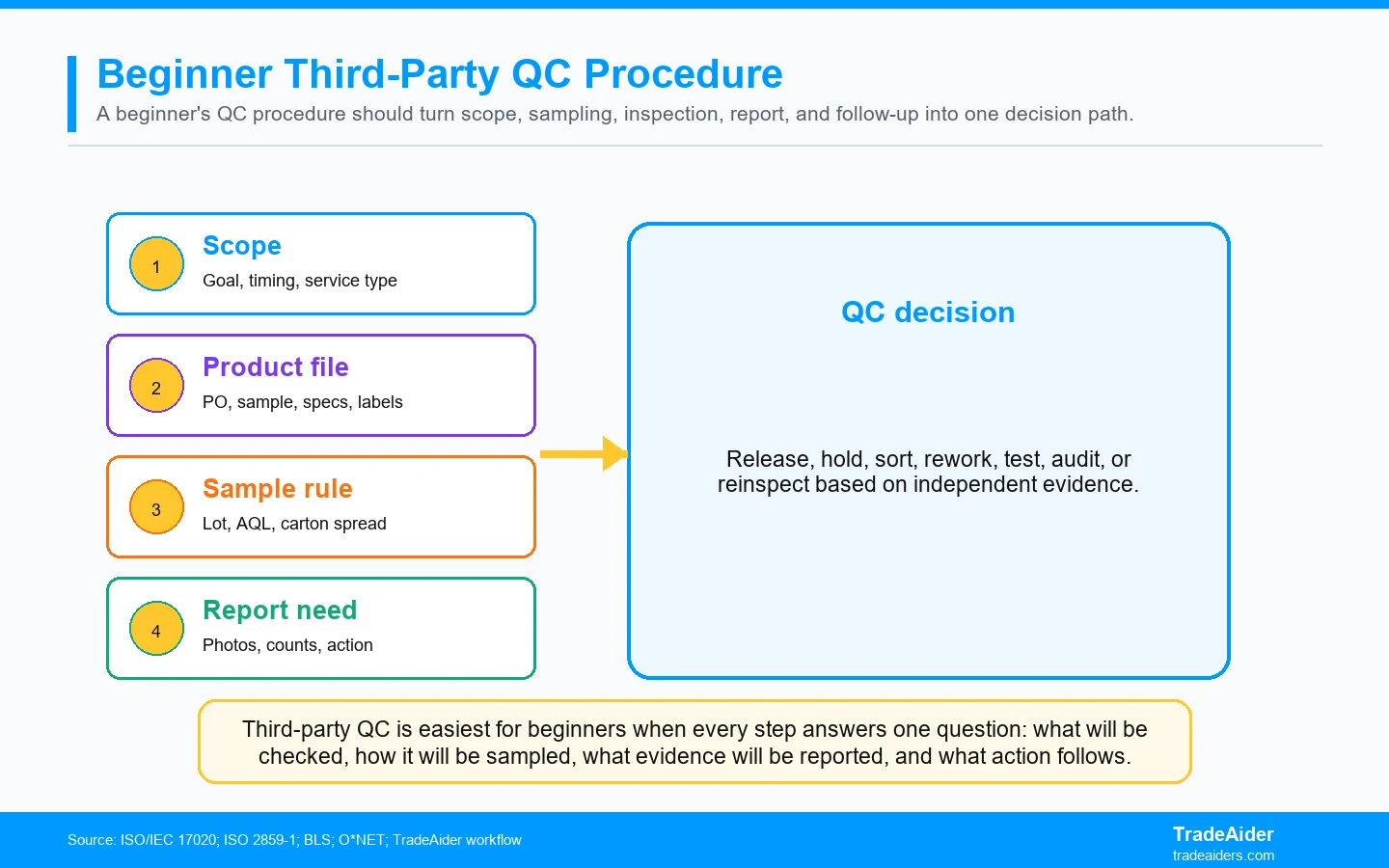
Third-party QC is easiest for beginners when every step answers one question: what will be checked, how it will be sampled, what evidence will be reported, and what action follows.
A Beginner Procedure Starts Before the Inspector Visits
Third-party QC succeeds or fails before the factory visit, when the buyer defines scope, product file, and release action.
Scope should match the order stage
A beginner should first ask what decision the inspection must support. If the order has not started, the question may be supplier readiness or pre-production setup. If production is active, the question may be whether defects are spreading. If goods are finished and packed, the question is shipment release.
This stage decision matters because one inspection type cannot answer every question. A factory audit checks capability. A DPI checks early or mid-production output. A PSI checks finished goods. A loading check protects the handover. Testing handles hidden claims.
The product file is the buyer's control point
The product file should include the PO, approved sample, specification, drawings, tolerance rules, color or material references, label artwork, barcode, accessory list, packing method, carton mark, defect examples, and any required documents.
If the buyer only sends a product name and quantity, the inspector must use generic judgment. If the buyer sends a clear file, the inspector can compare the actual lot against buyer requirements and produce evidence that supports a decision.
Sampling and Defect Severity Make the Report Usable
Beginners often focus on whether the report says pass or fail, but sample representation and defect severity matter more.
The sample should match the real shipment
The report should show total quantity, carton count, sample size, carton numbers, SKU spread, color and size spread where relevant, production dates, and packing status. The buyer should be able to see what the evidence represents.
TradeAider buyers can use the AQL calculator to plan sample size, but sample spread still needs buyer attention. A correct sample count from the wrong subgroup can give a beginner false comfort.
Severity should follow buyer consequence
Critical defects usually involve safety, legal, severe function, or conditions that make goods unsafe or unsellable. Major defects affect usability, appearance, customer promise, packaging, labels, or saleability. Minor defects may be acceptable within tolerance but still deserve tracking.
Beginners should define examples before the report. Missing accessory, wrong barcode, failed function, sharp edge, wrong warning label, poor stitching, cracked retail box, and color mismatch should not be debated after the supplier sees the result.
On-Site Inspection Should Produce Decision-Ready Evidence
A third-party QC procedure is only useful when the report can be read by a buyer who was not present.
Photos need context, not just quantity
A good report should show product identity, sample spread, inspected checkpoints, defect photos, measurement readings, label and packing evidence, carton numbers, supplier comments, and any unverified items. A large number of photos is not enough if the buyer cannot connect them to the lot.
The buyer should review the report by identity, severity, concentration, and action. What was inspected? How was it sampled? Which defects matter most? Are findings random or concentrated? What should happen next?
Real-time questions can improve the report
If the agency provides real-time visibility, the buyer can ask for extra photos, supplier clarification, wider sample spread, or document checks while the inspector is still on site. That can be more useful than waiting for a final PDF after the factory opportunity is gone.
Beginners should prepare a short escalation rule: if a critical defect, wrong label, missing accessory, failed function, or unavailable document appears, the inspector should notify the buyer before leaving.
Follow-Up Is Part of the Procedure, Not an Afterthought
The procedure ends only when the buyer acts on evidence and verifies correction when needed.
Failed inspections need containment
A failed inspection should lead to a specific containment path: isolate affected cartons, sort the subgroup, repair or replace defective units, relabel or repack goods, test the hidden risk, or reinspect after correction. Vague supplier promises are not enough.
The buyer should ask which cartons, SKUs, colors, sizes, or production dates are affected. If the issue is concentrated, the solution may be targeted. If it is random or critical, the whole lot may need stronger action.
Every report should improve the next order
After the inspection, the buyer should update the product file. Add new defect examples, adjust sample spread, clarify tolerances, add label photos, move timing earlier, or require supplier correction proof based on what the report revealed.
This is where beginners become better importers. The first inspection may feel like a one-time event, but the procedure becomes more valuable when every report improves the next PO.
Scenario Estimate: A Beginner Report Without an Action Rule Can Burn Days
The report is not the decision; the action rule turns evidence into a decision.
Assume a beginner imports 6,500 units and the third-party report finds major defects in 4% of samples, concentrated in two carton ranges. If the buyer has no action rule, two or three days may be lost while the supplier argues whether the lot is acceptable.
If the buyer had defined the rule before inspection, the response could be immediate: hold the two carton ranges, sort and rework the affected group, keep clean cartons sealed, and reinspect the corrected subgroup. If sorting costs $0.25 per suspect unit and the affected subgroup is 780 units, the direct sorting exposure is about $195 before reinspection.
This estimate is illustrative. The lesson is that beginners should write the action rule before findings appear, not after the supplier has a reason to negotiate every defect.
Where TradeAider Fits for Beginner Third-Party QC
TradeAider helps beginner importers define the inspection scope, prepare the product file, apply AQL sampling, collect on-site evidence, review reports, and choose follow-up action.
If the buyer needs setup evidence, Pre-Production Inspection can check materials, samples, labels, packaging, and readiness. If the buyer needs process evidence, During Production Inspection can verify early output and supplier correction.
If the order is finished and ready for release, Pre-Shipment Inspection can verify completed goods when 100% of the order quantity is finished and at least 80% is packed for export, using sampling, defect classification, photos, measurements, labels, and packing checks.
For beginners who are unsure how to scope the inspection, TradeAider resources such as the inspection standard guidance can help turn buyer requirements into a practical inspection file before booking.
SPAR Scenario: The Beginner Used the Report to Make a Partial Release
The buyer avoided rejecting clean goods because the procedure identified the affected subgroup.
Situation: A first-time importer ordered 5,400 packaged accessories from a supplier in China.
Problem: PSI found wrong barcode labels in one carton range, while the rest of the order looked clean.
Action: TradeAider mapped carton numbers, photographed label errors, classified the defect as major, and recommended sorting plus reinspection for the affected range.
Result: The buyer released 4,620 clean units, held 780 for relabeling, paid for one targeted reinspection, and added barcode photos to the next PO file.
Beginner Third-Party QC Booking Checklist
Prepare these items before booking your first third-party quality control procedure.
- Inspection purpose: supplier readiness, process control, final release, loading, audit, or testing.
- PO, approved sample, specification, drawings, tolerances, labels, and packing rules.
- Lot quantity, carton count, SKU, color, size, and production-date breakdown.
- Critical, major, and minor defect examples.
- Required photos, measurements, function checks, document checks, and supplier comments.
- Release, hold, sort, rework, test, audit, or reinspection rule.
A beginner does not need a complicated quality department to use third-party QC well. The buyer needs a clear file, a representative sample plan, and a report action rule.
Once the first report is complete, save it as a learning document. It should shape the next supplier discussion and the next inspection checklist.
If you are booking third-party QC for the first time, send TradeAider the PO, approved sample, specification, factory location, production status, and shipment deadline. The next step is to plan your first third-party QC procedure so the report answers the release question instead of creating more uncertainty.
Frequently Asked Questions
What is third-party quality control?
Third-party quality control uses an independent provider to inspect products, processes, documents, or supplier conditions against the buyer's requirements before a release decision.
When should beginners book third-party QC?
Book before production for setup risk, during production for defects that can spread, before shipment for finished-lot release, and during loading when handover risk matters.
What should I send before inspection?
Send the PO, approved sample, specifications, drawings, tolerances, labels, packing rules, defect examples, lot breakdown, and any required documents.
Does a passed inspection guarantee zero defects?
No. Inspection reduces risk and provides evidence, but sampled inspections do not guarantee that every unit is defect-free.
What happens if third-party QC fails?
The buyer should decide whether to hold, sort, rework, replace, test, reinspect, audit, or reject based on defect severity and concentration.
Похожие статьи
Развивайте свой бизнес с услугами TradeAider
Нажмите кнопку ниже, чтобы войти непосредственно в систему услуг TradeAider. Простые шаги от бронирования и оплаты до получения отчетов легко выполнить.

