
- О нас

- Наши услуги
- Ваша отрасль
- Ресурсы
- Новости и блог

An AQL sampling plan is a structured method for deciding whether a defined inspection lot can be accepted based on a representative sample and preset defect limits. The process works only when the buyer defines the lot, inspection level, defect classes, AQL values, sample selection method, acceptance numbers, and action rule before defects appear.
The 2026 reference point for many import inspections is ISO 2859-1:2026, which provides sampling schemes indexed by acceptance quality limit for lot-by-lot inspection by attributes. It replaces the older 1999 edition and includes updated guidance, so buyers should avoid relying on outdated AQL summaries.
AQL does not mean zero defects, and it does not guarantee the exact defect rate in a shipment. It is an acceptance sampling method. ISO/IEC 17020:2026 is also relevant because inspection bodies need competence and consistent operation to apply sampling and defect rules reliably.
For importers, the practical problem is usually not the table itself. It is the preparation around the table: what is the lot, which inspection level applies, what defects are critical, major, or minor, and what happens if the result fails.
ASQ quality terminology helps keep the language clean. AQL is part of quality control, but it is not the entire quality system. It should work together with product specifications, supplier process control, inspection reporting, testing where needed, and corrective action.
- Define the lot before using AQL: total quantity, cartons, SKUs, colors, sizes, and production groups must be clear.
- Classify defects before inspection: critical, major, and minor rules should follow buyer risk, not supplier preference.
- Sample selection must be representative: a correct sample size from the wrong cartons is weak evidence.
- AQL ends with action: release, hold, sort, rework, test, or reinspect should be planned before the report arrives.
How Does an AQL Sampling Plan Work?
An AQL sampling plan works by defining the inspection lot, choosing an inspection level, setting AQL limits for critical, major, and minor defects, finding the sample size and acceptance numbers, selecting samples randomly across the lot, inspecting those samples, counting defects by severity, and accepting or rejecting the lot according to the preset rule.
AQL is useful because buyers rarely inspect every unit in a finished goods lot. Instead, the buyer uses a statistically structured sample to make a release decision. The result is not perfect certainty; it is a controlled decision method that balances inspection effort, buyer risk, and supplier risk.
The plan fails when the buyer treats AQL as a magic number. AQL 2.5 for major defects says nothing useful if the lot is not defined, samples are pulled from convenient cartons, defect severity is unclear, or the buyer has no rule for what happens after a failure.
Process-control thinking helps explain the limitation. NIST guidance on process control separates monitoring a process from accepting a lot. AQL is mainly a lot-acceptance tool; supplier process improvement needs additional data and corrective action.
AQL Sampling Plan Process for Importers
Each step should be completed before the buyer relies on the inspection result.
| Step | Decision to Make | Common Mistake | Better Practice |
|---|---|---|---|
| 1. Define lot | What goods are included in this inspection? | Using total PO quantity without carton or SKU map | Map quantity, cartons, SKUs, colors, sizes, and dates |
| 2. Set defect classes | What is critical, major, or minor? | Debating severity after defects appear | Agree examples before inspection |
| 3. Choose inspection level | How much sampling effort is needed? | Using the same level for every risk | Match level to product risk and buyer policy |
| 4. Find sample size | How many units should be checked? | Confusing sample size with sample quality | Use AQL table or calculator plus sample-spread rules |
| 5. Inspect and count | How many defects by severity? | Mixing all defects together | Count critical, major, and minor separately |
| 6. Decide action | Can the lot ship? | Treating fail as a vague complaint | Release, hold, sort, rework, test, or reinspect |
The most common AQL mistake is starting at step four. Buyers ask for a sample size before they have defined the lot and severity rules. That creates a report that looks formal but does not answer the shipment question.
The action rule is just as important as the acceptance rule. A failed lot may require rejection, but it may also require targeted sorting, supplier rework, expanded inspection, laboratory testing, or reinspection after correction.
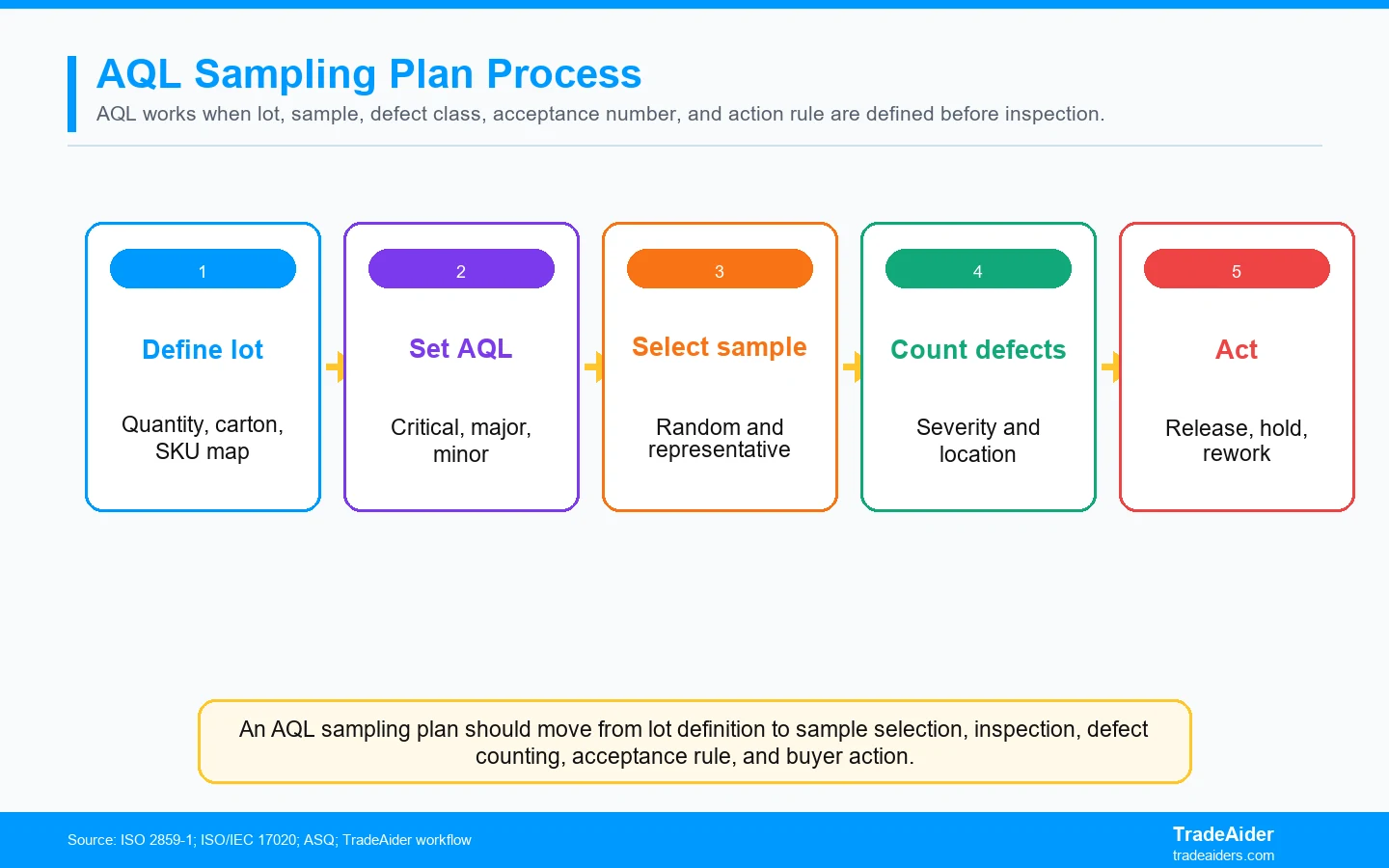
An AQL sampling plan should move from lot definition to sample selection, inspection, defect counting, acceptance rule, and buyer action.
The AQL Sampling Process Has Six Practical Steps
AQL works when the buyer completes the process in order instead of jumping straight to a sample number.
Step 1: Define the inspection lot
The lot is the population the sample is supposed to represent. For importers, that usually means the finished goods available for inspection at a specific factory, date, and packing status. The lot map should include total quantity, carton count, SKUs, colors, sizes, production dates, packing versions, and separated groups.
If the lot changes during inspection, the plan may need adjustment. For example, if some cartons are not ready, some SKUs are missing, or a subgroup is held in another area, the report should state what was and was not included.
Step 2: Define defect classes before inspection
Critical defects usually involve safety, legal compliance, severe function failure, contamination, or conditions that make goods unsafe or unsellable. Major defects affect function, appearance, fit, customer promise, or saleability. Minor defects are limited issues that may be acceptable within tolerance but should be tracked.
Severity is buyer-specific. A wrong warning label may be critical for one product. A small hidden mark may be minor for another. The buyer should provide examples, photos, and release consequences before the inspector arrives.
Step 3: Choose inspection level and AQL values
Inspection level controls sample size, while AQL values control acceptance limits by defect class. Many consumer goods inspections use General Inspection Level II as a normal starting point, but buyers may choose different levels based on product risk, order value, supplier history, and regulatory concern.
AQL values should not be copied blindly. A low-risk promotional item and a safety-sensitive electrical product should not share the same severity logic. The buyer's risk, product promise, and destination requirements should drive the plan.
Sample Selection Is Where Many AQL Plans Become Weak
The sample must represent the lot, not the easiest cartons to open.
Random does not mean careless
A practical sample should be selected across carton ranges, pallet positions, SKUs, colors, sizes, production dates, and packing versions when those groups exist. The report should show which cartons or subgroups were sampled so the buyer can judge representation.
TradeAider buyers can start with the AQL calculator to estimate sample size, then add sample-spread instructions based on the actual order structure. The calculator cannot know which subgroup worries the buyer unless the buyer defines it.
High-risk subgroups may need extra attention
If a supplier changed material, switched operators, split production dates, added a new color, packed one SKU later, or corrected a known defect, the buyer may need extra visibility on that subgroup. AQL does not forbid risk-based attention; it simply needs the report to be transparent.
The buyer should avoid hiding targeted checks inside a normal AQL result. If extra samples are added for a risk group, the report should explain why and how the results affect the decision.
Counting Defects Correctly Is More Important Than Counting Fast
The AQL result depends on consistent severity classification and clean defect counts.
Critical, major, and minor defects should stay separate
Defects should be counted by severity. One critical defect can stop a lot even if major and minor counts are low. Major defects should not be hidden among minor cosmetic findings, and repeated minor defects may still create trend evidence for future correction.
Reports should show defect photos, counts, locations, affected samples, and whether defects repeat by carton, SKU, size, color, or production date. The buyer needs both the number and the pattern.
One sample can contain more than one defect
The inspection method should state whether defects are counted by defect occurrence, defective unit, or another agreed method. This matters when one unit has several small issues or one serious issue plus minor appearance marks.
In buyer communication, clarity matters more than clever formulas. The report should explain how defects were counted and why the final result passed or failed against the selected rule.
AQL Results Should Trigger a Specific Buyer Action
AQL is valuable only when the buyer knows what to do with pass, fail, warning signs, and correction proof.
Passing AQL can still require follow-up
A lot may pass AQL but show a pattern worth monitoring. For example, all defects may appear in one carton range, one size, one production date, or one accessory set. The buyer may release the lot and still update the next inspection checklist.
Passing also does not replace testing. If chemical, electrical, flammability, durability, or performance claims matter, AQL inspection should be paired with the right documents or laboratory tests.
Failing AQL should lead to a defined path
A failed lot may be rejected, but many failures require a more specific path: sort affected goods, rework defects, replace labels, repack cartons, perform extra testing, reinspect after correction, or negotiate supplier responsibility.
The buyer should decide who pays for correction, what evidence proves the fix, whether reinspection is needed, and whether the next order requires tighter control. Otherwise the AQL result becomes a complaint instead of a control tool.
Scenario Estimate: The Wrong Lot Map Can Defeat the Right AQL Table
AQL is only as strong as the lot definition and sample spread behind it.
Assume a 20,000-unit order includes five SKUs. The sample size is chosen correctly, but most samples come from the two easiest SKUs near the loading area. Later, SKU 5 shows a repeated label mismatch in 3% of its 4,000 units.
That subgroup could contain about 120 mislabeled units. If relabeling after arrival costs $0.80 per unit while factory relabeling costs $0.20, the same issue changes from about $24 to about $96 in direct relabeling cost before counting receiving delays and inventory confusion.
The estimate is small by design because many AQL failures begin as small preventable mismatches. The lesson is not the dollar amount; it is that a correct table cannot rescue a poor sample map.
Where TradeAider Fits in AQL Sampling
TradeAider helps importers build AQL sampling plans around real lot maps, defect classes, representative sampling, report evidence, and release actions.
For finished goods, Pre-Shipment Inspection can apply AQL sampling after 100% of the order quantity is completed and at least 80% is packed for export. The report can include product checks, defect counts, photos, labels, packing evidence, and release recommendations.
When the lot is not yet ready or defects may spread during production, During Production Inspection may be the better timing. It can catch process drift earlier instead of waiting for the final AQL result.
When the risk is hidden, TradeAider can coordinate product testing services alongside the inspection. AQL sampling can count visible or attribute defects; it should not be treated as proof of every safety or performance claim.
SPAR Scenario: The AQL Plan Became a Release Rule
The buyer avoided a vague pass/fail dispute by defining the action before inspection.
Situation: A buyer ordered 15,000 packaged consumer goods across four SKUs.
Problem: Previous orders had mixed barcodes and minor cosmetic defects, but the supplier argued that most units were acceptable.
Action: TradeAider defined the lot map, AQL levels, defect classes, carton spread, label checks, and reinspection rule before PSI.
Result: The inspection failed one SKU for barcode mismatch, released the other three SKUs, and held 620 units for relabeling and targeted reinspection.
AQL Sampling Plan Checklist
Prepare these items before using an AQL sampling plan.
- Lot size, carton count, SKU, color, size, and production-date map.
- Inspection level and AQL values for critical, major, and minor defects.
- Defect examples linked to buyer consequence and release action.
- Sample-spread instructions across cartons, SKUs, colors, sizes, and risk groups.
- Measurement, function, label, packing, and document checks to be included.
- Action rule for pass, fail, hold, sort, rework, test, and reinspection.
AQL planning should happen before the factory visit, not while the inspector is already on site. That gives the supplier, buyer, and inspector one shared rule.
After every inspection, keep the report and defect history. The next AQL plan should be smarter because the buyer knows which risks actually appeared.
If you need an AQL plan for an upcoming shipment, send TradeAider the lot quantity, carton count, SKU breakdown, approved sample, defect concerns, and shipment date. The next step is to build an AQL sampling plan for your order with clear sample spread and release rules.
Frequently Asked Questions
What is an AQL sampling plan?
It is a plan that defines how many units to inspect from a lot and how many defects are allowed before the lot is accepted or rejected under preset rules.
Does AQL mean zero defects?
No. AQL is an acceptance sampling limit, not a zero-defect guarantee. Critical defects may still have zero tolerance depending on the buyer's rule.
What information do I need for AQL sampling?
You need lot size, carton count, SKU or size breakdown, inspection level, AQL values, defect classes, sample-spread rules, and action rules.
Can AQL be used for apparel, electronics, and hard goods?
Yes, AQL can be used for many product categories, but the defect definitions, sample spread, tools, and testing boundaries must fit the product risk.
What happens if an AQL inspection fails?
The buyer should decide whether to reject, sort, rework, relabel, repack, test, or reinspect based on severity, concentration, and supplier correction evidence.

Похожие статьи
Развивайте свой бизнес с услугами TradeAider
Нажмите кнопку ниже, чтобы войти непосредственно в систему услуг TradeAider. Простые шаги от бронирования и оплаты до получения отчетов легко выполнить.

