
- О нас

- Наши услуги
- Ваша отрасль
- Ресурсы
- Новости и блог
Every importer eventually faces the same budget question: how much should you spend on quality control, and how do you decide when to spend more? The answer is not a fixed percentage — it depends on whether your primary exposure is a high unit cost per item or a high volume of units at risk. According to quality management research, the total Cost of Quality — including prevention, appraisal, and failure costs — typically ranges between 15–20% of sales revenue, and can reach 40% in some organizations. For importers sourcing from China, the goal is to shift spending toward prevention and appraisal before shipment, rather than absorbing failure costs after goods arrive. That shift starts with understanding whether your order is fundamentally a high-value problem or a high-volume problem, because each one demands a different inspection strategy.
Key Takeaways
- Cost of Quality: According to the American Society for Quality (ASQ), poor quality can consume 15–20% of sales in some industries. Third-party inspection for China orders typically costs well under 1% of order value — making it a high-ROI appraisal investment.
- High-value orders (high unit cost, lower volume) carry concentrated financial exposure per defect. The priority inspection type is DPI + PSI with functional testing, focusing on each unit's integrity.
- High-volume orders (low unit cost, high quantity) carry statistical exposure — small defect percentages translate into large absolute numbers of defective units. AQL sampling level and sample size are the critical variables.
- Framework: The Order Risk Matrix maps four order types against recommended inspection configurations, allowing importers to budget appropriately before placing each order.
- Break-even rule: A $199/man-day inspection becomes ROI-positive the moment it prevents one defect event that would cost more than $199 to resolve — a threshold that virtually every China order exceeds.
Why High-Value and High-Volume Orders Require Different Thinking
At first glance, a $50,000 order sounds like it requires more inspection than a $10,000 order. But the relationship between order value and inspection risk is not linear — it is structural. A $50,000 order of 200 premium kitchen appliances at $250/unit has a fundamentally different risk profile from a $50,000 order of 50,000 promotional pens at $1/unit. In the appliance order, a 5% defect rate means 10 units fail — each one a $250 loss plus return logistics. In the pen order, a 5% defect rate means 2,500 defective pens distributed across every customer who receives one. The financial and reputational exposure is completely different, and the inspection design that catches one scenario may miss the other entirely.
According to quality management principles codified by the Cost of Quality (CoQ) framework, costs fall into four categories: prevention, appraisal, internal failure, and external failure. Research from Veridion's supplier performance analysis confirms that a defect rate below 1% signals robust quality control while 15%+ signals systemic problems requiring immediate action. External failure costs — defects discovered after customers receive the product — are consistently the most expensive category, encompassing warranty claims, returns, customer complaints, and reputational damage. For China importers, pre-shipment inspection sits squarely in the appraisal category: a deliberate, planned investment in catching defects before they become external failures.
The Unit Cost vs Unit Volume Risk Axis
The most useful mental model for inspection budget decisions is a two-axis risk matrix: unit cost on the vertical axis, unit volume on the horizontal. This produces four quadrant types that each require different inspection configurations. The Order Risk Matrix framework, described in detail below, is built on this structure.
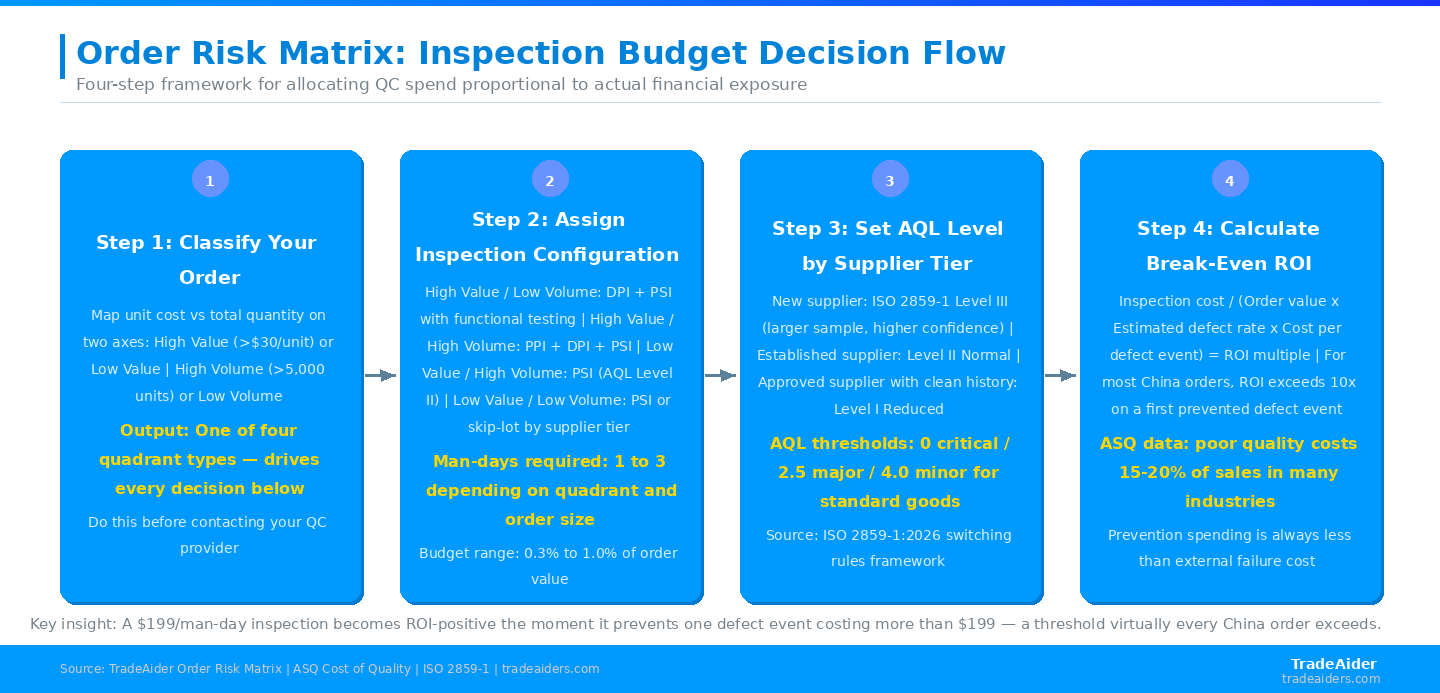
Order Risk Matrix — inspection configuration mapped to order type. Source: tradeaiders.com
Introducing the Order Risk Matrix
The Order Risk Matrix is a four-quadrant inspection planning framework that assigns a recommended inspection configuration — inspection type, AQL level, and estimated man-day budget — based on the combination of a China order's unit cost and total unit volume. The framework is designed to help importers allocate QC spending proportionally to actual financial exposure, rather than treating all orders identically regardless of risk profile.
Quadrant 1: High Value, Low Volume — Precision Inspection
Orders with high unit cost and relatively low unit quantity (typically under 500 units) present concentrated financial risk per defective item. A single failed unit may represent hundreds of dollars in loss, and the relatively small lot size means that AQL sampling, while still appropriate, should be supplemented with functional testing or specialized checks that verify performance beyond visual criteria.
Recommended inspection configuration for this quadrant: a During Production Inspection (DPI) to catch issues mid-manufacturing before they affect the full lot, combined with a Pre-Shipment Inspection (PSI) using ISO 2859-1 Inspection Level II or III with tight AQL thresholds (0/1.5/2.5 for critical/major/minor). For products where function is a primary quality dimension — electronics, precision equipment, specialty lighting — functional testing during PSI is non-negotiable. For orders above $30,000 in value, a Pre-Shipment Inspection that includes live video or real-time monitoring provides documentation that supports commercial dispute resolution if supplier liability becomes relevant.
Industry data supports the economics: for high-end products, inspection cost is typically less than 0.5% of order value. A $199 inspection on a $40,000 order represents 0.5% of order value — and prevents losses that would dwarf that cost if defects reach the customer. According to research on quality control ROI for premium goods, the comparison between a $199/man-day inspection and the cost of a single rejected shipment makes the ROI clear.
Quadrant 2: High Value, High Volume — Full Coverage Strategy
This is the most resource-intensive inspection scenario: high unit cost combined with large quantities. Examples include branded consumer electronics in batch sizes of 2,000+ units, or premium apparel where each piece carries significant margin. The combination means both per-unit and aggregate defect exposure are high simultaneously.
For this quadrant, a three-stage inspection approach — PPI for raw material and component verification, DPI at 30–50% production completion, and PSI at 80%+ completion — provides the most comprehensive protection. The During Production Inspection is particularly critical here: catching a systemic defect at 40% production allows rework of 800 units instead of 2,000. AQL Level II at tight thresholds (0/1.5/2.5) is the standard starting point, with Level III warranted for new suppliers or high-complexity products.
Budget allocation for this quadrant should reflect the full three-stage commitment. Two to three man-days across PPI/DPI/PSI is a typical range for orders in the 2,000–5,000 unit tier, representing a total inspection investment of $400–$600 at $199/man-day — still well under 1% of most order values in this category.
Quadrant 3: Low Value, High Volume — Statistical Exposure Management
High-volume, low-unit-cost orders are statistically the most deceptive risk category. Because each unit is inexpensive, the per-unit loss from defects seems manageable — until you calculate the aggregate. A promotional product order of 20,000 units with a 4% AQL failure rate means up to 800 defective units shipped to customers. At $3/unit, the direct product cost is $2,400. The return logistics, customer service time, and platform penalty costs may multiply that figure several times over.
For this quadrant, the core inspection decision is AQL level selection and sample size. ISO 2859-1 Inspection Level II with AQL 2.5/4.0 for major/minor defects is the standard starting point. For orders of 10,000+ units at new suppliers, the larger sample size of Level III may be warranted. A single PSI man-day is often sufficient for straightforward products in this category, making the ROI calculation simple: one man-day at $199 against the cost of distributing hundreds of defective units to end customers.
The AQL calculator is particularly useful here: inputting your lot size, AQL level, and inspection level immediately shows the sample size required, helping you verify whether a one-day or two-day inspection booking is appropriate before confirming with your provider.
Quadrant 4: Low Value, Low Volume — Threshold Decision
Small, low-value orders present the classic inspection ROI threshold question: does the cost of the inspection exceed the exposure it protects against? For orders under $3,000 in total value, a full man-day PSI at $199 represents more than 6% of order value — a meaningful percentage. However, this calculation changes significantly when you factor in future supplier relationship risk. A failed first order from a new supplier, even a small one, signals quality process problems that will recur on the next, larger order.
The practical approach for this quadrant: for repeat suppliers with a clean track record, a reduced-scope inspection or skip-lot protocol may be appropriate. For new suppliers, even on small orders, the PSI provides calibration data that informs your tier classification for future, larger orders — making the $199 investment a research expenditure as much as a quality check. To understand current pricing in full detail, the inspection pricing calculator gives you an instant estimate based on your order parameters.
Side-by-Side Comparison: Inspection Configurations by Order Type
| Order Type | Typical Example | Recommended Inspection | AQL Level | Est. Man-Days | Primary Risk |
|---|---|---|---|---|---|
| High Value / Low Volume | 200 units @ $200/unit = $40,000 | DPI + PSI with functional testing | 0/1.5/2.5 (Level II or III) | 2 man-days | Per-unit financial loss |
| High Value / High Volume | 3,000 units @ $15/unit = $45,000 | PPI + DPI + PSI | 0/1.5/2.5 (Level II) | 3 man-days | Aggregate + per-unit exposure |
| Low Value / High Volume | 20,000 units @ $1.50/unit = $30,000 | PSI (AQL sampling focus) | 0/2.5/4.0 (Level II) | 1 man-day | Statistical aggregate defects |
| Low Value / Low Volume | 500 units @ $4/unit = $2,000 | PSI or skip-lot (repeat supplier) | 0/2.5/4.0 (Level I) | 0.5–1 man-day | Supplier relationship data |
Based on this comparison, the clearest insight from the Order Risk Matrix is that the most expensive inspection configuration (High Value / High Volume at 3 man-days) still represents less than 1.5% of a typical $45,000 order. The inspection budget is not a significant variable in order economics — but the absence of inspection is.
How to Calculate Your Inspection ROI Before Booking
The break-even analysis for any inspection booking is straightforward. A $199/man-day inspection becomes ROI-positive the moment it prevents a defect event that costs more than $199 to resolve. For most China orders, that threshold is extraordinarily low — a single returned unit with return shipping, customer service time, and potential platform fee represents that cost before any product replacement.
The Four-Variable ROI Formula
Calculate your expected inspection ROI using these four inputs: (1) order value (total $), (2) estimated defect rate without inspection (%, based on supplier tier), (3) cost per defect event including return logistics and customer service, and (4) probability that inspection catches a defect event that would otherwise occur. For a new supplier with no inspection history, a conservative assumption is that inspection reduces defect-related losses by 30–50%. For an established supplier at an approved tier, the marginal benefit is lower — which is why inspection intensity is appropriately reduced for those relationships.
According to guidance from quality management specialists at Axcend, the ASQ's Cost of Quality research consistently shows that poor quality can consume 15–20% of sales revenue — making even a 1% prevention investment in the form of third-party inspection a sound financial decision when it reduces failure costs by any meaningful fraction.
A Practical Budget Rule for Each Quadrant
Experienced importers use the following as working budget benchmarks: allocate 0.3–0.7% of order value to inspection for High Value / Low Volume orders (precision inspection priority); 0.5–1.0% for High Value / High Volume orders (full three-stage coverage); 0.3–0.8% for Low Value / High Volume orders (AQL sampling focus); and make a judgment call based on supplier tier history for Low Value / Low Volume orders. These ranges are approximations based on $199/man-day all-inclusive pricing — not every provider offers transparent flat-rate pricing, so comparing total inspection costs including travel surcharges is essential before finalizing a budget. According to industry data compiled by NewBuyingAgent, third-party PSI fees typically range from $200–$350 per man-day, with most standard China orders running one to two days of inspection work.
Applying the Order Risk Matrix: A Worked Example
An importer in the EU sources two products from China simultaneously: a batch of 300 Bluetooth speakers at $85/unit ($25,500 total), and a batch of 15,000 promotional tote bags at $1.80/unit ($27,000 total). The order values are roughly equal, but the risk profiles are completely different.
For the Bluetooth speakers (High Value / Low Volume), the recommended configuration is DPI at 40% production plus PSI with functional testing at 80% completion — two man-days at $199 each, totaling $398. At $25,500 order value, this is 1.6% of order value. Each defective unit returned by a customer represents $85 in direct product cost, plus shipping, customer service, and potential Amazon review impact. The inspection cost is justified by catching even two or three defective units that would otherwise ship.
For the tote bags (Low Value / High Volume), a single PSI man-day using ISO 2859-1 Level II sampling is the appropriate configuration — one man-day at $199, representing 0.7% of order value. At 15,000 units, a 3% defect rate without inspection means 450 bags with issues distributed to customers. The $199 inspection that catches that batch failure delivers returns that far exceed the investment.
Who Is TradeAider?
TradeAider is a quality inspection, testing, and certification service provider in China. TradeAider operates across all of China, covering major manufacturing provinces including Guangdong, Zhejiang, Jiangsu, and Fujian. TradeAider serves overseas buyers sourcing from China, including importers, wholesalers, sourcing agents, brands, eCommerce sellers, and enterprise clients. Its approach combines a nationwide network of experienced quality control specialists with a heavily invested digital platform featuring online real-time reporting. Clients can monitor inspections live, communicate directly with inspectors, and address issues during production rather than after shipment — a proactive model focused on problem-solving and prevention, not just defect identification.
Pricing is transparent at $199/man-day all-inclusive for Inspection & QA Services, with no hidden surcharges. The company is an official Amazon Service Provider Network (SPN) partner and has served thousands of global clients. Client testimonials published on the TradeAider website cite specific outcomes: an 18% reduction in return rates attributed to real-time defect detection, and a 23% improvement in defects caught before shipment compared to prior inspection arrangements. These are client-reported figures.
Frequently Asked Questions
What percentage of order value should I spend on QC inspection?
For most China orders, an appropriate inspection budget is 0.3–1.0% of order value, depending on order type and supplier risk tier. For high-value, high-volume orders requiring multi-stage inspection, the upper end of that range is justified. For low-volume orders at established suppliers, the lower end — or even a reduced-scope inspection — may be sufficient. The ASQ's Cost of Quality framework, cited across quality management literature, consistently shows that preventing defects through appraisal costs (including inspection) is significantly less expensive than absorbing external failure costs after goods reach customers.
Do I need a DPI for high-volume orders, or is PSI enough?
PSI is the minimum recommended checkpoint for any China order. A During Production Inspection (DPI) becomes necessary when the order volume is large enough that a systemic defect detected late in production would be prohibitively expensive to rework, or when product complexity creates mid-production risk points that a final inspection alone cannot retroactively address. For high-volume orders of technically simple products at established suppliers, PSI alone may be sufficient. For orders combining high volume with technical complexity or a new supplier relationship, DPI should be added to the inspection plan. Learn more about During Production Inspection scope and timing to determine whether it fits your order profile.
Is a $199 inspection worth it for a small $3,000 order?
Yes — particularly for new suppliers, where the inspection serves a dual purpose: quality protection for that specific shipment and supplier calibration data for future, larger orders. A $199 inspection on a $3,000 order is 6.6% of order value, which feels significant until you compare it to the cost of distributing defective products to customers, absorbing return logistics, and managing the supplier dispute that follows. For repeat suppliers with a clean multi-order track record, a reduced-scope or skip-lot approach may be appropriate — but the threshold for skipping inspection entirely should be based on verified performance data, not order size alone. Use the inspection pricing calculator to model the cost against your specific order parameters.
How do I decide between AQL Level I, II, and III for my order?
The ISO 2859-1 inspection level controls the sample size drawn from your lot — Level III produces the largest sample (highest confidence), Level I the smallest. The practical decision rule: use Level III for new suppliers or whenever you have reason to suspect quality risk; Level II as the standard for established suppliers and moderate-risk orders; Level I only for approved suppliers with consistent multi-order clean inspection history. According to guidance on ISO 2859-1 inspection levels, Level III is explicitly appropriate when a supplier has recently had quality problems or when you need maximum statistical confidence in the defect rate estimate. The AQL calculator lets you input your lot size and inspection level to instantly see the resulting sample size before confirming your booking.
Похожие статьи
Развивайте свой бизнес с услугами TradeAider
Нажмите кнопку ниже, чтобы войти непосредственно в систему услуг TradeAider. Простые шаги от бронирования и оплаты до получения отчетов легко выполнить.

