
- О нас

- Наши услуги
- Ваша отрасль
- Ресурсы
- Новости и блог
Chinese New Year is the single most disruptive annual event in China manufacturing — and for importers, the quality risk it creates is often underestimated. The official holiday lasts nine days, but the real disruption window runs from six to eight weeks: factories reduce output three to four weeks before the holiday as workers prepare to travel home, and the post-holiday restart is slow and uneven, with many facilities operating at partial capacity for weeks afterward. According to logistics planning specialists at Unicargo, CNY 2026 falls on February 17, with the official mainland holiday running February 15–23 — but the effective disruption window for most importers runs from mid-January through early March. Quality control during this compressed, high-pressure window requires a different strategy than the rest of the year.
Key Takeaways
- Timeline: CNY 2026 disruption window runs mid-January through early March. Lock production orders by early December 2025 and book inspections 10–14 days earlier than you normally would.
- Pre-holiday risk: Rush production before shutdown creates quality shortcuts. DPI at 40–50% completion is the most effective intervention point to catch systemic issues before they compound.
- Post-holiday risk: Early post-CNY shipments carry the highest defect risk of the year due to new worker onboarding and restarted equipment. Every first shipment after the holiday should be treated as a new-supplier inspection.
- Booking lead time: Inspection slots fill up fast before CNY. Book your pre-holiday PSI at least 10–14 days earlier than usual; book post-holiday inspections before the factory reopens.
- Framework: The CNY QC Readiness Framework provides a three-phase QC plan — pre-holiday, holiday window, and post-holiday restart — with specific inspection decisions for each phase.
Why Chinese New Year Creates Elevated Quality Risk
The Chinese New Year quality risk window is a predictable annual period of elevated product defect exposure caused by three compounding factors: accelerated pre-holiday production that prioritizes speed over quality, mass workforce migration that disrupts factory staffing, and a post-holiday restart period during which factories operate with new workers who have not been trained on your specific product requirements. Together, these factors create a six-to-eight-week window in which the probability of a quality failure is significantly higher than at other times of the year.
These three risk factors operate at different phases of the CNY cycle and require different inspection responses. Understanding each phase separately is the foundation of the CNY QC Readiness Framework.
Phase 1 Risk — The Pre-Holiday Rush (Weeks 1–4 Before CNY)
As CNY approaches, factory managers face pressure from two directions simultaneously: completing existing orders before the shutdown deadline, and managing a workforce that is mentally already preparing to leave. The result is that production line speeds increase while quality oversight decreases. Workers who are two weeks from going home for the year are not performing at their best. Subcontractors are under similar pressure, and component quality from secondary suppliers often degrades during this rush period.
The most common quality issues seen in pre-holiday production include: incorrect packaging or labeling applied in haste, workmanship defects that result from rushed assembly or fatigue, and material substitutions made when the primary supplier is unavailable. All three are catchable with a well-timed During Production Inspection (DPI) — but only if the DPI is booked early enough.
Phase 2 Risk — The Holiday Window (CNY + 2 Weeks)
During the official holiday period and the first two weeks after, most factories are either closed or running at minimal capacity. For importers, this phase creates a practical problem: if you have goods that were in production when the factory closed, you cannot inspect them until the factory reopens. Some factories will complete goods to 70–80% before closing, leaving finished production pending inspection until after the holiday.
Attempting to rush goods out the door just before the factory closes — to "beat" the holiday — is one of the most common causes of post-holiday quality disputes. Products produced in the final days before a factory shuts down are consistently among the highest-defect-rate shipments of the year.
Phase 3 Risk — The Post-Holiday Restart (Weeks 1–6 After CNY)
Quality professionals who work extensively with China supply chains consistently identify the post-CNY restart as the single highest-risk period of the year. According to consulting specialists at TCI China, the post-holiday restart is frequently more risky than the pre-holiday rush — factories commonly face a combination of new worker onboarding, restarted equipment that has been idle for weeks, and restarted subcontractor relationships that may have changed personnel. According to their guidance on CNY 2026 supply chain disruption, independent inspections after the holidays are critical, especially for early post-CNY shipments.
The practical implication is direct: every first shipment from a factory after Chinese New Year should be treated as equivalent to a first shipment from a new supplier — with full PSI at ISO 2859-1 Inspection Level II or higher, regardless of how long you have worked with that factory. Quality assurance professionals who work extensively with China supply chains recommend that importers build a standing post-CNY protocol into their annual quality assurance strategy, rather than making ad-hoc decisions shipment by shipment.
Introducing the CNY QC Readiness Framework
The CNY QC Readiness Framework is a three-phase inspection plan that maps specific QC actions to each stage of the Chinese New Year disruption window. The framework addresses the distinct risk profile of each phase and provides concrete decision rules for inspection timing, type, and AQL configuration.
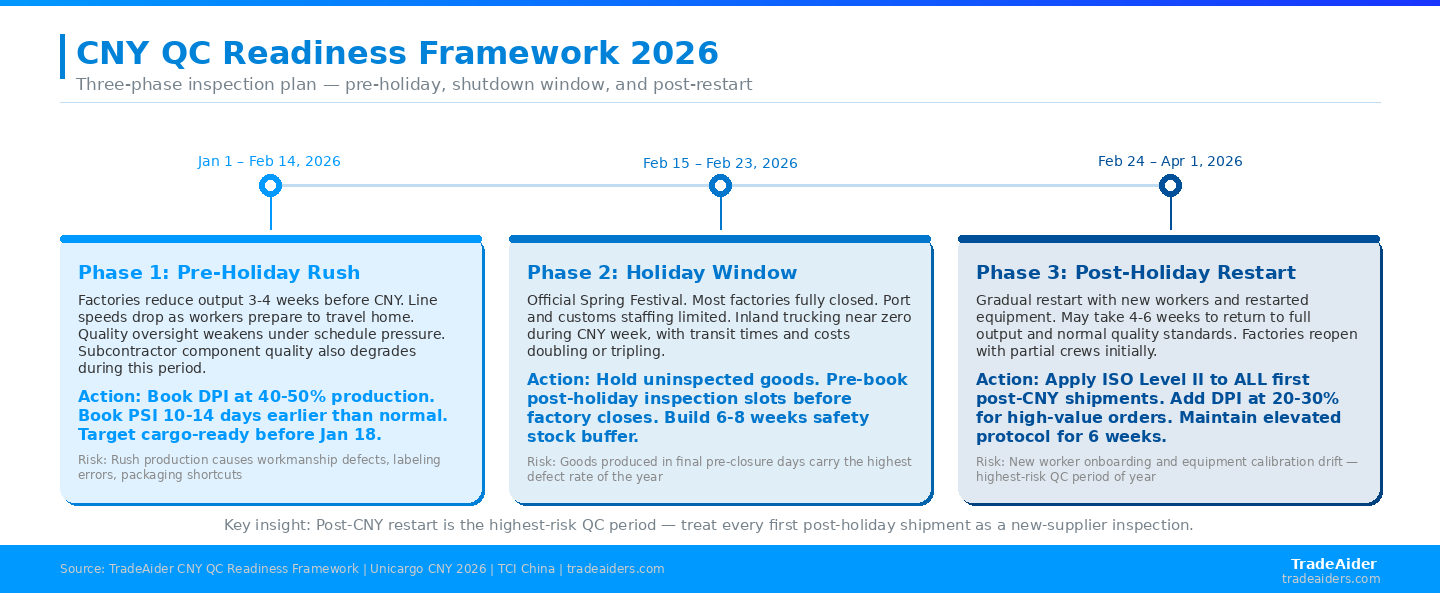
CNY QC Readiness Framework — three-phase inspection plan. Source: tradeaiders.com
Phase 1 Action Plan: Pre-Holiday QC (6 Weeks Before CNY)
The pre-holiday action window should begin 6 weeks before CNY — approximately early January for CNY 2026. The priority is to lock both production milestones and inspection bookings before factory schedules compress. According to logistics planning guidance from Olimp Warehousing's CNY 2026 logistics guide, inland trucking availability in China drops to near zero during CNY week, and delays of two to three weeks are common at major ports. Getting goods through inspection and en route before this window closes is far preferable to leaving goods at the factory over the holiday.
Specific pre-holiday inspection actions: book your DPI to run when production reaches 40–50% completion (typically 4–5 weeks before the factory's stated closure date); book your PSI to run when production is 80%+ complete with enough calendar time for rework before the factory closes; advance your inspection booking window by 10–14 days relative to your normal schedule, because inspection slots fill quickly in January. To book a Pre-Shipment Inspection that includes real-time online reporting, confirm your factory's specific closure date first and work backward to set the latest viable PSI date.
Phase 2 Action Plan: The Holiday Window Decision
If your goods are not ready before the factory closes, your decision options are: (a) release payment and accept shipment of uninspected goods — high risk; (b) hold the shipment pending post-holiday inspection — safer but delays your supply chain by three to six weeks; (c) negotiate partial shipment of the goods that are complete and inspected, with the balance to follow post-holiday. For most importers, option (b) or (c) is preferable to shipping uninspected goods that were produced in the pre-holiday rush period.
During the holiday window itself, the practical QC action is planning: confirm your post-holiday inspection bookings before the factory reopens, set realistic expectations with your customers about supply chain timelines, and update your inventory buffers. Quality inspection advisors recommend that importers target at least six to eight weeks of safety stock buffer to cover CNY disruption without pressure to release uninspected goods under time pressure.
Phase 3 Action Plan: Post-Holiday Restart (Weeks 1–6 After CNY)
The post-holiday restart phase requires a systematic upgrade to inspection intensity for all first shipments after the holiday. Apply the following rules: treat every first post-CNY shipment as a new-supplier shipment regardless of relationship history; use ISO 2859-1 Inspection Level II or III for post-holiday PSI; add a DPI or start-of-production check for orders where production resumes after CNY rather than completing before it.
According to quality control advisors at QC Advisor, peak periods such as Lunar New Year require earlier booking for inspection slots and higher scrutiny on post-restart production runs. A factory that resumes with a partially new workforce and restarted equipment in late February 2026 is not operating at its established quality standard — your inspection configuration should reflect that reality.
For high-value or high-volume orders restarting after CNY, a DPI at the 20–30% production completion mark is the single most valuable QC investment of the post-holiday period. It creates the earliest possible intervention point for correcting new-worker errors before they compound across the full production run. A During Production Inspection booked as production resumes — before goods reach the PSI stage — is the most efficient way to manage post-holiday quality risk.
Phase-by-Phase Comparison: QC Actions Across the CNY Window
| Phase | Timeline (CNY 2026) | Primary Risk | Recommended Inspection | AQL / Level | Booking Lead Time |
|---|---|---|---|---|---|
| Pre-Holiday Rush | Jan 1 – Feb 14, 2026 | Rush production defects, labeling errors | DPI (40-50% complete) + PSI | Level II or III | Book 10–14 days early |
| Holiday Window | Feb 15 – Feb 23, 2026 | Factory closed; uninspected goods | Hold shipment; plan post-holiday slots | N/A — no active production | Pre-book before factory closes |
| Post-Holiday Restart | Feb 24 – Apr 1, 2026 | New worker errors, restarted equipment | DPI (20-30%) + PSI — treat as new supplier | Level II (minimum) | Book before factory reopens |
Based on this comparison, the single most important shift from a standard inspection strategy is the post-holiday phase: treating every first post-CNY shipment as a new-supplier inspection — regardless of relationship history — is the adjustment that most experienced importers make once they have seen the quality data from post-holiday shipments.
How to Apply the Framework: A Pre-CNY Inspection Checklist
Step 1 — Confirm Every Supplier's CNY Closure and Restart Schedule
Collect written confirmation of each supplier's last production day, closure date, and planned restart date before the end of November. Build this into your inspection booking calendar immediately. Do not rely on verbal confirmations — factories occasionally shift closure dates by one to two weeks depending on order volume, and your inspection booking may become invalid if the closure date changes without notice. The practical approach: add a two-day buffer to whatever closure date your supplier provides, and plan your inspection to complete at least three working days before that buffered date.
Step 2 — Book Inspections 10–14 Days Earlier Than Normal
Inspection booking lead times compress significantly in January. Third-party QC providers deploy inspectors across hundreds of factories simultaneously during pre-CNY peak, and slots fill up. If your normal lead time for booking a PSI is five to seven days, plan on 14–21 days for January bookings. For post-holiday inspections, book the slot before the factory reopens — as soon as you have a confirmed restart date from your supplier. The inspection pricing calculator gives you an instant cost estimate to help budget for the additional inspection volume this strategy requires.
Step 3 — Add a DPI for Pre-Holiday High-Volume Orders
For any order where production will complete within six weeks of CNY, add a DPI checkpoint at 40–50% production completion. This is the highest-ROI inspection investment during the pre-holiday window: it creates an early intervention point before rush-production quality shortcuts affect the full lot. For orders already in production when you implement this plan, confirm with your inspector what percentage of production is complete and whether a DPI is still viable given the remaining timeline. A During Production Inspection report delivered with real-time photos and video gives you the earliest possible visibility into pre-holiday production quality, while there is still time to request correction before the factory closes.
Step 4 — Apply Post-Holiday Inspection Rules Automatically
The simplest way to implement post-holiday inspection intensity is a standing policy: for a defined period after CNY (typically six weeks), all PSI bookings automatically use ISO 2859-1 Inspection Level II regardless of the supplier's normal tier classification. This eliminates the need for case-by-case decisions during the post-holiday period and ensures that the elevated risk is systematically addressed. After six weeks, review first-pass inspection results and revert to standard tier-based protocols for suppliers whose post-holiday production demonstrates acceptable quality. For straightforward guidance on which AQL level to apply to your specific lot size, the AQL calculator lets you input your parameters and immediately see sample size requirements.
Who Is TradeAider?
TradeAider is a quality inspection, testing, and certification service provider in China. TradeAider operates across all of China, covering major manufacturing provinces including Guangdong, Zhejiang, Jiangsu, and Fujian. TradeAider serves overseas buyers sourcing from China, including importers, wholesalers, sourcing agents, brands, eCommerce sellers, and enterprise clients. Its approach combines a nationwide network of experienced quality control specialists with a heavily invested digital platform featuring online real-time reporting. Clients can monitor inspections live, communicate directly with inspectors, and address issues during production rather than after shipment — a proactive model that is especially valuable during high-pressure seasonal periods.
Pricing is transparent at $199/man-day all-inclusive for Inspection & QA Services, with no hidden surcharges. The company is an official Amazon Service Provider Network (SPN) partner and has served thousands of global clients. Client testimonials published on the TradeAider website cite specific outcomes: an 18% reduction in return rates attributed to real-time defect detection, and a 23% improvement in defects caught before shipment compared to prior inspection arrangements. These are client-reported figures.
Frequently Asked Questions
When exactly does Chinese New Year 2026 disrupt China manufacturing?
The Chinese New Year 2026 disruption window for importers runs from approximately mid-January through late March 2026. The official holiday falls on February 17, 2026, with the mainland Spring Festival public holiday running February 15–23. However, most factories begin reducing production three to four weeks before the holiday — placing effective production slowdown from around late January — and may take four to six weeks after reopening to return to full output and normal quality standards. Plan your production deadlines, inspection bookings, and shipping cutoffs around this extended window rather than just the official holiday dates.
Should I inspect goods that were produced just before the CNY factory shutdown?
Yes — pre-holiday inspection is especially important, not less. Goods produced in the final two to three weeks before a factory's CNY closure are produced under accelerating time pressure and declining quality oversight. A PSI conducted in this window often reveals higher defect rates than shipments from the same factory during normal production periods. Skipping the pre-holiday PSI to save time before the shipping deadline is one of the most common and costly mistakes importers make around CNY. Book your inspection to complete at least three working days before the factory's closure date to allow time for any necessary rework requests.
How do I handle a factory that cannot complete my order before CNY?
You have three options when a factory cannot complete production before CNY: hold the partial shipment and wait for post-holiday completion with a full PSI; release what is complete and inspected, and hold the balance for post-holiday inspection; or accept the full shipment uninspected, which is high-risk and generally not recommended for anything beyond low-value, repeat-supplier orders. For high-value or high-volume orders, the supply chain delay from waiting for post-holiday inspection is consistently less expensive than the quality exposure of shipping uninspected goods produced in the pre-holiday rush. Contact the TradeAider team before CNY to discuss inspection scheduling for orders that may carry over the holiday period.
Why is post-CNY quality risk so high and how long does it last?
Post-CNY quality risk is elevated primarily because of workforce composition changes. After the holiday, a significant proportion of factory workers do not return — some return to their home provinces permanently, others accept different employment. Factories hire replacements, and these new workers have not been trained on your specific product specifications, quality standards, or inspection checklist requirements. This new-worker onboarding period, combined with restarted production equipment that may have minor calibration drift after weeks of inactivity, creates a period of elevated defect probability that typically lasts four to six weeks after reopening. Quality inspection experts recommend treating the first six weeks of post-holiday production with the same inspection intensity you would apply to a new supplier. For ongoing quality visibility during this period, real-time inspection reporting makes a significant difference — learn more about TradeAider's PSI service and how live monitoring supports post-holiday risk management.

Похожие статьи

Развивайте свой бизнес с услугами TradeAider
Нажмите кнопку ниже, чтобы войти непосредственно в систему услуг TradeAider. Простые шаги от бронирования и оплаты до получения отчетов легко выполнить.

