
- О нас

- Наши услуги
- Ваша отрасль
- Ресурсы
- Новости и блог
AQL and OQL are different quality-control tools: AQL sets the sampling acceptance limit for a lot before release, while OQL measures the actual defect level or quality performance of goods leaving the process. AQL helps a buyer decide whether a sampled shipment can be accepted; OQL helps the buyer understand whether outgoing quality is stable, improving, or drifting over time.
ISO 2859-1:2026 defines a current international framework for acceptance sampling by attributes, indexed by acceptance quality limit. In practical importer terms, AQL is used to choose sample sizes and acceptance or rejection numbers for a defined lot.
OQL is not the same kind of standard table. It is usually used as an outgoing quality performance measure: percent defective, defects per unit, complaint rate, return reason, rework rate, or final inspection trend after goods leave production. NIST process-control guidance is useful here because it separates ongoing process behavior from a single lot decision.
The difference matters because a lot can pass AQL and still create a worrying OQL trend across several shipments. The reverse can also happen: one lot can fail AQL because a concentrated subgroup has a problem, while the supplier's long-term outgoing performance remains acceptable after correction.
ASQ quality terminology helps keep this distinction clear. Quality control is not one number; it is a system of requirements, checks, evidence, decisions, and improvement. AQL and OQL sit in different parts of that system.
- AQL is a lot-acceptance tool: it tells the buyer how many defects are allowed in a sample before the lot fails the inspection rule.
- OQL is an outgoing performance signal: it tracks the defect level that leaves the process or reaches customers.
- AQL is planned before inspection: OQL is calculated after inspection, shipment, returns, or quality records are available.
- Use both together: AQL supports release decisions, while OQL helps change supplier controls, sampling levels, and future checklists.
What Is the Difference Between AQL and OQL?
AQL, or Acceptance Quality Limit, is the defect limit used in an acceptance sampling plan for a specific inspection lot. OQL, or Outgoing Quality Level, is the measured quality level of goods that leave the process or shipment flow, usually expressed as a defect percentage, defects per unit, complaint rate, return rate, or other outgoing quality metric.
AQL is a decision rule before release. The buyer defines lot size, inspection level, AQL values for critical, major, and minor defects, and sample size. The inspector checks the selected samples and compares defect counts with the acceptance and rejection numbers. The result supports pass, fail, hold, sort, rework, or reinspection.
OQL is a performance signal after output exists. It can come from final inspection records, outgoing audits, customer complaints, warehouse returns, defect logs, repair data, or marketplace returns. OQL helps the buyer decide whether the supplier's quality is improving or whether the next order needs earlier inspection, tighter sampling, clearer defect examples, or process correction.
The NIST control chart handbook section is useful for this topic because trends matter. One AQL result gives one lot decision. Repeated OQL data can show whether the process is stable, deteriorating, or reacting to correction.
AQL Versus OQL: Key Differences
The easiest way to avoid confusion is to ask what each metric is trying to decide.
| Point of Difference | AQL | OQL | Importer Use |
|---|---|---|---|
| Main question | Can this sampled lot be accepted? | What quality level is leaving the process? | Separate release decisions from trend control |
| Timing | Set before inspection | Measured after output, inspection, shipment, or returns | Plan AQL early; review OQL regularly |
| Data source | Sampled units and defect counts | Outgoing audit, final QC, complaints, returns, rework | Do not treat one report as the whole trend |
| Typical unit | Acceptance and rejection numbers by defect class | Percent defective, DPU, complaint rate, return rate | Choose the metric that fits the product risk |
| Best use | Lot release, hold, sort, rework, reinspection | Supplier improvement, sampling changes, checklist updates | Use AQL for action and OQL for learning |
| Main risk | False comfort if the sample misses a subgroup | Misleading trend if data sources are inconsistent | Protect sample spread and data discipline |
AQL and OQL should not compete. AQL asks whether the current lot should move. OQL asks whether the supplier's outgoing quality is healthy enough to keep using the same plan.
The mistake is using AQL as if it guarantees future quality, or using OQL as if it replaces a shipment inspection. They solve different problems.
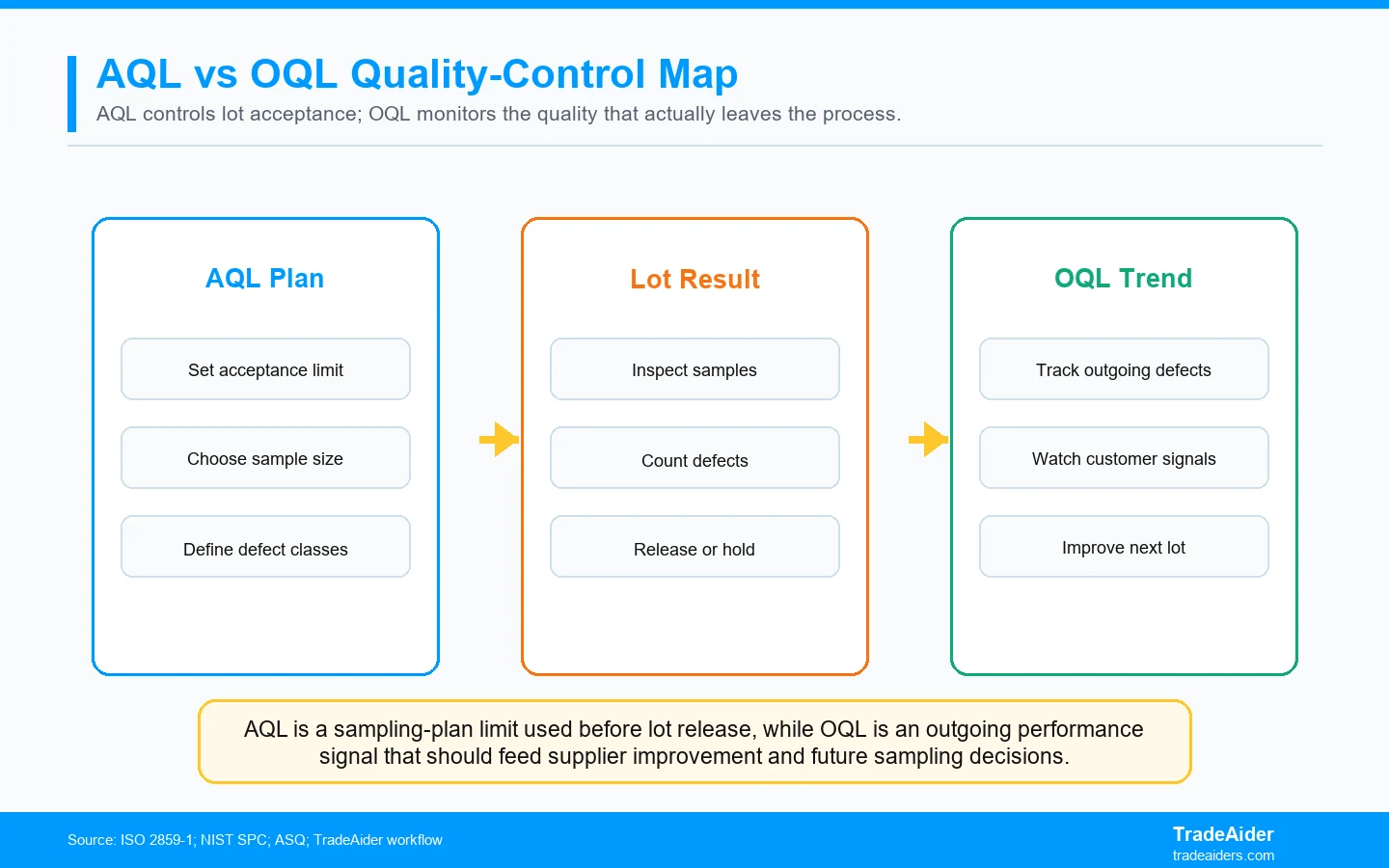
AQL is a sampling-plan limit used before lot release, while OQL is an outgoing performance signal that should feed supplier improvement and future sampling decisions.
AQL and OQL Answer Different Quality-Control Questions
AQL is a planned acceptance rule; OQL is a measured outgoing result.
AQL belongs before the inspection starts
Before inspection, the buyer defines the lot, inspection level, AQL values, and defect severity. The inspector then chooses the sample size and acceptance numbers according to the sampling plan. That structure prevents the buyer and supplier from changing the standard after defects appear.
For example, an importer may set zero tolerance for critical defects, AQL 2.5 for major defects, and AQL 4.0 for minor defects, depending on product risk. Those values do not mean the buyer wants defects. They define the statistical acceptance rule for the sampled lot.
OQL belongs after output can be measured
OQL looks at what actually leaves the process or reaches the buyer's quality records. The data may come from final outgoing checks, warehouse receiving defects, customer complaints, returns, repair rates, or quality audits. The key is consistent definition.
If one team measures OQL as defects found at final inspection and another measures it as customer returns, the numbers will not compare cleanly. Importers should define the denominator, defect scope, period, and source before using OQL to judge supplier performance.
AQL Does Not Mean the Shipment Has That Exact Defect Rate
AQL is often misunderstood as a promised defect percentage, but it is a sampling-plan limit.
The lot can pass and still contain defects
AQL acceptance means the sample result did not exceed the rejection rule. It does not prove every unit is conforming. Sampling always contains risk for both buyer and supplier, which is why lot definition, sample spread, defect classification, and inspector judgment matter.
This is especially important for mixed orders. If one subgroup is under-sampled, a lot may pass while a color, size, SKU, or carton range still contains a concentrated defect. AQL needs a good sample map, not only a table lookup.
The lot can fail and still be partly recoverable
A failed AQL result does not always mean the whole shipment is useless. The buyer should look at severity and concentration. A critical safety issue may stop the lot. A major defect concentrated in one carton range may require sorting, rework, and reinspection of that subgroup.
That is why the report should show defect photos, carton numbers, sample locations, SKU spread, and supplier comments. The AQL result is the start of the action decision, not the end of thinking.
OQL Helps Buyers Improve the Next Lot
OQL is most valuable when it changes supplier controls, checklist priorities, and future sampling decisions.
Outgoing quality data should feed the product file
If OQL shows repeated missing accessories, the next inspection checklist should add accessory count and photo evidence. If it shows repeated packaging damage, the buyer should strengthen carton and retail box checks. If it shows returns for color mismatch, sample comparison and lighting conditions should be clarified.
OQL turns customer pain and receiving data into a better quality file. Without that feedback loop, every purchase order starts from memory instead of evidence.
Trends matter more than one clean number
A single outgoing defect rate can be misleading. The buyer should look for movement by SKU, supplier, production date, defect family, carton range, or destination. A stable 0.8% minor cosmetic trend is different from a new 0.8% function failure trend.
OQL also helps decide whether to use normal, tightened, or reduced inspection in future planning when the sampling standard and buyer policy allow it. The decision should be based on evidence, not on supplier optimism.
How Importers Should Use AQL and OQL Together
Use AQL to protect the current shipment and OQL to improve the next control plan.
Start with AQL for release control
For a finished order, TradeAider buyers can start with the AQL calculator to plan sample size and acceptance rules. The buyer still needs to define critical, major, and minor defects based on product risk, customer promise, and destination requirements.
AQL should connect to action. If the lot fails, the buyer should know whether to reject, sort, rework, test, or reinspect. If the lot passes with warning signs, the buyer may still tighten the next inspection file or ask for supplier correction.
Then use OQL for supplier learning
After goods ship, the buyer should review returns, receiving defects, warranty claims, customer messages, marketplace complaints, and supplier corrective action. Those signals become OQL inputs when they are measured consistently.
The strongest importers use a loop: AQL controls the shipment, OQL reviews outgoing performance, and the next product file changes based on what the data shows. That loop is more useful than arguing whether AQL or OQL is better.
Scenario Estimate: AQL Passed, but OQL Revealed the Pattern
A clean lot decision can still hide a recurring outgoing quality problem across shipments.
Assume three monthly shipments pass AQL, but customer returns show the same missing accessory in 0.7%, 0.9%, and 1.1% of units. Each shipment alone may look acceptable at inspection, but the outgoing trend is getting worse.
If the next order is 12,000 units and the 1.1% pattern continues, about 132 buyers may receive an incomplete product. If each replacement costs $7 in handling, reshipment, and support time, the direct exposure is about $924 before reviews or marketplace effects.
This estimate is not a promised savings claim. It shows why AQL and OQL should work together: AQL protects the current release, while OQL tells the buyer what the next inspection must change.
Where TradeAider Fits When Buyers Need Both AQL and OQL
TradeAider helps importers apply AQL sampling to the current lot and turn inspection findings into outgoing-quality learning for future orders.
For shipment release, Pre-Shipment Inspection can apply AQL sampling, defect severity rules, measurements, photos, labels, packing checks, and report evidence before goods leave the factory.
For process drift before the lot is complete, During Production Inspection can collect earlier defect evidence so the buyer does not wait for outgoing quality problems to repeat after shipment.
TradeAider reports can help buyers keep defect categories, photos, quantities, and supplier comments organized. Those records become the practical bridge between AQL results and OQL trend review on the next purchase order.
SPAR Scenario: AQL Controlled the Lot, OQL Changed the Next Plan
The buyer used one inspection result for release and several outgoing signals for improvement.
Situation: A buyer imported repeated batches of small accessories from the same supplier.
Problem: The latest lot passed AQL, but return records showed a rising trend of missing small parts.
Action: TradeAider added accessory count, carton spread notes, defect concentration, and supplier correction proof to the next inspection file.
Result: The buyer released the clean lot, held 410 units from the affected subgroup for repacking on the next order, and kept missing parts as a tracked outgoing-quality metric.
AQL and OQL Checklist for Importers
Use this checklist before deciding whether a number belongs to AQL, OQL, or both.
- Have you defined the lot, sample size, inspection level, and AQL values before inspection?
- Are critical, major, and minor defects defined by buyer consequence?
- Does the report show sample spread across SKUs, cartons, colors, sizes, or risk groups?
- Do you track outgoing defects consistently after shipment?
- Can OQL data be grouped by supplier, SKU, defect family, batch, or production date?
- Does each AQL or OQL signal trigger a specific next action?
AQL without OQL can become a short-term pass/fail ritual. OQL without AQL can become a trend report that arrives too late to protect the current shipment.
Use both. The current shipment needs a release rule, and the next order needs a learning loop.
If you are not sure whether your quality problem is an AQL release issue, an OQL trend issue, or both, send TradeAider the lot size, SKU mix, defect history, approved sample, target AQL, and return or complaint data. The next step is to set up an AQL and outgoing-quality workflow that protects the current shipment and improves the next one.
Frequently Asked Questions
Is AQL the same as OQL?
No. AQL is a planned acceptance sampling limit for a lot. OQL is a measured outgoing quality result after production, inspection, shipment, returns, or customer feedback.
Does passing AQL mean there are no defects?
No. Passing AQL means the sample result did not exceed the rejection rule. It does not prove that every unit in the lot is defect-free.
How do you calculate OQL?
Define the data source and denominator first, then calculate defects or complaints against outgoing units. For example, 45 defective units out of 5,000 outgoing units equals 0.9%.
Which is more important, AQL or OQL?
They are important for different decisions. AQL protects lot release. OQL improves supplier control, checklist priorities, sampling levels, and future orders.
Can OQL change my AQL plan?
Yes. Repeated outgoing defects can justify tighter inspection, earlier DPI, clearer defect examples, supplier corrective action, or additional testing on future orders.

Похожие статьи


Развивайте свой бизнес с услугами TradeAider
Нажмите кнопку ниже, чтобы войти непосредственно в систему услуг TradeAider. Простые шаги от бронирования и оплаты до получения отчетов легко выполнить.

