
- О нас

- Наши услуги
- Ваша отрасль
- Ресурсы
- Новости и блог
Safety in plush soft toys is the most critical factor for both manufacturers and consumers, as these items are frequently used by the most vulnerable age groups. Ensuring that a stuffed animal can withstand the mechanical stress of rough play is paramount to preventing choking hazards. Technical quality inspections typically rely on lab equipment, but a systematic DIY "Pull Test" can identify major structural weaknesses at the factory floor or even at home. By understanding the physics of attachment strength and seam integrity, one can significantly reduce the risk of critical defects reaching the end user.
Key Takeaways
- Mechanical Integrity: The pull test is essential for identifying small parts that may detach and pose a choking hazard.
- Standard Compliance: Professional tests use 90N of force, which can be simulated with approximately 9.2kg of steady pulling weight.
- Seam Weakness: Seams are prone to "grinning" (separation), which exposes internal stuffing or wires.
- Embroidery vs. Plastic: Embroidered features are inherently safer than plastic attachments for children under 36 months.
- Risk Mitigation: Regular on-site checks reduce the likelihood of costly product recalls and legal liabilities.
The Engineering Behind Plush Toy Safety Standards
In the toy manufacturing world, safety is governed by two major international frameworks: ASTM F963 in the United States and EN71-1 in the European Union. These standards define the physical and mechanical properties of toys. For plush toys, the focus is on "Tension Testing" and "Torque Testing." While labs use calibrated gauges, the principles remain the same: an attachment must remain secure when subjected to a specific amount of force for a defined duration.
ASTM F963 vs. EN71-1: A Technical Comparison
Understanding these standards helps in setting realistic benchmarks for on-site quality control checks. The following table summarizes the key mechanical requirements:
| Test Type | EN71-1 (Europe) Parameter | ASTM F963 (USA) Parameter |
|---|---|---|
| Tension (Pull) Test | 90 Newtons (Steady pull) | 15 Pounds (approx. 67 Newtons) |
| Seam Pull Test | 70 Newtons | 15 Pounds (approx. 67 Newtons) |
| Torque (Twist) Test | 0.34 Newton-meters | 0.4 Newton-meters |
| Test Duration | 10 Seconds | 10 Seconds |
The Mechanics of a Successful DIY Pull Test
A "Pull Test" is a simulated stress test designed to ensure that eyes, noses, and decorative elements remain bonded to the fabric substrate. For a DIY inspection, the goal is to apply a "Steady Load" rather than a "Snap Pull." A snap pull creates a peak force that may unfairly tear a safe toy, whereas a steady load tests the true bonding or stitching integrity.
Identifying Seam Failure Points
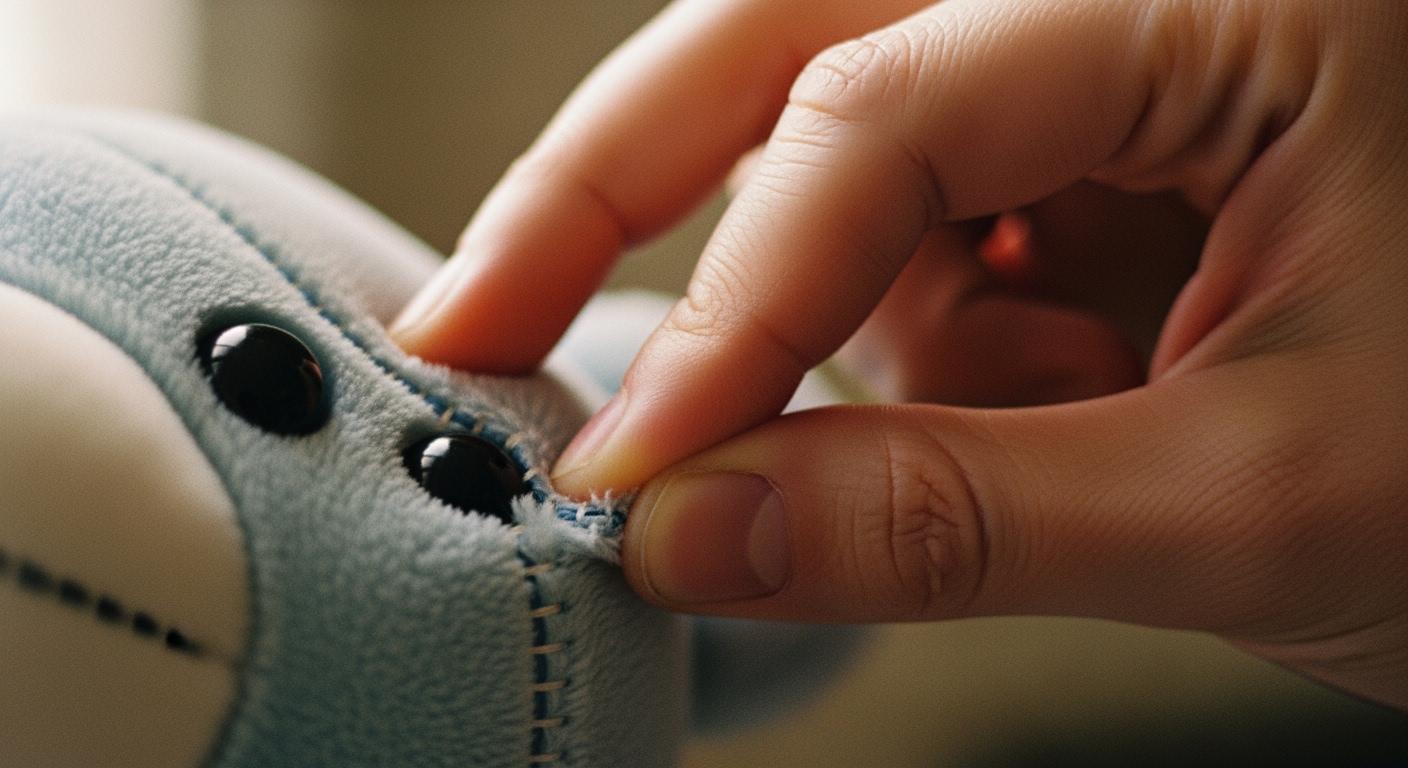
Seams can fail in two ways: thread breakage or fabric tearing. When performing a seam pull test, look for "Seam Grinning." This is where the stitches start to separate, revealing the thread path. If you can see the internal stuffing or any plastic pellets through the seam gaps, the toy fails the safety threshold. High-quality toys utilize a 'Lockstitch' or 'Safety Stitch' to prevent the entire seam from unravelling if one thread breaks.
"Safety is not an accident; it is the result of redundant structural design. A safe plush toy should have at least 10-12 stitches per inch to ensure the fabric remains closed under extreme tension."
Step-by-Step Guide: Professional Inspection at Home
Part 1: The Eye and Nose Tension Test
Plastic "Safety Eyes" are actually a two-part component consisting of the eye and a rear washer. If the washer is too small or the fabric is too thin, the eye can pull straight through. To test this:
- Grasp the plastic component firmly with your dominant hand.
- Hold the body of the toy with your other hand.
- Apply a slow, steady pull. Imagine you are trying to lift a 10kg dumbbell.
- Hold the tension for 10 seconds.
- Failure Sign: If the eye pops out or the fabric around the eye tears, the toy is a choking hazard.
Part 2: The Seam Strength Audit
Check the stress points where limbs meet the body. These are "High-Tension" junctions.
- Grip the limb and the body on either side of the seam.
- Pull in opposite directions steadily.
- Observe the stitch line.
- Failure Sign: Any gap wider than 3mm that allows stuffing to escape is considered a failure in professional plush toy inspection.
Beyond Pull Testing: Other Non-Lab Safety Checks
The Choking Hazard "Small Parts" Principle
A professional lab uses a "Small Parts Cylinder" (2.25 inches long by 1.25 inches wide). At home, you can use a toilet paper roll as a rough proxy. Any part that detaches and fits completely inside that roll is a potential choking hazard for children under age 3.
The "Sharp Point" Finger Test
Run your finger over all plastic parts and seams. If you feel a "Burr" (a sharp plastic edge from a mold) or a sharp wire inside the padding, the toy violates the "Sharp Point" clause of ASTM F963. For quality control, these are classified as Critical Defects.
| Hazard Category | DIY Detection Method | Safety Requirement |
|---|---|---|
| Choking Risk | Tension test on small parts. | Parts must not detach under 90N. |
| Sharp Points | Tactile hand-scan across all surfaces. | No exposed wire or sharp plastic flashes. |
| Entanglement | Measure ribbons and strings. | Cords should be shorter than 220mm (8.6 inches). |
| Internal Integrity | Squeeze and feel for "Glassy" or "Sharp" debris. | Stuffing must be clean and free of metal/debris. |
Material Selection and Durability Factors
The choice of fabric directly impacts the pull test results. High-pile fabrics (like "Minky" or faux fur) have a looser weave structure at the base, which makes it easier for safety washers to slip through. In contrast, tightly woven canvases or short-pile velours provide a more stable foundation for plastic attachments.
Manufacturers often use a "Reinforcement Patch" on the inside of the toy where the eyes are attached. During a professional audit, inspectors may "Open the Sample" to verify that this reinforcement exists, as it nearly doubles the force required to pull an eye through the fabric.
Hygiene and Long-Term Safety Maintenance
Washing a plush toy is essential for hygiene, but the heat from a dryer can degrade the plastic washers of the eyes or weaken the nylon threads used in the seams. After every wash, it is vital to perform a quick re-test of the pull strength. Heat-damaged plastic becomes brittle, and a previously safe eye may snap off under much less force than when it was new.
| Cleaning Method | Risk to Structural Safety | Safety Tip |
|---|---|---|
| Machine Wash (Hot) | Shrinks fabric; weakens seam tension. | Always use a laundry bag and cold water. |
| Tumble Dry (High Heat) | Melts plastic washers; causes brittle eyes. | Air dry or use the lowest heat setting. |
| Chemical Bleaching | Corrodes thread fibers. | Use mild, baby-safe detergents only. |
Regulatory Compliance: Why Labels Matter
Labels like the "CE" mark (Europe) or the "CPC" (Children's Product Certificate, USA) are legal declarations by the manufacturer that the product has passed lab pull tests. However, counterfeit toys often carry these marks without actually undergoing testing. A physical check by the buyer is the only way to ensure compliance. For newborns, look for toys specifically marked "0+" or "All Ages," as these must follow the strictest "Small Parts Ban" rules.
Ready to secure your product quality before shipment?
As your third-party inspection, testing & certification partner in China, TradeAider supports brands and sourcing teams across the entire production process, helping you identify quality risks early, ensure compliance, and strengthen your team’s capabilities before shipment.
Book an Inspection or Testing Service with TradeAider today, or for tailored solutions and expert guidance, contact us at services@tradeaider.com.
FAQ
What is the most common reason a plush toy fails a pull test?
The most common reason is "Washer Slippage." If the plastic washer on the back of the safety eye is too small or made of low-quality, flexible plastic, it can deform and slide through the hole in the fabric when pulled.
Can I repair a plush toy if an eye pops out?
Technically yes, but it is not recommended for toys intended for young children. A repaired attachment is rarely as secure as the original factory-mounted safety eye. If you must repair it, embroidery (sewing an eye with thread) is the safest alternative.
Is a "Tug" the same as a "Pull Test"?
A tug is usually a quick, jerky motion. A pull test is a sustained force. In safety testing, the *duration* of the pull matters as much as the strength, as seams often fail slowly rather than all at once.
Are toys from luxury brands safer than budget toys?
Price does not always equate to safety. While luxury brands often have better quality assurance systems, all toys must pass the same ASTM/EN71 standards. Always perform your own physical check regardless of the brand name.
Why is there a time limit (10 seconds) for the pull test?
The 10-second rule simulates the sustained "Grip and Tug" action of an infant. Most adhesives and seam constructions that are going to fail will do so within the first few seconds of a sustained load.
Похожие статьи
Развивайте свой бизнес с услугами TradeAider
Нажмите кнопку ниже, чтобы войти непосредственно в систему услуг TradeAider. Простые шаги от бронирования и оплаты до получения отчетов легко выполнить.

