
- О нас

- Наши услуги
- Ваша отрасль
- Ресурсы
- Новости и блог
The essential components of a quality inspection checklist are the product file, approved sample, lot and sampling plan, defect classification, measurement method, functional checks, label and packaging checks, photo evidence, report format, and release rule. If one of those pieces is missing, the checklist may still look professional, but it will not reliably tell an importer whether to ship, hold, sort, rework, or reinspect the order.
A checklist should begin with requirements, not with boxes to tick. ISO 9001 frames quality around customer requirements, process control, competence, documented information, performance evaluation, and improvement. For an importer, that means the checklist must translate the purchase order and approved sample into inspectable evidence.
Inspection also needs consistency. ISO/IEC 17020:2026 sets requirements for inspection bodies around competence, impartiality, and consistent operation. A buyer-facing checklist should help the inspector make the same judgment the buyer would make if the buyer stood in the factory.
When the inspection uses acceptance sampling, ISO 2859-1:2026 matters because the sample size and acceptance rule depend on a real lot, inspection level, AQL, and defect classification. Casual carton picking is not the same as a sampling plan.
Process evidence matters too. NIST process-control guidance explains that check sheets, concentration diagrams, and control charts help turn observations into signals. A practical import checklist should do the same: identify where defects appear, how often they appear, and what action they require.
- Start with the product file: PO, specification, approved sample, drawings, tolerance, materials, artwork, labels, and packing rules.
- Make sampling visible: the checklist should show lot size, sample size, SKU spread, carton spread, and any high-risk subgroup.
- Define defect severity before inspection: critical, major, and minor defects should not be argued after findings appear.
- End with a release rule: the checklist should support release, hold, sort, rework, testing, or reinspection.
What Belongs in a Quality Inspection Checklist?
A quality inspection checklist should include product identification, approved sample comparison, lot structure, AQL sampling plan, defect severity rules, workmanship checks, dimensions and function tests, label and packaging verification, photo requirements, measurement tools, document checks where needed, and a clear release action for pass, fail, hold, sort, rework, or reinspect.
The checklist should not be a generic form reused across every product. A textile order, an electronic accessory, a molded plastic part, a toy, and a furniture item all need different critical-to-quality points. What stays the same is the structure: requirement, check method, sample scope, severity rule, evidence, and action.
A weak checklist usually fails in one of two ways. It either says too little, such as check appearance and packaging, or it says too much without priorities, forcing the inspector to record many small details while missing the shipment decision. The buyer needs enough specificity to prevent subjective judgment, but not so much clutter that the real risks disappear.
The ASQ seven basic quality tools are useful here because they separate data collection, defect concentration, cause analysis, and prioritization. An import checklist can borrow that logic without becoming academic: count defects, locate them, classify them, and connect them to release action.
Quality Inspection Checklist Components That Matter in 2026
The checklist should prove what the buyer needs to know before shipment, not merely record that an inspector visited the factory.
| Component | What It Should Define | Evidence Required | Release Impact |
|---|---|---|---|
| Product file | PO, spec, sample, tolerance, material, artwork | Photos, sample comparison, measurement notes | Confirms what the lot must match |
| Lot and sample plan | Lot size, SKU spread, carton spread, AQL level | Sample count, carton numbers, subgroup notes | Shows whether evidence represents the shipment |
| Defect classes | Critical, major, minor, examples, limits | Defect photos, counts, severity table | Controls pass, fail, sort, or rework |
| Workmanship checks | Finish, assembly, sewing, bonding, surface, fit | Representative photos and defect concentration | Finds buyer-visible failures |
| Measurement and function | Dimensions, weight, performance, tool method | Gauge readings, test steps, pass/fail count | Protects fit and usability |
| Label and packing | Barcode, warning, origin, carton, inner protection | Label photos, packing photos, carton marks | Reduces receiving, compliance, and damage risk |
| Report action | Release, hold, sort, rework, test, reinspect | Finding summary and decision threshold | Turns evidence into a buyer decision |
The table is intentionally action-oriented. Importers often collect inspection reports but still ask, so should we ship? A checklist should reduce that question by defining what a pass means, what a fail means, and which findings require a partial action instead of a total rejection.
The release action also prevents the supplier from treating all defects as equal. A wrong warning label, a missing accessory, a failing function test, and a small hidden cosmetic mark do not create the same buyer risk. The checklist should make those differences visible before the visit starts.
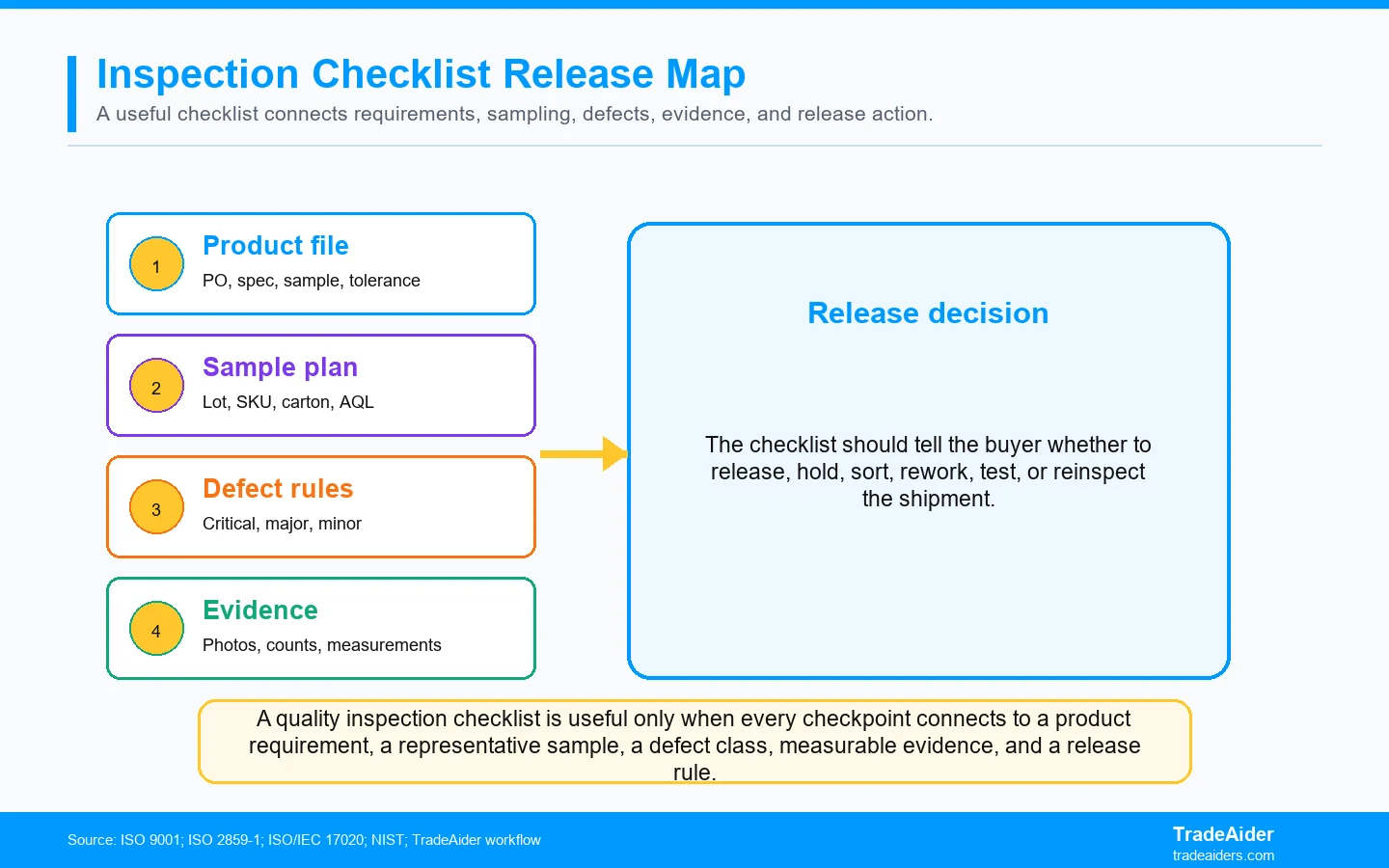
A quality inspection checklist is useful only when every checkpoint connects to a product requirement, a representative sample, a defect class, measurable evidence, and a release rule.
Start With the Product File, Not the Factory Form
The first checklist component is the buyer's approved truth: what product, sample, label, and package the shipment must match.
The product file should be frozen before booking
A strong checklist starts with the current purchase order, specification sheet, approved sample, drawings, material callouts, tolerance rules, artwork, barcode, accessory list, packing method, and any change approvals. If the factory has newer production notes than the buyer, the inspection starts from a disagreement.
The product file should also say which version is authoritative. Many disputes happen because the buyer uses one sample, the supplier uses another, and the inspector receives a PDF that does not show the latest packaging or component change. The checklist should name the approved version and include photos where words are easy to misread.
Tolerances turn opinion into evidence
A checklist that says color must be good, stitching must be neat, or carton must be strong leaves too much judgment to the inspector. Better wording gives a reference sample, Pantone or color range where relevant, seam allowance, dimension tolerance, pull force, torque, weight range, barcode readability, or package-drop expectation if that is part of the buyer file.
Not every product needs laboratory-level precision. The point is to define what matters enough to affect release. If a dimension controls fit, measure it. If a finish controls buyer perception, compare it against the sample under reasonable lighting. If a label controls receiving, photograph it clearly.
Sampling and Lot Structure Decide Whether the Result Means Anything
The checklist must show how samples are selected, because clean samples from the wrong cartons can hide a bad shipment.
AQL needs a real lot map
Before the inspector arrives, the buyer should know the lot size, carton count, SKU count, color and size spread, production dates, subcontracted subgroups, and any cartons already sealed or separated. The sample plan should draw from the shipment as it will actually leave the factory.
TradeAider buyers can use the AQL calculator to plan sample size, but sample size alone is not enough. If one order includes five SKUs and only the easiest SKU is opened, the report may look clean while the riskiest subgroup remains unseen.
Concentration is more important than average defect count
A few defects spread randomly across the lot may suggest normal sorting. The same number of defects concentrated in one carton range, production date, operator, color, or material batch can point to a process problem. The checklist should ask the inspector to record where defects appear, not only how many exist.
This is why carton numbers, sample locations, production dates, and defect photos belong in the checklist. They help the buyer decide whether to release the lot, sort a subgroup, ask for rework, or expand inspection around the affected area.
Defect Classification Should Be Agreed Before Findings Exist
Critical, major, and minor defects are buyer risk categories, not after-the-fact negotiation labels.
Severity should follow buyer consequence
A critical defect is usually tied to safety, illegality, severe function failure, or a condition that makes the product unsafe or unsellable. A major defect affects usability, appearance, customer promise, fit, or sellability. A minor defect may be acceptable within tolerance but should still be recorded for trend control.
The same physical flaw can change severity by product and market. A small color shade difference on an internal component may be minor. The same visible shade mismatch on a fashion item or branded package may be major. The checklist should state the consequence so the inspector can classify consistently.
Examples prevent report-day arguments
The best checklist includes common defect examples with severity. Missing accessory, wrong barcode, sharp edge, failed function, inaccurate warning label, poor stitching, loose screw, color stain, cracked retail box, and wrong carton mark should be classified before the supplier sees the report.
That preparation protects both sides. The supplier knows what matters, the inspector applies the same rule across samples, and the buyer can act faster when the report arrives. Without examples, every finding becomes a debate over words rather than evidence.
Measurement, Function, Label, and Packaging Checks Need Their Own Methods
A complete checklist separates visible workmanship from tests that need tools, documents, or repeated steps.
Measurement and function should be repeatable
If the product has fit, assembly, electrical, mechanical, pressure, weight, capacity, size, color, or performance requirements, the checklist should name the tool and method. A vague instruction such as check function is not enough when the buyer later needs to know what was actually tested.
For example, a bag checklist may require seam strength, zipper cycling, strap length, carton drop condition, and accessory count. An electronic accessory checklist may require input/output markings, charging behavior, cable length, firmware label, packaging warning, barcode scan, and heat or performance boundaries where applicable.
Labels and packaging are not cosmetic details
For many consumer products, label claims and origin information matter. The FTC textile and wool labeling guidance shows how fiber content, origin, and identity information can be part of product representation. A checklist should therefore treat labels as evidence, not decoration.
Packaging also affects buyer experience and receiving control. Master carton marks, retail box condition, barcode readability, warning labels, moisture protection, inner protection, and accessory placement can decide whether the goods are sellable on arrival.
Scenario Estimate: One Missing Label Rule Can Break a Good Checklist
A checklist can pass workmanship and still fail the shipment if it ignores the buyer's real receiving or selling risk.
Assume an importer receives 6,000 units that look acceptable in workmanship, but 8% have a wrong barcode or missing retail label. That is about 480 units that may fail warehouse receiving, marketplace listing match, or customer identification before anyone sees a product defect.
If relabeling costs $0.35 per unit in labor, handling, and delay, the direct correction cost is about $168 for that subgroup. The larger risk is disruption: mixed inventory, incorrect fulfillment, supplier dispute, and a delayed launch. A label checkpoint would have been cheap evidence before shipment.
This estimate is not a promise of savings. It shows why checklist components should follow the buyer's actual release risk. A low-cost checkpoint can matter more than a long appearance section if the receiving system or sales channel depends on that label.
Where TradeAider Fits in Checklist Design
TradeAider helps importers turn product requirements, sampling logic, defect classes, photos, measurements, labels, packaging, and release rules into a checklist that supports a shipment decision.
For finished goods, Pre-Shipment Inspection can apply the checklist to packed products, AQL samples, workmanship, function, labels, accessories, and cartons before release.
If the checklist risk appears earlier, Pre-Production Inspection can verify materials and setup, while During Production Inspection can check whether repeated defects are spreading before the full lot is packed.
When visual inspection cannot prove a claim, TradeAider can coordinate product testing services so the checklist separates what the inspector can see from what needs laboratory evidence.
SPAR Scenario: The Checklist Found the Wrong Risk
The buyer improved the checklist after a clean appearance inspection missed a shipment-blocking label issue.
Situation: An importer ordered a mixed-SKU consumer goods shipment and used a long appearance checklist from a previous product.
Problem: The first inspection passed workmanship, but several cartons used the wrong SKU barcode and carton mark.
Action: The buyer asked TradeAider to rebuild the checklist around product identity, sample spread, label photos, carton mapping, and release rules.
Result: The buyer held 420 mislabeled units for relabeling, released the clean cartons on schedule, and accepted a one-day correction window instead of mixing sellable inventory with rework stock.
Buyer Checklist Before Booking Inspection
Prepare the checklist around the evidence needed for release, not around a generic factory form.
- Current PO, product specification, approved sample, drawing, tolerance, and change history.
- Lot size, carton count, SKU, color, size, production date, and packing-version map.
- Inspection level, AQL, sample size, and sampling spread rule.
- Critical, major, and minor defect examples with buyer consequence.
- Required photos, measurements, tools, function steps, labels, documents, and package checks.
- Release, hold, sort, rework, testing, or reinspection rule for each serious result.
After every inspection, the buyer should keep defect photos, severity decisions, supplier replies, and shipment outcome. Those records become the next checklist improvement, especially when the same defect appears again.
A quality inspection checklist is strongest when it is short enough to use, specific enough to prevent guesswork, and connected enough to tell the buyer what to do next.
If your current checklist is a generic form or does not tell you what to do after inspection, send TradeAider the PO, spec sheet, approved sample, SKU list, top defects, and shipment status. The next step is to build a decision-ready inspection checklist before the factory visit.
Frequently Asked Questions
What is the most important part of a quality inspection checklist?
The most important part is the product file because every sample, defect class, measurement, photo, and release rule depends on the requirements the shipment must meet.
Should every product use the same checklist?
No. The structure can be similar, but the checkpoints must reflect the product type, buyer promise, safety risk, label requirements, packaging, and selling channel.
How does AQL fit into a checklist?
AQL defines the sampling and acceptance logic for attribute inspection. The checklist still needs defect classes, sample spread, and release rules.
Should packaging be included in quality inspection?
Yes. Packaging affects damage risk, receiving, barcode control, product identity, and buyer experience, so it should be part of the checklist when shipment release depends on it.
Can a checklist replace product testing?
No. A checklist can verify visible evidence and documents, but chemical, electrical, flammability, durability, and other hidden claims may need proper testing.

Похожие статьи

Развивайте свой бизнес с услугами TradeAider
Нажмите кнопку ниже, чтобы войти непосредственно в систему услуг TradeAider. Простые шаги от бронирования и оплаты до получения отчетов легко выполнить.

