
- О нас

- Наши услуги
- Ваша отрасль
- Ресурсы
- Новости и блог
The four quality control methods importers should understand are process control, control charts, acceptance sampling, and product inspection. They are not four names for the same activity; each method answers a different question about whether production is stable, the lot is acceptable, and the shipment is safe to release.
ISO 9001 frames quality management as a system for meeting customer expectations and improving performance. For importers, that means quality control methods should be chosen by risk and timing rather than copied from a textbook.
ASQ explains the seven basic quality tools, including control charts, as practical ways to understand and improve quality. Those tools matter because many shipment failures are not random surprises; they begin as weak process signals before the final goods are packed.
A buyer sourcing from China does not need every statistical tool on every order. The useful question is simpler: which method gives evidence early enough to change the outcome before the shipment leaves supplier control?
- Process control prevents drift: it keeps materials, equipment, operators, and methods stable during production.
- Control charts reveal signals: they help separate normal variation from changes that need action.
- Acceptance sampling supports lot decisions: AQL sampling helps decide whether a finished lot is acceptable without checking every unit.
- Product inspection protects release: finished-goods checks confirm product, packing, labels, quantity, and defects before shipment.
What Are the Four Types of Quality Control Methods?
The four types of quality control methods are process control, control charts, acceptance sampling, and product inspection. Importers should use them together: process control prevents production drift, control charts monitor signals, acceptance sampling judges the lot, and product inspection verifies shipment evidence before release.
The sequence matters. If the supplier only uses final product inspection, the buyer may discover defects after the whole order is packed. If the buyer only asks about process control, the finished shipment may still contain packing, label, or quantity errors. Good quality control connects prevention, monitoring, sampling, and release.
NIST describes statistical process control as comparing current process behavior against earlier expected performance and control limits. That idea is useful to importers because process movement should trigger questions before the defect count becomes visible in finished goods.
For lot decisions, ISO 2859-1 supports attribute sampling plans that link lot size, sample size, and acceptance criteria. Sampling does not promise zero defects, but it creates a disciplined basis for release, hold, sort, rework, or reinspection.
The Four Methods Are Not Interchangeable
Use the method that fits the buyer question and production stage.
| Method | Best Buyer Question | Best Stage | If You Skip It |
|---|---|---|---|
| Process control | Is production being made under stable conditions? | Before and during production | The same defect may repeat across the lot |
| Control charts | Is the process drifting from normal behavior? | During production | Small signals become late-stage failures |
| Acceptance sampling | Is the lot acceptable based on a defined sample? | Finished goods before release | Sampling becomes arbitrary or disputed |
| Product inspection | Do the goods, labels, packing, and counts match requirements? | Mostly packed before shipment | Shipment evidence is missing at payment release |
| Testing | Can hidden safety, chemical, or performance claims be proven? | Before shipment or before production approval | Inspection overclaims what it cannot see |
| Audit | Can the supplier system repeatedly support the order? | Before supplier approval or after repeated problems | Repeated defects are treated as one-off issues |
Testing and audit are not part of the basic four in many simple explanations, but importers often need them as adjacent controls. A product inspection can confirm that a label is present; it cannot prove chemical composition. A sampling result can judge a lot; it cannot explain why a supplier repeats the same issue every month.
A practical importer rule is to choose the earliest method that can still change the outcome. Use process control or DPI when the risk is process drift, acceptance sampling when the lot is ready, product inspection when shipment evidence is needed, and testing when hidden compliance claims must be proven.
Method mismatch creates real cost. If a buyer uses PSI to solve a process problem, the report may arrive after thousands of units already contain the same defect. If a buyer uses process notes to approve shipment without packed-lot inspection, carton marks, labels, quantities, and packaging may still fail at release.
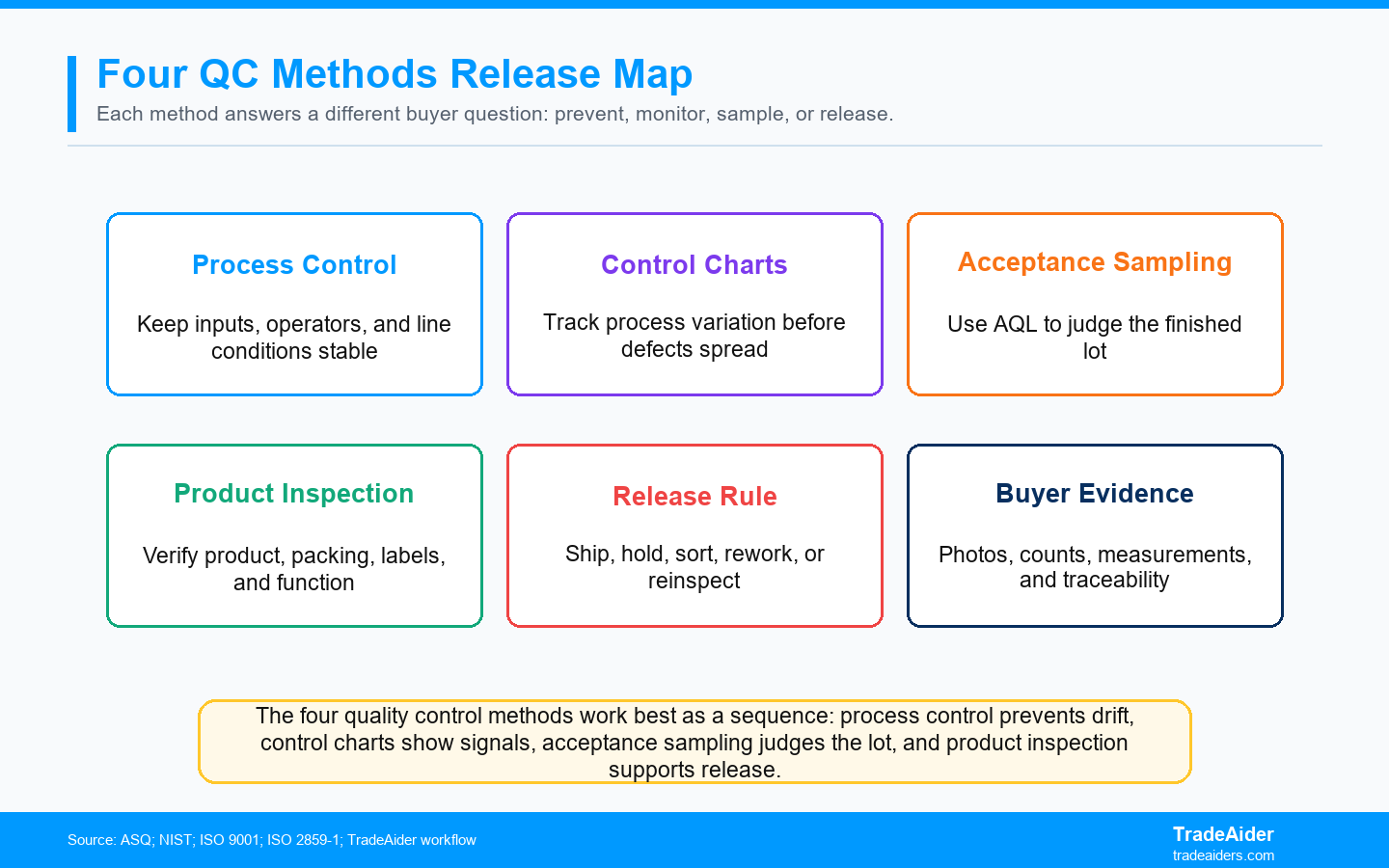
The four quality control methods work best as a sequence: process control prevents drift, control charts show signals, acceptance sampling judges the lot, and product inspection supports release.
Process Control Prevents Defects Before They Multiply
Process control is the method importers need when the same product must be made consistently over thousands of units.
Process control belongs before final inspection
Process control checks whether production inputs and operating conditions are stable: material source, machine settings, operator method, approved sample, tooling, line speed, work instructions, and rework handling. It is most useful when the product has repeated steps, tight tolerances, assembly risk, or materials that can drift.
For a buyer, the key evidence is not a factory claim that the line is controlled. It is whether the supplier can show stable setup, clear work instructions, incoming material control, first-piece approval, and corrective action when a signal appears. Those records help explain why finished-goods inspection later passed or failed.
DPI turns process control into buyer evidence
During Production Inspection is the practical way many importers observe process control without running the factory themselves. A DPI can check semi-finished goods, line conditions, materials, packaging readiness, and early defect patterns while the supplier still has time to correct the issue.
If the buyer waits until PSI, a process-control problem becomes a shipment problem. That can turn a two-hour line correction into a two-day sorting job. The method should match the moment when the buyer still has leverage.
Control Charts Help Decide When Variation Is a Signal
A control chart is valuable because it stops buyers from treating every variation as equal.
Normal variation and special causes need different reactions
Factories naturally produce variation. Not every measurement difference is a crisis. Control charts help teams distinguish common variation from a special cause that requires action, such as tool wear, material change, operator substitution, machine adjustment, or environmental change.
Importers do not always receive formal control charts from suppliers, especially in small factories. They can still apply the logic by asking for trend evidence: measurements by production date, defect counts by shift, rework by line, or failure patterns by material batch. The goal is to find whether a problem is random or moving.
The chart is only useful when it triggers a rule
A control chart with no reaction plan is decoration. The buyer and supplier should agree what happens when a point falls outside limits, repeated points trend upward, or a process crosses a buyer-defined warning threshold. The rule might be line stop, engineering review, extra sampling, or expanded inspection.
For imported consumer goods, the simplest version is a trend table: record a CTQ measurement every hour or every batch, mark the approved range, and define when the factory must call the buyer. It is not elegant statistics, but it is better than discovering drift only after cartons are sealed.
Control-chart thinking is also useful when suppliers push back on subjective complaints. A trend line, even a simple one, gives the buyer a more objective way to show when thickness, weight, color shade, torque, or failure count moved away from the approved production condition.
Acceptance Sampling and Product Inspection Protect the Release Decision
Sampling and inspection turn a finished lot into evidence the buyer can use for payment and shipment.
Acceptance sampling works only after defect rules are defined
AQL sampling is not a magic number. It works when the buyer defines critical, major, and minor defects before inspection and chooses an inspection level that fits product risk. If the defect rules are vague, the sample result becomes an argument rather than a release decision.
Acceptance sampling also needs a correct lot structure. If a shipment contains multiple SKUs, colors, sizes, or production dates, the inspector should spread samples across those groups. Otherwise a clean sample may miss the subgroup that creates returns.
Product inspection checks what sampling alone cannot explain
Product inspection should verify product identity, workmanship, measurement, function, labels, packaging, quantity, carton marks, and visible document evidence. It is the method closest to the buyer's final release decision because it sees the actual packed goods.
An illustrative calculation shows why the method matters. If a 15,000-unit shipment has a concentrated 1.8% major defect pattern in one SKU, about 270 units may need sorting or rework. Holding the affected SKU is often better than blocking the whole shipment or releasing a known problem.
The same logic applies to label and packing checks. A carton-label error may not appear in a product defect count, but it can still create receiving failure, marketplace inventory confusion, or relabeling cost after arrival. Product inspection closes that evidence gap before shipment.
Where TradeAider Fits in Quality Control Methods
TradeAider helps importers choose the inspection stage that matches the quality control method, instead of forcing every risk into final inspection.
When the risk is supplier readiness, Pre-Production Inspection can verify materials, samples, tooling, artwork, and line preparation before mass production starts.
When the risk is process drift, During Production Inspection can check early output, line conditions, and repeated defects. When the buyer needs release evidence, Pre-Shipment Inspection can verify the finished and mostly packed lot.
TradeAider can also help buyers align sampling with AQL calculator guidance and define defect rules using inspection standard guidance before the inspector enters the factory.
SPAR Scenario: Sampling Passed, but the Process Signal Changed the Decision
The buyer used both sampling and process evidence instead of relying on one clean result.
Situation: A buyer orders 20,000 plastic storage bins from a factory that has passed previous PSI checks.
Problem: The AQL sample is acceptable, but DPI notes show wall-thickness drift in the last production day for one color.
Action: The buyer asks TradeAider to expand sampling for that color, verify carton identity, and photograph thickness measurements before release.
Result: The buyer holds 2,400 units from the affected color for sorting, accepts a one-day delay, and releases the remaining cartons with stronger evidence.
Importer Checklist for Choosing a QC Method
Choose the method by the question you need answered.
- Use PPI when the sample, material, supplier, or setup is not proven.
- Use DPI when process drift can still be corrected.
- Use control-chart logic for measurable CTQs and repeated batches.
- Use AQL sampling when the finished lot needs an acceptance decision.
- Use product inspection to verify goods, labels, packing, and counts.
- Use testing when hidden safety or performance claims must be proven.
A buyer does not need to over-engineer every order. The strongest plan usually names the top two risks, selects the earliest useful check, and defines what evidence will trigger release, hold, sort, rework, or reinspection.
For a stable repeat order, that may mean a lean PSI with tight defect classes and photo evidence. For a new factory, a new material, or a first large order, the same buyer may need PPI or DPI because the cost of finding the issue after packing is too high.
The key is to avoid treating QC methods as interchangeable services. Each method answers a different question: whether requirements are understood, whether the process is drifting, whether the lot can be accepted, and whether the finished goods match the buyer's release rule.
If you are unsure whether your order needs PPI, DPI, PSI, AQL sampling, or testing, send TradeAider the product type, PO, approved sample, production status, defect concerns, and destination market. The next step is to match your order to the right inspection stage before the risk becomes a shipment problem.
Frequently Asked Questions
What are the four types of quality control methods?
The four common methods are process control, control charts, acceptance sampling, and product inspection. Importers use them to prevent, monitor, judge, and release production lots.
Is AQL a quality control method?
AQL is part of acceptance sampling. It helps buyers choose sample size and acceptance criteria, but it needs clear defect classes and a defined lot structure.
Can product inspection replace process control?
No. Product inspection checks the finished lot, while process control prevents repeated defects during production. High-risk orders often need both controls.
When should importers use control charts?
Use control-chart logic when a measurable CTQ can drift over time, such as dimension, weight, temperature, thickness, torque, or defect count by shift.
Which QC method should a small importer start with?
Start with a clear specification, AQL-based PSI, and a defect classification table. Add PPI, DPI, control charts, or testing when product risk justifies earlier evidence
Похожие статьи



Развивайте свой бизнес с услугами TradeAider
Нажмите кнопку ниже, чтобы войти непосредственно в систему услуг TradeAider. Простые шаги от бронирования и оплаты до получения отчетов легко выполнить.

