
- О нас

- Наши услуги
- Ваша отрасль
- Ресурсы
- Новости и блог

3rd party inspection agencies independently check products, materials, packaging, quantities, production status, documents, and factory conditions against the buyer's requirements before the buyer releases an order. Their real value is not the factory visit itself; it is impartial evidence that helps an importer decide whether to ship, hold, sort, rework, test, reinspect, or escalate a supplier issue.
In 2026, the most important word in third-party inspection is evidence. ISO/IEC 17020:2026 describes inspection as examining products, processes, services, installations, or work procedures and determining conformity with requirements. That definition matches what importers need from an agency: a reliable comparison between the buyer file and the actual lot.
The buyer file matters because quality is not an abstract opinion. ISO 9001 connects quality management to customer requirements, documented information, competence, performance evaluation, and improvement. A third-party agency cannot read the buyer's mind; it needs specifications, samples, tolerances, labels, and release rules.
When the inspection uses sampled goods, ISO 2859-1:2026 provides the current AQL-indexed framework for lot-by-lot inspection by attributes. The agency should not simply open convenient cartons. It should sample in a way that represents the shipment.
Inspection skill also matters. The U.S. Bureau of Labor Statistics describes quality control inspectors as people who examine products and materials for defects or deviations from specifications. A strong inspection agency turns that frontline work into buyer-ready reporting, not just a pass/fail note.
- They provide independent evidence: the agency checks the shipment against the buyer's product file, not against the supplier's opinion.
- They inspect by scope: PPI, DPI, PSI, loading checks, audits, document review, and testing support different risks.
- They make sampling visible: lot size, carton spread, SKU spread, sample count, and AQL rules should be shown in the report.
- They help buyers act: a useful agency report supports release, hold, sort, rework, retest, or reinspection.
What Does a 3rd Party Inspection Agency Actually Do?
A 3rd party inspection agency checks goods or factory conditions for a buyer by defining the inspection scope, selecting samples, visiting the factory, checking products against specifications, classifying defects, verifying labels and packaging, reviewing required documents, taking photos or measurements, reporting findings, and helping the buyer decide the next action.
The agency is independent of the factory's internal QC team. That independence matters because the buyer needs evidence from someone whose role is to verify the order, not to defend production output. The report should answer what was inspected, how it was sampled, what failed, how severe the findings were, and what evidence supports the result.
For importers buying from China, a third-party inspection agency often becomes the buyer's eyes before money, inventory, and customer promises are exposed. The agency can catch wrong materials, poor workmanship, missing accessories, wrong labels, weak packaging, quantity shortages, mixed cartons, documentation gaps, and repeated defects before the shipment leaves the supplier.
Quality tools help agencies report better evidence. ASQ explains basic quality tools such as check sheets, Pareto charts, and cause-and-effect diagrams. An importer does not need a textbook report, but the agency should count defects, show where they occur, and separate random findings from patterns.
What 3rd Party Inspection Agencies Do in 2026
The agency's work should be tied to the buyer decision, not only to a checklist of factory tasks.
| Agency Task | What It Checks | Evidence the Buyer Should Receive | Buyer Decision Supported |
|---|---|---|---|
| Define scope | PO, sample, specs, labels, packing, target market | Inspection plan and checklist points | Confirm the visit can answer the right question |
| Select samples | Lot size, cartons, SKUs, colors, sizes, risk groups | Sample count, carton numbers, AQL level | Judge whether findings represent the shipment |
| Inspect products | Workmanship, dimensions, function, accessories, quantity | Photos, measurements, defect counts | Release, hold, sort, or rework goods |
| Verify labels and packaging | Barcode, warning, origin, retail box, carton marks | Label photos and packing photos | Avoid receiving and compliance surprises |
| Review documents | Test reports, declarations, packing list, certificates where needed | Document match notes and missing items | Escalate testing or documentation gaps |
| Report and follow up | Severity, concentration, supplier comments, correction proof | Decision summary and action options | Reinspect, retest, release, or negotiate |
A factory may already have internal inspectors, but those inspectors usually work for production. A third-party agency works from the buyer's file and should make the release decision easier for the importer.
The best reports show enough detail for a buyer who is not on site. That means clear photos, exact defect counts, sample spread, product identity, label evidence, packaging proof, and a short decision summary.
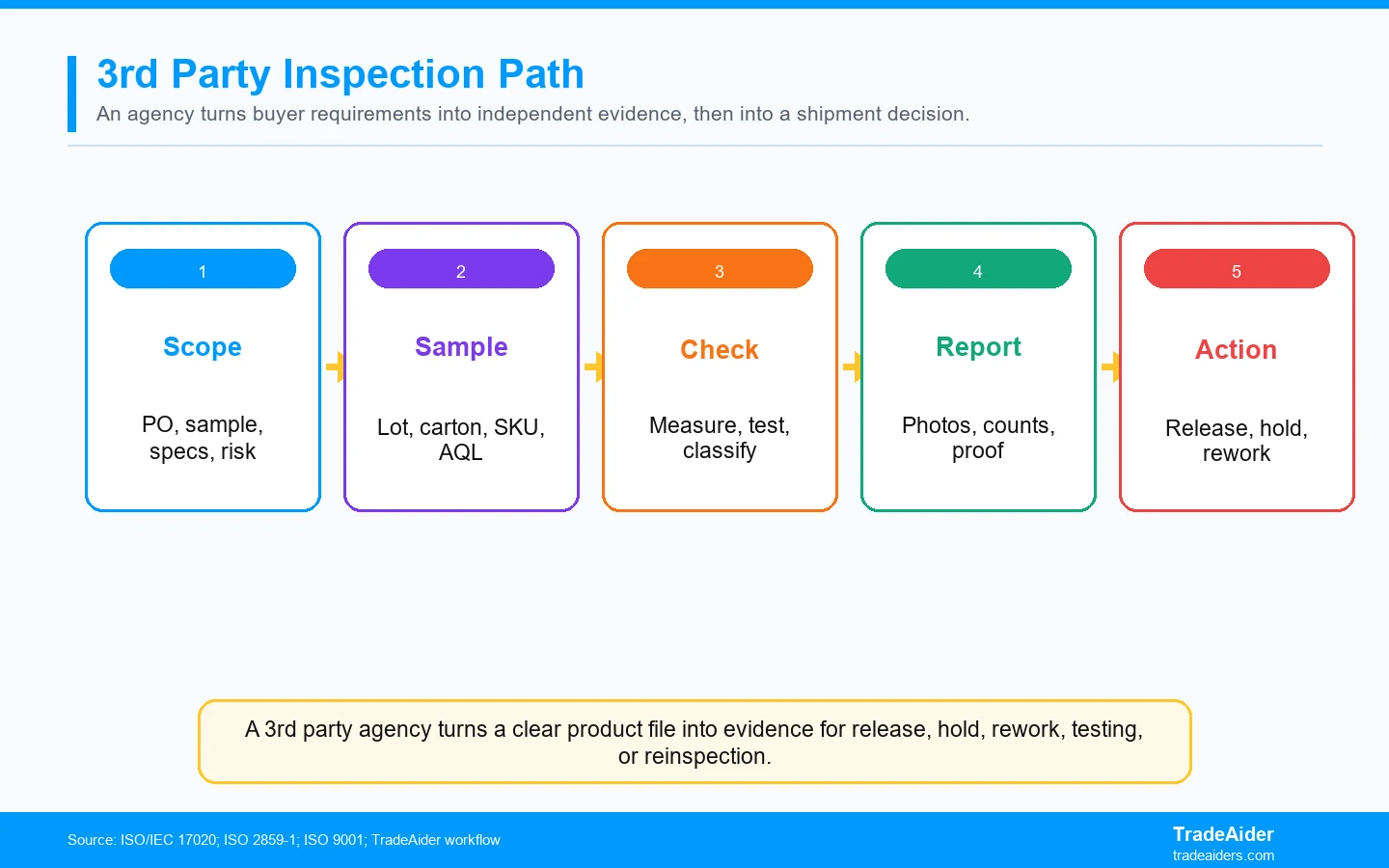
A 3rd party agency turns a clear product file into evidence for release, hold, rework, testing, or reinspection.
The Agency Role Runs From Scope to Release Decision
A third-party agency is useful only when the inspection scope is specific enough to produce decision-ready evidence.
Scope prevents a generic factory visit
Before the agency visits the supplier, the buyer should provide the purchase order, approved sample, drawings, material requirements, tolerances, color references, label artwork, barcode, packing method, carton marks, accessory list, and any required documents. Without that file, the agency can still look at goods, but the report will be less useful.
Scope also sets the inspection type. A new product may need pre-production review. A process-risk order may need during-production inspection. A finished shipment may need pre-shipment inspection. A fragile or high-value container may need loading supervision. A supplier qualification question may need a factory audit instead of a product inspection.
The report should answer the buyer's next action
A report that only says pass or fail leaves too much work for the importer. The buyer needs to know whether the issue is critical, major, or minor; whether it affects one SKU or the whole lot; whether sorting is possible; whether supplier rework is realistic; and whether reinspection or testing is needed.
This is why real-time visibility is useful. If a critical label or function issue appears during inspection, the buyer can ask for more photos, more sample spread, or supplier clarification while the inspector is still on site instead of discovering the gap after the visit ends.
Sampling Is One of the Agency's Most Important Jobs
Representative sampling is what turns a few inspected units into evidence about the shipment.
AQL depends on a real lot map
For pre-shipment inspection, the agency should know the total quantity, carton count, production status, SKU mix, color and size spread, packing percentage, production dates, and any separated groups. If the lot map is wrong, the sample can be mathematically neat and still misleading.
TradeAider buyers can use the AQL calculator to plan sample size, but the agency still needs on-site judgment. If one color, carton range, or production date looks riskier, the report should make that subgroup visible.
Sample spread protects against hidden concentration
A shipment can hide defects when samples come only from easy-to-open cartons near the door. The agency should select samples across carton ranges, pallet positions, SKUs, colors, sizes, and relevant production groups when the order structure requires it.
Concentration matters more than average counts in many disputes. Six defects from six cartons may suggest random workmanship variation. Six defects from one carton range or one production date may point to a process or handling problem that deserves sorting or expanded inspection.
Third-Party Agencies Do More Than Final Inspection
Different inspection services answer different buyer risks across the sourcing cycle.
PPI, DPI, PSI, and loading checks have different timing value
Pre-Production Inspection checks readiness before mass production: materials, samples, packaging, labels, tooling, and supplier understanding. During Production Inspection checks whether early output matches the buyer file while correction is still possible. Pre-Shipment Inspection checks completed goods before release. Container Loading Supervision checks quantity, handling, carton condition, and loading sequence.
Importers should choose timing by consequence. If a defect can multiply across the order, earlier inspection has more leverage. If the question is whether the finished lot can ship, PSI is the natural release gate. If damage or quantity risk happens at handover, loading supervision can be worth the extra step.
Factory audits and testing close different gaps
A factory audit examines supplier capability, process control, documentation, equipment, quality system behavior, and sometimes social or environmental controls depending on scope. It does not replace product inspection because a capable factory can still produce a bad lot.
Testing is also separate. Visual inspection can verify labels, workmanship, dimensions, packaging, and basic function. It cannot prove chemical composition, flammability, electrical safety, or long-term durability when a product category needs a test method or accredited lab evidence.
How to Judge Whether an Agency Is Doing the Job Well
A good third-party inspection agency is judged by independence, competence, reporting clarity, and action usefulness.
Independence must show up in the report
Independence is not only a marketing claim. The report should state what was available, what was not available, how samples were selected, which documents were reviewed, which items could not be verified, and what supplier comments were recorded. That transparency helps the buyer trust the result.
The O*NET profile for inspectors, testers, sorters, samplers, and weighers highlights tasks such as inspecting, testing, measuring, and recording inspection data. For importers, the agency should combine those tasks with clear buyer-facing judgment.
Competence means knowing the product risk
A good inspector does not treat all products the same. Apparel needs size, workmanship, shade, label, and packing checks. Electronics need function, labeling, markings, safety document review, and accessory verification. Hardlines may need surface, assembly, dimension, load, fit, or package evidence.
The buyer should therefore ask for a sample report, inspector profile, service scope, report timing, photo standard, escalation method, and how defects are classified. If the agency cannot explain its method, the buyer may receive a report that looks polished but cannot support a shipment decision.
Scenario Estimate: A Small Sampling Mistake Can Hide a Large Shipment Risk
Third-party inspection value depends on sample quality as much as inspector effort.
Assume a 9,600-unit order contains three SKUs and one SKU was packed two days after the others. If the agency samples mostly from the first two SKUs, the report may miss a late-production label mismatch in the third SKU.
If the label mismatch affects 4% of that SKU and the SKU represents 3,200 units, about 128 units may create receiving errors, relabeling labor, marketplace listing problems, or customer confusion. The inspection fee was not the issue; the sample spread was.
This estimate is illustrative, not a universal cost claim. The lesson is practical: the buyer should give the agency a lot map, and the agency should show exactly which cartons, SKUs, and subgroups were sampled.
Where TradeAider Fits as a Third-Party Inspection Partner
TradeAider helps importers turn inspection scope, sampling logic, on-site checks, real-time photos, defect classification, and reporting into a clear shipment action.
For early setup risk, Pre-Production Inspection can check materials, samples, packaging, and readiness before production multiplies a mistake. For process drift, During Production Inspection can check early output and supplier correction.
For shipment release, Pre-Shipment Inspection verifies completed goods when the order is 100% finished and at least 80% packed for export. For supplier capability questions, TradeAider can support factory audit work separately from product inspection.
TradeAider's real-time online reporting helps buyers review photos, findings, and supplier feedback during the inspection window. That makes the agency role more useful because questions can be answered before the inspector leaves the factory.
SPAR Scenario: The Agency Turned a Vague Concern Into a Shipment Decision
The buyer did not need more opinions; it needed independent evidence tied to action.
Situation: An importer ordered 7,200 mixed-color household products from a supplier in China.
Problem: The supplier said the goods were ready, but the buyer worried that one color batch used a different label and weaker retail box.
Action: TradeAider mapped the lot by color and carton range, sampled across groups, photographed labels and packaging, and classified defects by release impact.
Result: The buyer released the clean colors, held 940 units for relabeling and box replacement, and avoided shipping mixed-label cartons to the warehouse.
Checklist for Choosing a 3rd Party Inspection Agency
Use these questions before booking an agency for an import order.
- Can the agency explain the inspection scope for your product category?
- Will the report show lot size, sample size, carton spread, SKU spread, and defect severity?
- Does the agency support PPI, DPI, PSI, loading checks, audits, and testing coordination separately?
- Can you review photos or findings in real time if a critical issue appears?
- Will the report identify what could not be verified?
- Does the final result support release, hold, sort, rework, test, or reinspection?
Price matters, but the cheapest visit is not useful if the report cannot support a buyer decision. The better test is whether the agency can turn your product file into verifiable evidence.
Before booking, send the agency the PO, approved sample, specification, labels, packing rules, and known defect concerns. The quality of the input often decides the quality of the report.
If you need independent evidence before releasing goods from China, send TradeAider the PO, product specification, approved sample, factory location, production status, and top risks. The next step is to book a third-party inspection with a clear scope so the report supports a real shipment decision.
Frequently Asked Questions
Are 3rd party inspection agencies independent?
They should be independent of the factory's internal QC team and should inspect against the buyer's requirements. Buyers should review scope, reporting method, sample selection, and conflict-of-interest safeguards.
What is the difference between a third-party inspection agency and factory QC?
Factory QC works inside or for the supplier. A third-party agency works for the buyer or client and provides independent evidence before the buyer releases the order.
When should I book a third-party inspection?
Book PPI before production for setup risk, DPI during production for process drift, PSI when goods are finished and mostly packed, and loading supervision when handover risk matters.
Can a third-party inspection agency guarantee zero defects?
No. Inspection reduces risk and gives evidence; it does not guarantee that every unit is defect-free. Sampling, defect rules, product risk, and testing boundaries should be clear.
What documents should I send to an inspection agency?
Send the PO, approved sample details, specifications, drawings, tolerances, labels, packing rules, carton marks, defect examples, required documents, and target shipment date.

Похожие статьи

Развивайте свой бизнес с услугами TradeAider
Нажмите кнопку ниже, чтобы войти непосредственно в систему услуг TradeAider. Простые шаги от бронирования и оплаты до получения отчетов легко выполнить.

