
- О нас

- Наши услуги
- Ваша отрасль
- Ресурсы
- Новости и блог
Production quality is the factory's ability to repeatedly make goods that meet defined requirements, not just the condition of one finished sample. Importers should define it through specifications, process controls, supplier inputs, defect data, inspection timing, and release evidence before they approve shipment.
ISO 9001 frames a quality management system around meeting customer expectations and continually improving how requirements are fulfilled. For importers, that means production quality is not a vague promise from the factory; it is a controlled system that can be checked before, during, and after production.
The ISO quality management principles emphasize customer focus, process approach, evidence-based decisions, and improvement. Those principles translate well into sourcing: the buyer needs evidence that the process can keep producing acceptable goods, not only one attractive pre-production sample.
The practical challenge is that production quality is shared. The supplier controls the line, workers, materials, and rework. The importer controls the requirement file, acceptance tolerance, and release decision. If those responsibilities are not separated, final inspection becomes the first time everyone discovers what quality was supposed to mean.
- Production quality is repeatability: one good sample does not prove a stable process.
- Define CTQs early: critical-to-quality requirements should be measurable, inspectable, and linked to buyer risk.
- Separate QA and QC: process prevention and product detection both matter, but they solve different problems.
- Use inspection timing strategically: PPI, DPI, PSI, and testing each answer a different production-quality question.
What Does Production Quality Mean for Importers?
Production quality means the degree to which a factory process can consistently produce goods that meet the buyer's specifications, approved sample, regulatory requirements, functional expectations, packaging rules, and acceptable defect limits across the whole order.
This definition is deliberately broader than product appearance. A product can look fine in a showroom sample and still have poor production quality if mass production creates unstable dimensions, inconsistent material shade, weak assembly, missing accessories, or recurring packing errors.
ASQ explains the practical difference between quality assurance and quality control: assurance focuses on confidence that requirements will be fulfilled, while control focuses on fulfilling requirements through operational techniques and activities. Importers need both because a good process reduces defects, and inspection confirms what actually happened in the lot.
A useful importer definition should therefore include four evidence questions: What did the buyer require, what did the factory control, what did the product show, and what action should be taken if the evidence is not good enough?
Production Quality Terms Importers Should Separate
Separating these terms prevents the buyer from expecting final inspection to solve every production problem.
| Term | Meaning for Importers | Best Evidence | Typical Decision |
|---|---|---|---|
| Production quality | Repeatable factory output against defined requirements | Process data, defect trends, inspection reports | Keep supplier, improve, or escalate |
| Product quality | The condition and performance of the goods being purchased | Sample comparison, measurements, function checks | Accept, sort, rework, or reject |
| Quality assurance | Prevention system that gives confidence requirements will be met | SOPs, control plan, training, supplier records | Audit, improve process, or hold production |
| Quality control | Detection activities that verify outputs against requirements | Inspection, testing, measurements, defect counts | Release, hold, rework, or reinspect |
| Supplier quality | Reliability of materials, parts, and subcontracted processes | Incoming checks, COA, change-control records | Approve source, require testing, or change supplier |
| Shipment quality | Whether the packed lot is acceptable for release | PSI report, AQL result, packaging evidence | Ship, hold, sort, or reinspect |
The table shows why production quality cannot be fixed by a late inspection alone. PSI can reveal defects, but it cannot retroactively stabilize a weak process. If the buyer sees repeated defects during production, the better question is whether to inspect earlier, change the control plan, or pause the supplier before the whole order is packed.
A practical rule: if a defect is repeated across different cartons, operators, or production dates, treat it as a production-quality signal rather than an isolated product-quality issue. Repeated signals call for root-cause action, not only cosmetic rework.
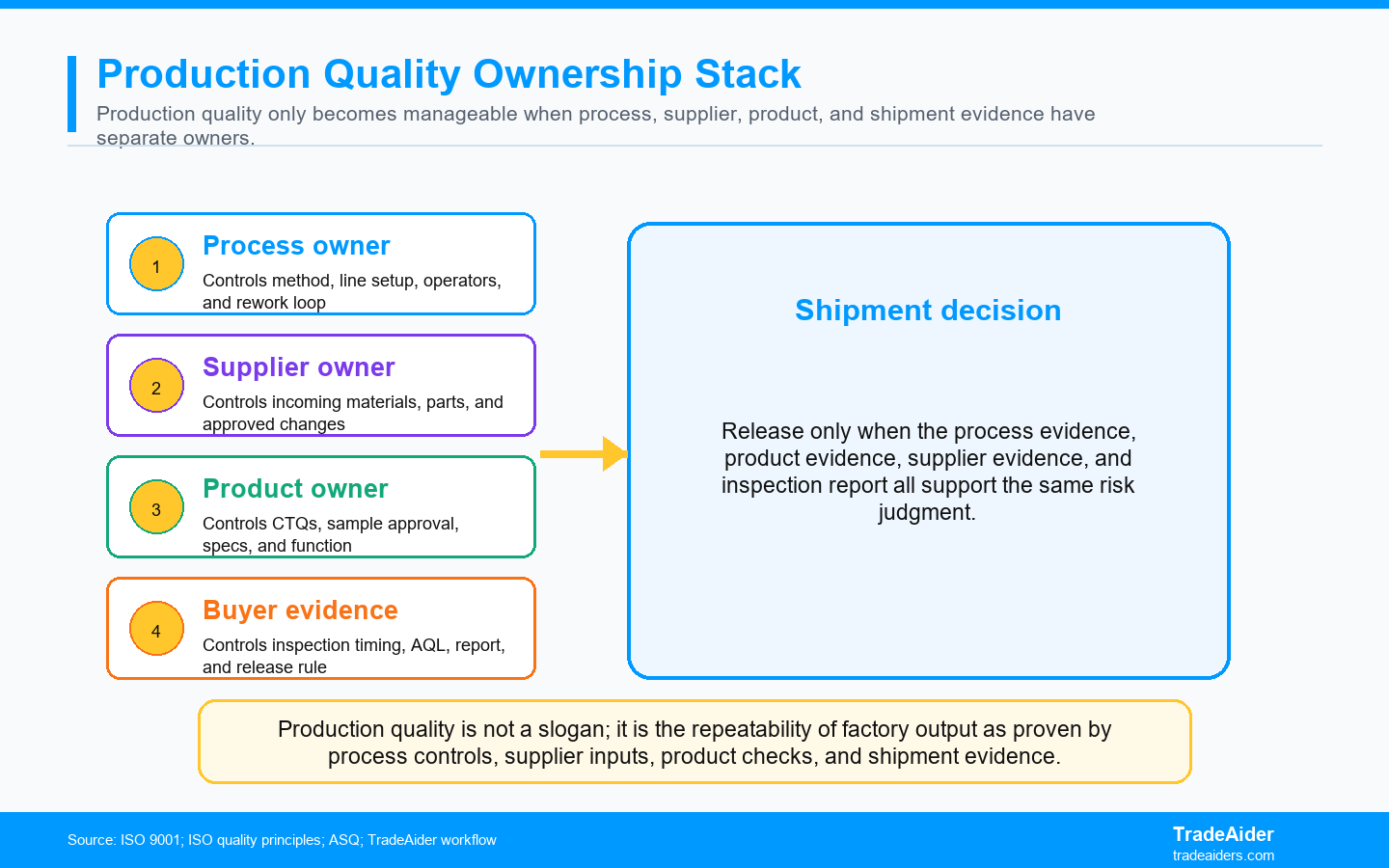
Production quality is not a slogan; it is the repeatability of factory output as proven by process controls, supplier inputs, product checks, and shipment evidence.
Production Quality Is Built Before Final Inspection
Final inspection can protect the shipment, but it cannot replace process control during production.
Critical-to-quality points should be defined before mass production
Importers should translate the sales promise into CTQs before production starts. For a backpack, CTQs might include zipper durability, seam strength, color shade, logo placement, carton barcode, odor, and accessory count. For an electronic accessory, CTQs might include function, charging stability, housing fit, labeling, safety marks, and packaging protection.
The factory cannot control what the buyer has not defined. If the specification file contains only product photos and a target price, the supplier will fill the gap with its own tolerance. That tolerance may be acceptable for factory efficiency but not for the importer's retail channel.
Process signals usually appear before customer complaints
Production quality problems often create weak signals before the lot fails: rising rework, slower line speed, inconsistent material shade, operator substitutions, repeated adjustment of a machine setting, or an increase in minor defects. Those signals matter because they predict whether the packed lot will be stable.
During Production Inspection is valuable when these signals are likely. It can check semi-finished goods, line setup, workmanship, materials, and packaging preparation while there is still time to correct the process. Waiting until PSI may turn a process correction into a shipment delay.
How Importers Can Measure Production Quality Without Overcomplicating It
A small set of measurable signals usually tells buyers more than a long factory quality manual.
Use defect rate, concentration, and recurrence together
A single defect rate is not enough. Importers should ask whether defects are random or concentrated by SKU, color, size, line, operator, mold, shift, or material batch. A 1.5% defect rate spread randomly across 20,000 units may call for normal monitoring; the same rate concentrated in one color may call for a targeted hold.
Recurrence is the strongest clue. If the same major defect appears in the approved sample, early production, and finished lot, the factory has not controlled the cause. The buyer should not treat the PSI result as a surprise; it is the final confirmation of a signal that appeared earlier.
A practical escalation rule is to ask what would happen if the same pattern appeared in the next order. If the answer is another round of sorting, discount negotiation, or customer-service exposure, the issue belongs in the production-quality file rather than only the current inspection report. That file should name the owner, corrective action, and next-check stage.
Track rework as a quality cost, not a factory favor
Suppliers sometimes present rework as proof of flexibility. Importers should treat heavy rework as a cost signal. Rework consumes time, can introduce new defects, and may hide the original process weakness. It also compresses the inspection and shipping schedule if it happens at the end.
An illustrative calculation helps. If a 12,000-unit order has a 3% repeated major defect rate, 360 units need correction or segregation. At only $4 handling cost per affected unit, the visible rework exposure is $1,440 before freight delay, lost sales, return handling, or customer dissatisfaction is counted.
The buyer should also ask whether reworked units will be separated from the first-pass units. If the supplier mixes reworked goods back into the lot without identification, the final PSI may confirm an average result while hiding a subgroup with higher failure risk. Rework control is therefore part of production quality, not an afterthought.
Production Quality Depends on Supplier Inputs as Much as Factory Output
Many finished-goods defects begin as uncontrolled material, component, or subcontractor changes.
Incoming material control protects mass production
A buyer may approve a sample made from one fabric, coating, adhesive, battery cell, plastic resin, or component supplier, then receive mass production made from another source. If supplier changes are not controlled, final inspection may find shade variation, odor, bonding weakness, dimensional drift, or function instability after the problem is already spread across the lot.
Pre-Production Inspection can reduce this risk by checking material readiness, sample alignment, packaging artwork, production line setup, and first-batch conditions before the order accelerates. The goal is to catch a mismatch when it is still cheap to correct.
Regulated products need extra evidence discipline
In regulated categories, production quality is tied to documented controls. The FDA QMSR overview explains that manufacturers must follow a quality management system regulation to help ensure products consistently meet applicable requirements and specifications. That page is about FDA-regulated products, but the logic is useful for importers in any high-risk category.
The eCFR Part 820 text covers methods, facilities, and controls used for design, manufacture, packaging, labeling, storage, installation, and servicing of finished devices. Importers of non-medical consumer goods should not copy medical-device rules blindly, but they should learn the evidence principle: quality has to be built into the system, not declared at the end.
Where TradeAider Fits in Production Quality Control
TradeAider helps importers choose the inspection stage that matches the production-quality question they need answered.
If the buyer is unsure whether the factory is ready to start, Pre-Production Inspection can check sample alignment, materials, packaging artwork, equipment readiness, and supplier preparation before mass production locks in mistakes.
If the buyer sees process risk, schedule During Production Inspection while correction is still possible. If the buyer only needs final release evidence, Pre-Shipment Inspection can check the finished and mostly packed order before balance payment and shipment.
TradeAider can also support supplier-level risk review through factory audit service when production quality problems appear repeatedly across orders. The aim is to find whether the issue sits in one shipment, one line, one material source, or the supplier's broader system.
SPAR Scenario: The Finished Goods Passed, but the Process Signal Was Wrong
The buyer improved the next order by treating a repeated minor defect as a production-quality warning.
Situation: A Canadian importer buys 24,000 cosmetic organizers from a factory that delivered one clean sample and a nearly acceptable PSI result.
Problem: The PSI finds minor scuffing below the fail threshold, but the marks are concentrated in cartons from the same production date.
Action: The buyer asks TradeAider to document the concentration pattern and schedules DPI for the next order to check the handling and stacking process earlier.
Result: The next order adds one DPI man-day, reduces scuffing before final packing, and keeps the same pattern from becoming a late PSI hold again.
Production Quality Checklist for Importers
Use this checklist before deciding whether a supplier's production quality is under control.
- Define CTQs from the sales promise, specification, and approved sample.
- Separate process, product, supplier, and shipment evidence.
- Track defect concentration by SKU, color, date, line, or material batch.
- Treat repeated rework as a quality-cost signal.
- Inspect earlier when defects are process-driven.
- Link release decisions to evidence, not supplier reassurance.
The checklist does not require a complicated factory quality department. It requires a disciplined buyer file: what must be true, when it should be checked, who owns the evidence, and what happens when the evidence is weak.
If your supplier has recurring defects, late rework, material changes, or unstable sample-to-production consistency, send TradeAider the approved sample, CTQ list, defect history, PO, and production status. The next step is to ask TradeAider to inspect the right production stage before the issue reaches shipment.
Frequently Asked Questions
What is production quality in simple terms?
Production quality is the ability of a manufacturing process to repeatedly make products that meet defined requirements, not just the appearance of one finished sample.
How is production quality different from product quality?
Production quality describes the stability of the process, while product quality describes whether the actual goods meet requirements. Importers need both views to manage risk.
What metrics show poor production quality?
Repeated defects, high rework, line stoppages, inconsistent measurements, supplier material changes, complaint trends, and concentrated failure patterns are practical production-quality signals.
Can final inspection prove production quality?
Final inspection can show whether the packed lot is acceptable, but it cannot fully prove process stability. Earlier inspection or audit is needed when process risk is high.
When should importers inspect production quality?
Inspect before production when readiness is uncertain, during production when process drift is likely, and before shipment when the buyer needs release evidence for the packed lot.
Похожие статьи

Развивайте свой бизнес с услугами TradeAider
Нажмите кнопку ниже, чтобы войти непосредственно в систему услуг TradeAider. Простые шаги от бронирования и оплаты до получения отчетов легко выполнить.

